4 compliance must haves for US based teleradiology
Compliance first checklist for admins: require licensure matrix, PSV, subspecialty match and SLA before signing U.S. teleradiology contract.
US-based teleradiology is remote image interpretation performed by U.S.-licensed, board-certified radiologists that hospitals and imaging centers contract for coverage, subspecialty reads, and guaranteed turnaround times. Before signing with any provider, administrators should require a state licensure matrix, documented primary source verification for every reading radiologist, subspecialty alignment to your case mix, and a written service level agreement with penalty terms. Ask for these four items in writing before the first contract call.
TL;DR:
- Ensure your teleradiology provider offers a state licensure matrix and verified primary source certification for all radiologists before signing a contract.
- Confirm the provider's radiologists are licensed in your patients’ states, practice under US oversight, and meet ACR practice parameters for remote supervision and QA.
- Require measurable SLA targets for STAT, urgent, and routine reads, with penalties for delays, and verify subspecialty coverage matches your case mix.
- Obtain current performance reports showing actual turnaround times and SLA compliance, especially for STAT and urgent cases, before finalizing an agreement.
- Conduct a detailed technical integration test plan with DICOM, HL7, and PACS early in onboarding and collect references from similar facilities to ensure operational readiness.
Table of Contents
- What services US-based teleradiology providers typically cover
- What does the regulatory checklist for licensure, PSV, and ACR standards include?
- SLA benchmarks and quality controls that separate providers
- Checklist for choosing and onboarding a teleradiology partner
- AstraRad's compliance model and what to verify
- Outsourcing radiology coverage versus building it in-house
- How a teleradiology provider can support your coverage and compliance goals
- Where to verify the standards behind this guide
- Sources
- FAQ
What services US-based teleradiology providers typically cover
Teleradiology exists to close staffing and coverage gaps that most facilities cannot solve by hiring alone. A radiology department covering nights, weekends, and holidays with a small in-house roster will eventually hit a wall, either through burnout or through gaps in coverage that delay diagnosis. Remote reading groups fill those gaps with radiologists who are licensed in your state but working from a different time zone or a centralized reading hub.
The scope of work is broader than emergency overnight reads. A well-built teleradiology program typically covers:
- STAT reads for emergency department and inpatient cases requiring interpretation within minutes
- Overnight and weekend coverage so a facility is not staffing an in-house radiologist around the clock
- Overflow support during volume surges, seasonal spikes, or staff shortages
- Subspecialty reads in areas like neuroradiology, musculoskeletal, and body imaging where a generalist may not be available onsite
- Mammography interpretation under Mammography Quality Standards Act requirements
- PET-CT and nuclear medicine reads that require specific certification and equipment familiarity
Rural and critical access hospitals are the clearest beneficiaries. A 25-bed hospital in a small town cannot justify a full-time neuroradiologist, but its ED still sees strokes and trauma at 2 a.m. Urgent care centers face a similar math problem: high patient volume for X-ray and CT, but not enough volume to justify an onsite radiologist for every shift. Larger hospital systems use teleradiology differently, mainly to absorb overflow during surges or to add subspecialty depth their internal group does not carry.
The phrase "US-based" matters because it is doing real regulatory work, not just marketing work. It means the interpreting radiologist holds an active, unrestricted medical license in the state where the patient is located, practices under U.S. clinical oversight, and is credentialed at your facility the same way an onsite radiologist would be. A provider that reads studies from outside the country, or that uses radiologists not licensed in your state, creates a compliance gap that shows up during an accreditation survey or a malpractice claim, not before.
What does the regulatory checklist for licensure, PSV, and ACR standards include?
Every credentialing decision in teleradiology traces back to two questions: is this radiologist licensed to read studies from patients in this state, and is their board certification real and current. Both questions have documented answers, and administrators should collect the paperwork before, not after, a contract is signed.
State licensure is the first gate. ACR practice parameters require interpreting radiologists to hold active, unrestricted licensure in the jurisdiction where the patient is physically located at the time of the study, not just where the radiologist sits. For a facility working with a national teleradiology group, this means building a licensure matrix: a simple table mapping each radiologist on the group's roster to every state where they hold an active license, cross-referenced against the states your facility serves. If your system draws patients from three states, your matrix needs to show licensure in all three for every radiologist who might read your studies.

Primary source verification is the second gate, and it is easy to skip if you rely on a vendor's word alone. The American Board of Medical Specialties treats primary source verification of board certification as the standard for credentialing, meaning certification status is confirmed directly with the certifying board rather than taken from a resume or a vendor's internal file. Ask your provider for PSV logs, not summaries, showing the verification source and date for each radiologist reading your studies.
Here is the sequence to follow when vetting a new provider:
- Request the full licensure matrix covering every state your facility admits patients from.
- Request PSV documentation for board certification on each radiologist assigned to your account.
- Confirm the provider follows ACR practice parameters for remote imaging supervision and facility-level QA.
- Ask how the provider's peer review process integrates with your own facility's QA committee.
- Review CMS guidance on telehealth billing and supervision to confirm your contract structure will not create a reimbursement problem.
CMS periodically updates telehealth guidance covering billing, supervision, and program rules that affect how telemedicine services, including teleradiology, are structured and reimbursed. These rules shift often enough that a contract signed two years ago may reference outdated supervision language, so a mid-contract compliance review is worth scheduling annually.
Pro Tip: Keep the licensure matrix as a living document in your credentialing file, not a one-time PDF from the sales process. State licenses lapse, radiologists rotate off panels, and your next accreditation survey will ask for current proof.
SLA benchmarks and quality controls that separate providers
A teleradiology contract without measurable performance terms is not really a contract, it is a hope. Administrators should translate clinical need into specific numbers before writing an RFP, then hold vendors to those numbers with real consequences for missing them.
Turnaround time is usually structured in tiers. STAT reads, covering strokes, trauma, and other emergent findings, need a committed turnaround measured in minutes rather than hours. Urgent reads, for cases that need same-shift attention but are not immediately life-threatening, sit in a middle tier. Routine reads, covering scheduled outpatient studies, have the most flexibility but still need a defined ceiling, commonly within 24 hours. Your contract should state each tier's turnaround target as a number, not a description like "prompt" or "priority."
Subspecialty matching affects diagnostic quality more than most administrators initially budget for. A study of Medicare claims found higher rates of repeat imaging when studies were interpreted by nonphysician providers compared with radiologists, a finding that supports the broader case for routing every study, especially complex neuro, musculoskeletal, and oncologic imaging, to a board-certified subspecialist rather than a generalist reader. Repeat imaging costs money, delays diagnosis, and exposes patients to additional radiation where applicable.
Physician burnout in radiology remains higher than in many other specialties, according to AMA survey data. That figure matters operationally: a teleradiology partner with a thin roster and no redundancy plan is more exposed to burnout-driven errors and coverage gaps than one with a distributed panel.
Before signing, confirm the following:
- Named SLA targets for STAT, urgent, and routine tiers, with penalty clauses for missed turnaround
- Subspecialty roster depth in the modalities your facility actually orders, not just a general claim of coverage
- Workforce redundancy, meaning more than one qualified reader per subspecialty and shift
- A documented peer review process, often scored using a RADPEER-style framework, with a defined review cadence and incident reporting timeline
Checklist for choosing and onboarding a teleradiology partner
Selecting a teleradiology partner is a two-phase project: vendor evaluation before the contract, and technical onboarding after it. Skipping steps in either phase tends to surface as a coverage gap or a compliance finding months later.
Before sending an RFP, gather these items internally and request matching documentation from each vendor:
- Build your own licensure matrix requirement listing every state your patients come from, and ask each vendor to match it exactly.
- Request PSV proof for board certification, not a vendor summary, for the specific radiologists likely to read your studies.
- Ask for two or three sample signed reports in the modalities you order most, to evaluate clarity and structure.
- Request a current HIPAA and HITRUST security attestation, since teleradiology involves transmitting protected health information across networks you do not control.
- Confirm integration requirements early: your PACS vendor, DICOM routing needs, and any HL7 or FHIR order and results mapping the vendor will need to support.
Contract terms should lock in SLA metrics and turnaround commitments by tier, the pricing model (typically per-report), audit rights so your compliance team can review performance data on demand, indemnity language covering licensure or credentialing failures, and clear data ownership terms for the images and reports themselves.
Onboarding, once signed, moves through integration testing with your PACS, sending sample studies to confirm DICOM transfer and HL7 order and results mapping work correctly, validating report templates against your facility's format, and training your ordering physicians on escalation paths for urgent findings.
Pro Tip: Run at least ten test cases across your most common study types before going live. A vendor that resists a real integration test, rather than a slide deck describing one, is telling you something about their operational maturity.
Red flags that should pause or end onboarding: a vendor unwilling to produce a complete licensure matrix, no documented PSV process, SLA language that uses words like "priority" instead of a stated time, or resistance to an audit clause.
AstraRad's compliance model and what to verify
One effective teleradiology provider is built around the checklist above rather than around it as an afterthought. Every study is interpreted and signed by a US-based, board-certified subspecialist matched to the modality and body part, under contractual turnaround commitments and direct PACS integration with no added portal for your staff to manage. For administrators building an RFP from this article, this is a concrete example of what a compliance-first contract should look like in practice.
Before including AstraRad, or any provider, in a shortlist, verify these specific claims rather than taking them at face value:
- A provider states a median turnaround under one hour for STAT reads and under 24 hours for routine studies. Ask for a recent SLA compliance report showing actual performance against these targets, not just the stated goal.
- The provider reports very high SLA compliance over the past year. Request the underlying report broken down by tier so you can see whether performance held steady across STAT, urgent, and routine categories.
- The provider states its radiologists are matched to modality and subspecialty. Ask for the roster breakdown relevant to your case mix, along with PSV logs for those specific readers.
- AstraRad states integration happens directly with existing PACS systems. Request a sample integration test plan covering DICOM transfer and HL7 order and results mapping, with defined acceptance criteria.
Specific questions worth asking any vendor during evaluation include the current licensure matrix for your state or states, the peer review cadence and how findings are reported back to your facility, a sample technical integration test plan, and references from hospitals or imaging centers with a similar case mix to yours. AstraRad's own state licensing pages and its Colorado coverage example show one way a provider can lay out this information clearly, which is itself a useful benchmark when comparing how transparent other vendors are willing to be.
Outsourcing radiology coverage versus building it in-house
Outsourcing makes sense when coverage needs are intermittent, when you need subspecialty depth you cannot justify hiring for, or when a volume surge needs short-term relief without a permanent headcount commitment. A critical access hospital with overnight ED volume that does not support a full-time night radiologist is a clear case.
Building internal capacity makes more sense when volume is sustained and predictable, or when your facility carries an academic or training mission that benefits from having subspecialists physically present. A large health system with consistent daily volume across multiple modalities may find that hiring covers its own cost over time in ways a per-report model does not.
Most systems land on a hybrid model: an in-house group handles core daytime volume and retains clinical leadership over protocols and QA, while a teleradiology partner covers nights, weekends, and overflow. Governing this well means keeping your internal radiologists in charge of peer review standards and escalation protocols, so outsourced coverage extends your clinical culture rather than operating apart from it.
Rafael Vieira
How a teleradiology provider can support your coverage and compliance goals
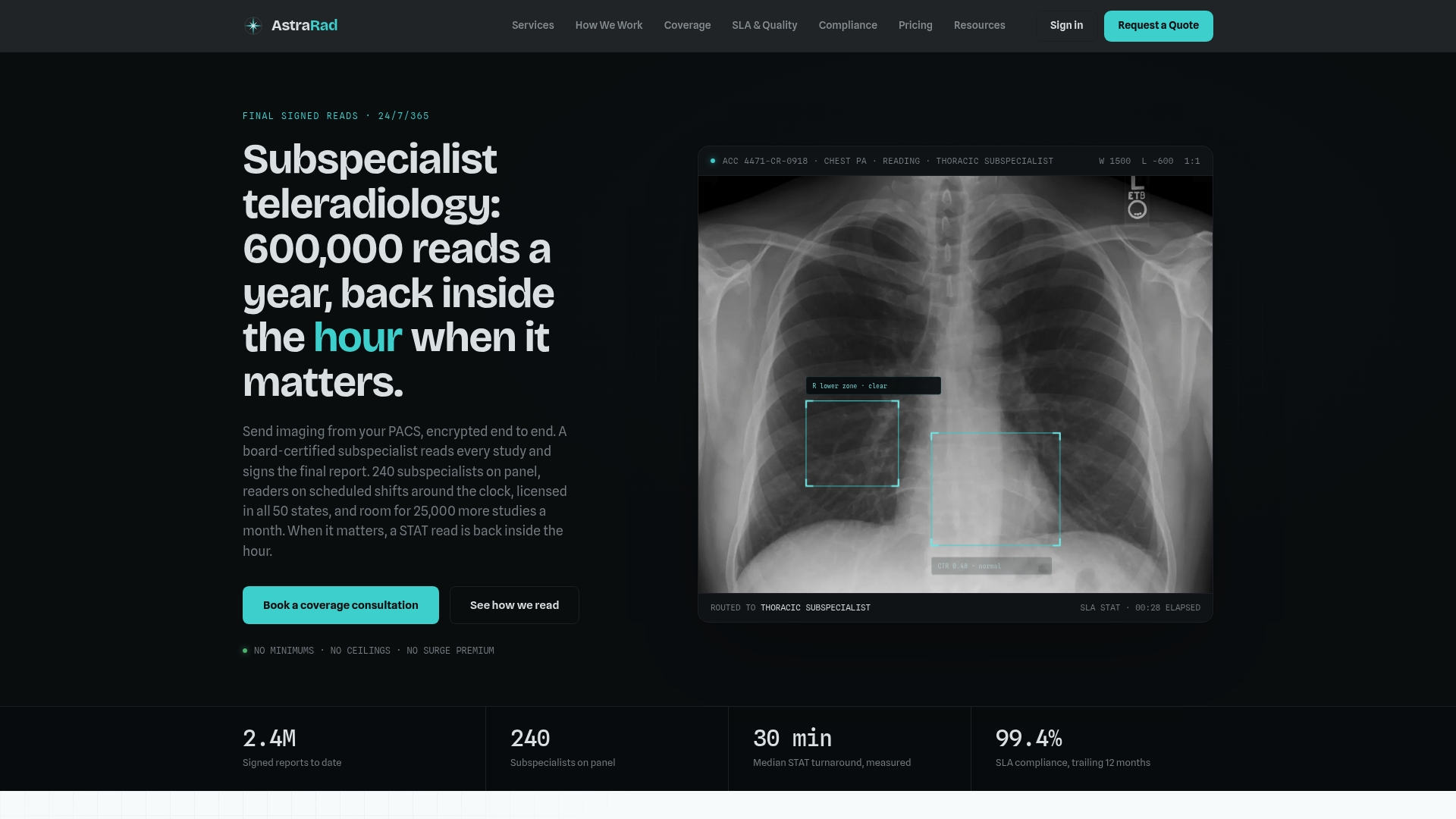
If the checklist above is the standard, some teleradiology providers are built to meet it directly rather than approximate it. Reports are read and signed by US-based board-certified subspecialists matched to the study type, often under a per-report pricing model with no volume minimums, and with direct PACS integration so your team is not learning a new portal on top of an existing workflow.
For administrators ready to move past the RFP stage, the practical next steps are straightforward:
- Request the current licensure matrix from any provider for the states your facility serves.
- Ask for a recent SLA performance report broken down by STAT, urgent, and routine tiers.
- Schedule a technical integration demo to walk through DICOM routing and HL7 order and results mapping before committing to a pilot.
AstraRad's pricing page lays out per-report rates by study type, and the licensing overview shows how coverage maps across states, useful references to have open during your own internal comparison. If your facility is evaluating coverage specifically in Colorado, the Colorado licensing page shows what a state-specific coverage page should include and doubles as a working example for your RFP requirements. Whichever provider you choose, insist on the same documentation you would request from AstraRad: a licensure matrix, an SLA report, and a real integration test plan before any study crosses your PACS.
Where to verify the standards behind this guide
Administrators building or reviewing a teleradiology contract should keep a few primary sources on hand rather than relying on vendor summaries. The ACR practice parameters cover licensure, remote supervision, and facility QA requirements in detail. ABMS provides the tools to verify board certification directly with certifying boards. CMS publishes telehealth guidance covering billing and supervision rules that affect telemedicine contracts, and a partner resource on telehealth coding compliance walks through documentation expectations in more depth. The AMA publishes ongoing workforce and burnout data relevant to staffing decisions.
This article is general information, not a substitute for advice from a qualified doctor. Consult a qualified healthcare professional about your own circumstances before acting on anything here.
Sources
- ACR practice parameter for remote imaging (preview)
- American Board of Medical Specialties (ABMS)
- Who’s interpreting the imaging? Training makes a difference | AMA
- CMS telehealth FAQ (April 2025)
FAQ
What are the largest teleradiology companies in the United States?
The teleradiology market includes several national providers of varying size and specialty focus, and rankings shift as companies merge or expand coverage. Rather than relying on a single "largest" label, administrators should compare providers on licensure coverage, subspecialty depth, and documented SLA performance for their specific case mix.
Is there a shortage of radiologists in the USA?
Radiology is among the specialties the AMA has flagged for higher burnout rates relative to other fields, which contributes to coverage strain at hospitals trying to staff nights, weekends, and subspecialty reads internally. This strain is a primary driver behind hospitals and imaging centers turning to teleradiology for overnight, overflow, and subspecialty coverage rather than expanding in-house rosters alone.
What is the largest radiology company in the United States?
There is no single, universally agreed answer to this, since "largest" can mean different things depending on whether you measure by read volume, radiologist headcount, or number of contracted facilities. Administrators evaluating providers should ask each vendor directly for documented volume and staffing figures rather than relying on general market claims.
What is the highest-paid radiology subspecialty?
Compensation varies by subspecialty, geographic market, and practice setting, and no single source in this guide provides a definitive ranking. Administrators focused on staffing and vendor selection should prioritize verified subspecialty coverage and licensure over compensation benchmarking, which is a separate workforce planning question.
Recommended
Related on AstraRad
- Resources
Teleradiology in California: 2026 licensing rules
California requires a full Medical Board license for every teleradiologist reading for a patient in the state. Rules, timelines, and what to verify.
- Resources
Teleradiology licensed in all 50 states: what it means
What teleradiology licensed in all 50 states really means, how vendors get there through the IMLC, and how to verify the claim for your own state.
- Resources
Teleradiology coverage for critical access hospitals
Teleradiology coverage for critical access hospitals: CMS conditions of participation, credentialing by proxy, coverage design, and per-read economics.
Put a radiologist's name on your next read.
Tell us your modalities and monthly volume. A complete per-report rate card, with turnaround tiers and SLA terms in writing, lands in your inbox within one business day.