Teleradiology for urgent care centers: X-ray and CT reads
Teleradiology for urgent care clinics: final signed X-ray and CT reports, per report with no minimums, Routine under 24 hours, portal upload, no PACS.
Teleradiology for urgent care clinics comes down to per-report pricing with no minimums, final signed reports on plain film and limited CT, and coverage that runs through evenings, weekends, and holidays. Urgent care centers, walk-in clinics, and the chains that operate both buy the same three things under different signage. How well the arrangement works depends on your case mix, whether your clinic has a PACS, and how many locations you operate. AstraRad reads urgent care studies as final signed reports from board-certified, fellowship-trained subspecialists, with Routine turnaround under 24 hours and no subscriptions or platform fees. A single clinic sending 100 studies a month and a 20-location chain sending 6,000 use the same model and the same rate card.
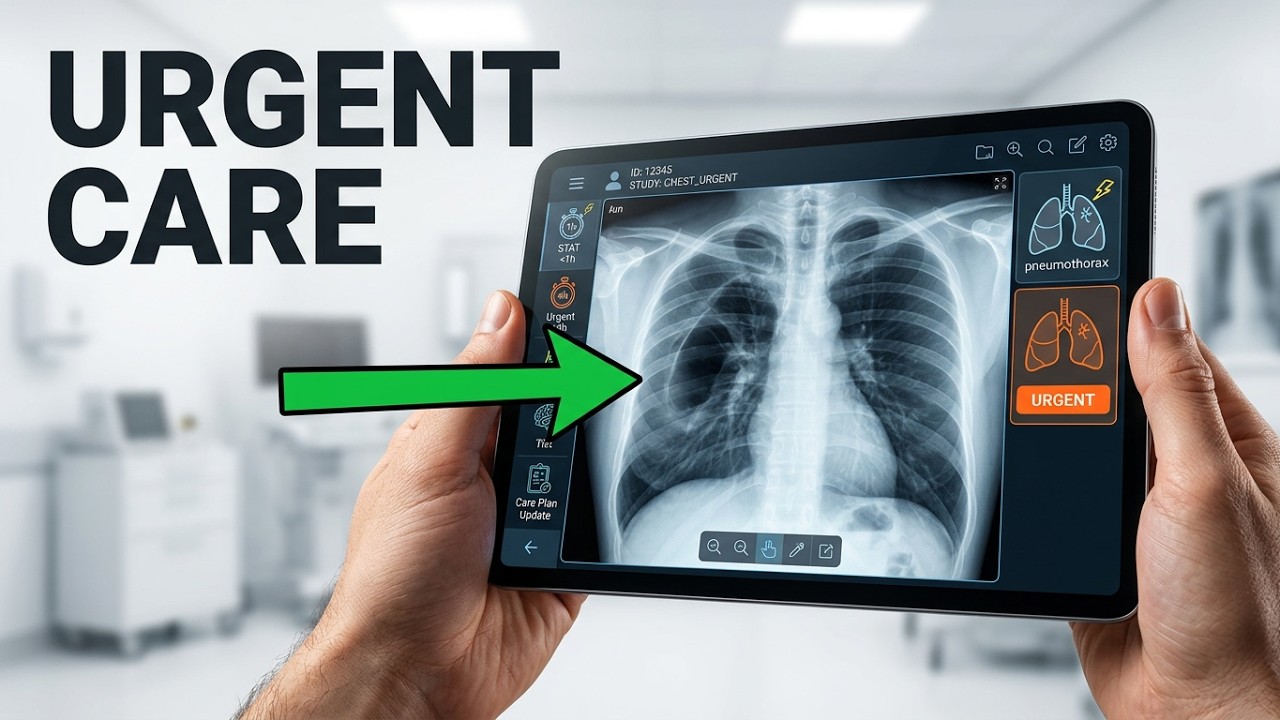 YouTubeThe Secret to 24/7 Urgent Care Radiology
Most teleradiology contracts are shaped by hospital work: overnight call, trauma CT, emergency department throughput. Urgent care is a different business, with a plain film case mix, evening and weekend hours, and monthly volumes a hospital agreement would round to zero. This page covers what changes when the client is a clinic, or a chain of them. Operators who also run a fixed outpatient imaging center will find that side of the business, where the pressure is backlog and same-day turnaround on cross-sectional volume rather than plain film throughput, on teleradiology for imaging centers.
Urgent care imaging is plain film first
Extremity and chest plain film carry most of an urgent care center's imaging volume, and that mix should drive the choice of teleradiology partner. Fracture rule-out is the workhorse: wrist, ankle, hand, foot, knee, shoulder. Chest films follow, ordered for cough, shortness of breath, and chest pain triage, with volume that spikes hard through respiratory season. Spine and pelvis films arrive in a smaller, steadier stream after falls and low back pain visits. Clinics with a scanner add head CT for minor head injury, sinus CT, and the occasional abdominal study; many centers have no CT and refer those patients out. Ultrasound appears where the clinic staffs a tech, most often soft tissue, DVT rule-out, and limited abdominal work. MRI almost never enters the picture.
Judge a partner on plain film first, then on the edges where fellowship training pays. An MSK subspecialist catches the subtle scaphoid and radial head fractures that plain film misses most often. A chest subspecialist settles the equivocal infiltrate. A neuro subspecialist reads the head CT when your clinic runs a scanner. Detail on plain film and ultrasound reading, including quality controls and backlog handling, lives on our X-ray and ultrasound overflow page; the CT side is covered under STAT CT reads.
Who signs the report on an urgent care X-ray?
A US board-certified radiologist, licensed in the state where the patient was imaged, signs every urgent care X-ray AstraRad reads. The report is final at the moment it lands. Nobody at your clinic countersigns it, and no preliminary version circulates ahead of it for a second radiologist to replace the next morning.
That distinction carries more weight in urgent care than anywhere else, because the word "read" covers two different documents. A preliminary read is a non-final interpretation issued for immediate clinical use and later superseded by a signed final report. A final signed report is the interpretation that enters the medical record, supports the billing, and is the document reviewed years later if the visit is ever questioned. AstraRad issues no preliminary tier at any priority, including STAT, so the report your provider reads at 9pm is the same document a subspecialist put a signature on. The three terms are pulled apart in detail on preliminary vs final radiology reads.
Most urgent care clinics have their own provider look at the film before the patient is discharged, which is sound practice and often clinically necessary. It does not stand in for the radiologist interpretation. A three-year community emergency department series in the Western Journal of Emergency Medicine compared 1,044 discrepancies against 16,111 emergency physician radiograph interpretations, which is 93.5% agreement with the radiologist reading. Most of the gap was clinically quiet: 75.8% of discrepancies needed no action at all and 22.3% needed a call to the patient or the pharmacy.
The residue is what matters to a clinic. In that series 1.7% of discrepancies required the patient to come back for treatment, the study's own example being a fracture that went unsplinted, and its authors conclude that radiologist interpretation should be performed where it is available. Case mix in an emergency department is heavier than in urgent care, so treat the figures as directional for a walk-in clinic.
Every AstraRad report carries the reading radiologist's name, their credentials, the signature timestamp, and the facility the study came from. Turnaround is counted from last-image arrival to that signature, which is the definition and the measurement window published on our SLA methodology page.
Most urgent care studies can wait until morning
Most urgent care plain film belongs at Routine priority, which returns a final signed report in under 24 hours and in practice usually the same day or by the next morning. You choose the tier per study:
| Priority | Turnaround | Typical urgent care use |
|---|---|---|
| Routine | Under 24 hours | Splinted extremities, resolving-cough chest films, anything charted before the follow-up call |
| Urgent | Under 4 hours | Findings that change today's plan: the ortho referral, the antibiotic decision |
| STAT | Under 1 hour | Suspected pneumothorax, head CT after a fall on anticoagulation, neurovascular concern |
Priority selection is where an urgent care operator controls the radiology budget, and it deserves more attention than it usually gets. Consider the shape of a typical month. Roughly nine studies in ten are a splinted wrist or a clearing chest, ordered on a patient who has already gone home with instructions; the signed report needs to reach the chart before the follow-up call, hours away. Escalating those studies buys turnaround the visit never depends on, at a multiple of the Routine rate. A clinic that marks everything STAT by reflex multiplies its radiology spend without changing a single clinical outcome.
The working discipline is simple. Leave the default at Routine, train providers to escalate the specific case where the result decides what happens in the next hour, and audit the STAT share every month. That discipline only holds if Routine is dependable, and it is: trailing 12-month SLA compliance is measured and published on our facts page with the date behind it, so your callback workflow can be built on the Routine clock. Model your spend on your Routine base, not your STAT tail.
What happens when the finding arrives after the patient has gone home?
The reading radiologist phones the clinical contact your clinic nominates, within minutes of signing, and that call is documented on the report itself with the time and the name of the person who took it. Your clinic then makes the callback to the patient. Nothing waits for the clinic to reopen.
This is the operational fear that belongs specifically to urgent care. A hospital finds the pneumothorax while the patient is still in the department. An urgent care center has already sent that patient home with a splint and an ice pack, often before the study is signed, and the person who has to reach them may be an hour past the end of their shift. So the pathway has to be built around a patient who is already gone.
Suspected critical findings jump the on-call worklist by clinical severity as soon as they arrive, ahead of studies that were submitted earlier. A subspecialist confirms the finding and signs the report, and the phone call goes out at sign-off. That is the non-routine communication the ACR expects for findings that suggest a need for immediate action, and documenting the time and the recipient on the report is what turns the call into a record your risk manager can produce later.
What we need from you is a contact list per facility: a daytime number, an after-hours number, and the role that answers each one. Chains supply one list per site, and the site that generated the accession is the site we call. Coverage runs 24/7/365 on scheduled US shifts, so a Sunday night STAT is handled the same way as a Tuesday afternoon one.
One boundary worth stating plainly. AstraRad reaches the treating clinician, and the treating clinician reaches the patient. We hold no treatment relationship with your patients and no access to your scheduling system, so patient contact stays with the clinic. What we can do is make sure the callback starts from a signed document already sitting in the chart, delivered as an HL7 ORU message or a FHIR DiagnosticReport into whatever system the clinic runs, with the finding flagged and the notification time visible on the report.
Pricing at 100 to 600 studies a month
Per-report pricing with no minimums fits the urgent care volume band, where a single clinic sends 100 to 300 studies a month and a small chain rarely clears 600. That band is awkward. It is far too small to justify a part-time radiologist on payroll, and many vendors bridge it with monthly minimums, subscription fees, or platform charges that quietly turn per-study pricing into a fixed monthly cost. AstraRad charges per report, with the priority multiplier printed on the rate card. A slow February after a mild flu season costs less than a busy January. A new clinic ramping at 40 studies a month pays for 40 reports. A location that pauses imaging simply stops sending studies, with nothing to cancel and no residual charge, and adding a facility never reopens the contract.
One honest caveat: if a local radiology group already reads for your clinic under a professional services agreement with capacity to spare, per-report teleradiology is unlikely to improve on that arrangement, and you should keep it.
Per-report rates depend on your modality mix and priority distribution, so we quote them against your numbers. For how per-report pricing works in general, including what separates plain film from cross-sectional pricing, see what teleradiology costs and our pricing page.
Portal upload works without a PACS
A clinic with no PACS sends studies to AstraRad through a secure web portal, straight from the acquisition workstation. Many urgent care centers run a DR panel and a viewer with nothing behind them, and an onboarding process that opens with connect-your-PACS stalls on day one. Portal upload attaches the clinical indication and a priority tier in the browser; the final signed report returns to the portal and can also go out by secure email or fax to the referring provider. Chains that already run a PACS or a cloud image manager send DICOM directly, with the signed result delivered as an HL7 ORU message or a FHIR DiagnosticReport into whatever electronic medical record (EMR) the clinic runs. We do not require a particular EMR and we do not sell one. Same rate card, same radiologists.
Both paths run on the same HIPAA aligned, DICOM conformant pipeline, so portal upload carries the full compliance posture of a PACS integration. Study transfer is encrypted in transit, which is how AstraRad meets the transmission security standard at 45 CFR 164.312(e), the requirement to guard electronic protected health information against unauthorized access while it moves over an electronic communications network. A single clinic typically moves from first contact to first signed report within days: quote, portal credentials, a test study, then live volume.
How does a multi-location urgent care chain roll out teleradiology?
A chain rollout stands on three legs: per-location credentialing, consistent reports across facilities, and the freedom to add locations without touching the contract.
Each clinic is its own facility, with its own address, its own state, and often its own payer and accreditation requirements. AstraRad supplies a credentialing packet per location: licenses, board certifications, malpractice history, and references for the radiologists reading for that facility. Those are the items a facility privileging committee works from. The ACR White Paper on Teleradiology Practice recommends that teleradiologists hold medical staff membership and appropriate privileges at the transmitting facilities and carry professional liability coverage in the transmitting and receiving states.
Every report is signed by a radiologist licensed in the state where your patients are located, which is how state medical practice acts allocate jurisdiction. The Colorado Division of Professions and Occupations puts it flatly: licensure requirements are determined by the physical location of the patient at the time services are rendered, whatever the location of the treating physician. AstraRad carries that licensing work when your chain opens in a new state. For chains with delegated credentialing agreements, we work inside your existing delegation framework. The general rules are on our state licensing page.
Consistency matters as much as speed once a clinical director reviews charts across 15 locations. Every report is a final signed report from a fellowship-trained subspecialist, the official interpretation the ACR Practice Parameter for Communication of Diagnostic Imaging Findings expects to be generated and archived following any examination regardless of the site of performance. One in 20 is independently double-read, and major discrepancies run under 0.3% of signed reports. The report from location 15 reads like the report from location one.
Most chains start with one or two locations, confirm turnaround and report quality against their own charts, then expand. There is no tier to renegotiate when the third facility goes live and no penalty if a pilot location pauses. A chain arriving with an accumulated queue is covered as well: an 8,000-study backlog clears in under 30 days while daily volume stays current, and headroom for 25,000 additional studies a month means a chain-wide rollout never competes with existing clients for capacity.
One portal, per-site routing, one monthly statement
A chain runs on one AstraRad account, and the account is what makes 12 clinics feel like one operation. Everyone signs into the same portal with access scoped to their facilities: a site manager sees their own studies, a regional director sees the region, the medical director sees all of it. There is no separate login, no separate contract, and no separate rate card per location.
Routing is keyed to the accession. Every study arrives carrying its originating facility identifier, and that identifier decides four things at once:
- Which state license the signing radiologist needs, because the patient was physically at that clinic when the study was acquired.
- Which priority default applies, so a site with a scanner can default its head CT differently from a site running plain film only.
- Where the finished report goes, whether that is an HL7 ORU message into a shared EMR instance, a FHIR DiagnosticReport, or a PDF in the portal for a location with nothing to integrate.
- Who gets the phone call on a critical finding, from that site's own contact list.
Billing follows the same structure. One consolidated monthly statement covers the whole chain, itemized by facility, study type, and priority, with the multiplier shown on any STAT or Urgent line so a regional director can see which site is escalating and why. Finance receives one invoice; operations receives the per-site breakdown inside it. There is no per-site platform fee, no per-seat charge, and no onboarding or integration fee for the eleventh clinic any more than the first. Adding a location adds report lines and nothing else. The agreement is month to month with 30 days notice, and a rate card comes back within one business day of a request, so a chain evaluating us can put real numbers in front of its board before committing anything.
Evenings, weekends, and holidays are covered hours
Urgent care volume peaks on weekday evenings, weekends, and holidays, and AstraRad staffs all of those hours at the same per-report rates. The panel of 240 board-certified, fellowship-trained subspecialists reads 24/7/365 on scheduled shifts, so a Sunday afternoon study is signed under the same SLA as a Wednesday morning one. There is no separate after-hours contract and no overnight surcharge; the only pricing variable is the priority tier you choose. That SLA is public, including how we measure turnaround from last-image arrival to radiologist signature.
The peaks are predictable: holiday weekends, the Monday after a long weekend, the first cold snap of respiratory season. A per-report model absorbs each spike without a staffing decision on your side, because the panel already covers those hours. For the same problem seen from a hospital or imaging center, see weekend and holiday coverage.
Urgent care imaging runs on a seasonal pulse: slow Februaries, brutal Januaries, holiday weekends that fill the waiting room by mid-morning. Volume that swings deserves pricing that swings with it. Send a month of your volume, broken out by modality and priority, and request a volume quote. The rate card comes back within one business day and shows what that month would have cost per study. Urgent care is one of several teleradiology use cases that share the same panel, pricing, and SLA.
Frequently asked questions
What is the best teleradiology service for urgent care centers?
The best fit for an urgent care center is a per-report teleradiology service that reads plain film and limited CT with no minimums, accepts studies through portal upload when the clinic has no PACS, and staffs clinic hours including evenings, weekends, and holidays. AstraRad meets that profile: final signed reports from board-certified, fellowship-trained subspecialists, Routine turnaround under 24 hours, Urgent under 4 hours, STAT under 1 hour, and per-report pricing with no subscriptions or platform fees, which suits urgent care volumes of 100 to 600 studies a month.
How does teleradiology for urgent care clinics work?
The clinic sends the study, an AstraRad subspecialist reads and signs it, and the final report lands back in the clinic's system. Studies go up through the secure portal straight from the acquisition workstation when a clinic has no PACS, or by DICOM push when it does. Reports return as an HL7 ORU message or a FHIR DiagnosticReport into whatever system the clinic runs, with a PDF waiting in the portal either way. Priority is chosen per study: Routine under 24 hours, Urgent under 4 hours, STAT under 1 hour. Billing is per signed report, so a single-location clinic carries no minimum and no monthly fee.
Do you have a minimum volume for a single urgent care clinic?
No. There are no minimums, no subscriptions, and no platform fees. A single clinic sending 120 studies a month pays for 120 reports. A ten-location chain sending 5,000 pays for 5,000. Slow weeks cost nothing, which matters in urgent care where volume swings with respiratory season and local injury patterns.
Can you read our X-rays if we do not have a PACS?
Yes. Many urgent care clinics run a DR panel and a viewer with no PACS behind them. You upload studies through our secure web portal directly from the acquisition workstation, and final signed reports come back the same way. Clinics with a PACS or a cloud image manager send DICOM directly, with the signed result returned as an HL7 ORU message or a FHIR DiagnosticReport into whatever system the clinic runs. Either path goes live without an integration project.
How fast do urgent care reads come back?
You choose per study. Most urgent care plain film goes Routine, which returns in under 24 hours and in practice usually the same day or by the next morning. A study you need before the patient leaves the building goes Urgent for a report in under 4 hours, or STAT for a report inside the hour. Trailing 12-month compliance against those SLA windows is measured and published.
Who reads the study if the patient is in a different state from your radiologist?
The report is signed by a radiologist licensed in the state where your patients are located, which is what state medical practice acts require. AstraRad maintains the licenses and supplies credentialing packets per location, so a chain adding a clinic in a new state inherits that licensing work along with the contract.
Are these final reads or preliminary reads?
Final signed reports, from board-certified, fellowship-trained subspecialists. Nobody at your clinic re-reads or countersigns them, and your referral partners receive a single definitive report per study. One in 20 reports is independently double-read, and major discrepancies run under 0.3% of signed reports.
Related on AstraRad
- Services
X-ray and ultrasound teleradiology: overflow final reads
X-ray and ultrasound overflow reads signed as final reports by US board-certified radiologists: routine under 24 hours, per-report pricing, no minimums.
- Use cases
Teleradiology with no minimums, no subscription fees
Teleradiology with no minimums, no subscriptions and no platform fees. You pay per signed report, so a quiet month simply invoices fewer reads.
- Use cases
STAT radiology reads: 30-min median, 99.4% SLA (2026 data)
STAT radiology reads should return inside an hour. AstraRad's median is 30 minutes to a signed final report, with 99.4% compliance across all tiers.
Put a radiologist's name on your next read.
Tell us your modalities and monthly volume. A complete per-report rate card, with turnaround tiers and SLA terms in writing, lands in your inbox within one business day.