ACR accreditation for teleradiology: facilities own QA
ACR accredits facilities, not teleradiology vendors. See how US sites manage remote read QA, credentialing, technical standards, and survey preparation.
ACR accreditation is granted to imaging facilities, not to teleradiology vendors, and the facility stays responsible for folding remote reads into its quality program. Accredited sites must include every off-site interpretation in physician QA and peer review, apply the same credentialing standards to remote radiologists as to on-site staff, and meet the ACR, AAPM, and SIIM technical standard for electronic practice.
- Facility-based scope: ACR accreditation evaluates the imaging facility and its equipment, not the outside radiology group reading the studies, as described in research on teleradiology accreditation.
- QA must include remote reads: Accredited sites need an active physician QA program that captures every interpretation, whether read on-site or remotely, per ACR physician QA requirements revised March 4, 2025.
- Technical standard governs the pipeline: The ACR-AAPM-SIIM standard calls for DICOM-conformant systems, role-based access controls, and end-to-end encryption for any electronic imaging exchange.
- Remote scanning stays acceptable: ACR accreditation support confirms remote scanning is permitted when it supports patient safety, with current guidance subject to ongoing committee review.
- Licensure and privileging apply equally: Remote radiologists go through the same credentialing, CME, and competency checks as on-site physicians under facility bylaws.
- AstraRad is a US teleradiology service that delivers final signed reports read by board-certified subspecialists, one of several vendor options facilities weigh when building an accreditation-ready remote reading program.
TL;DR:
- Under requirements revised March 4, 2025, facilities must document one accepted QA pathway, sampled remote cases, discrepancy handling, and corrective actions.
- Facilities must verify each remote radiologist’s board status, modality case volume, CME, and licenses wherever studies originate, then explicitly privilege preliminary and final reads.
- Before studies flow, facilities need a signed business associate agreement, tested PACS and DICOM connections, role based access, and end to end encryption.
- Facilities should start documentation early because remote read QA history accumulates over time, and keep case examples, calibration logs, connectivity tests, and turnaround commitments ready.
Table of Contents
- Does ACR accreditation cover teleradiology vendors?
- How does ACR handle QA for remote radiology reads?
- What credentialing applies to remote interpreting physicians?
- What technical and privacy standards do surveyors check?
- How do we prepare a teleradiology program for an ACR survey?
- How does ACR accreditation change teleradiology turnaround and workflow?
- How does a facility actually obtain ACR accreditation while using teleradiology?
- How do teleradiology providers support a facility's accreditation compliance?
- How AstraRad maps to accreditation requirements
- FAQ
- Sources
Does ACR accreditation cover teleradiology vendors?
No. ACR accreditation evaluates the imaging facility: its equipment, staffing, and quality processes, not the outside group or platform that reads studies remotely. A teleradiology company cannot hold ACR accreditation on a facility's behalf; the hospital or imaging center that owns the accreditation stays accountable for every interpretation performed under its name.
This distinction matters during procurement. When a facility contracts a remote reading service, it is still the accredited party that surveyors evaluate, and research on teleradiology accreditation confirms facilities retain responsibility for quality oversight of those remote interpretations. ACR accreditation support notes that remote scanning is acceptable when it promotes patient safety, with no immediate change to core accreditation requirements, though facilities should document how remote arrangements meet existing standards.
Before a survey, assemble:
- Signed business associate agreements covering every vendor with access to protected health information.
- Written QA and peer-review policies that explicitly name remote interpretations as in scope.
- Equipment performance and calibration logs for scanners feeding studies into the teleradiology pipeline.
- Technologist training records for staff operating equipment used in remote-read workflows.
How does ACR handle QA for remote radiology reads?
ACR requires accredited facilities to run an active physician QA program that captures every interpretation, including those performed off-site, and surveyors check for that inclusion directly. The RADPEER program is the most common peer-learning pathway, scoring discrepancies between an original read and a second reviewer's interpretation.
Facilities commonly aim to double-read a representative sample of reports independently and blindly to structure a meaningful peer-review program, since checking every study is rarely practical at volume. Facilities need to document:
- Which peer-review pathway they use and how often cases are sampled.
- How discrepancies get scored, discussed, and fed back to the interpreting physician.
- How incidents or significant discrepancies are escalated and remediated.
Revised ACR physician QA requirements, updated March 4, 2025, define two acceptable pathways for meeting QA minimums across CT, MRI, nuclear medicine, PET, and ultrasound. Surveyors validate compliance during on-site visits, often asking for sample cases that show how a discrepancy was caught, documented, and closed out, rather than taking a policy statement at face value.
What credentialing applies to remote interpreting physicians?
Remote radiologists go through the same credentialing standards as on-site physicians: board certification or active board eligibility, modality-specific case minimums, and documented continuing education. A facility's medical staff bylaws, not the vendor's internal roster, determine who is privileged to read studies under that facility's accreditation.
ACR practice parameters for an interpreting physician in CT spell out board-certification expectations, recent case-volume thresholds, and CME documentation that facilities should verify before granting privileges, with equivalent parameters for MRI and other modalities. Facilities should confirm for each remote radiologist:
- Current board certification or eligibility in the relevant subspecialty.
- Recent case volume in the specific modality, meeting the facility's bylaws threshold.
- CME and maintenance-of-certification records on file and up to date.
- State medical licensure covering every state where studies originate.
Bylaws also distinguish preliminary from final reads. A remote radiologist issuing a preliminary interpretation overnight, with a final signed report following, needs privileging language that covers both roles explicitly, not an assumption that one covers the other.
What technical and privacy standards do surveyors check?
Surveyors look for DICOM-conformant imaging systems, role-based access controls, and end-to-end encryption across every point where studies move between the facility and a remote reader. These controls come from the ACR-AAPM-SIIM technical standard for electronic practice of medical imaging, which also outlines equipment performance monitoring and documentation retention expectations referenced during accreditation review.
On the privacy side, any arrangement involving protected health information needs a signed business associate agreement, with the vendor operating as a business associate under HIPAA-aligned practices. Surveyors typically want to see:
- A current BAA naming the teleradiology vendor and the scope of data it can access.
- Audit logs showing who accessed which study and when.
- Equipment calibration and performance records tied to the scanners generating the studies.
- Documented PACS and DICOM connection testing between the facility and the remote reading system.
Pro Tip: Keep a single binder, physical or digital, with your current BAA, your last two equipment calibration logs, and a one-page summary of your QA sampling method. Surveyors ask for these first.
How do we prepare a teleradiology program for an ACR survey?
Preparation works best as a sequence: update privileging first, then confirm QA inclusion, then lock in the technical and contractual pieces. Treat it as a project with an owner and a deadline, not a checklist to revisit the week before a survey.
- Update medical staff bylaws to name remote interpretation explicitly, including preliminary versus final read authority.
- Confirm every remote radiologist's board certification, case volume, and CME records are on file.
- Verify state medical licensure for each state where studies will originate.
- Fold remote reads into the active QA and peer-review cycle, with documented sampling.
- Execute a signed BAA with every vendor touching protected health information.
- Test and document PACS and DICOM connectivity between facility and vendor systems.
- Request a written coverage plan and SLA terms covering turnaround commitments by study type.
| Document to assemble | What a surveyor typically asks |
|---|---|
| Medical staff bylaws | Do bylaws name remote interpretation and preliminary versus final reads? |
| QA and peer-review policy | Are remote reads sampled in the same cycle as on-site reads? |
| Signed BAA | Does the agreement name the vendor and the data it can access? |
| Equipment calibration logs | Are logs current for scanners feeding the teleradiology pipeline? |
| PACS/DICOM connectivity test | Is there a documented commissioning report for the vendor connection? |
| Coverage plan and SLA | Does the plan state turnaround commitments by study type? |
How does ACR accreditation change teleradiology turnaround and workflow?
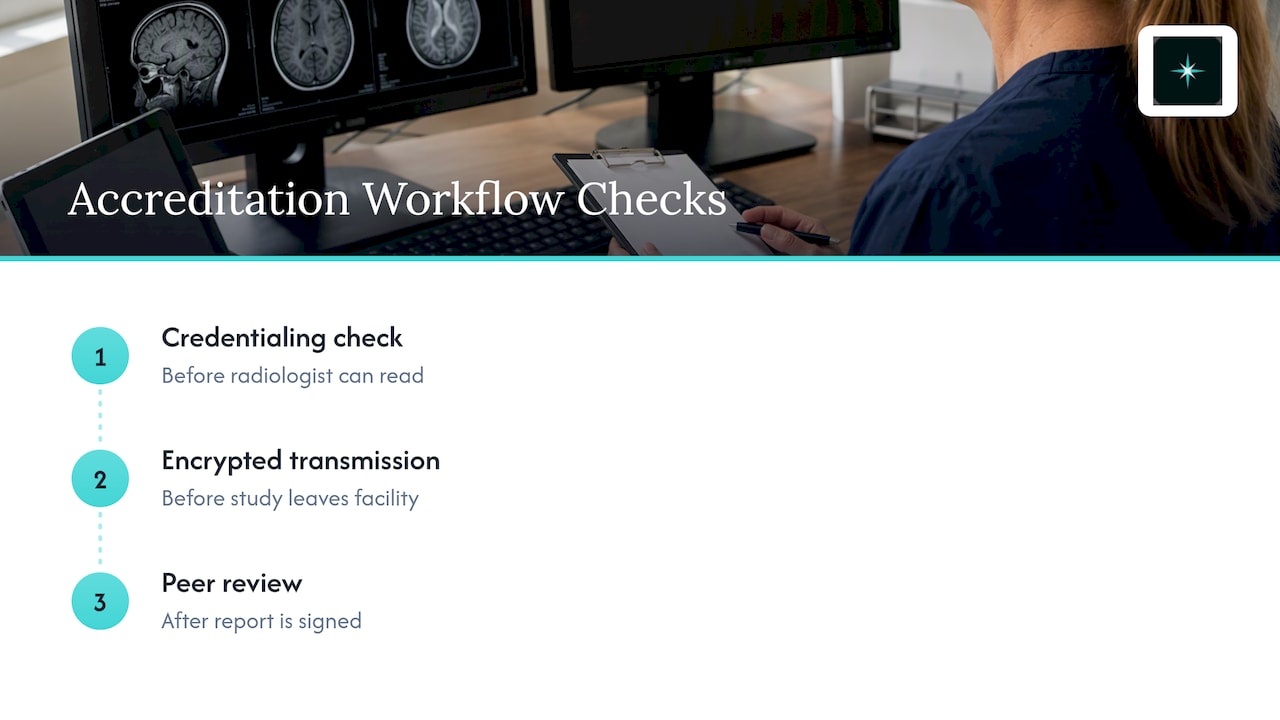
Accreditation does not set turnaround times directly, but it shapes workflow by forcing documentation at every handoff: credentialing checks before a radiologist can read, encrypted transmission before a study leaves the facility, and peer review after the report is signed. Each of those steps adds structure without necessarily slowing the read itself.
In practice, facilities that build accreditation requirements into their vendor contracts tend to get clearer turnaround commitments, because the same documentation a surveyor wants, case routing rules, licensure coverage, QA sampling, overlaps heavily with what a well-run SLA needs to specify. A coverage plan that states STAT, routine, and stroke-protocol turnaround by contract gives both the facility and the surveyor a concrete reference point rather than a vague service description.
Workflow friction usually shows up when PACS integration is incomplete. A facility routing studies through a separate vendor portal, rather than a direct DICOM connection into its existing PACS, adds a manual step at both ends that slows delivery and creates a documentation gap surveyors notice. Confirming a direct PACS connection during vendor onboarding, before the first study is ever sent, avoids that gap entirely and keeps the technical standard's DICOM-conformance expectation satisfied from day one.
How does a facility actually obtain ACR accreditation while using teleradiology?
A facility applies for ACR accreditation the same way whether or not it uses teleradiology: by submitting equipment and staffing documentation for the specific modality, then demonstrating QA processes that cover every interpretation performed under that accreditation. Using a remote reading service does not create a separate accreditation track; it adds documentation requirements to the existing one.
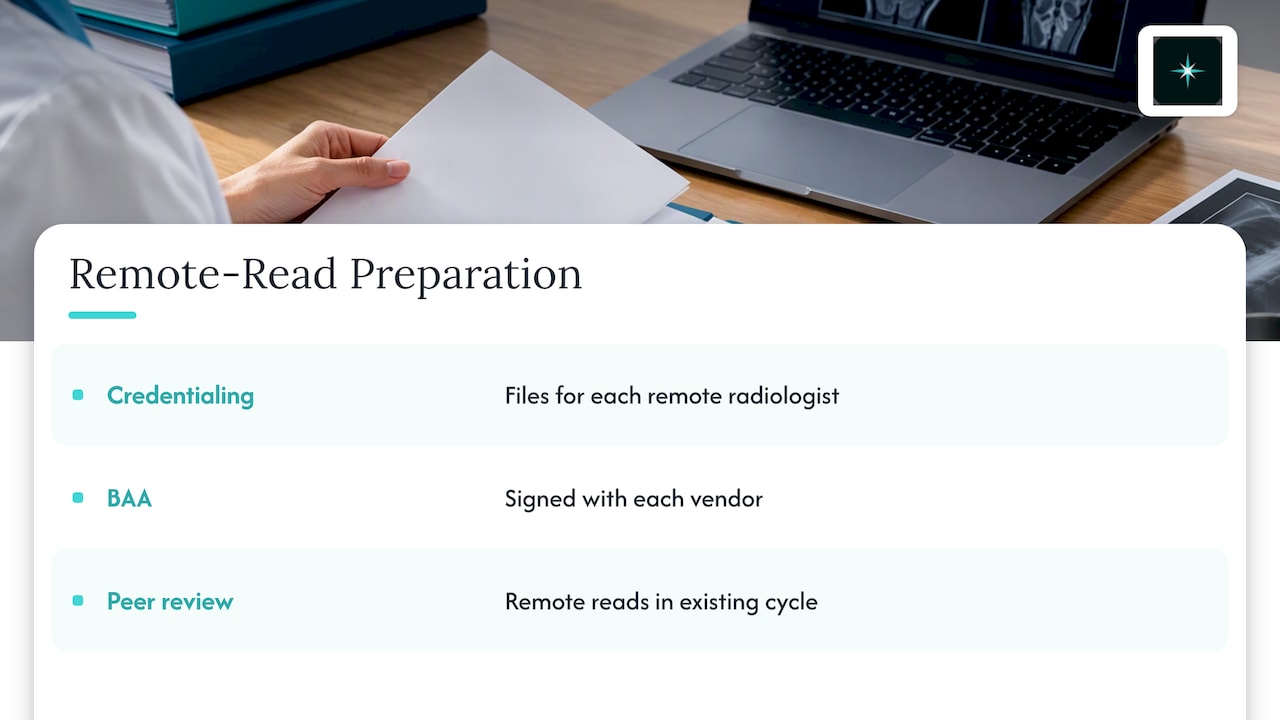
The practical sequence starts well before the application. Facilities need credentialing files for every remote radiologist, a signed BAA with each vendor, and evidence that remote reads are already flowing through the same peer-review cycle as on-site reads, not a parallel process set up just for the survey. ACR accreditation support's guidance on remote scanning confirms that current accreditation requirements remain in force regardless of where interpretation happens, so there is no shortcut around the standard QA and credentialing criteria.
Timing matters too. Case-volume minimums for interpreting physicians and QA sampling both accumulate over a defined period, so a facility that brings on a new teleradiology vendor three months before a scheduled survey may not have enough peer-review history for that vendor's reads to show a complete cycle. Building remote-read documentation into the QA program as soon as a vendor relationship starts, rather than retrofitting it before a survey date, is the difference between a clean review and a scramble.
How do teleradiology providers support a facility's accreditation compliance?
A teleradiology provider supports accreditation by supplying the documentation a facility needs, not by holding accreditation itself. That means credentialing files for every reading radiologist, a signed BAA, DICOM-conformant connectivity, and a peer-review structure the facility can fold into its own QA cycle.
The gap between vendors shows up in how much of that documentation arrives ready to use. A provider that tracks state licensure, board certification, and CME status for its radiologists on an ongoing basis saves the facility from chasing paperwork at renewal time. One that supports a direct PACS connection, rather than routing studies through a standalone viewer, keeps the technical standard's DICOM and access-control expectations satisfied without extra integration work on the facility's side.
Clear recordkeeping also matters downstream of the read itself. Facilities handling claims and reimbursement for teleradiology studies often lean on resources like guidance on medical necessity documentation from One For All Medical Billing to keep clinical documentation aligned with what payers require, a separate but related discipline from accreditation evidence. Both ultimately depend on the same habit: capturing the right record at the moment the work happens, not reconstructing it later.
How AstraRad maps to accreditation requirements
We provide US-based teleradiology services built around the documentation facilities need for accreditation rather than as an afterthought. Every study routes to a subspecialist matched to modality and body part, with a portion of reports independently double-read, blind, feeding directly into a facility's peer-review cycle.
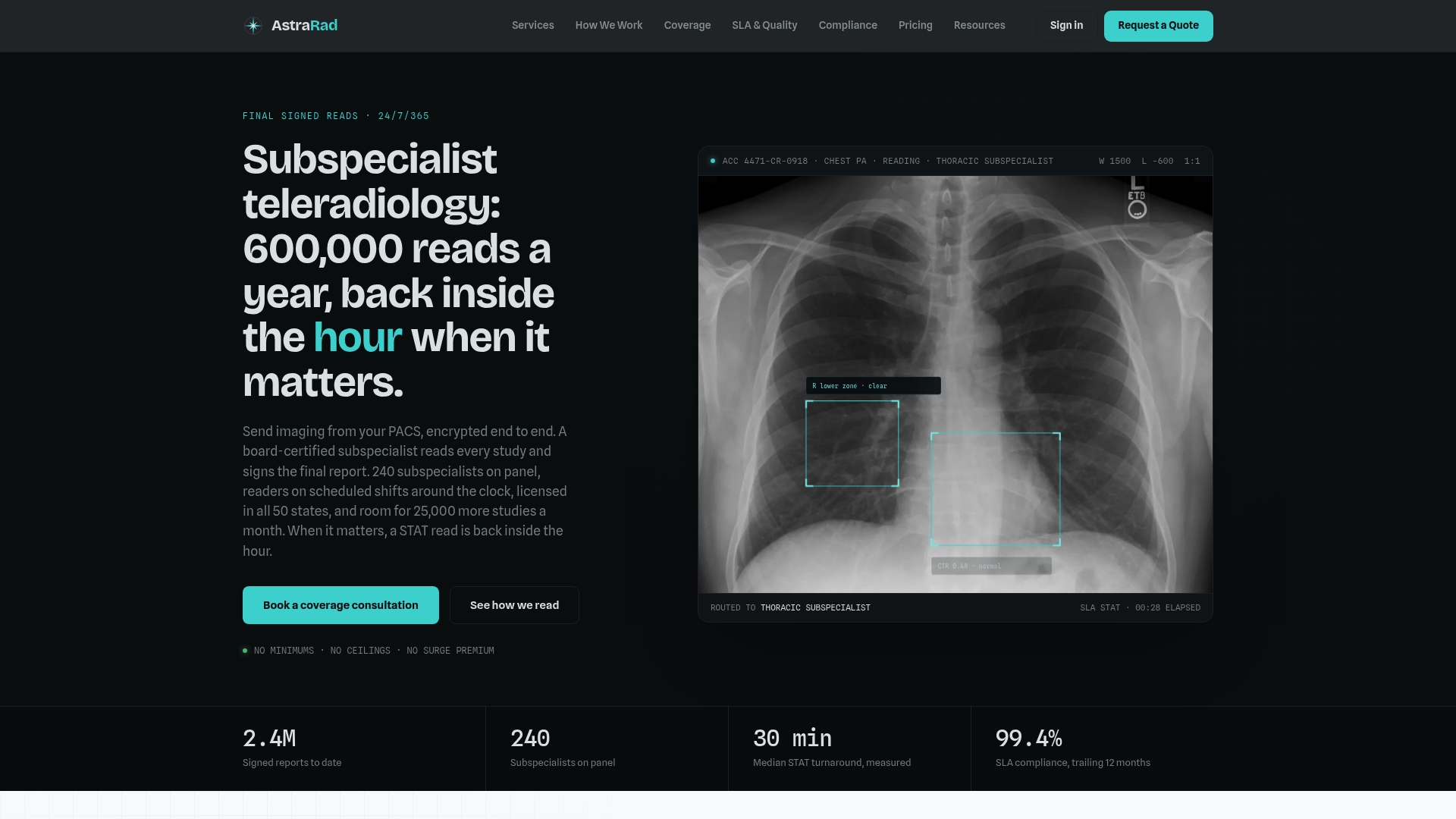
- Radiologists are licensed in all 50 states, with state-specific coverage detailed on our licensing pages, including Colorado.
- Reports are delivered directly into a facility's existing PACS, conforming to DICOM standards, without requiring a separate viewer integration.
- We operate as a business associate under signed BAAs, and turnaround times are committed by contract across various tiers.
- Pricing is per report with no minimums, with a full rate card available at /pricing.
| Accreditation need | How we address it |
|---|---|
| State licensure documentation | Radiologists licensed in all 50 states |
| PACS/DICOM integration | Direct connection, no added portal |
| Peer review for QA | 1 in 20 reports double-read, blind |
| BAA for data handling | Signed BAA, business associate relationship |
| Turnaround commitment for SLAs | Contractual STAT, routine, stroke protocol |
Review our full services overview or book a discovery call to get a written coverage plan with SLA terms for your facility.
This article is general information, not a substitute for advice from a qualified doctor. Consult a qualified healthcare professional about your own circumstances before acting on anything here.
FAQ
Can a teleradiology company itself be ACR accredited?
No. ACR accreditation applies to imaging facilities and their equipment, not to the outside radiology groups or platforms that read studies remotely, as confirmed by research on teleradiology accreditation. The facility stays the accredited party and remains responsible for overseeing every remote interpretation performed under its name.
Do remote reads need to be included in peer review?
Yes. Accredited facilities must run an active physician QA program that captures every interpretation, including remote ones, and surveyors verify that inclusion directly through ACR physician QA requirements. RADPEER is the most common peer-learning pathway facilities use to meet this standard.
What technical standards govern teleradiology connections?
The ACR-AAPM-SIIM technical standard for electronic practice of medical imaging requires DICOM-conformant systems, role-based access controls, and end-to-end encryption. Facilities should confirm their teleradiology vendor meets these requirements before studies start flowing.
Is remote scanning allowed under ACR accreditation rules?
Yes, with conditions. ACR accreditation support states that remote scanning is acceptable when it supports patient safety, and current accreditation requirements remain in force regardless of where scanning or interpretation occurs.
What credentials must a remote radiologist have?
Remote radiologists need board certification or active eligibility, modality-specific case-volume minimums, and documented CME, matching the standards applied to on-site physicians. ACR's interpreting physician guidance for CT outlines these expectations, and facility medical staff bylaws determine the exact privileging requirements.
What documentation do surveyors expect for teleradiology arrangements?
Surveyors typically ask for a signed business associate agreement, QA and peer-review records showing remote reads were sampled, equipment calibration logs, and documented PACS and DICOM connectivity testing. Having these assembled before a survey, rather than gathered the week of, avoids delays during the review.
Sources
Related on AstraRad
- Resources
Radiology companies explained: the five types compared
Radiology companies come in five types: practice groups, consolidators, teleradiology, imaging center operators, and AI vendors. Who does what, mapped.
- Resources
AI radiology companies in 2026: the vendor landscape
AI radiology companies mapped by category: triage, detection, and reporting vendors, what FDA clearance actually covers, and how AI fits human reads.
- Resources
Body imaging teleradiology: 5 steps to vet a provider
Compare body imaging teleradiology providers with five steps for vetting modalities, PACS integration, quality assurance, credentials, and service terms.
Put a radiologist's name on your next read.
Tell us your modalities and monthly volume. A complete per-report rate card, with turnaround tiers and SLA terms in writing, lands in your inbox within one business day.