Body imaging teleradiology: 5 steps to vet a provider
Compare body imaging teleradiology providers with five steps for vetting modalities, PACS integration, quality assurance, credentials, and service terms.
Body imaging teleradiology delivers final, signed reports for CT, MRI, ultrasound, X-ray, and PET-CT studies, read remotely by board-certified subspecialists under contractual turnaround times. Emergency departments, urgent care centers, imaging centers, and hospitals use it to speed disposition decisions, add subspecialty depth without a local hire, and absorb overflow volume. Before signing anything, confirm the provider's PACS integration method and ask for real SLA examples, not just marketing ranges.
TL;DR:
- Route oncology PET-CT staging to routine reads, since one retrospective series reported mean turnaround near 20 hours, while trauma CT needs STAT coverage within minutes.
- One survey found serious error rates below 1%, while another reported 21.6% clinically significant discrepancies, so request each provider’s own peer review data.
- Verify PACS connectivity, EMR result routing, and HL7 or FHIR mapping, then test a STAT case before signing to expose integration gaps.
- Confirm enrollment through PECOS and state licenses for every service area, because radiologist licensure generally follows the state where each patient’s study originates.
- A public hospital study found waits dropped 71%, but treat that result as directional and measure local performance in a parallel pilot lasting two weeks.
Table of Contents
- What services and study types fall under body imaging teleradiology?
- What should you expect by modality?
- Integration, technical, and workstation requirements
- Quality assurance, licensure, and compliance checks
- How does teleradiology improve throughput and access?
- Steps to evaluate, pilot, and contract a provider
- AstraRad as a working example of these standards
- Three priorities when choosing a body imaging partner
- How AstraRad can help you close coverage gaps
- FAQ
- Sources
What services and study types fall under body imaging teleradiology?
Body imaging teleradiology spans the modalities most hospitals and imaging centers need covered around the clock. Coverage typically includes abdomen and pelvis CT, chest CT, MRI liver and pelvis protocols, focused ultrasound, and general X-ray series, and PET-CT for oncologic staging. Providers usually structure service around acuity rather than a single flat rate, which lets a facility route a trauma CT differently than a scheduled outpatient MRI.
Most contracts define a handful of service tiers:
- STAT reads for emergent cases needing interpretation within minutes.
- Urgent reads for same-shift but non-emergent studies.
- Routine reads for scheduled or outpatient volume.
- Overnight and weekend coverage that extends a facility's hours without onsite staffing.
- Backlog or overflow support during staffing gaps or volume spikes.
Every tier should end in the same deliverable: a final signed report, structured findings where relevant, and an immediate notification path for critical or unexpected results.
What should you expect by modality?
Not every study carries the same complexity, and matching the right subspecialist to the right scan matters more in some modalities than others. Oncologic CT staging, vascular CTAs, and MR liver protocols benefit from a reader who works that anatomy regularly, since subtle findings in these studies are easy to understate without focused experience. PET-CT staging for oncology follows a similar logic: a retrospective series of PET-CT scans interpreted via teleradiology reported a mean turnaround near 20 hours, which fits a workflow built around scheduled oncology tumor boards rather than emergency turnaround.
A few patterns to expect when comparing modalities:
CT and MRI for trauma, stroke, and acute abdominal pain usually carry the tightest STAT windows.
PET-CT oncologic staging tolerates longer routine windows tied to clinic or tumor board schedules.
Plain film X-ray for straightforward fractures or line checks often suits a generalist radiologist.
Focused ultrasound for acute concerns like appendicitis or gallbladder disease typically needs faster routing than scheduled outpatient ultrasound.
Integration, technical, and workstation requirements
Connecting to a teleradiology partner should not mean building a second portal or retraining your staff on new software. Ask whether the provider connects directly through DICOM transfer protocols like C-MOVE and C-STORE, a VPN tunnel, or an HL7-based integration that avoids a separate login entirely. Result routing matters just as much as image transfer: confirm how findings flow back into your EMR, and ask what mapping work your IT team will need to do for HL7 or FHIR messaging. Teams unfamiliar with the difference between these two standards can review a practical FHIR versus HL7 v2 comparison before scoping the integration.
For remote-reading infrastructure itself, a review of home-based teleradiology workstations found that properly configured setups can match hospital reading-room performance, with recommended ambient lighting between 25 and 75 lux, noise under 40 dB, and sustained bandwidth planning around 50 to 100 Mbps.
Before contracting, request documentation on:
- Diagnostic-grade display specifications and workstation environment controls.
- Encryption standards for data in transit and at rest.
- Role-based access controls and audit logging.
Pro Tip: Ask for a written integration diagram before the contract stage: if the provider cannot explain data flow in one page, acceptance testing will take longer than planned.
Quality assurance, licensure, and compliance checks
Quality assurance is where procurement teams should spend the most scrutiny, because the difference between an adequate teleradiology partner and a strong one shows up in process, not marketing copy. Start by asking for the radiologist roster and subspecialty credentials behind the reads you'll actually receive, not a general claim of board certification.
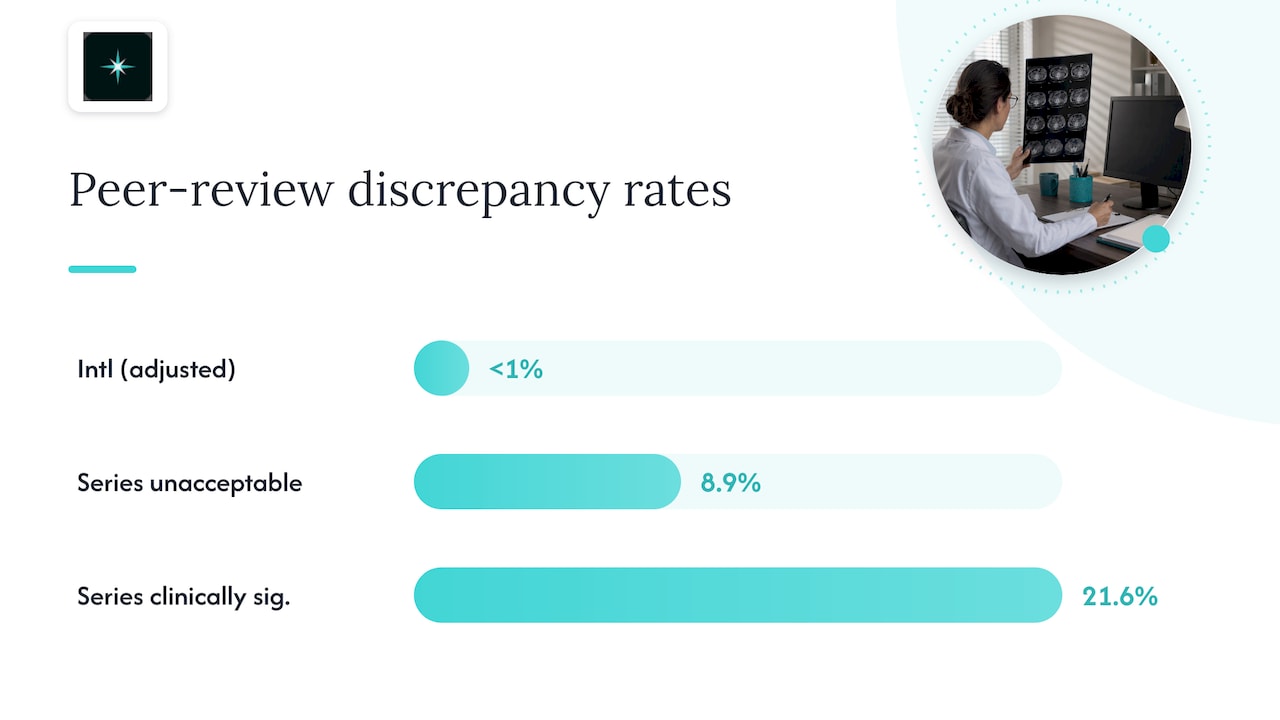
Request peer-review data directly. A large discrepancy survey across an international teleradiology service found clinically significant error rates below 1% after adjustment for underreporting, which shows mature QA programs can hold serious errors to a low rate. Other peer-review research reports wider variation: one series found 8.9% of reviews classified unacceptable and 21.6% of discrepancies clinically significant, with rates differing by modality and subspecialty section. That spread is exactly why asking for a specific provider's own discrepancy data matters more than citing an industry average.
A working checklist:
- Radiologist roster with subspecialty match to your case mix.
- Peer-review or RADPEER-equivalent discrepancy rates, reported on a regular cadence.
- SLA terms and a sample report showing how STAT and routine turnaround are measured.
- Licensure and enrollment confirmation: under CMS guidance, teleradiologists must be enrolled through PECOS using their actual practice location, and licensure follows the state where the patient's study originates.
How does teleradiology improve throughput and access?
The clearest evidence for teleradiology's value sits in waiting-time and throughput data rather than general claims about convenience. A quasi-experimental study in Northwest Ethiopia found that implementing a web-based teleradiology system cut median patient waiting time from 43.5 hours to 4.62 hours, a 71% reduction, alongside an 11% rise in service satisfaction.
Statistic: A quasi-experimental teleradiology rollout in public hospitals reduced median patient waiting time by 71%, showing how much operational drag a remote-reading gap can create when local radiologist coverage is limited.
U.S. buyers should read that figure as directional evidence of what teleradiology fixes, not a guaranteed local result, and validate it against their own pilot metrics. Workflow design compounds the benefit: a quality improvement project that integrated teleradiology requests directly into the EMR cut the interval from preliminary read to request by 29.2% and improved total CT order-to-result time. Common use cases include:
- Overnight and weekend ED coverage when onsite radiologists are unavailable.
- Rural and critical-access hospitals without full-time subspecialty staff.
- Backlog clearance during vacation coverage gaps or unexpected volume surges.
Steps to evaluate, pilot, and contract a provider
Moving from evaluation to a signed contract goes faster with a defined sequence rather than parallel conversations with five vendors at once.
- Define scope: list modalities, monthly volume, and acuity mix before requesting proposals.
- Request evidence: ask for sample SLA reports, QA discrepancy data, and radiologist credential summaries.
- Run technical acceptance tests: verify DICOM transfer, confirm EMR result routing, and simulate a STAT case drill with escalation.
- Negotiate contract terms: turnaround commitments, SLA penalties, data retention, and reporting cadence.
- Pilot in parallel: run live reporting alongside your current workflow for roughly two weeks before full cutover.
Pro Tip: Build your acceptance test around your actual worst case, a STAT trauma CT at 2 a.m., rather than a routine daytime study; that's where integration gaps show up first.
AstraRad as a working example of these standards
Our service is built around the exact checklist above, because procurement often stalls on vague claims instead of verifiable commitments. Every study we read is interpreted by a board-certified subspecialist matched to the modality and body part, and we back that with contractual turnaround commitments rather than best-effort targets.
Against the buyer needs outlined in this guide, our setup maps directly:
- STAT reads are committed under 4 hours (under 2 hours or 1 hour on request), stroke protocol reads under 30 minutes, and routine studies in 24 to 48 hours.
- Reports connect through existing PACS systems, enabling routing without a separate portal login for your team.
- Peer review double-reads 1 in 20 studies, and SLA reporting is measured against those contract terms.
- Coverage runs 24/7/365 with no required volume minimums or added platform fees.
Three priorities when choosing a body imaging partner
If you only have time to check three things, check these in order: subspecialist quality and documented QA, how little friction the integration adds to your existing PACS, and whether SLA terms are written into the contract rather than promised in a sales deck. Favor dedicated STAT coverage for ED and trauma volume, and scheduled subspecialist reads for oncology and outpatient MRI. One tip that shortens evaluation time: ask every finalist for the same SLA report format up front, so comparisons take minutes instead of weeks.
How AstraRad can help you close coverage gaps
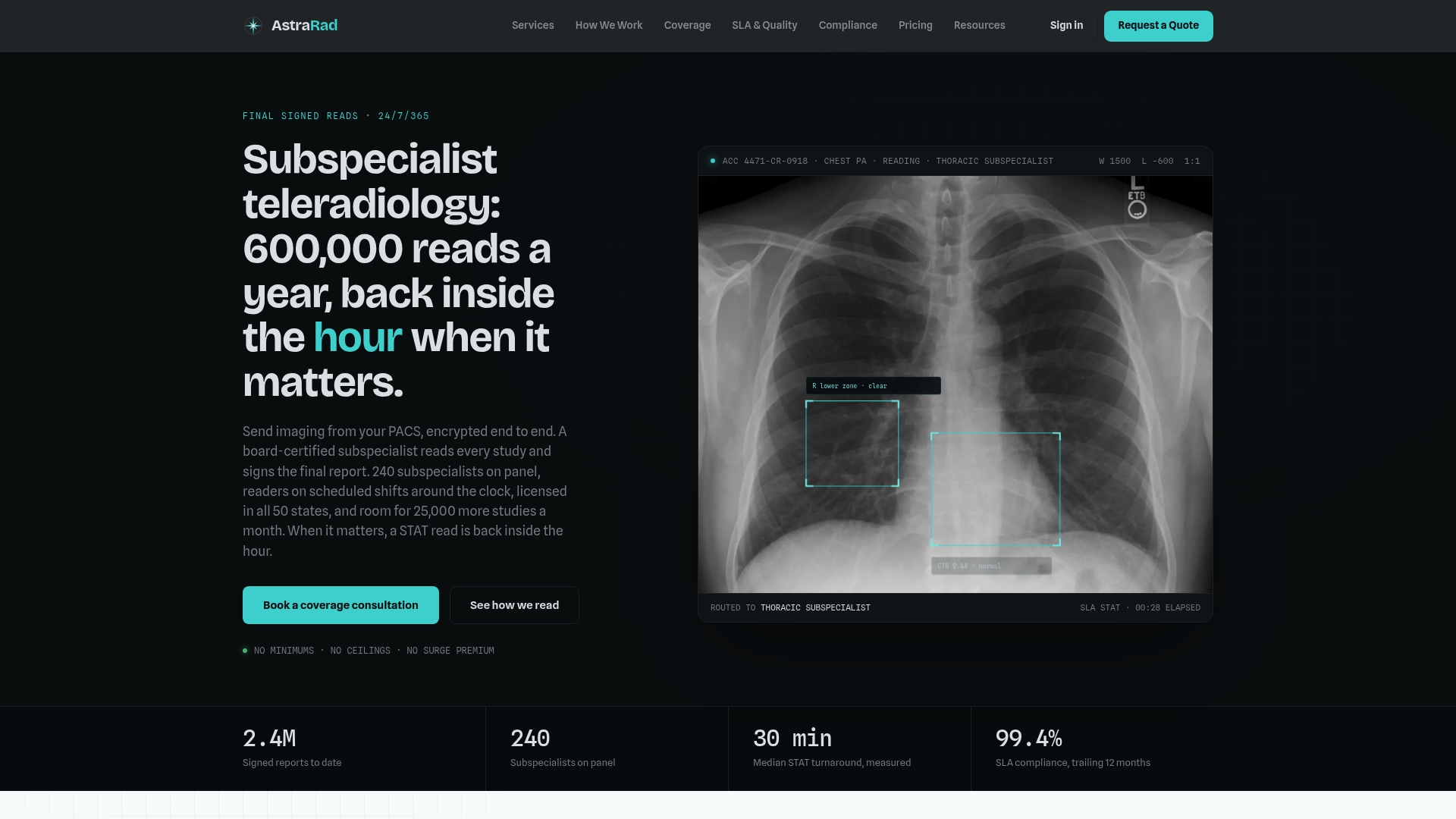
If the checklist in this guide matches what your facility needs, the next step is a direct conversation rather than another vendor deck. We ensure every imaging study is read with subspecialist oversight matched to the case, offer rapid STAT and routine turnaround times, and connect directly into your existing PACS without adding a new portal for your staff to learn.
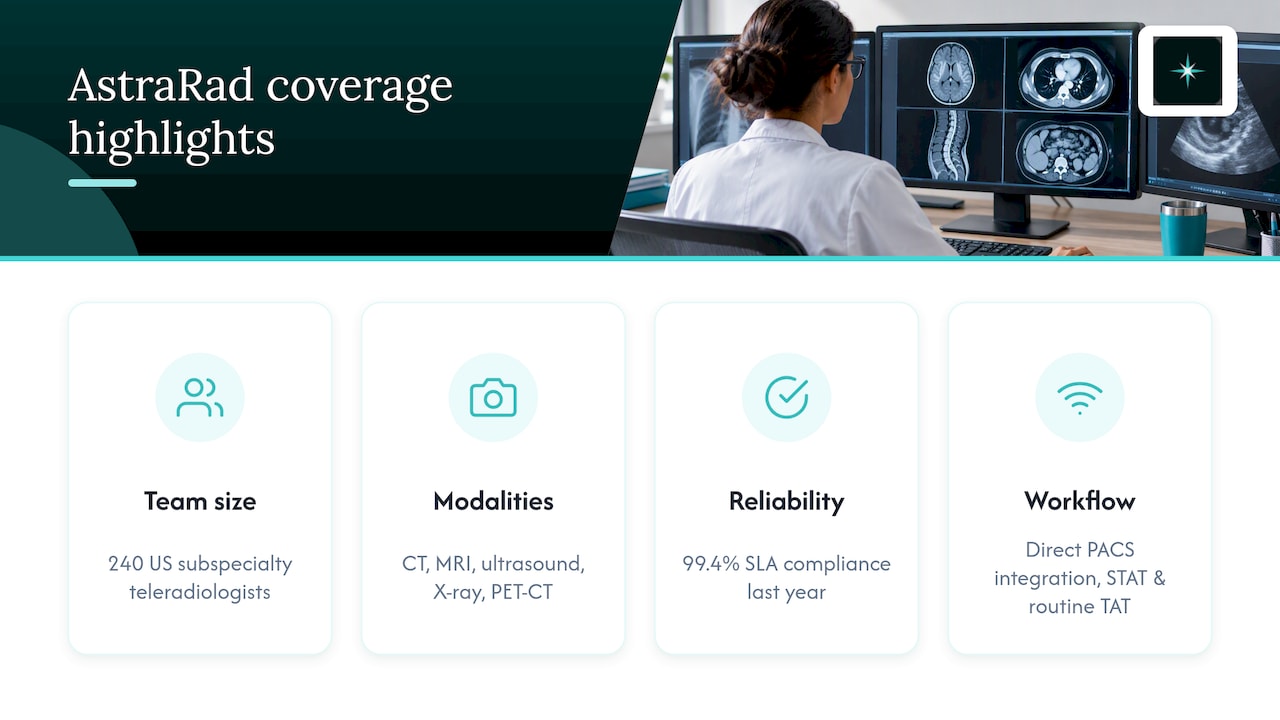
Our US board-certified subspecialists, licensed in all 50 states, cover CT, MRI, ultrasound, X-ray, and PET-CT, backed by peer review on a 1 in 20 double-read sample. If overnight ED coverage is your immediate pressure point, our STAT radiology reads page walks through the turnaround terms. For oncology staging volume, see our PET-CT and nuclear medicine reporting service, and for day-to-day overflow, our X-ray and ultrasound overflow reads page outlines how that volume routes through our team. Reach out to start a pilot, request a sample SLA report format, or get a quote for your specific case mix.
This article is general information, not a substitute for advice from a qualified doctor. Consult a qualified healthcare professional about your own circumstances before acting on anything here.
FAQ
What modalities does body imaging teleradiology cover?
Body imaging teleradiology typically covers CT, MRI, ultrasound, X-ray, and PET-CT, with subspecialists reading studies like abdomen and pelvis CT, MRI liver protocols, and oncologic PET-CT staging. Coverage models usually split into STAT, urgent, and routine tiers based on clinical acuity.
How fast are teleradiology turnaround times?
Turnaround depends on acuity and modality: PET-CT oncologic staging reported a mean turnaround near 20 hours in one retrospective series, while STAT trauma cases typically demand much faster windows measured in minutes. Ask any provider for their specific median STAT and routine turnaround figures rather than relying on general ranges.
What licensure rules apply to remote radiologists?
Under CMS guidance, teleradiologists must enroll through PECOS using their actual practice location, and state licensure generally follows where the patient's study originates rather than where the radiologist sits. Facilities should confirm a provider's enrollment and licensure coverage for every state they operate in before contracting.
How accurate is teleradiology compared to onsite reads?
A large discrepancy survey across an international teleradiology service found clinically significant error rates below 1% after correction for underreporting, suggesting mature QA programs keep serious errors low. Rates vary by modality and subspecialty, so request a provider's own peer-review data rather than relying on industry-wide figures alone.
What technical setup does teleradiology require?
A properly configured home-based workstation can match hospital reading-room performance, with recommended ambient lighting between 25 and 75 lux and sustained bandwidth planning around 50 to 100 Mbps. Facilities should also confirm DICOM connectivity options and HL7 or FHIR result routing before go-live.
Sources
- Technical requirements and optimization strategies for home-based teleradiology workstations: a review article
- Effect of teleradiology on patient waiting time and service satisfaction in public hospitals, Northwest Ethiopia: a quasi‑experimental study
- Understanding telehealth enrollment (CMS guidance) , teleradiology notes
- Systematic survey of discrepancy rates in an international teleradiology service
Related on AstraRad
- Resources
AI radiology companies in 2026: the vendor landscape
AI radiology companies mapped by category: triage, detection, and reporting vendors, what FDA clearance actually covers, and how AI fits human reads.
- Resources
Mobile X-ray teleradiology: signed reads for hospitals
Operational handbook for hospital imaging leaders: contract, integrate, and verify PACS, KPIs, and SLA terms so portable X-ray reads arrive signed
- Resources
4 teleradiology malpractice checks radiologists must verify
U.S. radiologists: verify teleradiology malpractice coverage with this checklist, including state listings, claims-made vs occurrence, retroactive/tail
Put a radiologist's name on your next read.
Tell us your modalities and monthly volume. A complete per-report rate card, with turnaround tiers and SLA terms in writing, lands in your inbox within one business day.