4 teleradiology malpractice checks radiologists must verify
U.S. radiologists: verify teleradiology malpractice coverage with this checklist, including state listings, claims-made vs occurrence, retroactive/tail
Before reading a single remote study, confirm four things: your malpractice policy names every state where your patients are physically located, you know whether it's claims-made or occurrence and what that means for tail coverage, both the reading entity and the individual radiologist are covered without gaps, and you have exposure data ready (reads by state, modality mix, projected revenue) before requesting quotes.
TL;DR:
- Malpractice policies must explicitly list all states where patients are located, matching coverage to actual read volume by state.
- A claims-made policy requires confirmation of tail coverage and retroactive dates to prevent gaps after leaving a group or vendor.
- Entity-level coverage and additional insured endorsements are essential to protect hospitals, imaging centers, and teleradiology groups from vicarious liability claims.
- Pricing relies on projected annual reads by state and modality, with legal environment and claims history significantly affecting premiums.
- Proper documentation of licensing, operational data, and communication procedures supports underwriting and claims defense in teleradiology malpractice coverage.
Table of Contents
- What malpractice insurance must cover for teleradiology
- Claims-made vs occurrence: which clauses actually protect you?
- Who should the policy actually name?
- How do insurers price teleradiology malpractice risk?
- Checklist for quoting teleradiology malpractice coverage
- How we support compliant teleradiology operations
- Risk management practices that lower teleradiology claims
- What do teleradiology malpractice claims typically look like?
- How are telemedicine regulations changing malpractice coverage?
- How does on-site radiology coverage differ from teleradiology coverage?
- Why policy wording matters more than carrier reputation
- FAQ
- Sources
What malpractice insurance must cover for teleradiology
State licensure determines where your coverage needs to apply, and the rule is simpler than most radiologists expect: the practice of medicine occurs where the patient is located, not where the radiologist sits. AMA guidance on telemedical liability confirms this is the prevailing standard among state medical boards, and most states require licensure or registration before a physician can read for patients within their borders. That means a teleradiology group covering twelve states needs a policy that explicitly lists those twelve states, not a generic "telemedicine included" clause.
Before signing with any carrier or joining a teleradiology group, radiologists and practice managers should demand the following in writing.
- A full list of states the policy covers, matched against your actual read volume by state.
- Written confirmation that teleradiology or telehealth services are named in the policy, not assumed under general coverage.
- Clarification on whether coverage applies to episodic consults only or to full-scope final reads.
- A certificate of insurance naming the teleradiology entity itself, not just individual readers.
- Confirmation of automatic additional insured endorsements for client hospitals and imaging centers.
Vague language costs groups during claims. AMA policy and state board practice both point toward the same conclusion: specificity about states and services at the time of binding protects you far more than a broad assurance from a sales representative.
Claims-made vs occurrence: which clauses actually protect you?
Two policy structures dominate radiology malpractice coverage, and the difference matters most the day you leave a group or a vendor relationship ends. An occurrence policy covers an incident based on when the care happened, regardless of when the claim is filed. A claims-made policy only covers claims filed while the policy is active, which creates a gap problem for anyone who reads remotely across multiple contracts over a career.
Four things to check before accepting any teleradiology assignment:
- Whether your policy is claims-made or occurrence, since this changes who is exposed after you stop reading for a client.
- Your retroactive date, which determines how far back prior acts are covered under a claims-made policy.
- Whether tail coverage is available and who pays for it when you leave an employer or vendor.
- Typical limits and deductibles for your market, since these set your real exposure if a claim exceeds your coverage.
AuntMinnie's overview of teleradiology coverage notes that per-claim limits paired with larger aggregate limits are common in teleradiology programs, alongside flexible deductible or self-insured retention structures. A retroactive date that predates your start with a group, combined with employer-funded tail coverage, is the combination most radiologists should negotiate for before signing anything.
Who should the policy actually name?
A policy that only covers the individual radiologist leaves the contracting hospital and the teleradiology entity exposed, which is why most well-structured teleradiology arrangements carry layered coverage rather than relying on one physician's personal policy.
- The teleradiology business should hold its own entity-level policy in addition to any individual physician coverage, since vicarious liability claims often name the organization, not just the reader.
- Client hospitals and imaging centers typically require additional insured endorsements, which extend coverage to them for claims arising from the teleradiology group's work on their studies.
- When a group relies on contractor radiologists who carry only personal policies, gaps appear fast: request proof of coverage with limits at least equal to the group's own policy, or purchase entity-level coverage that names every contracted reader directly.
Skipping this step is one of the more common ways a facility discovers, after a claim is filed, that no one's policy actually responds.
How do insurers price teleradiology malpractice risk?
Underwriters price teleradiology differently than traditional on-site radiology because the exposure isn't tied to a single location. Annual reads broken down by modality and state matter more to a carrier than a simple headcount of radiologists on staff, since one radiologist reading for ten states carries a different risk profile than ten radiologists each reading in one state.
- Exposure units are typically measured as projected annual reads by state and modality, not by physician count.
- State mix affects pricing directly because legal environments, damage caps, and licensing requirements vary widely.
- Minimum group premiums and per-read pricing benchmarks have historically shaped how smaller groups budget for coverage, according to AuntMinnie's industry overview, which also describes self-insured retention options for groups with strong claims histories.
- Clean documentation, including claims history and active QA programs, tends to support better terms at renewal.
One industry pattern worth noting: coverage design commonly includes entity-level policies and additional insured endorsements as standard features, not optional add-ons, for groups that want clean underwriting submissions.
Checklist for quoting teleradiology malpractice coverage
Underwriters move faster and price more accurately when a submission arrives complete. Before requesting quotes, assemble the following.
- Annual reads broken down by state and modality, not just a total volume figure.
- Projected revenue and staffing model, including how many radiologists read under the entity.
- Existing policy wording, especially retroactive dates and any tail provisions already in place.
- Claims history for the group or the individual readers being added to the policy.
- Written endorsement requests specifying covered states and whether reads are final or preliminary.
State licensing records, written turnaround commitments, and PACS integration documentation are precisely the materials underwriters and contracting facilities ask teleradiology groups to produce when verifying compliance before binding coverage. A group that can hand an underwriter organized licensing and operational documentation typically moves through underwriting with fewer follow-up questions than one that cannot.
Pro Tip: Ask your broker to request state-by-state coverage confirmation in writing, not a verbal assurance, before you read your first study under a new policy.
How we support compliant teleradiology operations
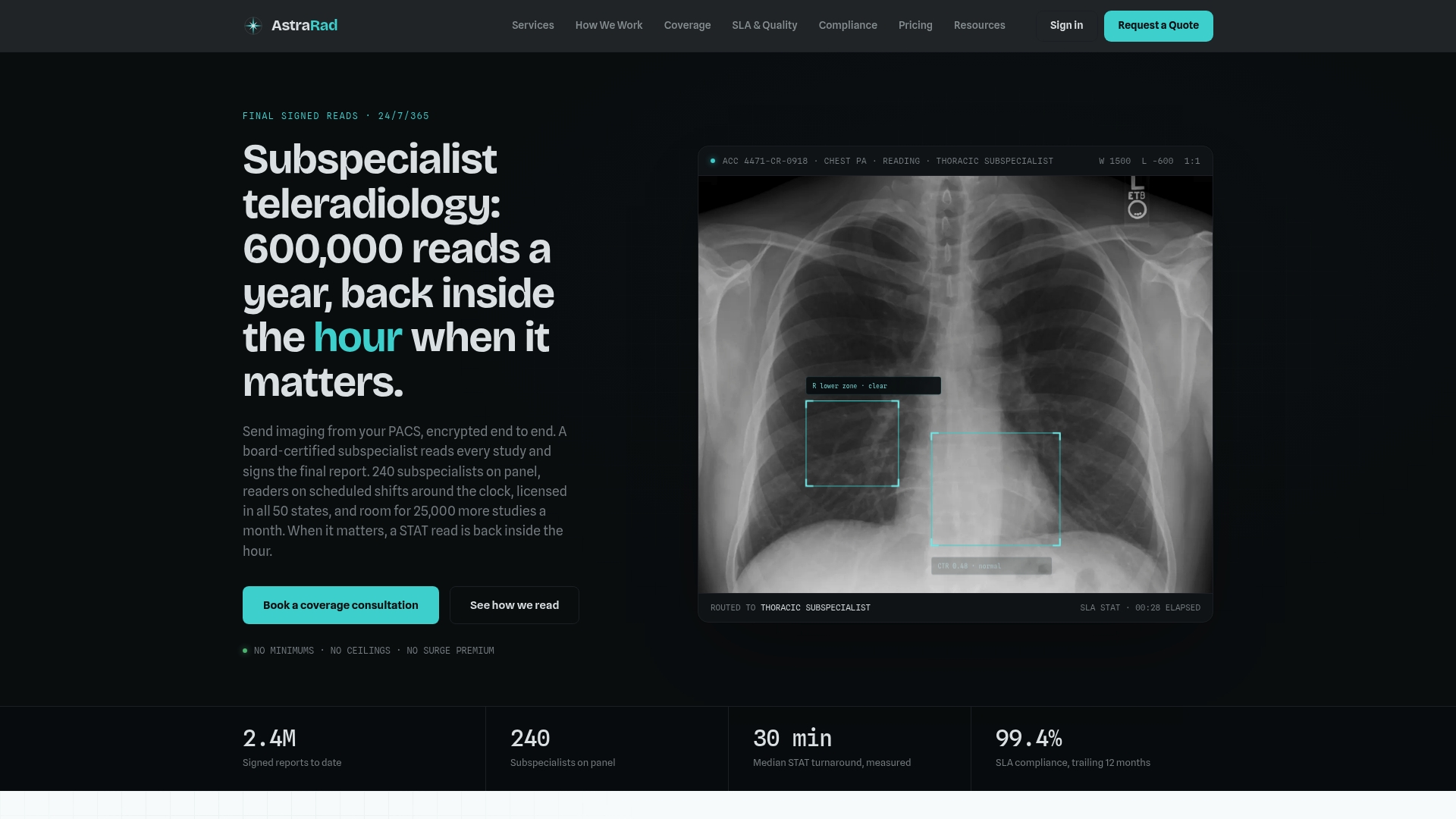
We read every study with subspecialists matched to modality, and we back that work with published turnaround commitments, state-by-state licensing documentation, and direct PACS integration, the same categories of information insurers and contracting facilities ask teleradiology groups to produce during underwriting or compliance review. For a hospital or imaging center trying to assemble a clean insurance submission, having a vendor that already organizes this material by state and study type removes a step most groups otherwise handle manually.
- State licensing pages that show exactly where coverage applies, useful when an insurer asks for state-by-state confirmation.
- Published turnaround commitments (STAT under 4 hours, routine 24 to 48 hours, stroke protocol under 30 minutes) that underwriters can use to assess operational risk.
- PACS integration documentation that answers the technical questions insurers and IT teams raise during review.
If you're assembling documentation for an insurer or a facility contract, our teleradiology licensing overview and per-report pricing page are the two starting points most groups request first.
Risk management practices that lower teleradiology claims
Operational habits affect both claim frequency and how well a claim defends once filed. ACR's overview of what happens when a radiologist is sued notes that issuing an interpreted opinion establishes a physician-patient relationship and a duty of care, and that diagnostic errors and communication failures are common claim categories.
- Report potential claims to your carrier promptly, since delayed notice can weaken your legal defense regardless of the clinical merits.
- Use subspecialist reads matched to modality and body part, which reduces the diagnostic variance that drives many claims.
- Document turnaround times and communication protocols so underwriters see a measurable, lower-loss operating profile.
- Apply RADPEER-style peer review consistently, since documented QA supports both claim defense and renewal pricing.
Pro Tip: Keep a written log of every critical finding communication, including the time it was relayed and to whom, since communication gaps are one of the most frequently cited factors in radiology malpractice claims.
What do teleradiology malpractice claims typically look like?
Teleradiology claims follow the same broad categories as on-site radiology claims: missed or delayed diagnosis, failure to communicate a critical finding, and discrepancies between preliminary and final reads. What differs in teleradiology is the chain of custody for the image and the report. A claim may turn on questions like which licensed radiologist read the study, whether the reading radiologist was licensed in the patient's state at the time, and whether the referring facility received the final report within the window its contract specified.
ACR's description of radiologist liability notes that issuing an interpreted opinion creates a duty of care regardless of where the radiologist is physically located, which means a teleradiology read carries the same legal exposure as an in-person read. The practical difference shows up in discovery: insurers and plaintiff attorneys increasingly ask for PACS timestamps, licensure records for the specific state, and documentation of who had access to the study at each step. A group that can produce a clean audit trail for a single read, showing licensure, turnaround time, and communication of any critical finding, is in a materially stronger position than one relying on informal records. This is part of why entity-level documentation, not just individual physician credentials, has become central to how teleradiology claims get defended.
How are telemedicine regulations changing malpractice coverage?
State licensure requirements remain the single biggest regulatory variable affecting teleradiology malpractice coverage, and they have been loosening gradually rather than all at once. The Interstate Medical Licensure Compact gives physicians a faster path to licensure across participating states, and AMA reporting on licensure and telehealth describes the Compact as a practical route for physicians seeking multistate practice, alongside other licensure exceptions some states maintain for telehealth specifically.
For malpractice coverage, this matters because insurers underwrite to the states where you are actually licensed and reading, not to a vague national footprint. As more states join compact or reciprocity arrangements, the administrative burden of adding a new state to your coverage schedule should, in theory, shrink. But AMA policy on telemedicine still emphasizes that physicians and groups must independently verify their malpractice coverage extends to telemedicine services across state lines rather than assuming a compact license automatically means insurance coverage follows. Licensure and insurance are separate verifications, and conflating them is a common mistake among radiologists moving into teleradiology for the first time. Any group adding states to its read volume should treat each addition as a two-step process: confirm licensure, then confirm the insurance endorsement names that state specifically.
How does on-site radiology coverage differ from teleradiology coverage?
On-site radiology malpractice coverage is comparatively simple because the radiologist, the facility, and the patient are all in one state, under one set of licensing rules, with one insurer relationship to manage. Teleradiology multiplies that complexity by the number of states a group reads into.
The practical differences show up in three places. First, licensure: an on-site radiologist needs one state license, while a teleradiology group may need a dozen or more, each requiring separate confirmation that the malpractice policy extends there. Second, entity structure: on-site radiologists are often covered under a hospital's or group's single policy, while teleradiology arrangements frequently involve a separate reading entity, the contracting facility, and individual radiologists, each needing clear endorsement language to avoid gaps. Third, underwriting data: an on-site group is priced largely on physician count and local claims history, while teleradiology pricing depends more heavily on exposure units like reads by state and modality, since the risk profile shifts every time the group adds a new state or client.
None of this means teleradiology carries inherently higher risk; it means the coverage has more moving parts to verify. A radiologist moving from a single-site practice into teleradiology should expect to spend more time reviewing policy wording and less time assuming their prior coverage structure simply carries over.

Why policy wording matters more than carrier reputation
A well-known insurer name means little if the policy schedule omits a state where you're reading. The decisive protection is specific wording: states named, entity named, retroactive date confirmed, tail addressed.
Underwriting has adapted to teleradiology's exposure pattern, but that adaptation only helps you if your submission is precise about reads and states. Operational quality, licensing discipline, documented QA, measurable turnaround, feeds directly into both insurability and price. Reputation is a starting point for trust, not a substitute for reading the schedule.
FAQ
What is teleradiology malpractice insurance?
Teleradiology malpractice insurance is professional liability coverage that extends to radiologists reading studies remotely for patients located in states other than where the radiologist is physically present. It needs to explicitly name the states where patients are located, since AMA guidance confirms the practice of medicine is governed by the patient's location, not the reader's.
Does my individual malpractice policy cover teleradiology reads?
Not automatically. Many personal policies are written for a single state or facility and don't name additional states or the teleradiology entity itself, which creates coverage gaps during a claim. Always request written confirmation that telemedicine or teleradiology services are explicitly included before accepting remote reading assignments.
What's the difference between claims-made and occurrence coverage for radiologists?
Occurrence coverage responds based on when the care happened, regardless of when a claim is filed later. Claims-made coverage only responds while the policy is active, which makes retroactive dates and tail coverage critical for radiologists who move between employers or vendors.
How do insurers calculate premiums for teleradiology groups?
Carriers typically price teleradiology risk using exposure units like annual reads by state and modality rather than a simple count of radiologists on staff. State mix matters because legal environments and licensing rules vary, and documented claims history or QA programs can influence the terms offered at renewal, according to industry coverage of teleradiology insurance design.
Does AstraRad provide malpractice insurance documentation for underwriters?
We maintain state licensing pages and published turnaround commitments that contracting facilities and insurers commonly request when verifying a teleradiology partner's operational compliance. These materials support underwriting submissions, though malpractice coverage itself is arranged through your insurer or broker.
Sources
- What physicians need to know about telemedical liability | AMA
- Into the courtroom: what happens when a radiologist is sued | ACR
- Malpractice insurance for teleradiology: What constitutes good coverage? | AuntMinnie
Recommended
Related on AstraRad
- Resources
Switch teleradiology providers: the 90-day checklist
A 90-day playbook to switch teleradiology providers: baseline metrics, credentialing transfer, a parallel run, go/no-go gates, and a rollback plan.
- Resources
Inside a teleradiology company: how the machine works
How a teleradiology company actually operates behind the reading room: worklist engines, night staffing, licensing operations, credentialing, and QA.
- Resources
Radiology compliance reporting for compliance officers
Checklist for compliance officers to make radiology reports audit ready: required fields, PACS risk analysis, ACR RADS, MIPS dose capture, audit cadence
Put a radiologist's name on your next read.
Tell us your modalities and monthly volume. A complete per-report rate card, with turnaround tiers and SLA terms in writing, lands in your inbox within one business day.