Mobile X-ray teleradiology: signed reads for hospitals
Operational handbook for hospital imaging leaders: contract, integrate, and verify PACS, KPIs, and SLA terms so portable X-ray reads arrive signed
Outsourced final reporting for portable X-ray studies is not just viable, it is already a standard operational lever for hospitals and imaging centers managing overnight coverage and overflow. Our service delivers board-certified subspecialist interpretation with signed reports, with STAT turnaround committed under 4 hours (under 2 hours or 1 hour on request) and routine studies in 24 to 48 hours, routed directly into existing PACS. For administrators, the outcome is a finished, signed diagnostic report that lands in the facility's workflow without a new portal or manual upload step.
TL;DR:
- Require a written QA program with peer review and discrepancy audits, diagnostic workstation reads, and closed loop acknowledgement for critical findings.
- The BAA should name every subcontractor and set a breach notification deadline; verify state licensure, since Medicare place of service follows image acquisition.
- Test direct DICOM and HL7 routing, prior study retrieval, accession matching, and downtime procedures under a real overnight batch before launch.
- Track turnaround by priority and workflow stage, and require monthly SLA reporting, with remediation triggered after three consecutive months below target.
- Facilities with unpredictable volume should compare per report fees, priority surcharges, add on QA costs, and minimums before accepting a monthly commitment.
Table of Contents
- What this service actually is and when to use it
- Does teleradiology meet ACR and Joint Commission requirements?
- Technical and operational integration: what to test before go-live
- Which KPIs should a contract actually require?
- Practical go-live checklist: pre-contract to first 90 days
- Contract terms and security assurances to require
- Criteria for selecting a mobile x-ray teleradiology provider
- Cost structure and pricing models of mobile x-ray teleradiology services
- Typical implementation timeline for integrating mobile x-ray teleradiology solutions
- Common contractual terms and negotiation tips for service agreements
- Key red flags and compliance risks when choosing a teleradiology vendor
- Treating teleradiology as strategic capacity
- AstraRad: how we meet the buyer job for portable X-ray final reads
- FAQ
- Sources
What this service actually is and when to use it
In this context, mobile x-ray teleradiology means remote interpretation and final signed reporting for portable X-ray studies, the images acquired at bedside or in the field and then sent out for a formal read. It does not refer to the on-site service that brings imaging equipment to a patient. The technologist and the equipment stay put; what moves is the image, and what comes back is a signed report from a radiologist working elsewhere.
We bring up our own role here because it shapes the rest of this guide: AstraRad reads exactly this type of study, routing portable X-ray images to US board-certified subspecialists matched to the body part and clinical context, then returning a signed report through direct PACS integration rather than a separate login. That structure is what the rest of this article assumes when it talks about turnaround, compliance, and contracting.
The clinical case for outsourcing rests on consistency. A subspecialist reviewing a chest or extremity film on a diagnostic workstation tends to catch subtler findings than a generalist working from a non-diagnostic screen, and a documented peer-review process keeps that quality stable across volume swings.
- Subspecialty-matched reads reduce the odds of a missed finding compared to general coverage spread across every modality.
- Round-the-clock availability clears overnight and weekend backlogs that would otherwise wait for morning staff.
- Per-report pricing lets administrators absorb volume spikes without adding headcount.
Does teleradiology meet ACR and Joint Commission requirements?
Before signing anything, confirm the vendor's quality and communication practices line up with the standards your accreditors already expect from on-site radiology. The ACR technical standard and practice parameters require facilities using remote interpretation to maintain a documented QA program equivalent to what they'd run on-site, including peer review and periodic audits of discrepancy rates. That same guidance recommends sending studies to diagnostic workstations rather than relying on phone or standard display previews, since subtle findings on a portable X-ray are easier to miss on a non-diagnostic screen.
Critical results carry their own obligation. ACR and Joint Commission guidance on communicating diagnostic findings calls for closed-loop systems, meaning an abnormal finding has to be received, acknowledged, and followed up on, whether the read happened down the hall or across the country. A platform like EquiLoop from WellCheck illustrates what closed-loop referral tracking looks like in practice for programs that need documented follow-up.
On the compliance side, HHS guidance on cloud and mobile access to ePHI permits remote image transmission only when administrative, technical, and physical safeguards are in place and a business associate agreement covers every third party touching the data, subcontractors included.
- Confirm a written QA program with peer-review sampling and audit frequency.
- Confirm closed-loop critical-result acknowledgement, not just a fax or portal alert.
- Confirm a BAA that names subcontractors and sets breach notification timelines.
On Medicare billing, the Claims Processing Manual ties the professional component's place of service to where the technical component (the acquisition) occurred, not where the radiologist sits, which matters when coding remote reads correctly.
Technical and operational integration: what to test before go-live
Portal-only delivery adds a login, a separate inbox, and a step someone eventually forgets. Direct DICOM and HL7 integration pushes the study in and the signed report back into the same PACS your staff already uses, which is the model AstraRad builds onboarding around.
- Confirm direct DICOM/HL7 push into your PACS, with the signed report returned to the same system rather than a separate portal.
- Verify studies render on diagnostic workstations, not phone previews, and that prior studies are retrievable for comparison.
- Run throughput and latency tests under realistic load, and get the vendor's documented downtime contingency plan in writing.
- Confirm accession-number matching, result acknowledgement steps, and a named escalation contact for urgent findings.
Pro Tip: Run your integration test with a real overnight batch, not a handful of sample files, so latency and accession matching get stress-tested under the conditions they'll actually face.
Which KPIs should a contract actually require?
A turnaround time number is only useful when it is broken down. AHRA's guidance on turnaround time recommends segmenting TAT by exam priority and by process step (acquisition, transmission, interpretation) because an aggregate number hides where delays actually happen.
- Segment TAT by priority, with each tier written into the contract, for example STAT under 4 hours, stroke protocol under 30 minutes, routine 24 to 48 hours.
- Track SLA compliance as a single percentage covering uptime and on-time report delivery.
- Track amendment and discrepancy rates surfaced through peer review, and time-to-acknowledgement for critical results.
Ask any vendor to show how that percentage is calculated before you accept it. Set a monthly reporting cadence with a defined threshold, say three consecutive months below target, that triggers a remediation conversation rather than a silent slide in performance.
Practical go-live checklist: pre-contract to first 90 days
- Define study volumes, modality mix, and priority tiers (STAT, urgent, routine) before signing anything.
- Set acceptance criteria for turnaround and report quality in writing, not as a verbal understanding.
- Test DICOM/HL7 connectivity, prior-study retrieval, and diagnostic-workstation display end to end.
- Confirm downtime procedures and a named escalation path for critical findings.
- Train on-site staff on routing and acknowledgement steps before the first live study.
- Schedule QA audits and peer-review sampling at 30, 60, and 90 days, with a written report back to your team.
Contract terms and security assurances to require
The contract is where good intentions become enforceable. Push for specifics rather than general assurances of compliance.
- A BAA naming every subcontractor with PHI access, plus a defined breach notification window.
- Audit rights and a standing cadence for peer-review summaries, not just annual reporting.
- Written uptime commitments, disaster recovery procedures, and a stated data retention period.
- Verified credentialing, malpractice coverage, and current licensure for every radiologist reading your studies.
Criteria for selecting a mobile x-ray teleradiology provider
Start with subspecialty match, not just radiologist count. A vendor with broad coverage but no dedicated chest or musculoskeletal reader for portable films is solving a different problem than the one you have. Ask how reads get assigned: by modality and body part, or by whoever is next in a generic queue.
Turnaround commitments need to be contractual, not aspirational. A vendor that states STAT and routine targets in the agreement, with a defined remediation path when they're missed, is a different proposition than one that cites averages in a sales deck.
Integration depth separates serious vendors from stopgaps. Direct PACS connectivity with signed reports returned automatically beats a portal that requires staff to log in and download. Ask to see the integration work in a test environment before committing volume.
Licensure and credentialing matter at the state level; confirm the vendor holds active licenses where your facility operates, and ask how they handle multi-state coverage if you operate across borders. Peer-review transparency is the final filter: a provider willing to share discrepancy-rate data and audit summaries on request is signaling a QA program built for scrutiny, not just for marketing.
Capacity is worth testing directly, not estimating.
Cost structure and pricing models of mobile x-ray teleradiology services
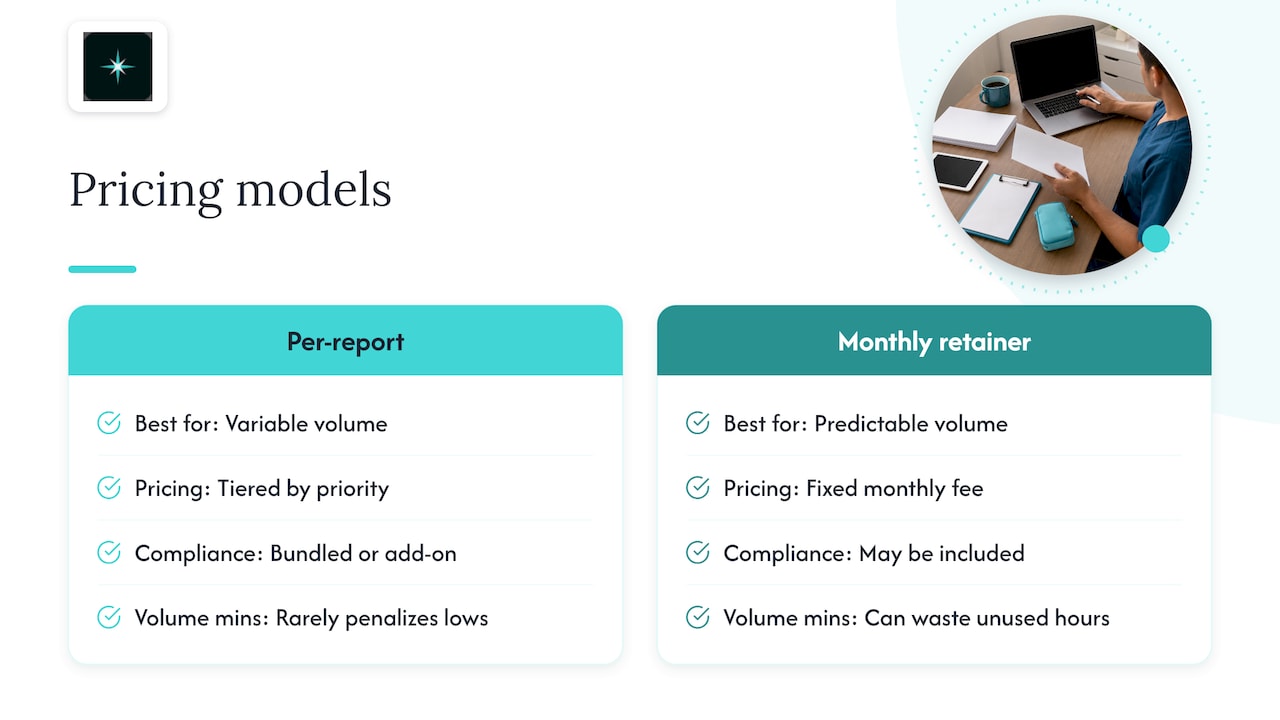
Per-report fee-for-service is the dominant model for portable X-ray teleradiology, and it tends to suit facilities with variable volume better than a flat monthly retainer. You pay for each completed, signed report rather than for a block of radiologist hours that may sit unused on a slow night.
Pricing typically varies by priority tier, since a STAT read staffed around the clock costs more to deliver than a routine read with a 24 to 48 hour window. Some vendors bundle peer review and compliance reporting into the per-report rate, while others price those as add-ons, so it's worth asking explicitly what's included before comparing two quotes side by side.
Volume minimums are a detail that changes the real cost of a contract. A facility with unpredictable overnight volume should avoid a structure that penalizes low-volume months, and should ask directly whether a provider requires minimums or charges a platform fee on top of per-report pricing.
The billing side connects back to Medicare's place-of-service rules: since the professional component follows the technical component's location, your own billing team needs clarity on how the teleradiology vendor's reports get coded in your system. A partner familiar with revenue cycle details, such as One For All Medical Billing's overview of EMR integration and billing workflows, can help clarify how remote reads flow into claims submission once the clinical side is settled.
Typical implementation timeline for integrating mobile x-ray teleradiology solutions
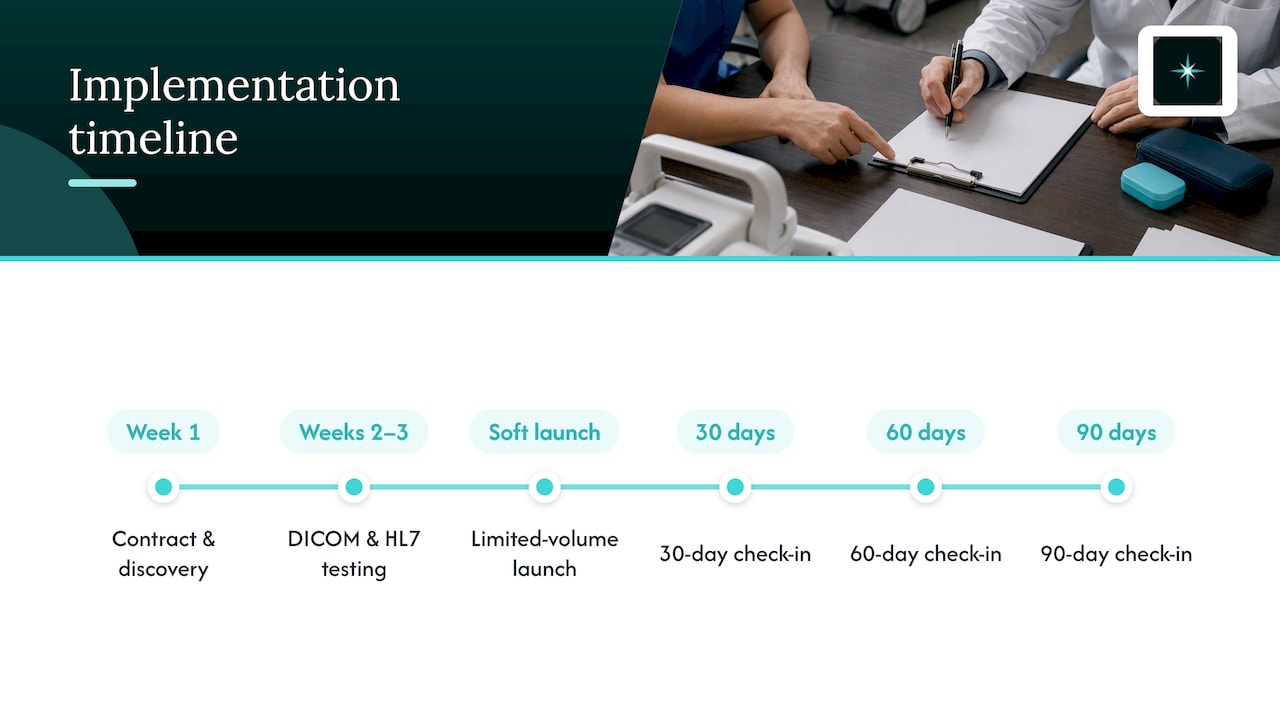
Most facilities move from signed contract to first live study within two to four weeks, though the pace depends heavily on how quickly technical teams can complete integration testing. The first week typically covers contract finalization, scope confirmation, and initial technical discovery, identifying PACS version, network configuration, and connectivity requirements.
Weeks two and three are where DICOM and HL7 connectivity get built and tested, prior-study retrieval gets verified, and diagnostic-workstation display gets confirmed on the vendor's end. This is also when downtime contingency plans should be documented and shared, not left until an actual outage forces the question.
A soft launch with a limited study volume, often a single shift or a specific modality, lets both sides catch routing or acknowledgement issues before full volume goes live. From there, most facilities plan structured check-ins at 30, 60, and 90 days to review turnaround performance, discrepancy rates from peer review, and any workflow friction that surfaced once real volume started flowing. Facilities with straightforward PACS environments sometimes compress this to under two weeks; those with legacy systems or multiple sites should plan for the longer end of the range.
Common contractual terms and negotiation tips for service agreements
Turnaround guarantees should be written as specific numbers tied to priority tier, not described as "fast" or "responsive." If a vendor won't commit STAT and routine targets to the contract itself, treat that as a negotiating point, not a minor omission.
Termination clauses deserve attention before signing, not after a relationship sours. Ask for a reasonable notice period and clarity on data return procedures if the contract ends, including how quickly historical reports and images get transferred back.
Volume commitments and minimums are negotiable more often than vendors initially suggest. If your facility has seasonal or unpredictable demand, push for a structure that scales with actual volume rather than penalizing slow periods.
Liability and indemnification language should be reviewed alongside malpractice coverage verification, not treated as boilerplate. Ask specifically who carries liability for a missed or delayed critical finding, and confirm the answer matches what the malpractice certificate actually covers.
Finally, negotiate audit rights explicitly into the agreement rather than assuming they exist. A vendor confident in its QA program should have no objection to a clause granting periodic access to peer-review summaries and discrepancy-rate data.
Key red flags and compliance risks when choosing a teleradiology vendor
A vendor reluctant to put turnaround numbers in writing is the clearest warning sign. Verbal assurances about speed mean nothing once a contract is signed and a holiday weekend backlog starts piling up.
Portal-only delivery with no direct PACS integration is a second flag worth weighing seriously. It adds a manual step for every study and increases the odds that a signed report sits unread in a separate inbox while a patient waits.
Watch for vagueness around the BAA. A vendor that can't clearly name its subcontractors or commit to a breach notification timeline is asking your facility to accept risk it hasn't fully disclosed. The HHS guidance on mobile and cloud access to ePHI makes clear that safeguards and BAAs covering every third party are not optional.
A QA program that exists on paper but produces no actual peer-review data on request is another signal to slow down. Ask to see a sample discrepancy report before committing volume, and treat hesitation as an answer in itself.
Finally, be cautious of licensure gaps. A radiologist reading your studies needs active licensure in the state where your facility operates, and a vendor that can't produce that documentation quickly is not ready for your volume.
Treating teleradiology as strategic capacity
Most administrators still treat outsourced reads as an emergency patch for a radiologist shortage. That framing undersells what a well-contracted teleradiology relationship actually does: it's standing capacity, governed by the same QA rigor and SLA accountability as an in-house service. A board-certified subspecialist model and contractual SLA terms work because they're built for sustained volume, not a one-time overflow fix. The tactical move for leaders planning to scale is simple: negotiate the SLA and peer-review terms now, before volume forces a rushed decision later.
AstraRad: how we meet the buyer job for portable X-ray final reads
We built our service around the specific job administrators need done: a signed, subspecialist-read report for a portable X-ray study, delivered on a committed timeline, without a new portal to manage. Board-certified subspecialists read every study, STAT cases are committed under 4 hours (under 2 hours or 1 hour on request), stroke protocol reads under 30 minutes and routine studies in 24 to 48 hours, and reports arrive through direct PACS integration rather than a separate login.
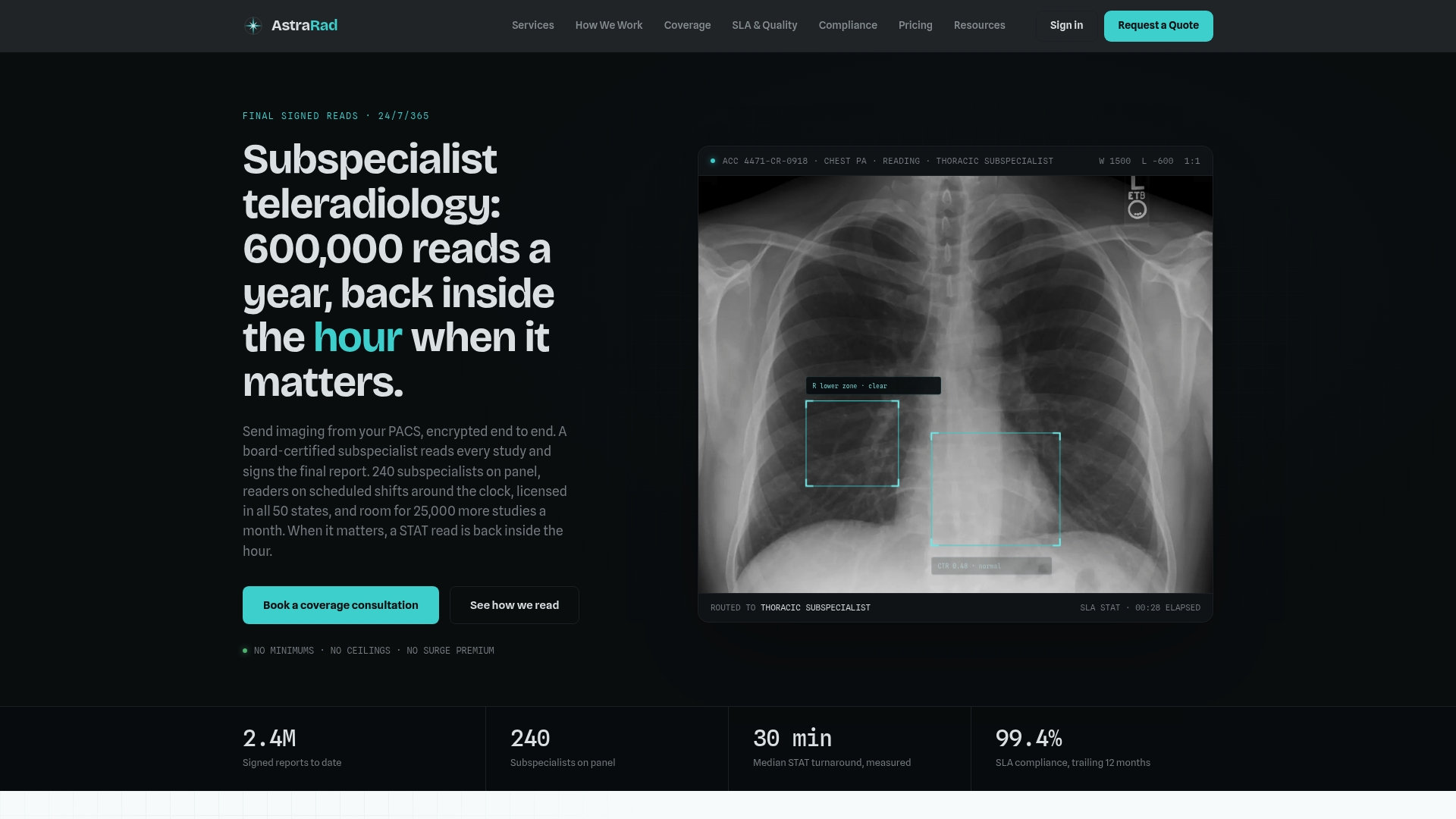
The same model extends to MQSA-qualified telemammography for facilities that need subspecialist coverage across more than one modality. It fits naturally into overnight and weekend coverage gaps, hospital overflow during volume spikes, and urgent care settings where a fast, signed read keeps patients moving.
- Board-certified subspecialists matched to modality and body part.
- STAT reads under 4 hours, stroke protocol under 30 minutes, routine 24 to 48 hours.
- Direct PACS integration with no separate portal required.
If your facility is evaluating overflow support for X-ray and ultrasound studies, that's the right place to start the conversation.
FAQ
What turnaround time should we expect for portable X-ray reads?
When working with AstraRad, expect STAT studies read in under 4 hours (under 2 hours or 1 hour on request) and routine studies in 24 to 48 hours. Turnaround should be written into the contract by priority tier, segmented by acquisition, transmission, and interpretation steps per AHRA's guidance on TAT metrics.
Who signs the final report on an outsourced portable X-ray study?
A board-certified subspecialist employed or contracted by the teleradiology vendor signs the final report, matched to the study's modality and body part. Credentialing and active state licensure should be verified before any reads begin.
Is a business associate agreement required for teleradiology services?
Yes. HHS guidance on mobile and cloud access to ePHI requires a BAA covering the vendor and any subcontractors touching patient data, along with documented safeguards.
Does teleradiology integrate with our existing PACS?
A well-built teleradiology relationship integrates directly with your PACS through DICOM and HL7, returning signed reports without a separate portal login. Confirm this during technical onboarding before committing volume.
How does Medicare billing work for remotely interpreted X-rays?
The Medicare Claims Processing Manual ties the professional component's place of service to where the technical component, the image acquisition, occurred, not where the reading radiologist is located.
Sources
- ACR,AAPM,SIIM technical standard and practice parameters (ACR guidance)
- ACR / Joint Commission guidance on communication of diagnostic imaging findings
- HHS OCR guidance on cloud computing and mobile device access to ePHI
- Medicare Claims Processing Manual (relevant POS and radiology billing sections)
- Evaluating turnaround time for medical imaging studies (AHRA, 2025)
Recommended
Related on AstraRad
- Resources
AI radiology companies in 2026: the vendor landscape
AI radiology companies mapped by category: triage, detection, and reporting vendors, what FDA clearance actually covers, and how AI fits human reads.
- Resources
4 teleradiology malpractice checks radiologists must verify
U.S. radiologists: verify teleradiology malpractice coverage with this checklist, including state listings, claims-made vs occurrence, retroactive/tail
- Resources
10 vendor checks for neuroradiology teleradiology SLA
A procurement ready checklist for hospital leaders choosing neuroradiology teleradiology. Vendor questions, licensure, PACS integration, QA, and STAT
Put a radiologist's name on your next read.
Tell us your modalities and monthly volume. A complete per-report rate card, with turnaround tiers and SLA terms in writing, lands in your inbox within one business day.