10 vendor checks for neuroradiology teleradiology SLA
A procurement ready checklist for hospital leaders choosing neuroradiology teleradiology. Vendor questions, licensure, PACS integration, QA, and STAT
Neuroradiology teleradiology is the right call whenever a time-sensitive case, a telestroke workup, a trauma scan, a pediatric emergency, needs a subspecialist read faster than your on-site schedule allows. Our service is built around that exact need: board-certified subspecialists read every study, with stroke protocol reads committed under 30 minutes, STAT under 4 hours (under 2 hours or 1 hour on request), and routine studies in 24 to 48 hours. Done well, it means shorter emergency department decision times, dependable signed reports, and documented quality assurance you can show auditors.
TL;DR:
- Teleradiology services must include licensed subspecialists in all operating states to meet professional standards and ensure compliance during audits.
- Stroke-protocol turnaround under 45 minutes significantly improves emergency decision-making, while routine studies need a predictable signed-report window.
- Direct PACS-to-PACS integration is preferable to portal-based workflows, reducing delays and streamlining urgent case handling.
- Vendors should provide clear SLA data, active QA programs, and signed sample reports, while avoiding portal-only systems and licensing gaps.
- Combining speed with subspecialty expertise reduces interpretative disagreements and enhances diagnostic accuracy, leading to better patient outcomes.
Table of Contents
- What neuroradiology teleradiology covers and typical use cases
- Why subspecialist reads matter more than fast reads alone
- Licensing, credentialing, compliance, and data security checklist
- Integration and operational workflow: PACS, viewers, and clinician handoff
- How do you choose a neuroradiology teleradiology partner?
- Challenges and limitations you should plan around
- Reimbursement and billing considerations specific to this service
- Workflow strategies for onsite and remote neuroradiologist collaboration
- How to get started with AstraRad
- FAQ
- Sources
What neuroradiology teleradiology covers and typical use cases
Neuroradiology teleradiology spans the modalities where brain, spine, and vascular interpretation calls for subspecialty training rather than a general radiologist's read: CT head and CTA, MRI brain and spine, MR angiography, and PET-CT in select oncology or seizure workups. Each modality carries its own protocol and turnaround expectation, which matters when you are deciding what to route remotely versus what stays on-site.
The clinical scenarios where remote subspecialist reads add the most value include:
- Telestroke decision-making, where a CT or CTA read determines whether a patient qualifies for thrombolysis within a narrow window.
- ED trauma reads after hours, when the on-call generalist needs a second, faster opinion on a head or spine injury.
- Pediatric emergencies, where pediatric neuroradiology expertise is scarce at most community hospitals.
- After-hours or subspecialty staffing gaps, when no fellowship-trained neuroradiologist is on-site overnight or on weekends.
- Backlog clearance, routing outpatient brain and spine MRIs that have piled up during staff shortages or equipment downtime.
STAT workflows and routine workflows are not the same operational problem. A STAT telestroke CT needs an alerting path that reaches a reading radiologist in minutes and a communication channel back to the ordering physician the moment the read is done. A routine outpatient MRI backlog needs predictable daily volume handling and a signed report inside a predictable window, commonly 24 to 48 hours, not minute-by-minute escalation. Building both paths into your workflow, rather than treating every case as urgent, is what keeps staffing and alerting sustainable.
Why subspecialist reads matter more than fast reads alone
Speed without subspecialty training is a partial answer. The clinical literature on telestroke networks backs this up directly: a study of agreement between spoke radiologist, hub vascular neurologist, and hub neuroradiologist found that interpretation agreement improves when the reading physician has both specialty training and clinical context, and that FDA-approved teleradiology systems support Class I recommendations for CT review in suspected acute stroke. In practice, that means a fellowship-trained neuroradiologist reading with the referring clinician's history in hand produces fewer actionable disagreements than a generalist working from the image alone.
A multi-state retrospective study of emergency pediatric and adolescent neuroimaging found average CT turnaround of 37.5 minutes and average MR turnaround of 61.2 minutes across nearly 10,000 scans, with a diagnostic yield of 13.4% positive findings. That benchmark gives administrators a real yardstick: if your current remote reading service runs well past 60 minutes on STAT CT, you are likely losing time that matters clinically, not just operationally.
Turnaround medians translate directly into bedside decisions. A median CT turnaround in the 37 to 45 minute range, measured in high-performing telestroke networks, keeps most cases inside the window where thrombolysis is still an option and shortens the stretch of ED length of stay spent waiting on imaging. For stroke codes, a dedicated stroke-protocol target well under 60 minutes is table stakes; services that consistently land under 45 minutes give emergency physicians room to make the call before the clinical picture changes. When you evaluate a vendor's published turnaround numbers, ask whether they reflect STAT cases specifically or a blended average across all priority levels, since the two numbers can differ by a wide margin and only one of them tells you what happens during a stroke code.
Licensing, credentialing, compliance, and data security checklist
Every remote radiologist who signs a final report must hold an active license in the state where the patient received the scan, not just where the radiologist is based. Multistate coverage means your vendor needs licensed subspecialists in every state you operate across, and verifying that roster before signing is worth the delay. The ACR practice parameter for remote imaging is explicit that remote interpretation must meet the same professional standard as on-site reads, including licensure, quality assurance, and secure data handling, and it treats equipment performance monitoring and peer review as shared responsibilities between the on-site and remote teams.
Before contracting, require vendors to show you:
- Active state licenses for every subspecialist who will read your studies, not a sample roster.
- A documented peer-review and QA program, ideally benchmarked against RADPEER-style scoring.
- Equipment performance monitoring records consistent with ACR technical standards.
- A written incident response plan covering PACS outages or failed transmissions.
- Evidence of encrypted DICOM transport under a signed business associate agreement, encryption at rest, and audit trails on every study accessed.
Pro Tip: Ask for a signed business associate agreement and a recent third-party security assessment before you ask for pricing. If a vendor cannot produce either on request, treat that as a disqualifying answer, not a delay.
Credentialing timelines vary by state, but most vendors should be able to show you documentation, license verification, malpractice coverage, and privileging paperwork, within a few weeks of contract signature. If a vendor cannot produce that paperwork promptly, licensing gaps will surface later, usually during an audit rather than during onboarding. For a closer look at how multistate coverage actually works in practice, our state licensing overview walks through the jurisdictional mechanics.
Integration and operational workflow: PACS, viewers, and clinician handoff
Direct PACS-to-PACS integration beats portal-based workflows for one practical reason: your technologists and ordering physicians never have to leave the system they already use. A portal model forces a second login, a separate viewer, and a manual step that slows down exactly the cases where seconds count. Vendor comparisons of integration models confirm that direct DICOM transfer between systems reduces the workflow friction that portal-only solutions introduce.
A dependable urgent-case flow typically runs through five steps:
- The sending site transmits the study directly from its PACS using standard DICOM transport.
- The receiving service's system generates an automatic notification to the on-call subspecialist.
- The subspecialist completes the STAT read inside the contracted window.
- Critical findings trigger an immediate verbal or secure messaging escalation to the ordering physician, ahead of the written report.
- A signed report posts back into the originating PACS, with an addendum process available if findings change.
Interoperability standards matter here beyond DICOM. HL7 messaging keeps patient demographics and order data synchronized between systems, and FHIR-based integration is increasingly useful where a health system wants structured data exchange rather than a flat file transfer. Reports should include structured fields and an explicit critical-results flag, not just a narrative paragraph, so downstream systems can route alerts automatically.
Ongoing monitoring closes the loop: SLA dashboards that track turnaround by priority level, regular peer-review sampling, and scheduled QA meetings between your on-site team and the remote service keep both sides accountable to the same numbers.
How do you choose a neuroradiology teleradiology partner?
Selecting a partner is a procurement decision as much as a clinical one. Score candidates against a short list of criteria: subspecialty coverage across the modalities you need, confirmed state licensure in every jurisdiction you operate in, STAT and stroke turnaround commitments written into the contract with SLA reporting behind them, direct PACS integration rather than portal-only access, an active peer-review and QI program, adequate malpractice and indemnity coverage, a transparent pricing model, and references from comparable facilities.
Bring these questions into the RFP or vendor interview:
- Which states are your subspecialists currently licensed in, and can you provide the roster?
- What STAT and stroke turnaround do you commit to by modality, and how is it reported, not blended across all priority levels?
- What is your escalation policy for a critical finding outside business hours?
- How long does PACS integration typically take from contract signature to live reads?
- Can you share de-identified sample signed reports for CT and MRI brain studies?
- What third-party security audits have you completed in the past 12 months?
- How do you handle peer review, and what percentage of studies get a second look?
- What happens if a study needs an addendum after the report is signed?
- Do you require minimum study volumes or charge platform fees beyond per-report pricing?
- Who covers malpractice liability on a remote read, and what are the policy limits?
Watch for red flags during the process: no US-based subspecialists on staff, SLA language that avoids specific numbers, a portal-only workflow with no PACS integration option, an inability to produce QA or peer-review data, and no willingness to share sample signed reports. Any one of those should slow down a contract decision. Our per-report pricing page breaks down what a transparent pricing model looks like by study type, which is a useful benchmark when comparing proposals.
Challenges and limitations you should plan around
Neuroradiology teleradiology is not without operational friction. Image quality depends on the sending site's acquisition protocols: mismatched CT reconstruction kernels or inconsistent MRI pulse sequences between the sending facility and the reading service can degrade interpretability, and the ACR-ASNR-SPR practice parameter for brain MRI spells out the sequence and documentation standards meant to prevent exactly that mismatch.
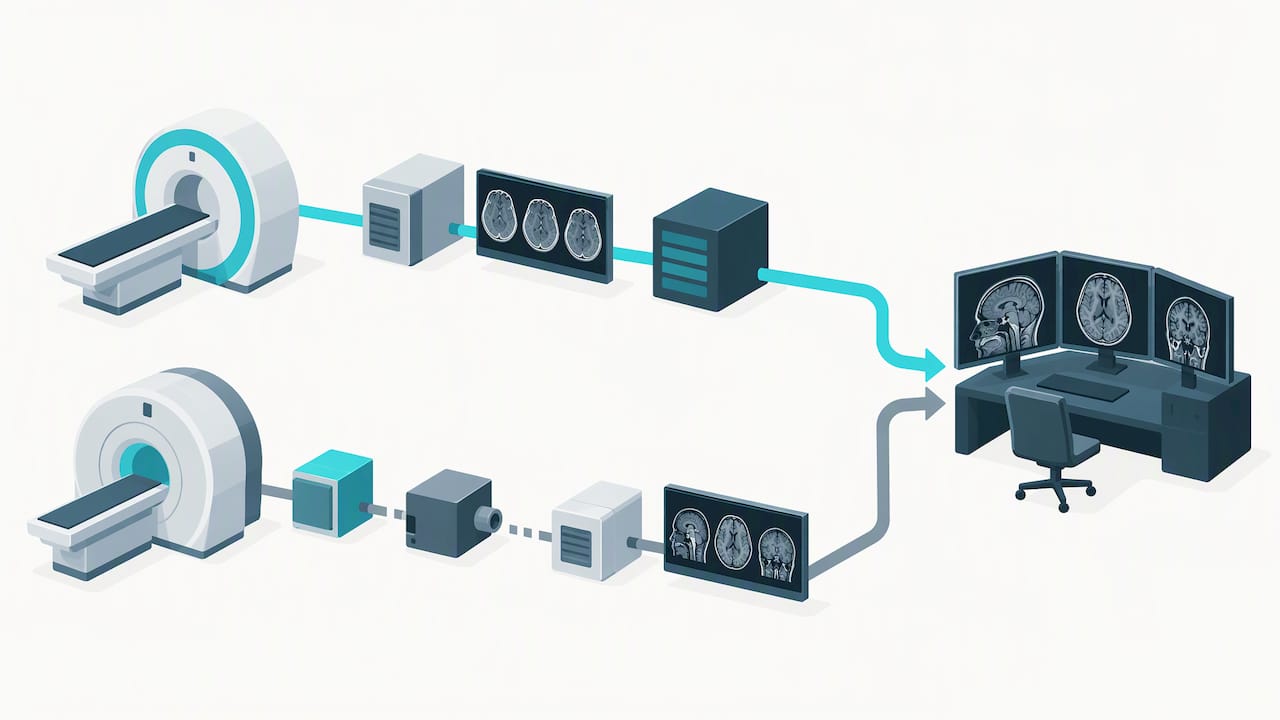
Network reliability is the second recurring issue. A STAT read is only as fast as the transmission behind it, and an unstable connection or a PACS outage at either end can erase the turnaround advantage a vendor otherwise delivers. Facilities should ask vendors how they handle transmission failures and whether a backup pathway exists for sending studies when the primary connection drops.
Diagnostic pitfalls tend to show up at the margins: a remote radiologist working without full clinical context may flag an equivocal finding differently than one who has the referring physician's note in hand. That is part of why clinical context and structured communication channels matter as much as raw turnaround speed, and why peer review sampling should specifically check for context-related discrepancies, not just technical accuracy.
Reimbursement and billing considerations specific to this service
Billing for a neuroradiology teleradiology read follows the same CPT coding structure as an on-site interpretation. The complexity sits in who is billing and where. The interpreting radiologist's reassignment of benefits, state licensure, and the physical location of the patient at the time of the scan all affect how a claim is submitted and which payer rules apply. A radiologist licensed and credentialed correctly in the patient's state is a prerequisite for a clean claim, not a formality, since payers can deny reimbursement for a report signed by a radiologist without active privileges in that jurisdiction.
Facilities contracting a remote service typically pay per-report fees directly to the vendor rather than routing payment through the payer claim at all, which simplifies the administrative side considerably compared to employing additional on-site staff. That said, the professional component of the claim submitted to the payer still needs to reflect the correct performing provider and location information. Getting the credentialing and billing details aligned before the first study is read avoids denials that are expensive to unwind later. For practices managing the broader revenue cycle around these reads, including coding accuracy and denial management, a specialized partner like ClaroClaim handles the compliance and security side of claim submission that sits alongside the clinical read itself.
Workflow strategies for onsite and remote neuroradiologist collaboration
The facilities that get the most out of neuroradiology teleradiology treat it as an extension of their existing team, not a separate pipeline. That starts with a shared protocol library: the sending site and the reading service should agree in advance on acquisition parameters, contrast protocols, and reporting templates so neither side is interpreting unfamiliar data under time pressure.
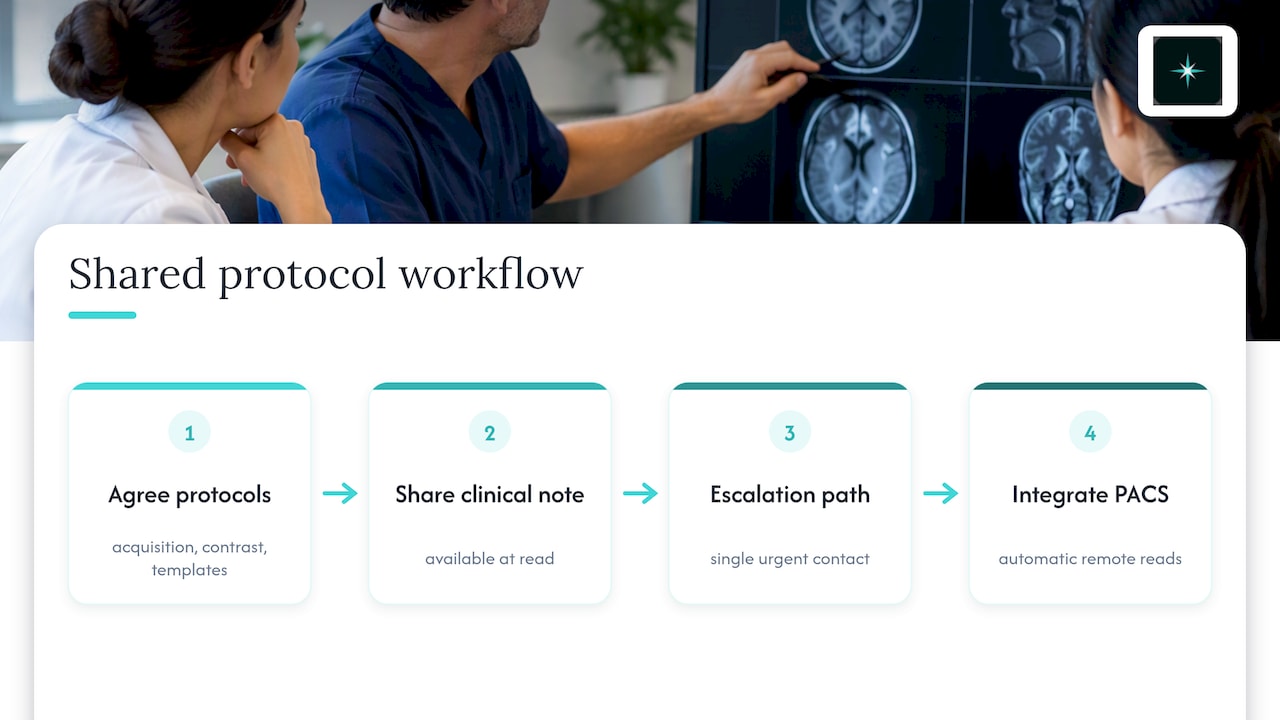
Regular case conferences between on-site radiologists and remote subspecialists, even brief monthly reviews of flagged or discordant cases, build the kind of shared clinical judgment that reduces disagreement over time. Structured escalation paths matter just as much: on-site staff need a clear, single point of contact for urgent findings rather than a general inbox, and remote radiologists need the referring physician's clinical note available at the moment of the read, not after.
Technology choices reinforce or undercut this collaboration. Direct PACS integration keeps on-site staff inside their familiar system while remote reads flow in automatically, which keeps the handoff invisible to the ordering physician instead of adding a second system to check.
How to get started with AstraRad
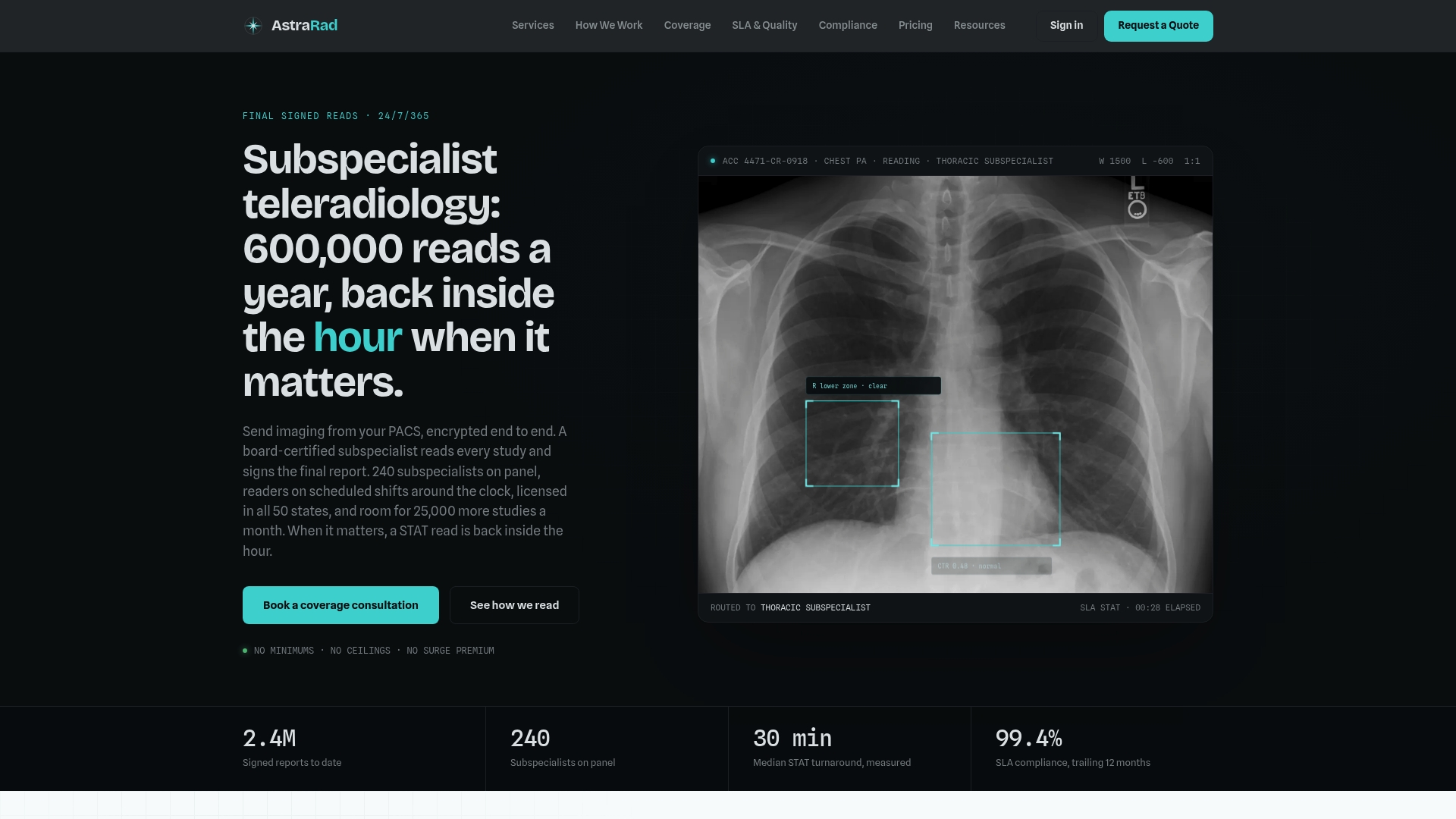
We read every study with a board-certified subspecialist matched to the modality, commit to stroke protocol reads under 30 minutes, STAT under 4 hours (under 2 hours or 1 hour on request) and routine reads in 24 to 48 hours, and integrate directly with your existing PACS so nobody on your team learns a new portal. That combination is built for the exact cases where a slow or generalist read costs the most.
Two steps get you moving:
- Request per-report pricing by study type to see what a transparent cost model looks like for your volume.
- Schedule a readiness call to review how our workflow connects to your PACS before you commit to anything.
This article is general information, not a substitute for advice from a qualified doctor. Consult a qualified healthcare professional about your own circumstances before acting on anything here.
FAQ
What is the highest paid type of radiologist?
Subspecialty areas with the most demanding training and call schedules, including interventional radiology and neuroradiology, tend to command higher compensation than general diagnostic radiology. Exact figures vary widely by region, practice setting, and call burden, so a specific number is not meaningful without that context.
What is the average salary for a neuroradiologist in the US?
Neuroradiologist compensation varies substantially by geography, practice type, and call responsibilities, and no single figure applies across the field. Administrators comparing compensation data should rely on current regional salary surveys rather than a flat national average.
What are the top teleradiology companies?
The teleradiology market includes a range of providers differentiated mainly by subspecialty coverage, turnaround commitments, and integration approach rather than a single ranking. We focus on board-certified subspecialists reading every study, stroke, STAT and routine turnaround committed in the contract, direct PACS integration, and 1 in 20 studies double-read for peer review, which is the comparison that matters most for clinical decisions.
How many years does it take to become a neuroradiologist?
Becoming a neuroradiologist requires completing medical school, a diagnostic radiology residency, and then a dedicated neuroradiology fellowship on top of that training. Altogether this path typically spans well over a decade of combined medical education and specialty training before board certification in neuroradiology.
Sources
Below are the standards and studies referenced throughout this guide.
- ACR practice parameter for the supervision and performance of CT and MR imaging at remote locations, remote imaging
- Computed tomography interpretation in a telestroke network: agreement between spoke radiologist, hub vascular neurologist, and hub neuroradiologist
- Performance of a multistate teleradiology service in emergency pediatric and adolescent neuroimaging: a two-year retrospective study
Recommended
Related on AstraRad
- Resources
4 teleradiology malpractice checks radiologists must verify
U.S. radiologists: verify teleradiology malpractice coverage with this checklist, including state listings, claims-made vs occurrence, retroactive/tail
- Resources
Switch teleradiology providers: the 90-day checklist
A 90-day playbook to switch teleradiology providers: baseline metrics, credentialing transfer, a parallel run, go/no-go gates, and a rollback plan.
- Resources
Inside a teleradiology company: how the machine works
How a teleradiology company actually operates behind the reading room: worklist engines, night staffing, licensing operations, credentialing, and QA.
Put a radiologist's name on your next read.
Tell us your modalities and monthly volume. A complete per-report rate card, with turnaround tiers and SLA terms in writing, lands in your inbox within one business day.