One AJR study cut waits by 12 minutes
An AJR study found triage cut radiology wait time by 12 minutes. Set priorities with physicians, oversee AI, audit worklists, and plan overflow clearance.
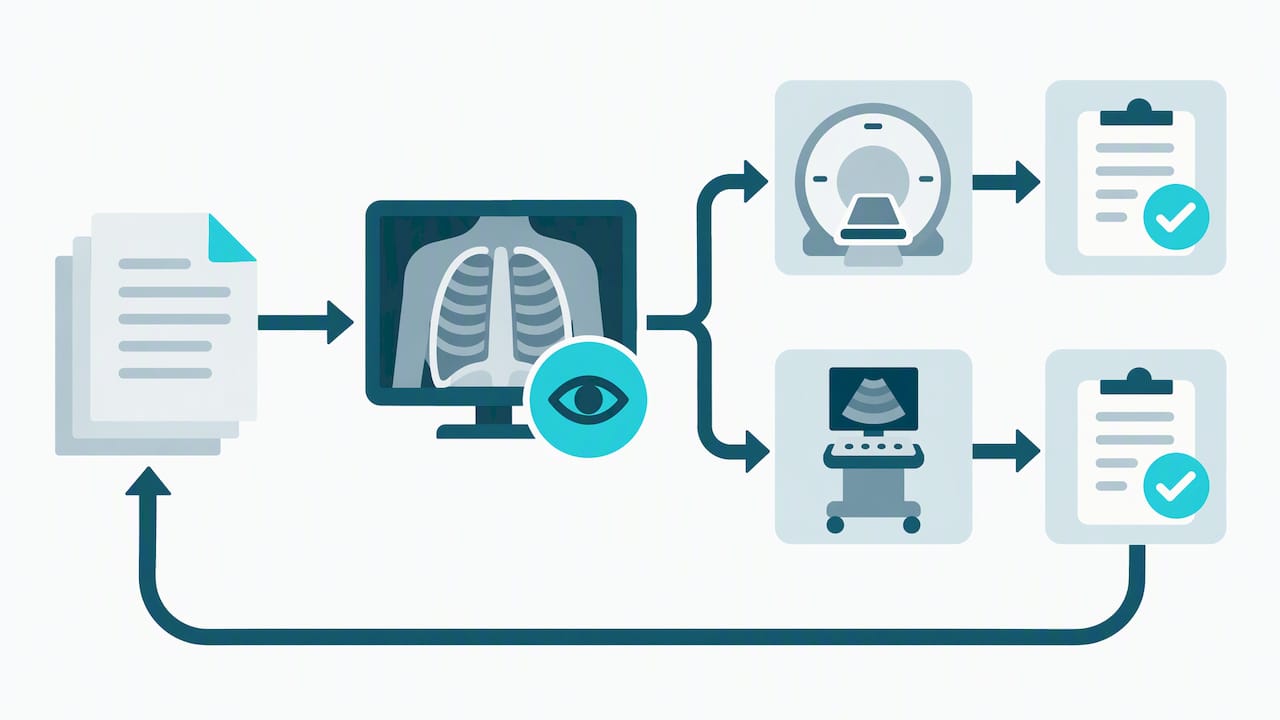
The fastest safe way to clear a radiology backlog combines a physician-led prioritization policy, a single unified and auditable worklist, human-in-the-loop AI applied to high-prevalence targets, and surge capacity through insourcing packets or teleradiology overflow. Surge capacity can be provided directly by teleradiology teams offering final signed reports with turnaround committed by contract, including STAT reads and routine overflow clearance, integrated directly into your existing PACS. For departments carrying aged studies with no safe way to expand reading capacity, overflow options can turn a policy decision into measurable throughput within days.
TL;DR:
- A single center study found that prioritizing pulmonary embolism positive CTPA exams cut mean turnaround from 59.9 to 47.6 minutes and wait time from 33.4 to 21.4 minutes.
- Build rankings around clinician priority, patient location, queue age, acuity, and appointment timing, with maximum wait rules, human overrides, and audit logs.
- AI reprioritized 12.7% of examinations; false negatives can bury urgent cases, so test on 90 days of past data and retain physician review.
- Use insourcing for brief spikes when staff capacity exists; choose teleradiology for sustained demand, subspecialty gaps, or coverage outside regular hours.
- Run a pilot at one site or modality for 6 to 12 weeks, setting baseline turnaround, wait time, and queue age before changing workflows.
Table of Contents
- Why backlogs matter: patient safety, clinical flow, and key metrics to track
- How backlogs develop: the common operational and IT failure modes
- What prioritization framework should you encode into policy?
- Triage and backlog-clearance checklist you can act on this week
- Can AI safely reorder a radiology worklist?
- Operational examples and when to outsource vs insource
- A short pilot and scale playbook: scope, success metrics, governance
- Three priority actions to start this month
- How AstraRad can help with pilot evaluation and overflow services
- FAQ
- Sources
Why backlogs matter: patient safety, clinical flow, and key metrics to track
A backlog is not just a queue problem. When reprioritization logic moved pulmonary embolism-positive CTPA exams to the front of the worklist, mean report turnaround fell from 59.9 to 47.6 minutes and wait time dropped from 33.4 to 21.4 minutes in a single-center AJR study. Read time itself did not change, which tells us the gain came entirely from queue wait, not faster interpretation.
Tracking the right metrics matters as much as the policy itself:
- Report turnaround time (TAT), measured from study completion to signed report.
- Wait time, the interval a study sits unread before a radiologist opens it.
- Queue age distribution, so a handful of outliers do not hide behind a favorable average.
- Percentage of studies tied to upcoming appointments, since these convert into urgent escalations fastest.
TAT alone can mask harm when a handful of critical findings sit buried under routine volume, so outcome-linked metrics belong in the same dashboard.
How backlogs develop: the common operational and IT failure modes
Most backlogs trace back to a handful of recurring causes rather than one single failure.
- Demand outpacing capacity, often seasonal or tied to referral growth without matching staffing.
- Segmented or hidden worklists across sites or modalities that hide true queue depth from anyone trying to manage it.
- EHR, RIS, and PACS integration gaps that leave studies orphaned between systems.
- Incomplete orders and duplicate studies that inflate apparent volume without adding clinical value.
- Scheduling and appointment-linkage gaps, where a modestly aged study suddenly becomes urgent because a clinic visit is tomorrow.
- Staffing variability and task switching, which erodes reading throughput even when headcount looks adequate on paper.
What prioritization framework should you encode into policy?
ACR guidance lists the inputs a sound triage policy should weigh together, not in isolation:
- Order priority as set by the referring clinician.
- Patient location (inpatient, emergency department, outpatient).
- Study completion time and how long it has aged in queue.
- Modality and protocol, since risk profiles differ by exam type.
- Detected acuity, whether flagged by AI or a technologist.
- Appointment linkage, particularly for outpatient studies tied to a near-term visit.
- Vitals, lab values, and clinical history where available.
Safety backstops matter as much as the ranking logic itself: maximum-wait thresholds that force a study into view regardless of its score, aging rules that prevent silent drift, a human override at every step, and audit logging that captures who changed what and when.
Pro Tip: Require every prioritization rule change to pass through a radiologist on the triage committee before it goes live, not after.
Governance should stay physician-led, with modality-specific review and iterative local validation rather than a single fixed algorithm applied everywhere. The ACR's own use case documentation makes that point directly: rules built for one site's case mix can misfire at another.
Triage and backlog-clearance checklist you can act on this week
A workable backlog plan starts with visibility, then adds capacity.
- Unify every worklist into one view, no hidden or segmented queues anywhere.
- Flag appointment-linked studies automatically rather than relying on manual escalation.
- Name a backlog coordinator with authority to reassign volume daily.
- Set aging SLAs by modality and publish them to referring departments.
- Review the dashboard at a fixed daily time, not on an ad hoc basis.
Staffing choices depend on how long the backlog has existed and how specialized the studies are:
- Packet-based insourcing works well for short-term spikes with existing in-house capacity.
- Targeted overtime suits a narrow, time-boxed surge where staff are willing and available.
- Per-report teleradiology overflow fits sustained volume, subspecialty gaps, or after-hours coverage that internal staffing cannot absorb.
Set a baseline before changing anything, then target measurable movement within 4 to 12 weeks. Daily aging dashboards paired with a weekly executive review keep the effort from losing momentum once the initial push fades.
Can AI safely reorder a radiology worklist?
AI-assisted reprioritization has a real, measured effect, but it comes with limits worth planning around. In the AJR single-center study, AI reprioritized 12.7% of examinations, and a broader systematic review of deep learning-driven triage found consistent turnaround reductions across conditions, with the largest gains when algorithms actively reordered the worklist rather than simply flagging cases.
The same review noted that benefits vary by condition and prevalence, and reliability still needs more study. False negatives remain the core risk: a missed flag can quietly deprioritize a study that needed urgent attention. Maximum-wait backstops and a human-in-the-loop review address that risk directly, and expert consensus treats physician oversight as the deployment standard, not an optional add-on.
Before signing with any vendor, check for:
- Native PACS and RIS integration, no bolt-on portal required.
- Full audit logs tied to every reprioritization event.
- Real-time queue-aging visibility, not a static end-of-day report.
- Clear exception handling when the algorithm and a radiologist disagree.
- Measurable before-and-after TAT data from your own pilot, not a vendor's marketing deck.
Pro Tip: Run any new triage tool against your last 90 days of worklist data before trusting it with live cases.
Operational examples and when to outsource vs insource
Published quality improvement work gives a useful template. An RSNA quality improvement report described packet grouping of 12 to 17 exams combined with targeted insourcing, associated with faster backlog recovery and improved turnaround on cancer pathways. A two-year cohort study of 232,022 CT exams found that linking worklist priority to appointment timing cut mean daily urgent report requests by 60%, from 25 to 10, while CT volume rose 9% against an 8% rise in available radiologists.
Decision criteria for choosing insourcing versus outsourcing usually boil down to:
- Cost per study against the urgency of the backlog.
- Subspecialty coverage gaps, particularly for MRI and PET-CT.
- Integration complexity with existing PACS and RIS.
- Contractual SLA requirements for STAT versus routine turnaround.
This is where a teleradiology partner fits as a direct operational lever rather than a stopgap.
A short pilot and scale playbook: scope, success metrics, governance
A contained pilot beats a department-wide rollout on day one.
- Scope the pilot to one modality or one site, not the entire department at once.
- Run it for 6 to 12 weeks, long enough to see real queue behavior.
- Set baseline TAT, wait time, and queue age before changing anything.
- Define success criteria in advance, including a safety monitoring plan for missed or delayed flags.
- Assign a triage committee, an IT integration owner, and a named contact for referring departments.
- Scale only after sustained KPI improvement, clean safety audit results, and a clear operational handoff plan.
Three priority actions to start this month
Start by unifying your worklist, second by writing down your prioritization policy instead of leaving it to habit, third by lining up surge capacity before you need it. The single highest-impact move for most departments is appointment-linked flagging, since it converts a large share of manual urgent escalations into automatic ones.
Watch the trade-off that visibility work creates: unifying queues often exposes volume leaders would rather not see. Keep a radiologist accountable for every rule change and log it.
How AstraRad can help with pilot evaluation and overflow services
Once your prioritization policy and worklist are in place, the remaining gap is usually capacity, and that is where we help directly. We provide overflow final reads for X-ray and ultrasound, MRI studies read by subspecialists matched to the modality, and STAT turnaround committed by contract: under 4 hours as standard, under 2 hours or under 1 hour on request.
Reports may integrate directly into existing PACS, so additional portals may not be required for staff. If your backlog needs a tested capacity partner rather than another internal reshuffle, you can start a pilot evaluation with AstraRad and see how overflow clearance fits your worklist before committing to a larger contract.
FAQ
What is backlog triage in radiology?
Backlog triage is the process of ranking unread imaging studies by clinical urgency, patient location, and other factors so the most time-sensitive cases get read first. It relies on a documented, physician-led policy rather than informal judgment calls made case by case.
How much can AI reprioritization actually reduce turnaround time?
In a single-center AJR study, AI-based reprioritization substantially shortened mean report turnaround for PE-positive CTPA exams. A broader systematic review found similar reductions across other conditions, though the size of the effect depends on disease prevalence and how the algorithm is deployed.
What KPIs should we track for backlog recovery?
Core metrics include report turnaround time, wait time before a study is opened, the age distribution of the queue, and the share of studies tied to upcoming patient appointments. Tracking the distribution matters as much as the average, since a few aged outliers can hide behind a favorable mean.
When should we outsource overflow instead of adding internal staff?
Outsourcing tends to make sense when the backlog involves subspecialty gaps, sustained volume beyond what overtime can absorb, or a need for turnaround committed in a contract. AstraRad provides that capacity through subspecialist reads with written SLA terms, integrated directly into your existing PACS workflow.
Does unifying worklists create new risks?
Unifying worklists mainly creates a visibility challenge rather than a new clinical risk: departments often discover backlog volume they could not see before. Pairing a unified worklist with aging SLAs and a named backlog coordinator keeps that visibility actionable instead of overwhelming.
Sources
- Radiologist worklist reprioritization using artificial intelligence: impact on report turnaround times for CTPA examinations positive for acute pulmonary embolism (AJR)
- Appointment-linked automatic assignment reduces urgent report requests and turnaround time (two-year cohort study)
- Prioritization of exams on the worklist (ACR use case guidance)
- Systematic review on the impact of deep learning-driven worklist triage on radiology workflow and clinical outcomes
Recommended
Related on AstraRad
- Resources
2027 Medicare fee schedule: the radiology numbers explained
The CY2027 Medicare fee schedule cuts both conversion factors while ACR estimates radiology gains 2 percent. Both are true. Model your dollars per RVU.
- Resources
Clinician-radiologist communication: closing the loop
Clinician-radiologist communication fails when critical results reach a system but never reach the physician, and closed-loop standards close that gap.
- Resources
The hidden cost of the prelim-plus-overread model
The prelim-plus-overread model pays two radiologists and bills one report per overnight study. Cost the overread time, callbacks, and amendments first.
Put a radiologist's name on your next read.
Tell us your modalities and monthly volume. A complete per-report rate card, with turnaround tiers and SLA terms in writing, lands in your inbox within one business day.