Clinician-radiologist communication: closing the loop
Clinician-radiologist communication fails when critical results reach a system but never reach the physician, and closed-loop standards close that gap.
Clinician-radiologist communication is the exchange of imaging findings, clinical context and follow-up decisions between the radiologist who interprets a study and the clinician who ordered it. It works when a finding is sent, received, acknowledged and acted upon, not merely when a report is signed in the PACS. For hospitals, imaging centers and radiology groups, that standard has to be written into workflows and, when reads are outsourced, into the contract.
- Result communication accounted for 47.6% of the communication failures in a 380-case radiology quality assurance database, according to a 2016 analysis.
- In that same 2016 analysis, 37.9% of the communication errors had a documented impact on patient care.
- The Joint Commission's National Patient Safety Goal NPSG.02.03.01 addresses timely reporting of critical results of tests and diagnostic procedures.
- Closed-loop communication means every result is sent, received, acknowledged and acted upon, as described in Joint Commission Quick Safety Issue 52.
- AstraRad commits to turnaround by contract: STAT under 4 hours, routine 24 to 48 hours, stroke protocol under 30 minutes.
TL;DR
- A signed report is availability, not receipt. Build a process that confirms the ordering clinician actually got the finding.
- Standardize which findings need verbal or electronic notification, who makes the call, and how acknowledgment is documented.
- Use EHR-integrated, auditable notification rather than informal pages or emails.
- When you outsource reads, put communication rules, turnaround commitments and PACS delivery into the contract and SLA before the first study.
Table of Contents
- What is clinician-radiologist communication?
- Where does clinician-radiologist communication break down?
- Who is AstraRad, and why do we publish this guide?
- What do the Joint Commission and ACR expect for critical results?
- What is closed-loop communication in radiology?
- Which communication channel fits which finding?
- How does teleradiology change clinician-radiologist communication?
- Do subspecialty reads improve the conversation with clinicians?
- How do you write communication terms into a teleradiology contract?
- What does patient portal access mean for radiologist communication?
- Need a teleradiology partner with written communication terms?
- FAQ
- Sources
What is clinician-radiologist communication?
Clinician-radiologist communication is a two-way information exchange: the clinician supplies the clinical question, and the radiologist returns findings, an impression and, when needed, a direct conversation. It covers the order, the report, urgent calls, follow-up recommendations and consultations. The ACR practice parameter on communication of diagnostic imaging findings notes that a specific question on the request helps tailor the study and the report to the clinical scenario.
The exchange has two directions, and both matter for quality:
- Clinician to radiologist: the indication, relevant history, prior imaging, the specific question and the urgency of the order.
- Radiologist to clinician: the final signed report, an impression that answers the question, notification of critical or unexpected findings and recommendations for follow-up.
A final signed report is a report that a radiologist has interpreted, reviewed and electronically signed, making it the legal and clinical record of the read. Everything else in this article is about getting the content of that report, and its urgent parts, to a person who will act on it.
Where does clinician-radiologist communication break down?
Communication breaks down most often at the handoff after interpretation, when a finding is available but nobody confirms the right clinician has seen it. A 2016 quality assurance study of 380 cases found that 181 of the communication errors, or 47.6%, involved result communication, and 37.9% of the errors affected patient care.
The pattern behind those numbers is familiar to administrators:
- Assumed receipt. The radiologist signs the report and assumes the finding reached the care team. The research on assigning responsibility to close the loop frames failure to follow up on results as a serious breakdown point that can lead to missed or delayed diagnoses and patient harm.
- Passive channels for urgent findings. A result that sits in an inbox or worklist is not communicated. The ACR practice parameter describes situations that may warrant nonroutine communication, including findings that suggest a need for immediate or urgent intervention.
- Unclear ownership. The ordering clinician may be off shift, the patient may have moved units, or the referring office may have no on-call contact.
- Unstructured messages. Informal pages and emails vary in wording, carry no timestamp and cannot be audited later.
A review of communication errors in radiology also notes that communication failures are a common cause of patient harm and malpractice claims against radiologists. For a buyer, that makes communication a risk-management line item, not a courtesy.
Who is AstraRad, and why do we publish this guide?
AstraRad is a US teleradiology service that delivers final signed reports read by board-certified subspecialists. We sell teleradiology to hospitals, imaging centers and radiology groups, so we have a commercial interest in this topic: when reads leave your building, the communication workflow has to travel with them. We wrote this guide to help you evaluate that workflow, whether you choose us or not.
Our teleradiology services route each study to a subspecialist matched to the modality and body part, on scheduled US shifts 24/7/365, with every read performed inside the United States. Turnaround is committed by contract and measured from last-image arrival to radiologist signature. Pricing is per report with no minimums.
What do the Joint Commission and ACR expect for critical results?
The Joint Commission and the ACR expect facilities to have defined, written procedures for reporting critical test results. That includes deciding which findings need immediate verbal or electronic notification, who must be notified, and how receipt is documented. The Joint Commission's Quick Safety Issue 52 describes closed-loop communication as a requirement for reducing diagnostic error.
NPSG.02.03.01 is the Joint Commission goal that addresses reporting critical results of tests and diagnostic procedures on a timely basis. A neuroradiology study of critical-finding notification timing points out that the mandate does not specify which times must be recorded when documenting communication, so your policy has to define them.
A workable written procedure answers these questions:
| Policy element | Question it must answer | Example of a clear answer |
|---|---|---|
| Definition | Which findings count as critical or nonroutine? | A list by modality and finding, approved by medical staff |
| Recipient | Who must receive the notification? | Ordering clinician, or covering clinician if off shift |
| Channel | How is the message delivered? | Direct phone call or EHR-integrated alert |
| Time standard | How fast must it happen? | A defined window from recognition to notification |
| Acknowledgment | How is receipt confirmed? | Named recipient, date and time recorded |
| Escalation | What if there is no response? | Defined next contact and a supervisor path |
The RSNA critical test results management case study describes an effort to build a completely closed loop that begins with the priority of the exam order and ends with the critical result reaching the ordering clinician. Note where it starts: with order prioritization, not with the report.
What is closed-loop communication in radiology?
Closed-loop communication is a process in which a result is sent, received, acknowledged and acted upon, with each step confirmed. In radiology, it means the radiologist's responsibility does not end at signature for urgent findings: the finding must reach the responsible clinician, who confirms it, and the action is recorded. Open loops are where findings get lost.
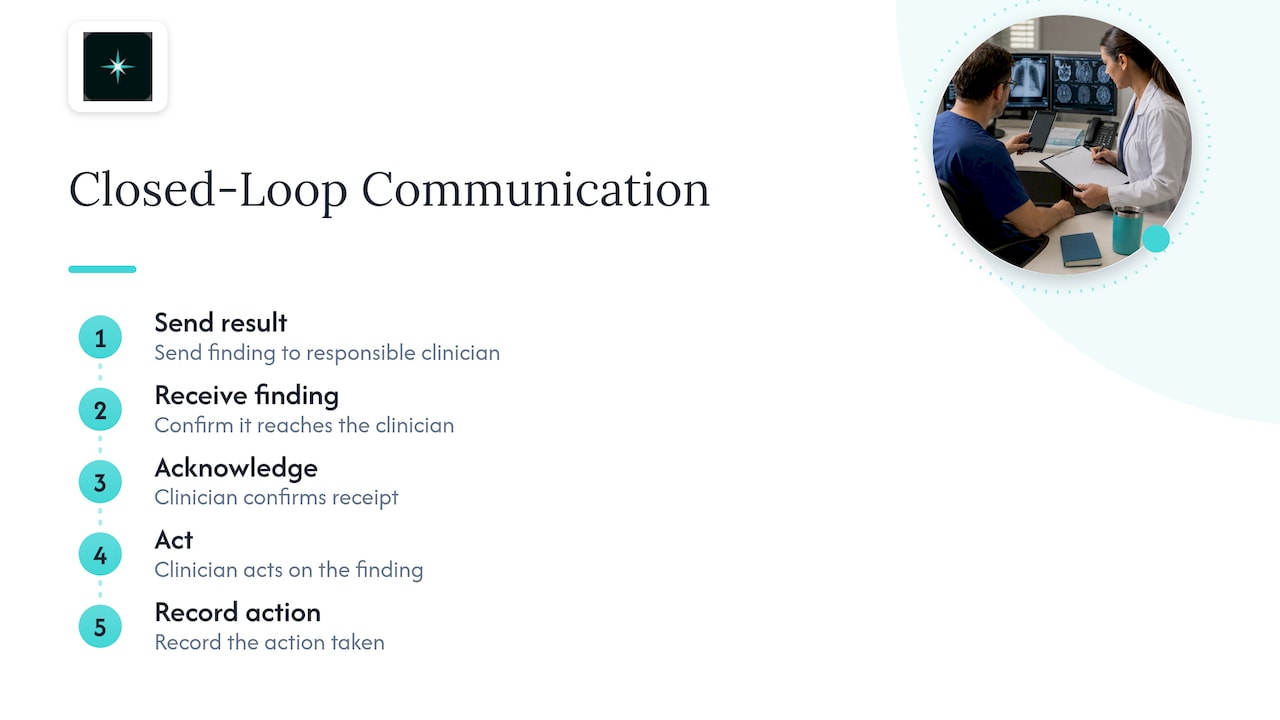
Research on closing the loop on radiology test results emphasizes that availability of a result in the system is not the same as receipt. That gap is sometimes called communication blindness: the sender assumes delivery because the report is finalized.
Five steps to close the loop
- Classify the finding. Use your written critical-result list to decide whether the finding is routine, nonroutine or critical.
- Route to the accountable clinician. Identify the ordering or covering clinician, not just the name on the order.
- Notify through a defined channel. Use a direct call or an EHR-integrated notification, matched to urgency.
- Capture acknowledgment. Record who received it, when, and how.
- Confirm action. For findings that need follow-up, track that the recommended step happened.
A 2025 report on a radiology reporting system for spine oncology is one example of structured reporting aimed at speeding communication between radiologists and treatment teams. Its setting is narrow, but the principle applies broadly: standard formats and tracked notifications reduce variability.
Which communication channel fits which finding?
The right channel depends on urgency, and the wrong match is a common pitfall. A direct conversation fits critical and unexpected findings, while the signed report in the EHR or PACS fits routine results. Informal emails and pages fit neither, because they cannot document who received what and when.
| Situation | Preferred channel | What to document |
|---|---|---|
| Routine finding, no action needed beyond the report | Final signed report delivered to the PACS or EHR | Report signature time |
| Nonroutine finding needing timely clinical attention | Direct verbal or electronic notification to the clinician | Recipient, time, method |
| Critical finding, such as an emergent condition | Direct verbal communication with read-back or confirmed electronic alert | Recipient, time, response |
| Incidental finding needing outpatient follow-up | Report impression plus a tracked follow-up recommendation | Recommendation and who owns it |
| Stroke protocol study | Immediate direct communication to the stroke team | Recipient, time, action |
The ACR practice parameter advises communicating by phone or in person as appropriate to confirm receipt of findings and documenting notification of critical results. A report that merely exists is not confirmation.
Why structured tools beat informal ones
Standardized, EHR-integrated notification tools produce an auditable record of acknowledgment. Informal pages and emails do not. Structured dictation macros also reduce variation in how findings are phrased, which helps the clinician who reads dozens of reports a day. The spine oncology work above links its structured approach to faster decision-making and reduced time to treatment.
An AHRQ-funded final report on automated notification of follow-up recommendations evaluated a system designed to communicate radiologists' follow-up recommendations to ambulatory primary care physicians. The takeaway for administrators: follow-up recommendations are a communication task too, and they need an owner.
How does teleradiology change clinician-radiologist communication?
Teleradiology changes the setting, not the standard. The remote radiologist no longer walks to the ED, so communication depends on defined contacts, a clear escalation path and a report that lands where your clinicians already work. If those three are specified in the contract, remote reads can meet the same closed-loop expectations as on-site ones.
Teleradiology is the practice of interpreting medical images at a distance and returning a report electronically to the facility that acquired them. For your buyers' checklist, the communication questions are concrete:
- Who does the radiologist call? Provide an on-call directory with the clinician to reach by service and shift.
- How are critical findings handled? Ask the provider to describe its procedure in writing and compare it with your own critical-results policy.
- Where does the report go? Reports delivered straight into your existing PACS avoid a separate portal that clinicians must remember to check. AstraRad delivers into the client's existing PACS with no extra portal, DICOM conformant. The How Teleradiology Works page walks through the path from your PACS to a signed report.
- Who owns follow-up? Define whether the radiology provider recommends and your team tracks, or whether another arrangement applies.
- What does overnight look like? A final signed report at every tier, including overnight, removes the gap where a preliminary read is later changed and the discrepancy must be communicated.
Turnaround is part of communication
A fast result that nobody receives is no better than a slow one. Still, turnaround sets the clock for everything after it. AstraRad's committed turnaround is measured from last-image arrival to radiologist signature: STAT under 4 hours (under 2 hours or under 1 hour on request), routine 24 to 48 hours, and stroke protocol under 30 minutes. Our STAT radiology reads page explains the STAT tier.
Electronic notification can also shorten the interval between a result and a clinical decision. A published emergency department study evaluated notification-supported workflows against manual monitoring of results.
Do subspecialty reads improve the conversation with clinicians?
They often make it easier, because a radiologist trained in the relevant body part can answer a specific clinical question precisely. AstraRad is a US teleradiology service that delivers final signed reports read by board-certified subspecialists. Each study goes to a subspecialist matched to the modality and body part, across ten subspecialties and twelve study types.
For a clinician, that matters in a few practical ways:
- The impression is more likely to address the clinical question on the order, such as a specific MRI protocol question. See our MRI teleradiology service for how that match works.
- Follow-up recommendations come from someone who reads that body part daily.
- Peer review adds a quality check. One in 20 AstraRad reports is independently double-read, blind, for peer review.
- Credentialing is simpler to document when radiologists are licensed in all 50 states.
These are structural features, not a promise about any individual result. Your own quality program should still monitor discrepancies and communication events.
How do you write communication terms into a teleradiology contract?
Put communication expectations in the contract and SLA, not in an email thread. Specify turnaround tiers, critical-finding procedures, escalation contacts, documentation, PACS delivery and BAA terms. Buyers who define these before go-live avoid the most common dispute: whether a late call was a breach or an unwritten expectation.
A service-level agreement, or SLA, is a written contract section that defines the measurable service a provider commits to deliver, how it is measured and what happens if it is missed. Use this checklist:
| Contract item | What to specify |
|---|---|
| Turnaround tiers | STAT, routine and stroke protocol, with the clock start and stop defined |
| Clock definition | Last-image arrival to radiologist signature, or your own definition |
| Critical-finding procedure | Which findings, who is called, how acknowledgment is recorded |
| Escalation path | Named contacts by shift and what happens if no one answers |
| Report delivery | Final signed report into your PACS, DICOM conformant |
| Credentialing and licensure | State licensure and your medical staff requirements |
| Peer review | Sampling approach and how discrepancies are reported to you |
| Privacy | A signed BAA, the agreement that governs protected health information |
| Pricing | Per-report terms and whether minimums or platform fees apply |
AstraRad works as a business associate under a signed BAA and is HIPAA aligned. A coverage plan with SLA terms in writing follows the discovery call, so you can review commitments before signing.
What does patient portal access mean for radiologist communication?
Immediate portal access means patients can read results before their clinician has discussed them, so the radiologist's report and the clinician's context need to line up. An AHRQ issue brief on test result communication notes that the 21st Century Cures Act requires results to be made available in the portal once finalized.
The practical consequences for your workflow:
- Write impressions in plain, specific language, so a patient who reads first is less likely to misread.
- For significant findings, notify the ordering clinician directly so they can call the patient before or soon after release.
- Briefly explain incidental findings and their usual clinical significance. RSNA guidance on patient-radiologist communication encourages a consultative role and clear explanations.
This is a clinical-policy decision for your medical staff and compliance team, who should set release rules for sensitive results.
Need a teleradiology partner with written communication terms?
If you are outsourcing overnight, overflow or subspecialty reads, we can walk you through how the workflow would run. AstraRad is a US teleradiology service that delivers final signed reports read by board-certified subspecialists, with turnaround committed by contract and reports delivered into your existing PACS. Review our teleradiology services, request a per-report rate card at /pricing (delivered within one business day) or book a discovery call. The first signed report arrives within 10 business days of countersignature.
FAQ
What is the difference between a critical result and a routine result?
A critical result is a finding that may need immediate or urgent clinical action, so it warrants direct verbal or electronic notification beyond the signed report. A routine result is delivered through the standard report. Each facility defines its own critical list in a written procedure, as the Joint Commission and ACR expect.
Do radiologists communicate directly with referring clinicians?
Yes, when the situation calls for it. The ACR practice parameter describes nonroutine communication for findings such as those needing immediate intervention, and advises phone or in-person contact to confirm receipt. Routine findings are communicated through the final signed report. Consultations are also available when a clinician needs clarification.
Why is a signed report not enough for urgent findings?
A signed report only proves the result is available. It does not prove the ordering clinician saw it. Research on closing the loop on test results stresses that availability is not receipt, so urgent findings need acknowledged notification that is documented with the recipient and time.
What should a teleradiology SLA say about communication?
It should define turnaround tiers and the clock start and stop, the critical-finding procedure, escalation contacts, PACS delivery, peer review reporting and BAA terms. Written terms let you measure performance and resolve disputes. AstraRad provides a coverage plan with SLA terms in writing after the discovery call.
Does outsourcing reads weaken communication with our clinicians?
Not if the workflow is defined. Remote radiologists can communicate critical findings and consult with clinicians when contacts, escalation paths and report delivery are specified in the contract. Reports that arrive directly in your PACS keep clinicians in the system they already use, rather than adding a separate portal.
Sources
- Impact of Communication Errors in Radiology on Patient Care, Customer Satisfaction, and Work-Flow Efficiency (PubMed, 2016)
- Quick Safety Issue 52: Advancing safety with closed-loop communication of test results (The Joint Commission)
- ACR Practice Parameter for Communication of Diagnostic Imaging Findings
- Assigning responsibility to close the loop on radiology test results (PubMed)
- Communication errors in radiology: pitfalls and how to avoid them (PubMed)
- Critical Findings: Timing of Notification in Neuroradiology (PMC)
- Radiology Critical Test Results Management: A Successful Approach for Implementation (RSNA)
- Time Is Spine: A Novel Radiology Reporting System (PubMed)
- Automated Notification for Follow-Up Testing Recommendations Across Care Settings, Final Report (AHRQ)
- Emergency department notification study (PubMed)
- AHRQ diagnostic safety issue brief on test result communication
- Patient-radiologist communication (RSNA)
Related on AstraRad
- Resources
2027 Medicare fee schedule: the radiology numbers explained
The CY2027 Medicare fee schedule cuts both conversion factors while ACR estimates radiology gains 2 percent. Both are true. Model your dollars per RVU.
- Resources
The hidden cost of the prelim-plus-overread model
The prelim-plus-overread model pays two radiologists and bills one report per overnight study. Cost the overread time, callbacks, and amendments first.
- Resources
High volume teleradiology for US buyers: catch hidden costs
High volume teleradiology buyers can vet SLA tiers, credentialing, PACS integration, BAAs, and per report pricing before routing cases off site.
Put a radiologist's name on your next read.
Tell us your modalities and monthly volume. A complete per-report rate card, with turnaround tiers and SLA terms in writing, lands in your inbox within one business day.