High volume teleradiology for US buyers: catch hidden costs
High volume teleradiology buyers can vet SLA tiers, credentialing, PACS integration, BAAs, and per report pricing before routing cases off site.

High volume teleradiology is the routing of large, sustained imaging volumes to remote interpretation services under contractual turnaround tiers and per-report billing. If you buy it, require verified licensure and privileging, written SLA tiers for STAT, routine and stroke protocol studies, direct PACS integration, and a per-report rate card that covers every study type you send.
- Definition: Sustained overflow or primary coverage, priced per report, governed by an SLA.
- Licensure: Teleradiologists must be enrolled in the state where they perform services and must list their actual location on Medicare enrollment.
- Tiers: STAT, routine and stroke protocol each need their own measured turnaround commitment.
- Integration: Final reports should land in your PACS directly, not in a separate portal.
- Cost: Hidden costs tend to come from integration burden and quality assurance misalignment, not from the per-report fee.
AstraRad is a US teleradiology service that delivers final signed reports read by board-certified subspecialists. We write this guide as a provider with a commercial interest in your decision, so we state our own offer openly in the section on our service and keep the rest of the article about what any buyer should demand. If you want to see how our coverage models work in practice, our overnight, weekend and overflow coverage page describes the common shapes.
TL;DR:
- Verify every remote radiologist’s state enrollment and licensure, and complete your hospital’s privileging process before sending the first study to the service.
- Define separate STAT, routine, and stroke protocol commitments, including clock start and stop points, escalation paths, and remedies for missed deadlines.
- Require signed reports to return directly to your PACS, then price interface work, credentialing, and quality alignment because these expenses may outweigh small rate differences.
- Compare bids by pricing the same sample month against your actual study mix by modality and tier, rather than relying on a blended average.
- Pilot one site, modality, or shift before committing long term, with written success criteria for tiered turnaround, report quality, and integration tests.
Table of Contents
- What is driving the growth of high volume teleradiology?
- What do STAT, routine and stroke protocol tiers mean in a teleradiology contract?
- How do routing, AI assistance and staffing sustain high hourly throughput?
- What compliance and quality checks should you verify before routing volume off-site?
- What systems integration should you require for PACS, DICOM and HL7 or FHIR?
- How should you structure teleradiology pricing, SLAs and BAAs?
- What use cases drive high volume teleradiology, and what should you check for each?
- What does the research say about turnaround, hidden costs and regulatory expectations?
- How does AstraRad's service match a high volume teleradiology buyer checklist?
- FAQ
- Sources
What is driving the growth of high volume teleradiology?
Demand for remote interpretation keeps rising because imaging volumes keep rising faster than the supply of radiologists who can read them. For a buyer, the practical conclusion is that outsourcing is less a temporary patch than a standing part of how radiology capacity is built.
Market reports on teleradiology consistently describe an expanding market. We do not cite a specific market size here because the figures vary by publisher and methodology, and a single number would give a false sense of precision. What matters for procurement is the direction and the cause. A review of teleradiology business models identifies stand-alone teleradiology practices, nighthawk and on-call coverage, expert second-opinion services and global workload sharing as models that spread as imaging demand and workforce shortages persist.
The demand drivers are consistent across the sources we reviewed:
- Rising utilization: More CT, MRI and ultrasound studies per patient encounter, especially from emergency and urgent care settings.
- Workforce constraints: An uneven radiologist pipeline means local groups cannot always staff every shift or every subspecialty.
- After-hours demand: Emergency departments generate studies around the clock, while in-house coverage is concentrated in daytime hours.
- Consolidation: Larger health systems and radiology groups centralize reading to standardize quality and turnaround.
The workforce side of this is documented. A 2026 ACR Bulletin workforce analysis notes that rising imaging volumes and an uneven workforce pipeline push organizations to redesign work, using subspecialty distribution, workflow helpdesks and routing systems both to increase subspecialty reads and to protect radiologist time for complex cases.
Key finding (ACR Bulletin, 2026): Rising imaging volumes and an uneven workforce pipeline are pushing practices to redesign how reading work is distributed, which is the structural reason high volume teleradiology is now a planning question rather than a stopgap.
There is also an economic argument. An economic analysis of teleradiology versus a visiting radiologist service found that teleradiology can be cost-advantageous above a workload threshold, and that the result is sensitive to equipment lifetime and volume assumptions. That study is older, so treat it as a framework for your own volume modeling rather than a current price benchmark.
What do STAT, routine and stroke protocol tiers mean in a teleradiology contract?
A read tier is a contractual turnaround category tied to clinical urgency, and each tier should carry its own measured commitment. Without tier definitions in writing, "fast turnaround" is a sales phrase, not an enforceable term.
The three tiers buyers should expect to see are:
- STAT: Studies where a result is needed quickly to guide immediate care, such as trauma or acute emergency department imaging. The contract should state a maximum time and the clock's start and stop points.
- Routine: Studies that do not need immediate action. Define a suitable commitment in the contract, and specify how it is measured.
- Stroke protocol: Time-critical neuro imaging that needs its own escalation path and a clearly defined turnaround commitment.
The clock matters as much as the number. Ask whether turnaround is measured from last-image arrival to radiologist signature, or from order placement to preliminary read. Those definitions can differ substantially, and the difference decides whether a provider meets its SLA on paper while missing your clinical need.
Peer-reviewed data suggests that turnaround can hold steady at scale when integration is done well. A retrospective analysis of 10,200 teleradiology CT examinations at Charité found an average report generation time of about 34 minutes, and turnaround stayed nearly constant while teleradiology volumes rose. That is one institution's internal result, not a promise any vendor can transfer to you, so use it as evidence that the model can scale rather than as a benchmark to quote in an RFP.
Delivery models compared
| Model | Typical use | Buyer implication |
|---|---|---|
| Night-only coverage | Emergency departments without overnight radiologists | Narrow scope, simple SLA, but daytime gaps remain yours |
| Overflow final reads | Backlogs and volume spikes | Needs fast onboarding and clear handoff rules |
| Full-service subspecialist network | Broad modality and subspecialty needs | Routing quality and credentialing breadth matter most |
| Integrated enterprise model | Health systems standardizing across sites | Heaviest integration work, strongest consistency |
Per-report pricing and what it means for you
Per-report fee-for-service pricing means you pay for each completed, signed study rather than a fixed monthly retainer. With no minimums, your cost tracks your volume, which protects you in slow months and exposes you in surges. Ask for a rate card by study type, because a CT head and a PET-CT are not priced alike, and a blended average hides where your spend will actually land.
How do routing, AI assistance and staffing sustain high hourly throughput?
Throughput at scale depends on three systems working together: intelligent routing that matches each study to the right reader, automated image and report handoff, and staffing schedules built to hold SLAs through peaks. Weakness in any one of them shows up as missed turnaround.
Routing and worklists. Intelligent routing assigns each study to the most appropriate radiologist. ACR AI use-case documentation describes systems that route exams based on predicted volume, case mix and radiologist availability, improving turnaround and subspecialty coverage when implemented with clear requirements. The phrase "clear requirements" is the buyer's lever: ask the provider how studies are matched to subspecialists and what happens when the right reader is unavailable.
Image transfer and handoff. Cloud-based image transfer and DICOM-conformant exchange move studies without manual steps. Worklist handoff automation removes the human delay between a study arriving and a radiologist seeing it. Each manual touchpoint is a place where an SLA can quietly slip.
Staffing and scheduling. Sustained throughput requires scheduled shifts sized to expected volume plus a backup pool for spikes. A provider that staffs to average volume will miss SLAs on the busiest nights.
What to look for in a vendor:
- Matching logic: A documented method for assigning studies by modality and body part to subspecialists.
- Automated handoff: Study arrival to worklist placement without manual steps.
- Scheduled coverage: Named shift patterns for nights, weekends and holidays, not "on-call as available."
- Backup capacity: A defined pool that activates when volume exceeds forecast.
- Escalation: A direct path for stroke and STAT studies that bypasses normal queues.
- Reporting: Regular turnaround reports by tier, not only a headline average.
On AI, keep expectations measured. In the sources we reviewed, AI is described as a routing and prioritization aid that helps match work to readers, not as a replacement for the radiologist's interpretation. When a vendor says it uses AI triage, ask what decision it informs and who remains accountable for the final signed report.
Pro Tip: Ask each vendor to show turnaround data split by tier and by time of day, not a single monthly average. An average can look healthy while your 2 AM STAT studies are the ones running late.
Staffing commitments belong in the contract, not the sales deck. Require language that names coverage hours by tier, describes how surge volume is absorbed, and states the remedy if staffing falls short. A commitment you cannot enforce is a preference.
What compliance and quality checks should you verify before routing volume off-site?
Before you route studies to a remote reader, verify four things: the radiologist's state licensure, your own medical staff privileging, the quality assurance program, and the provider's alignment with ACR technical standards. Surveyors and payers will ask for evidence of each.
Licensure and enrollment. CMS guidance states that teleradiologists must be enrolled in the state where they perform services and must list their actual location on Medicare enrollment, with procedural steps for enrollment and reassignment using PECOS and CMS-855 forms. Ask for a licensure attestation for every reader who will touch your studies, and see how our state licensing coverage works if you want a reference for what that documentation looks like.
Privileging and Conditions of Participation. The CMS hospital survey procedures note that when interpretation is provided via telemedicine, the interpreting radiologist must be licensed and privileged consistent with medical staff and governing body requirements, and hospitals must ensure services are furnished within clinically appropriate timeframes. In practice, your medical staff office needs a privileging pathway for remote readers before the first study is sent, and that pathway takes time to build.
ACR standards. ACR practice parameters and technical standards recommend QA reviews, dose benchmarking, and adherence to ACR,AAPM,SIIM technical standards for the electronic practice of medical imaging, supporting safe remote interpretation and equipment performance monitoring. Ask which parameters the provider maps its operations to and how it documents the mapping.
Quality principle: A peer-reviewed analysis cautions that successful outsourcing requires remote radiologists to participate in ongoing quality improvement programs at least equivalent to those of the originating facility.
That standard gives you a clear test: if your own radiologists are in a peer review program, the remote reader should be held to the same bar.
Peer review mechanics. Ask vendors to document how quality is checked in practice. A useful checklist:
- Double-read rate: The percentage of reports independently re-read, and how studies are selected.
- Blind review: Whether the second reader sees the first interpretation.
- Discrepancy handling: How disagreements are classified, escalated and fed back to the reader.
- Reporting to you: Whether you receive quality metrics, and how often.
- Alignment with your program: How the vendor's QA connects to your own peer review committee.
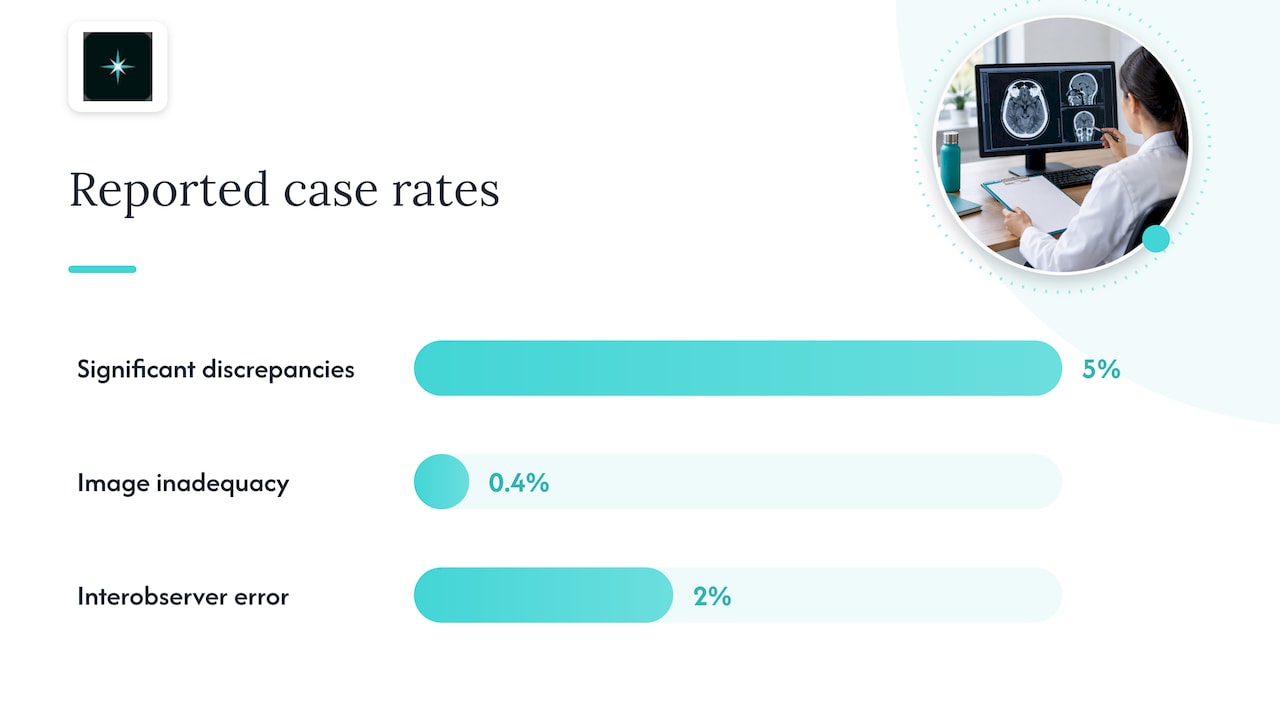
Clinical evidence supports careful implementation. A study of off-hours teleradiology interpretation in an emergency department found clinically significant discrepancies in 5% of cases, with 0.4% due to inadequate digital images and 2% due to interobserver error. The study is dated, but it illustrates why image quality and review processes belong in your requirements.
What systems integration should you require for PACS, DICOM and HL7 or FHIR?
Require direct PACS integration with final report insertion, DICOM-conformant transfer, HL7 or FHIR report routing, and written test sign-offs before go-live. Integration is where onboarding time and hidden cost accumulate, so define it in the statement of work.
Direct insertion means the signed report appears in your PACS next to the images, where your clinicians already work. A portal-based model asks clinicians to log into a separate system, which adds a step, creates a second place to look for results and raises the chance a report is missed. Direct insertion reduces that friction, which is why we describe how integration works from your PACS to a signed report in detail.
The technical requirements to list in an SOW:
- DICOM conformity: A DICOM conformance statement from both sides, with supported SOP classes confirmed.
- Report routing: HL7 or FHIR messages that return the report to your PACS, RIS or EHR as your environment requires.
- Secure transfer: Encrypted transport for images and reports, with firewall and VPN or equivalent configuration documented.
- Audit logs: Records of who accessed which study and when, retained and available on request.
- Test cases: Written scenarios covering each modality, each tier and error conditions, signed off by your team.
Typical integration phases follow a predictable order. First comes discovery, where both teams document your PACS, modality list and network setup. Next is configuration of connectivity and routing rules. Then comes test-study exchange, where nonclinical or de-identified studies prove images arrive and reports return. Finally comes a supervised go-live with defined success criteria. Put a milestone and an owner against each phase, and state who pays if a phase slips because of a change on either side.
The peer-reviewed caution on this point is direct: teleradiology can generate hidden costs from compromised communication workflows and integration burdens. Your best defense is a specific SOW that names each interface and test, so surprises show up as change orders you have already priced.
How should you structure teleradiology pricing, SLAs and BAAs?
Ask for a per-report rate card by study type, tier-specific turnaround SLAs, a signed business associate agreement, licensure attestations and clear integration responsibilities. Then price the hidden costs on your side, because they often exceed the rate differences between vendors.
On pricing, per-report with no minimums is the shape to request. It aligns cost with volume and avoids paying for idle capacity. You can request a complete rate card from our pricing page; whichever vendor you choose, insist on a table covering every modality you plan to send.
Clauses to require:
- Turnaround SLAs by tier: STAT, routine and stroke protocol, each with a defined clock start and stop.
- BAA: A signed business associate agreement, since the provider handles protected health information.
- Licensure attestations: Reader-level documentation of state licensure and enrollment.
- Indemnity language: Clear allocation of responsibility, reviewed by your counsel.
- Integration responsibilities: Who builds, tests and maintains each interface.
- Reporting rights: Regular turnaround and quality metrics delivered to you.
- Remedies: What happens when an SLA is missed, including credits or termination rights.
Hidden cost levers deserve their own budget line. Credentialing and privileging administration consumes medical staff office time. Technical integration takes your IT team's hours. Aligning the vendor's QA with your peer review program takes committee time. Change orders can appear when scope shifts mid-project. None of these appear in a per-report rate, yet together they can outweigh a small rate difference between two bids.
Pro Tip: Ask every bidder to price the same sample month using your actual study mix by modality and tier. A side-by-side total on identical volume exposes rate-card gaps that headline per-report numbers hide.
What use cases drive high volume teleradiology, and what should you check for each?
Each high volume use case translates into measurable requirements: a turnaround commitment, an escalation path and the subspecialty coverage the studies need. Build your RFP checklist from the use case, not from a generic vendor questionnaire.
- Emergency department overnight coverage. Require a STAT commitment with a defined clock, a direct escalation path for stroke protocol studies, and confirmed availability of neuro and body readers overnight. Test both tiers during the pilot with real study types.
- Urgent care X-ray and CT reads. Require fast routine and STAT turnaround, simple direct integration with your imaging systems, and clear rules for critical-finding communication. Our urgent care radiology reads page shows how this use case is typically scoped.
- Rural and critical access hospitals. Require overnight and weekend coverage, a plan for limited local IT support, and licensure confirmation for your state. See how rural hospital overnight coverage is commonly structured.
- Backlog clearance and overflow. Require rapid onboarding, a defined surge capacity commitment, and a written handoff process so overflow studies do not duplicate or drop.
- Subspecialty reads for advanced imaging. Require subspecialist matching by modality and body part, with documentation of reader credentials for MRI, PET-CT and other complex studies.
Whatever the use case, start with a pilot. A limited-scope trial on one site, one modality or one shift validates turnaround by tier, integration reliability and report quality before you commit long term. Define success criteria in writing before the pilot starts, including the turnaround targets, the quality metrics and the integration test results that would trigger a full rollout.
What does the research say about turnaround, hidden costs and regulatory expectations?
The evidence supports three conclusions: teleradiology can hold turnaround steady as volume grows, integration and quality alignment are the usual sources of hidden cost, and regulators expect licensure, privileging and timely service from any outsourced arrangement.
- Turnaround under growth: The Charité analysis of 10,200 teleradiology CT examinations found nearly constant turnaround as teleradiology volumes increased, which points to efficiency gains when the service is integrated well.
- Hidden costs: A peer-reviewed analysis of teleradiological outsourcing warns that compromised communication workflows and integration burdens generate costs that rate comparisons miss.
- Regulation: CMS enrollment guidance and the hospital survey procedures set expectations for state-level enrollment, licensure, privileging and timely service.
- Standards and workforce: ACR practice parameters and the ACR workforce analysis underscore the need for subspecialty routing and deliberate workforce design.
Statistic: In the Charité study, average report generation time was about 34 minutes across 10,200 teleradiology CT examinations (2011 to 2013), and turnaround stayed nearly constant as volume rose.
Read these findings with their limits in mind. The turnaround data comes from one institution's internal analysis of CT studies, and the clinical discrepancy data comes from a study conducted with older equipment. They show that the model works and where it tends to fail, not what any specific vendor will deliver for you. That is why measured pilots and written SLAs matter more than any published average.
How does AstraRad's service match a high volume teleradiology buyer checklist?
AstraRad is a US teleradiology service that delivers final signed reports read by board-certified subspecialists. We built our service around the checklist in this guide, and here is how our commitments line up with it:
- Subspecialist matching: Every study is routed to a subspecialist matched to the modality and body part, with every read performed inside the United States on scheduled shifts, 24/7/365.
- Tiered turnaround: We commit by contract to STAT, routine and stroke protocol tiers, with the measurement points defined in the SLA.
- Direct integration: Reports go straight into your existing PACS with no extra portal, and our transfer is DICOM conformant.
- Pricing: We price per report with no minimums.
- Quality and compliance: We conduct independent blind double reads for peer review, and we work as a business associate under a signed BAA.
Next steps are simple. Request a per-report rate card at /pricing, review our SLA terms at /sla, read how integration works from PACS to signed report, or compare our teleradiology services by modality. When you are ready to talk specifics, book a discovery call and we will follow with a coverage plan that puts SLA terms in writing.
This article is general information, not a substitute for advice from a qualified doctor. Consult a qualified healthcare professional about your own circumstances before acting on anything here.
FAQ
What is high volume teleradiology?
High volume teleradiology is the routing of large, sustained imaging volumes to remote interpretation services under contractual turnaround commitments and per-report billing. It typically covers overnight, weekend and overflow reading, and it works best when STAT, routine and stroke protocol tiers are defined in writing.
Do teleradiologists need to be licensed in my state?
Yes. CMS guidance states that teleradiologists must be enrolled in the state where they perform services. Your hospital also needs to privilege each remote reader through your medical staff process, so ask any provider for licensure attestations before the first study is sent.
Is a business associate agreement required for teleradiology?
A teleradiology provider handles protected health information on your behalf, so you should require a signed business associate agreement before any study is exchanged. The BAA defines how patient data is protected and who is responsible if something goes wrong. Treat it as a baseline contract item, not a negotiating chip.
How should I compare per-report pricing across vendors?
Ask each vendor to price the same sample month using your actual study mix by modality and tier. Then add your internal costs for credentialing, integration and quality alignment, which a peer-reviewed analysis identifies as common sources of hidden cost. The lowest rate card is not always the lowest total cost.
Should I run a pilot before signing a long-term contract?
Yes. A limited pilot on one site, modality or shift lets you measure turnaround by tier, test integration reliability and review report quality before committing. Define success criteria in writing first, including turnaround targets, quality metrics and integration test results, so the decision to expand is based on evidence.
Sources
- Teleradiological outsourcing-compromises and hidden costs
- Understanding Telehealth Enrollment
- CMS Manual System
- ACR PRACTICE PARAMETER FOR THE SUPERVISION AND PERFORMANCE OF CT AND MR IMAGING AT REMOTE LOCATIONS, REMOTE IMAGING
Recommended
Related on AstraRad
- Resources
2027 Medicare fee schedule: the radiology numbers explained
The CY2027 Medicare fee schedule cuts both conversion factors while ACR estimates radiology gains 2 percent. Both are true. Model your dollars per RVU.
- Resources
Clinician-radiologist communication: closing the loop
Clinician-radiologist communication fails when critical results reach a system but never reach the physician, and closed-loop standards close that gap.
- Resources
The hidden cost of the prelim-plus-overread model
The prelim-plus-overread model pays two radiologists and bills one report per overnight study. Cost the overread time, callbacks, and amendments first.
Put a radiologist's name on your next read.
Tell us your modalities and monthly volume. A complete per-report rate card, with turnaround tiers and SLA terms in writing, lands in your inbox within one business day.