Cardiac CT teleradiology for hospital admins
Hospital administrators: how cardiac CT teleradiology meets ACR/SCCT requirements, enforces SLAs, integrates with PACS, and provides subspecialist reads
Cardiac CT teleradiology delivers remote, subspecialist interpretation of CT coronary angiography and calcium scoring studies, read and signed off-site by radiologists trained specifically in cardiac imaging. Facilities turn to this model for STAT and after-hours coverage, subspecialty reporting their own staff cannot provide, backlog and overflow relief, and support in meeting accreditation standards.
TL;DR:
- Cardiac CT teleradiology mainly interprets coronary angiography, calcium scoring, and gated chest exams, often aligning findings with the CAD-RADS system.
- Accreditation requires specific contrast-enhanced exams with primary reconstructed images, documented dose metrics, and proper gating tags transferred via DICOM.
- For reliable results, radiologists must hold Level 2 or 3 credentialing and provide documented case volume and continuing education focused on cardiac imaging.
- Advanced analytics like FFR-CT and AI plaque phenotyping supplement interpretation but do not replace the need for a trained specialist and FDA clearance.
- Teleradiology providers should offer clear turnaroundSLAs, PACS integration, peer review, and detailed compliance documentation to ensure quality and accreditation readiness.
Table of Contents
- Which cardiac CT exams does teleradiology cover?
- Accreditation and credentialing requirements for cardiac CT reporting
- Technical and protocol considerations for gating, dose, and submission
- Turnaround, SLAs, and PACS integration for STAT versus routine reads
- How do AI and FFR-CT fit into cardiac CT reporting?
- Why subspecialist teleradiology solves cardiac CT bottlenecks
- How AstraRad can help with cardiac CT workflows
- Sources
- FAQ
Which cardiac CT exams does teleradiology cover?
Most cardiac CT teleradiology programs interpret a defined set of studies rather than every gated chest scan a facility performs. The core workload centers on coronary CT angiography, non-contrast calcium scoring, and gated chest exams ordered for a cardiac indication.
A signed report typically includes a vessel-by-vessel stenosis assessment for the left main, LAD, LCX, and RCA, calcium score context using the Agatston method, and a recommendation for follow-up or additional testing. Many groups align findings with the CAD-RADS classification system so referring cardiologists get a standardized severity grade rather than free text alone.
Facilities that want more than a stenosis read can add analytics on top of the base interpretation:
- CT coronary angiography (CCTA/CTCA): contrast-enhanced studies assessing coronary stenosis and plaque burden.
- Coronary artery calcium scoring: non-contrast scans quantifying calcified plaque for risk stratification.
- FFR-CT: a physiologic add-on calculated off site, typically returned within 24 hours, that estimates blood flow significance across a stenosis.
- AI plaque phenotyping tools: software that characterizes plaque composition to supplement, not replace, the subspecialist's read.
These advanced analytics feed into, rather than substitute for, the final signed report a cardiologist relies on for clinical decisions.
Accreditation and credentialing requirements for cardiac CT reporting
Before a facility outsources cardiac CT reads, administrators need to confirm two separate things: that the site's studies will pass accreditation review, and that the radiologists reading them hold the right credentials.
- ACR cardiac module submission. Programs must submit specific contrast-enhanced CTA exams along with documented dose metrics and required reformats, and primary reconstructed diagnostic images must accompany any curved MPRs, since reformats alone are a common reason submissions get sent back.
- SCCT/BSCI credentialing. Training guidance treats cardiac CT competency as distinct from general radiology training, tying it to Level 2 or 3 case-volume thresholds and ongoing continuing professional development rather than a general CT background.
- Contracting implications. Payers and hospital credentialing committees increasingly ask for proof of modality-specific volume and CME hours before approving a teleradiology group, so accreditation and credentialing documentation becomes part of the contracting conversation, not an afterthought.
Pro Tip: Ask any teleradiology partner for documented Level 2 or 3 case volumes and cardiac-specific CPD hours before you sign, not after the first accreditation audit.
Modality subspecialty matters here because a general body or chest radiologist, however experienced, has not necessarily logged the case volume SCCT associates with reliable cardiac CT accuracy.
Technical and protocol considerations for gating, dose, and submission
Studies that arrive without the right gating, dose documentation, or reformats slow down interpretation and can jeopardize accreditation. Prospective gating is preferred when a patient's heart rate and rhythm allow it, since it limits radiation exposure compared with retrospective gating across the cardiac cycle.
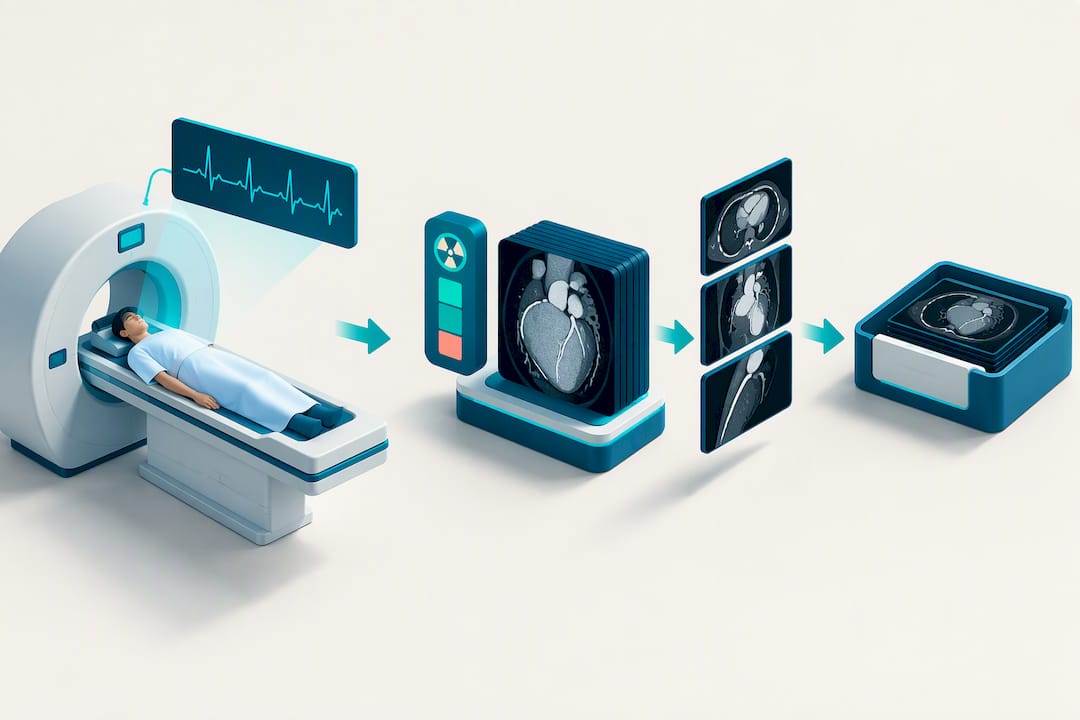
A CTDIvol of 50 mGy or below is the accreditation threshold for prospective gating, and 150 mGy or below for retrospective gating, according to ACR's cardiac module technique guidance. Dose-length product should accompany CTDIvol so reviewers can confirm total exposure, not just the peak value.
Before sending a study, confirm the submission includes:
- The best-contrast-phase axial image set as originally reconstructed, not only post-processed reformats.
- Curved multiplanar reformats for the LAD, LCX, and RCA.
- A non-contrast axial series for calcium scoring when ordered alongside CTCA.
- Documented EKG-gating policy and CTDIvol/DLP values, since incomplete image sets or missing primary reconstructions are a frequent cause of accreditation delay.
On the PACS side, confirm EKG-gating tags transfer intact with the DICOM header, since a teleradiology reader who cannot see gating metadata may need to request a resend before finalizing a report. Building an accreditation packet around this checklist ahead of time avoids most resubmission cycles.
Turnaround, SLAs, and PACS integration for STAT versus routine reads
Cardiac CT teleradiology contracts typically define at least three tiers: STAT for emergent findings, urgent for same-day but non-emergent cases, and routine for scheduled outpatient studies. Each tier should carry a specific turnaround commitment and an escalation path for cases that miss it, spelled out in the contract rather than left as a verbal understanding.
- STAT reads: fastest tier, aimed at emergency department and inpatient cases needing an immediate call.
- Urgent reads: same-day turnaround for cases that do not require emergent action.
- Routine reads: standard turnaround for scheduled outpatient CCTA and calcium scoring.
Integration matters as much as speed. A teleradiology partner that connects directly to a facility's existing PACS through DICOM and HL7, rather than requiring staff to log into a separate portal, removes a step that otherwise adds delay to every study. Structured reporting formats that match a facility's existing templates also cut down on manual reconciliation.
Pro Tip: Ask prospective partners how they handle report disputes or requests for clarification, and get the answer in writing before the first case goes out.
Quality assurance should include peer review on a defined percentage of cases, audit logs administrators can pull on demand, and a performance dashboard tracking turnaround against the contracted SLA.
How do AI and FFR-CT fit into cardiac CT reporting?
Not every software tool touching a cardiac CT study is cleared for primary diagnosis. A viewer that displays images is a different regulatory category from a segmentation or scoring tool marketed as software as a medical device, and only the latter carries FDA 510(k) clearance for its specific intended use.
Cardiovascular.Calcification.CT is intended to segment coronary calcifications and provide masks for calcium scoring systems; its outputs are intended to be used in conjunction with other clinical information by trained professionals and do not replace practitioner judgment.
TeraRecon's Cardiovascular.Calcification.CT clearance illustrates the pattern: the software outputs segmentation masks, not a final Agatston score, and a trained professional still has to interpret the result. Before adopting any third-party analytics tool, facilities should confirm its 510(k) status, run a validation set against known cases, and make sure the final report discloses which findings came from software assistance.
Why subspecialist teleradiology solves cardiac CT bottlenecks
A teleradiology provider delivers final signed reports read by US board-certified subspecialists matched to the specific modality and body part, backed by contractual turnaround commitments and peer review. For cardiac CT specifically, that means a facility gets a reader trained for coronary studies rather than a generalist stretched across every protocol on the schedule.
Administrators evaluating a partner for accreditation support can reasonably request sample report templates, documentation of the accreditation support process, and a PACS integration checklist before committing to a contract. A subspecialist-read model addresses the credentialing expectations SCCT lays out and the submission requirements ACR reviews, since the reader pool is already built around modality-matched experience rather than general coverage, which also helps clear backlog without diluting report quality.
Rafael Vieira
How AstraRad can help with cardiac CT workflows
For facilities juggling accreditation prep, credentialing verification, and a growing cardiac CT backlog, a teleradiology service offers board-certified subspecialists reading cardiac studies with contractual turnaround tiers and integration into existing PACS, so there is no separate portal to manage. Reports are backed by peer review and detailed compliance documentation accreditation teams can use directly.
- Request a PACS integration checklist to see what setup your systems need.
- Ask for an accreditation support documentation package for your ACR cardiac module submission.
- Get per-report pricing for cardiac CT and calcium scoring studies before you commit.
Sources
Administrators preparing an accreditation or credentialing file should keep these references on hand:
- Technique Parameters and Anatomic Coverage: CT - Adult Cardiac Module (Revised 1-8-2024) : Accreditation Support
- SCCT releases new guideline for training cardiology and radiology trainees in CCT
- K250288: TeraRecon Cardiovascular.Calcification.CT 510(k) summary
This article is general information, not a substitute for advice from a qualified doctor. Consult a qualified healthcare professional about your own circumstances before acting on anything here.
FAQ
What exams count as cardiac CT teleradiology?
The category covers CT coronary angiography, non-contrast coronary calcium scoring, and gated chest CT exams ordered for a cardiac indication. Reports typically include a vessel-by-vessel stenosis assessment and calcium score context, often aligned to the CAD-RADS classification system.
What dose limits apply to cardiac CT accreditation?
ACR's cardiac module guidance sets a CTDIvol threshold of 50 mGy or below for prospective gating and 150 mGy or below for retrospective gating. Dose-length product should be documented alongside CTDIvol in the accreditation packet.
What credentials should a cardiac CT teleradiologist hold?
Readers should carry Level 2 or 3 cardiac CT credentials or documented equivalent case volume, along with continuing education specific to cardiac CT rather than general radiology training. SCCT's training guidance treats this as a distinct competency track from general CT reading.
Does AI software replace the radiologist's cardiac CT read?
No. FDA-cleared segmentation tools like TeraRecon's Cardiovascular.Calcification.CT produce masks or measurements that a trained professional must still interpret alongside other clinical information, and outputs do not replace practitioner judgment.
What turnaround times should a cardiac CT teleradiology contract include?
Contracts typically define separate tiers for STAT, urgent, and routine reads, each with its own turnaround commitment and an escalation path if a case runs late. Administrators should get these tiers, along with PACS integration details, written into the service agreement rather than assumed.
Recommended
Related on AstraRad
- Resources
Teleradiology specialists: matching reads to your mix
How to match teleradiology specialists to your study mix: fellowship training, credential verification, and where specialist reads change outcomes.
- Resources
Report turnaround goals by priority for hospitals
Set hospital report turnaround targets: STAT under 1 hr, urgent 4,8 hr, routine 24 hr. Learn clock start rules, percentiles, plus teleradiology.
- Resources
Subspecialty teleradiology services: how routing works
How subspecialty teleradiology services route each study to a fellowship-trained reader, what the evidence shows, and when a general read is enough.
Put a radiologist's name on your next read.
Tell us your modalities and monthly volume. A complete per-report rate card, with turnaround tiers and SLA terms in writing, lands in your inbox within one business day.