Report turnaround goals by priority for hospitals
Set hospital report turnaround targets: STAT under 1 hr, urgent 4,8 hr, routine 24 hr. Learn clock start rules, percentiles, plus teleradiology.
Aim for STAT final-report turnaround under 1 hour, urgent within the same shift or roughly 4 to 8 hours, and routine final signature generally within 24 hours, using these as starting points to test against local volumes rather than fixed rules. Critical-result communication runs on its own, faster clock, separate from the report SLA. AstraRad, a teleradiology provider that delivers final signed reports through board-certified subspecialists, builds its service commitments around this same tiered structure, integrating directly with a client's PACS and reporting 99.4% SLA compliance over the past year.
TL;DR:
- Most facilities should define their own specific turnaround targets, with STAT reports under 1 hour and routine within 24 hours, based on local case mix.
- Clear SLA language should specify clock start points, report stages, and critical-result pathways, with documented evidence of report acknowledgment.
- Percentile-based metrics, especially the 80th and 90th percentiles, better reflect true turnaround performance than averages, which can be misleading.
- Centralized subspecialty reporting and integrated PACS workflows can significantly improve report times, but results vary depending on site and modality.
- Partnering with a teleradiology provider like AstraRad can meet strict STAT and urgent turnaround goals without adding staff, provided integration and licensing requirements are fulfilled.
Table of Contents
- Recommended targets by priority level
- What belongs in a written SLA?
- How do you set site-specific turnaround targets?
- Which metrics and percentiles should you track?
- What operational changes actually shorten turnaround?
- Where should leaders focus first?
- How AstraRad can help meet STAT and urgent commitments
- Sources
- FAQ
Recommended targets by priority level
Setting turnaround goals starts with acknowledging that no regulatory body publishes a single national table of report deadlines. The ACR and Joint Commission require facilities to define their own written timing standards, evaluate them, and document the results. This is why the ranges below are working benchmarks, not mandates.
For STAT studies, an AJR emergency-department CT study found a median time from CT completion to first report of 0.87 hour, with a 90th percentile of 2.43 hours. That gap between the median and the long tail is the reason percentile-based targets matter more than averages.
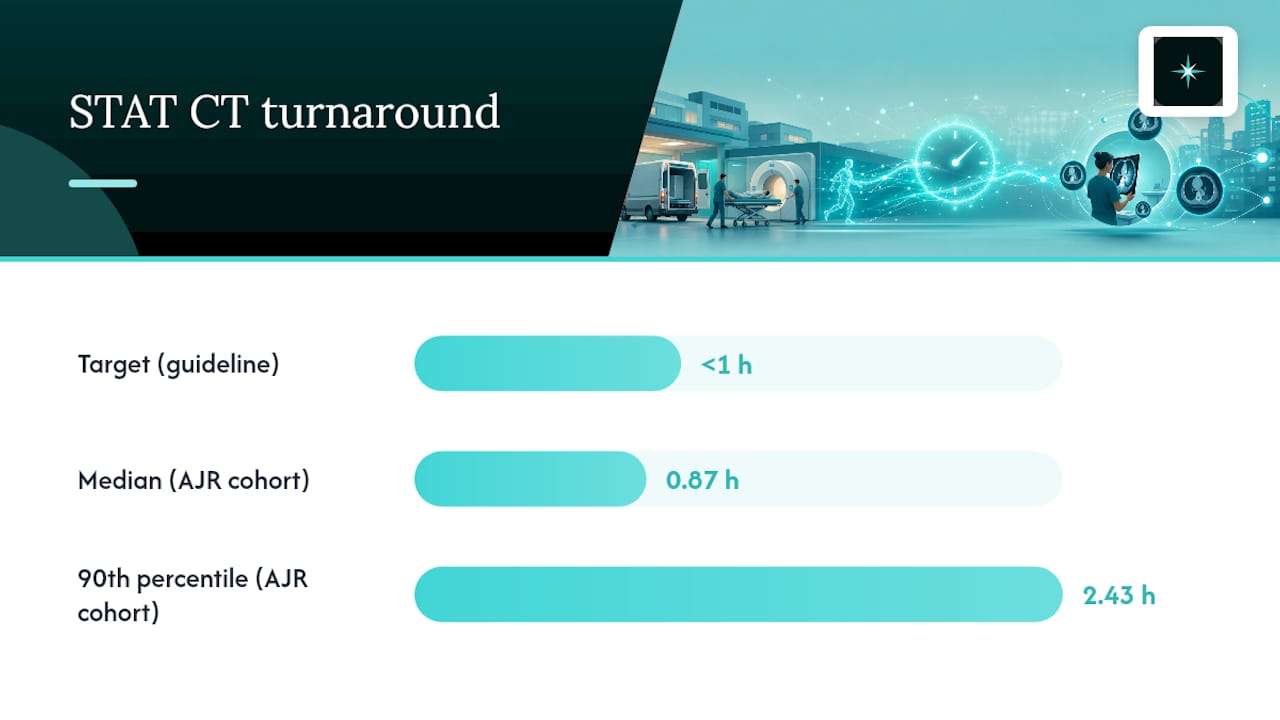
Statistic: In that AJR cohort, CT reporting accounted for nearly a third of total ED length of stay, which means shaving report time directly shortens how long patients wait in the department.
Consider these starting tiers, adjusted for local case mix:
- STAT: final report under 1 hour from image acquisition, with a 90th-percentile ceiling closer to 2 to 2.5 hours based on published ED CT data.
- Urgent: final signed report within the same clinical shift, typically several hours depending on modality and staffing.
- Routine: final signature generally within 24 hours, extendable for low-acuity outpatient studies with prior written agreement.
A 2020 multi-site study on subspecialized reporting found meaningful variation across sites and modalities, which argues against copying one enterprise-wide SLA table across every department.
What belongs in a written SLA?
A turnaround target only works if the SLA defines exactly when the clock starts and what counts as done. Vague language invites disputes and hides the real performance from leadership.
- Clock start: use order placement for urgent studies, acquisition completion for STAT imaging, and specify which one applies before signing anything.
- Report stage: distinguish a preliminary read, often issued for immediate clinical decisions, from the final signed report that becomes the legal record.
- Critical-result path: the ACR's diagnostic communication practice parameter treats nonroutine findings as requiring expedited notification and documented receipt, separate from the standard report SLA.
- Confirmation method: log delivery and, where possible, evidence that the ordering clinician opened or acknowledged the report.
Pro Tip: Write the clock-start rule into the SLA document itself, not just into a dashboard configuration, so it survives staff turnover and vendor changes.
The Joint Commission's National Performance Goals require hospitals to define acceptable time intervals for critical-result reporting in writing and to evaluate whether they are met, which makes this documentation a compliance item, not just an operational nicety.
How do you set site-specific turnaround targets?
Generic benchmarks are a starting point, not a finish line. The right target for a rural critical access hospital's overnight MRI queue looks nothing like the right target for a Level I trauma center's CT bay.
Work through these inputs before locking in a number:
- Clinical risk: higher-acuity settings, including trauma centers bound by ACR coverage requirements for 30-minute interpretation availability, need tighter targets than elective outpatient imaging.
- Modality complexity: a single-view X-ray and a multi-sequence MRI cannot share the same reporting window.
- Hours of operation and staffing: overnight and weekend coverage gaps often force a choice between in-house call schedules and teleradiology.
- Expected volume: a target that works at 20 STAT studies a night can collapse at 60.
Negotiate targets in tiers, a baseline that reflects current capability, a stretch goal tied to a specific intervention, and a critical-path minimum for the highest-risk studies. Pilot any new target on one modality or one shift first, using the 80th and 90th percentiles as your acceptance gate before rolling it out further.
Which metrics and percentiles should you track?
Turnaround measurement fails when it only reports an average. Means get pulled down by a handful of fast reads and hide the delays that actually affect patient care.

Capture these intervals separately: order-to-acquisition, acquisition-to-preliminary-report, preliminary-to-final-signature, and delivery-to-confirmed-read. Report each as a median alongside the 80th and 90th percentiles, plus a straightforward SLA-compliance percentage.
Statistic: An RSNA quality-improvement project on STAT body imaging cut median turnaround from 8.1 hours to 3.0 hours, yet only about 45% of exams met the four-hour target, a reminder that a lower median does not guarantee compliance.
- STAT: review daily, since a single missed read can affect patient safety within hours.
- Urgent and routine: review weekly, with monthly rollups for trend analysis and staffing decisions.
- Escalation threshold: flag any case exceeding the 90th-percentile target for immediate supervisor review.
- Read confirmation: track whether the ordering clinician opened the report, closing what the ACR flags as a frequently missed safety step.
What operational changes actually shorten turnaround?
Setting a target is the easy part. Hitting it consistently requires changes to staffing, workflow, and technology, not just a new number in a policy document.
- Centralize and subspecialize reporting. The 2020 multi-site study cited earlier found second-signature 80th-percentile turnaround fell from 295 to 238 minutes when reporting was centralized among subspecialists, a change particularly useful for smaller hospitals without on-site coverage for every modality.
- Fix the technology path. Direct PACS and RIS integration, prioritized worklist queues, and voice recognition transcription remove manual handoffs that add minutes to every study.
- Route STAT studies through dedicated channels. A separate queue and, where volume justifies it, dedicated transport resources for ED and inpatient STAT imaging keep urgent cases from waiting behind routine ones.
- Use incentives and QI loops deliberately. An AJR pay-for-performance study found departmental mean completion-to-final-signature turnaround fell from 42.7 hours at baseline to 16.3 hours two years into a focused incentive and peer-review program.
Pro Tip: Pair any new incentive program with a baseline measurement period of at least a few weeks so you can prove the intervention, not just seasonal variation, drove the improvement.
Where should leaders focus first?
Most turnaround problems are not caused by radiologists reading too slowly. They come from vague SLA language, clock-start definitions that nobody agreed on, and a lack of percentile reporting that would have caught the drift months earlier.
Over the next 90 days, pilot one modality's STAT queue against a written SLA that specifies clock start and confirmation method, add 80th and 90th percentile tracking to your existing dashboard, and get sign-off from both radiology leadership and the ordering departments on what "urgent" actually means at your site. Align your vendor or staffing checklist to those same definitions before signing anything long term.
Rafael Vieira
How AstraRad can help meet STAT and urgent commitments
Hospitals and imaging centers that need STAT and urgent targets met without rebuilding an entire reporting operation typically turn to a teleradiology partner rather than adding overnight staff. Some providers offer final signed reports from board-certified subspecialists matched to modality and body part, with contractual STAT turnaround under 1 hour and routine turnaround under 24 hours, integrated directly into an existing PACS without a separate portal.
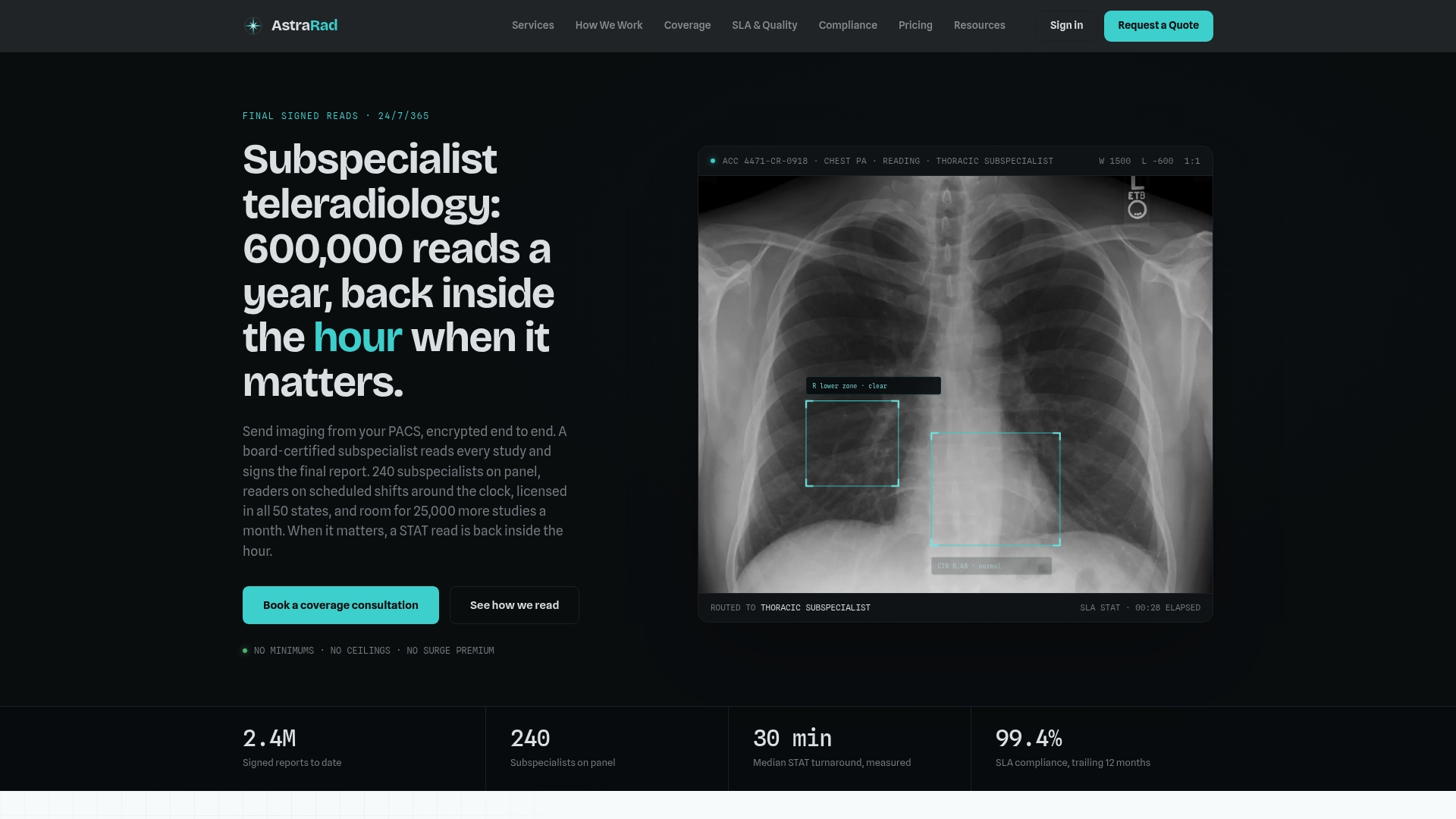
A reasonable pilot scope looks like one modality, one shift, and a defined volume ceiling, so you can measure real percentiles before expanding coverage. Before piloting, confirm:
- Your PACS supports the integration path AstraRad uses for routing studies and returning signed reports.
- Which modalities you need covered, since AstraRad's service list spans CT, MRI, X-ray, ultrasound, and PET-CT.
- Whether your state requires specific licensing, which varies by region.
Review per-report pricing to see how a fee-for-service model compares to adding staff or overtime for the same coverage.
Sources
- ACR practice parameter for radiologist coverage of imaging performed in hospital emergency departments
- AJR emergency-department CT study (2015)
- 2020 multi-site study on subspecialized reporting and RTAT
- Joint Commission National Performance Goals / requirements (NPG.01.02.01)
- AJR pay-for-performance RTAT study (2010)
FAQ
What is a reasonable STAT report turnaround target?
A common starting target is a final report within 1 hour of image acquisition, though the AJR ED CT study found a 90th percentile of 2.43 hours, showing real-world variation around that goal. Facilities should set their own written target and measure against percentiles, not just an average.
How is critical-result communication different from a report SLA?
Critical-result notification is a separate, faster safety process that requires expedited contact with the ordering clinician and documented receipt, distinct from the standard report turnaround clock. The Joint Commission's National Performance Goals require hospitals to define and evaluate these timing standards in writing.
Should turnaround be measured by average or percentile?
Percentile-based reporting, typically the median alongside the 80th or 90th percentile, gives a more accurate picture than a mean because averages can hide a long tail of delayed reports. The 2020 multi-site subspecialty study used percentile comparisons to show real improvement that a simple average would have masked.
Does centralizing radiology reporting actually reduce turnaround?
Evidence from a multi-site study found that centralized, subspecialized reporting reduced the 80th-percentile second-signature turnaround from 295 to 238 minutes. Results varied by site and modality, so any centralization plan should include per-site exception handling rather than one uniform target.
What does AstraRad guarantee for STAT and routine turnaround?
AstraRad states a contractual STAT turnaround under 1 hour and routine final-signature turnaround under 24 hours, backed by a reported 99.4% SLA compliance rate over the past year. These are the company's own service commitments rather than an industry-wide standard.
Recommended
Related on AstraRad
- Resources
Subspecialty teleradiology services: how routing works
How subspecialty teleradiology services route each study to a fellowship-trained reader, what the evidence shows, and when a general read is enough.
- Resources
Teleradiology in California: 2026 licensing rules
California requires a full Medical Board license for every teleradiologist reading for a patient in the state. Rules, timelines, and what to verify.
- Resources
4 compliance must haves for US based teleradiology
Compliance first checklist for admins: require licensure matrix, PSV, subspecialty match and SLA before signing U.S. teleradiology contract.
Put a radiologist's name on your next read.
Tell us your modalities and monthly volume. A complete per-report rate card, with turnaround tiers and SLA terms in writing, lands in your inbox within one business day.