Dose monitoring teleradiology: what buyers should know
Dose monitoring teleradiology explained for hospital and imaging center buyers: what gets tracked, who owns it, and what to put in a contract.
Dose monitoring teleradiology is the practice of tracking radiation dose data for every CT, fluoroscopy and X-ray study while the images are interpreted by radiologists at a remote site. The dose data stays with the facility that owns the scanner. The remote radiologist supplies the final signed report, and the contract should state who watches dose alerts and who acts on them. This guide covers how the data flows, what to ask for, and where the responsibilities sit.
TL;DR
- Dose monitoring software collects dose data from your scanners. Teleradiology delivers the interpretation. They are two systems that need clear ownership lines in your contract.
- Dose records travel as RDSR objects from the modality to a database, not through the radiology report.
- Alerts should go to a named medical physicist or radiation safety officer, not to an inbox no one owns.
- Ask your teleradiology provider how a protocol or image-quality concern is raised and answered, and put the process in the SLA.
- Dose monitoring is a quality management tool. It does not replace the benefit-risk decision made for each exam.
Table of Contents
- Key facts
- What is dose monitoring in teleradiology?
- Who provides what: our role in this topic
- How do dose monitoring systems collect exposure data across modalities?
- How are dose alerts used to find unusually high exposure?
- Does real-time dose monitoring reduce exposure?
- What should you consider before connecting dose monitoring to a remote reading workflow?
- What should a teleradiology contract say about dose and protocol questions?
- Which modalities carry the most dose monitoring weight?
- How does this apply to small and rural sites?
- Work with AstraRad on remote reads
- FAQ
- Sources
Key facts
- The ACR Dose Index Registry held dose data on over 236 million examinations from nearly 2,400 U.S. facilities as of January 2025.
- Radiation Dose Index Monitoring (RDIM) software collects RDSR objects from imaging equipment and produces dose trends, histograms and alert dashboards.
- The DIR is certified as a PQI project for ABR MOC Part IV and helps facilities qualify for ACR DICOE designation.
- A 2019 coronary angiography study found that a BMI of 40 or higher was associated with a 7-fold increase in physician radiation dose compared with a BMI under 25.
- A 2017 interventional radiology study showed that real-time automated monitoring can join personal dose meter readings with procedural dose area product to find high-exposure procedures.
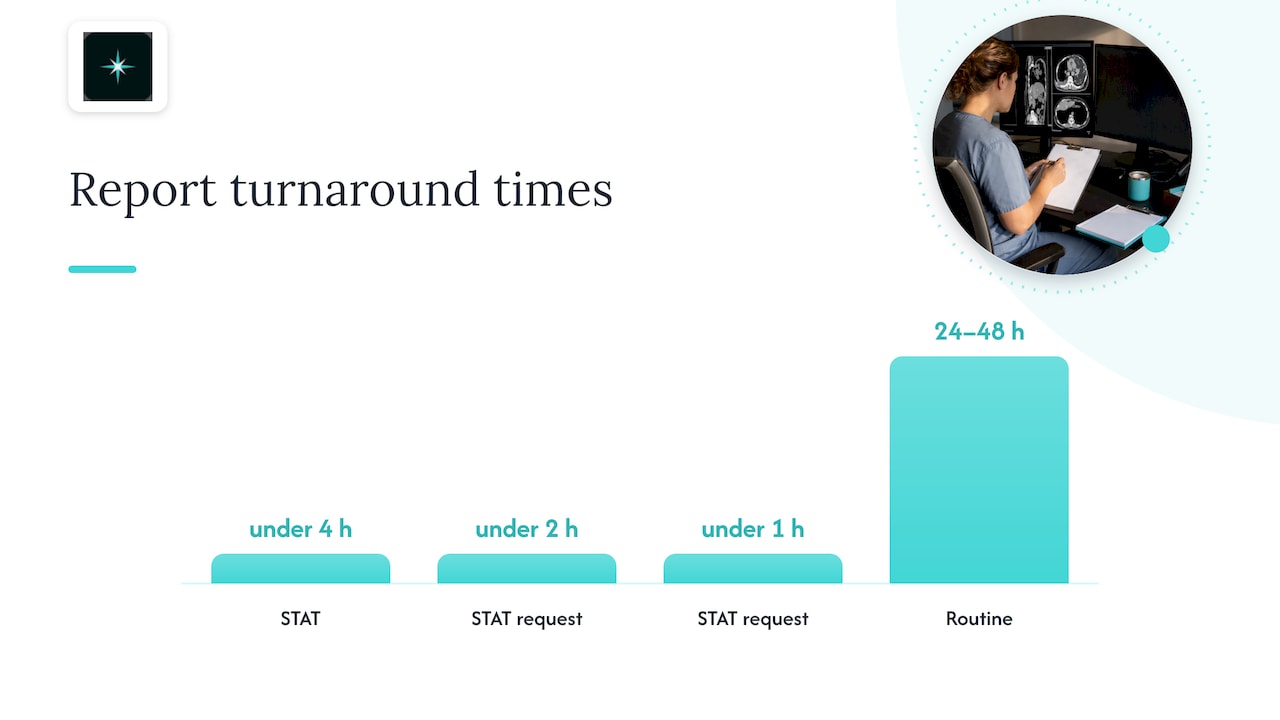
- AstraRad commits to turnaround by contract: STAT under 4 hours, routine 24 to 48 hours, and stroke protocol under 30 minutes.
What is dose monitoring in teleradiology?
Dose monitoring is the systematic collection, review and benchmarking of radiation dose values produced by imaging equipment. In teleradiology, it means that the scanner site keeps measuring dose even though the radiologist reading the study is in another city or state. Dose monitoring and remote interpretation run side by side, and each has its own owner.
A dose monitoring program usually tracks these values:
- CT: volumetric CT dose index (CTDIvol), dose length product (DLP), and size-specific estimates where the software supports them.
- Fluoroscopy and interventional procedures: air kerma, dose area product (DAP) and fluoroscopy time.
- Digital radiography: exposure indicators and dose area product, where the equipment reports them.
- Staff exposure: personal dosimeter readings, which some facilities pair with procedure data.
A dose index registry is a national database where facilities send de-identified dose values so they can compare themselves with regional and national benchmarks. The ACR Dose Index Registry collects and benchmarks dose indices for CT, fluoroscopy, interventional procedures and digital radiography.
Why does this matter once reads move off site? Because the person who sees the image is no longer the person who sees the scanner. A remote radiologist may notice noise, odd coverage or a repeated series. The local team sees the dose record. Those two observations only help each other if the workflow connects them.
Who provides what: our role in this topic
AstraRad is a US teleradiology service that delivers final signed reports read by board-certified subspecialists. We have a commercial interest in this topic, and we say so plainly: we sell remote reads to hospitals, imaging centers and radiology groups, and this article is written to help buyers scope their contracts.
Our role is interpretation. Every study is routed to a subspecialist matched to the modality and body part, and reports go straight into your existing PACS. Dose monitoring software, dosimeter programs and the physicist who reviews alerts remain with your facility. You can see the full scope on our teleradiology services page.
What we can do inside a contract is define how a dose or protocol question moves between our radiologists and your team. Settle that on the discovery call, and have it written into the coverage plan.
How do dose monitoring systems collect exposure data across modalities?
Dose monitoring systems collect data by receiving a Radiation Dose Structured Report (RDSR) from each modality over the network, storing the extracted values in a database, and presenting analytics. An RDSR is a DICOM object that carries dose parameters such as DLP and CTDIvol for each exam. The result is a view across scanners and vendors.
Per a 2023 radiologist's guide to RDIM, these systems store extracted data and provide dose trends, histograms and alert dashboards. For participation in the national registry, DIR data can be sent from scanners and fluoroscopes through ACR Connect and DIR Link software after anonymization at the site, according to the ACR's January 2025 feature description.
Here is how the pieces fit together:
| Layer | What it does | Typical owner |
|---|---|---|
| Modality (CT, fluoroscope, X-ray) | Produces the RDSR or dose summary for each exam | Facility, with the equipment vendor |
| Network and interface | Sends dose objects to the dose database | Facility IT or PACS administrator |
| Dose monitoring database | Stores values, trends and alerts | Facility, reviewed by a medical physicist |
| Registry submission | Sends de-identified data for benchmarking | Facility |
| PACS | Holds images and the final signed report | Facility, fed by the teleradiology provider |
| Remote interpretation | Produces the final signed report | Teleradiology provider |
The table shows why the contract matters. The dose path and the report path touch the same studies, but they use different interfaces, so a teleradiology provider does not need to sit inside the dose pipeline to be useful to it.
For integration, one academic review recommends connecting dose management systems to hospital IT through HL7-ADT interfaces for patient identity and HL7-ORM for order verification. Those interfaces keep patient identity consistent when exams come from several sites. If your sites share one PACS, that identity work is easier. If they do not, plan it early.
How are dose alerts used to find unusually high exposure?
Dose alerts compare each exam against a local or national diagnostic reference level (DRL) or a set alert level. When a value falls outside the range, the system flags it, and a person reviews it. The 2020 review of dose management requirements says abnormal values should be sent to the medical physics expert or radiation protection officer.
A diagnostic reference level is a benchmark dose value for a standard exam, used to spot practices that deliver more radiation than comparable facilities. It is a check on process. It is not a dose limit for an individual patient.
A workable alert workflow has five steps:
- Set alert levels by exam type and patient size category with your medical physicist.
- Route alerts to a named reviewer, with a backup for nights and weekends.
- Review the exam against its protocol, the patient's size and the clinical indication.
- Record the outcome, such as a protocol fix, a technologist coaching point or a no-action finding.
- Trend the results monthly so repeat causes show up.
Where does the remote radiologist fit? Usually at step three, as a source of information. A reader who sees a repeat series or poor image quality can flag it. Whether that flag is sent by phone, a message in the workflow or a note in the report is a process choice that should be written down before go-live, not worked out during an overnight shift.
Quality tool, not a decision tool
Published industry guidance advises treating dose monitoring systems mainly as quality management tools, not as the basis for decisions about a patient's cumulative dose history, because each procedure needs its own benefit-risk assessment. For buyers, that means a dose dashboard should not be written into a teleradiology contract as a clinical gate on whether an exam is read.
Does real-time dose monitoring reduce exposure?
The evidence shows that real-time monitoring identifies where exposure is concentrated, which gives teams something specific to optimize. It does not reduce dose by itself. The strongest published work focuses on interventional procedures and staff exposure, so apply it to CT and radiography with care.
A study of interventional radiology in the Netherlands found that real-time monitoring of patient and staff dose identified intervention types with high staff doses and could allow targeted optimization of radiation protection. The 2017 paper showed that automated systems can integrate personal dose meter data with procedural DAP to pinpoint which interventions carry high occupational exposure.
Patient factors also move the numbers. A 2019 U.S. study of coronary angiography found that a BMI of 40 or higher was associated with a 7-fold increase in physician radiation dose compared with a BMI below 25. That is one reason alert levels should account for patient size.
Three takeaways for a buyer:
- Monitoring finds outliers. Corrective action comes from protocols, training and equipment settings.
- Staff dose and patient dose are different programs with different data sources.
- Evidence from one setting does not transfer automatically to another, so ask your physicist what applies to your modalities.
What should you consider before connecting dose monitoring to a remote reading workflow?
Start by separating the data paths: dose objects go to your dose database, images go to PACS, and the final signed report returns to PACS. Then assign an owner to each path and write the escalation rules into the contract. Most gaps appear at the handoffs, not inside any one system.
Use this checklist when you scope the arrangement:
| Question | Why it matters | Where to document it |
|---|---|---|
| Who owns dose alert review? | Alerts without an owner go unread | Internal policy and the coverage plan |
| Which modalities send RDSR? | Older scanners may need other capture methods | Dose program documentation |
| How does a remote reader flag a protocol concern? | Image-quality observations can point to dose issues | SLA communication terms |
| Who submits to a registry? | Registry participation is a facility decision | Facility quality plan |
| How is patient identity matched across sites? | Mismatches break trends | HL7 interface specification |
| What is the BAA position on dose data? | Dose records are tied to patient identifiers | Business associate agreement |
Registry participation can carry a quality benefit. The DIR is certified as a PQI project for ABR MOC Part IV and helps facilities qualify for ACR DICOE designation, per the ACR's January 2025 page. It also benchmarks you against peers: the registry's quarterly and interactive reports let participants compare their indices with regional and national values.
The European Society of Radiology's EuroSafe Imaging initiative, as described in the 2020 review, holds that effective protection requires continuous monitoring and automated data transmission from all devices to a central IT structure, because manual recording is inaccurate. That is a European perspective, but the point holds for any multi-site group: automate the capture.
What should a teleradiology contract say about dose and protocol questions?
A teleradiology contract should state who reads, how fast, and how a protocol or quality concern travels between the remote radiologist and your site. It should keep dose monitoring ownership with the facility, unless you have agreed otherwise in writing. Clear terms prevent assumptions on both sides.
Terms worth drafting:
- Scope of the final signed report: modalities, body parts and subspecialty matching.
- Turnaround: measured from last-image arrival to radiologist signature, by tier.
- Credentialing and licensure: state licenses for the sites you operate in.
- Peer review: how the provider checks its own quality.
- Communication path: phone and workflow steps for critical findings and quality concerns.
- BAA and data handling: a signed business associate agreement before any protected health information moves.
- Integration: DICOM conformance and delivery into your PACS.
Our commitments for these items are written as contract terms. Turnaround is committed by contract: STAT under 4 hours (under 2 hours or under 1 hour on request), routine 24 to 48 hours, and stroke protocol under 30 minutes. Radiologists are licensed in all 50 states, and 1 in 20 reports is independently double-read, blind, for peer review. AstraRad works as a business associate under a signed BAA and is HIPAA aligned. Read how the STAT tier is described on our STAT radiology reads page.
Which modalities carry the most dose monitoring weight?
CT, fluoroscopy and interventional procedures carry the most weight because they deliver the higher doses, and they are the modalities the ACR registry reports on most fully. Digital radiography and nuclear medicine matter too, but dose reporting there is less developed.
The registry notes that its CT dose index reports have existed since 2011, and fluoroscopy reports for interventional procedures are now available, with work underway on diagnostic fluoroscopy, digital radiography and nuclear medicine, according to the ACR Dose Index Registry page.
For a buyer outsourcing reads, here is how to think about each modality:
| Modality | Dose monitoring relevance | Related read type |
|---|---|---|
| CT | Highest volume of dose records and alerts | Final signed CT reports, including STAT |
| Fluoroscopy and interventional | Patient and staff dose, DAP tracking | Usually performed and monitored on site |
| X-ray | Exposure indicators, repeat tracking | X-ray and ultrasound overflow reads |
| MRI | No ionizing radiation, so no dose records | MRI teleradiology reporting |
| PET-CT and nuclear medicine | Administered activity plus CT dose | PET-CT and nuclear medicine reads |
MRI uses no ionizing radiation, so it falls outside dose monitoring. Mixing MRI volume into a dose program only adds noise to your trends.
How does this apply to small and rural sites?
Small and rural sites usually have fewer scanners, no on-site radiologist overnight and limited physics support. They benefit from a simple setup: one dose database, one named reviewer, and a teleradiology contract with clear communication terms. The aim is a program the site can sustain.
A single CT scanner can still send RDSR data to a monitoring system, and a visiting or contracted medical physicist can review the alerts on a set schedule. The remote radiologist covers the interpretation gap after hours. For that model, see our page on teleradiology for rural and critical access hospitals.
Work with AstraRad on remote reads
If you are scoping remote interpretation next to a dose monitoring program, we can help with the reading side. AstraRad is a US teleradiology service that delivers final signed reports read by board-certified subspecialists. Reads are performed inside the United States on scheduled shifts 24/7/365, with final signed reports at every tier, including overnight.
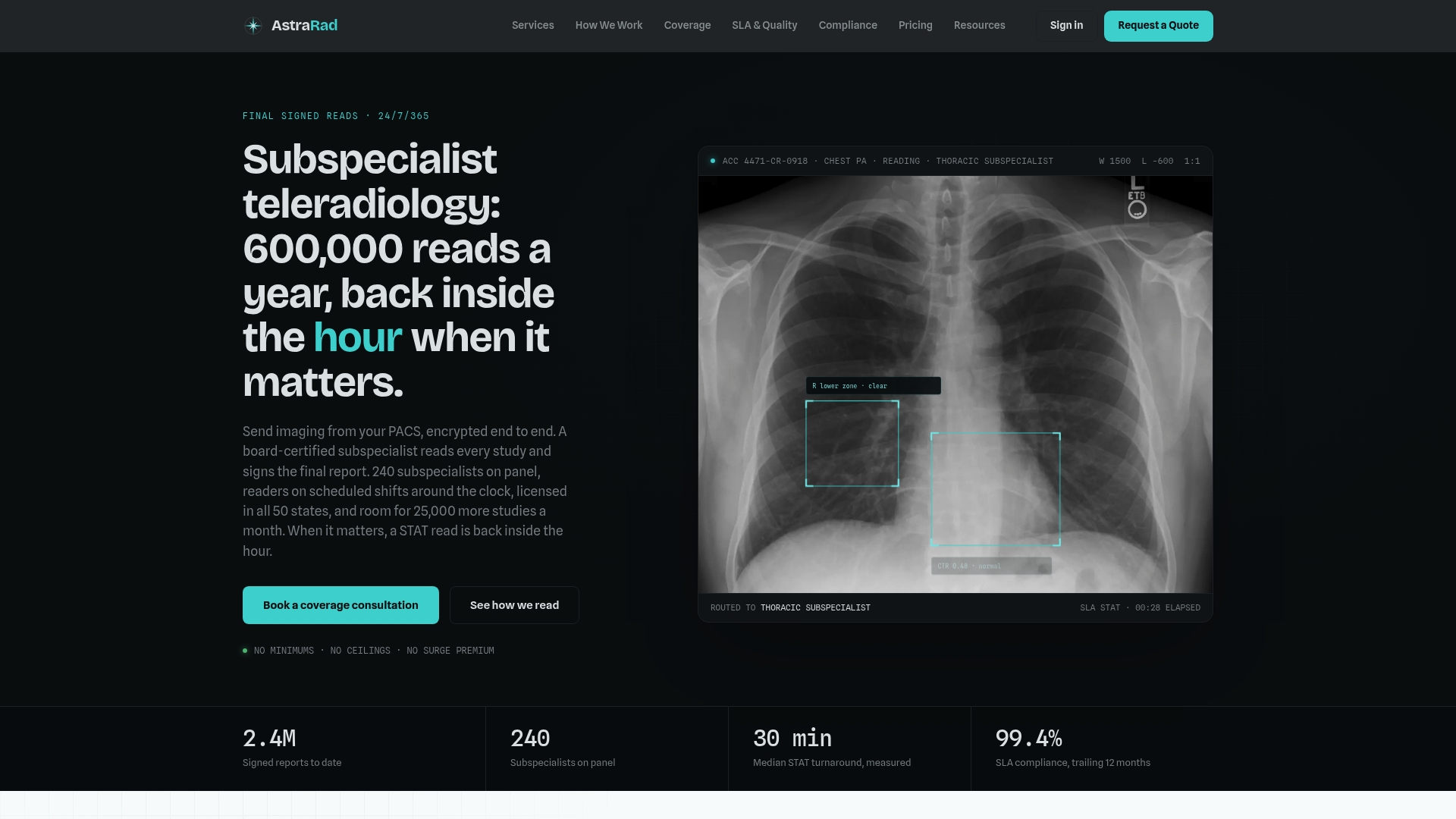
Pricing is per report with no minimums, and the first signed report arrives within 10 business days of countersignature. You can request a complete per-report rate card at /pricing, delivered within one business day, or book a discovery call at /book-a-call. A coverage plan with SLA terms in writing follows the call. To meet the radiologists, see our radiologists.
FAQ
What is dose monitoring in teleradiology?
Dose monitoring in teleradiology is the tracking of radiation dose values from a facility's scanners while radiologists read the studies remotely. The dose data stays with the scanning site and its medical physicist. The remote provider delivers the final signed report, and the contract defines how quality concerns are communicated.
Does a teleradiology provider run my dose monitoring software?
Not by default. Dose monitoring software usually connects to your scanners and is reviewed by your physicist or radiation safety officer. A teleradiology contract covers interpretation and reporting. If you want the provider involved in dose or protocol questions, define that role in writing during contracting.
What is an RDSR and why does it matter?
An RDSR is a Radiation Dose Structured Report, a DICOM object that holds dose parameters for an exam, such as DLP and CTDIvol for CT. Dose monitoring systems collect RDSR data over the network and use it to build trends, histograms and alerts. Newer scanners generally produce it directly.
Who should review dose alerts?
A named person with radiation safety expertise should review them, typically a medical physicist or radiation protection officer. Published guidance says abnormal values should be sent to that role. Assign a backup for nights and weekends so alerts do not wait for a single person.
Can dose monitoring support peer review of remote reads?
They serve different purposes. Dose monitoring checks exposure against benchmarks, while peer review checks interpretation quality. Our process double-reads 1 in 20 reports, blind, for peer review. Keep the two programs separate in your quality plan, and share findings through the communication path your contract defines.
Sources
- ACR Dose Index Registry
- Dose Index Registry (DIR) Features, ACR Support
- A Radiologist's Guide to Radiation Dose Index Monitoring, Applied Radiology
- Radiation dose management systems: requirements and recommendations, PubMed Central
- Real-Time Patient and Staff Radiation Dose Monitoring in IR, PubMed Central
- Patient Body Mass Index and Physician Radiation Dose During Coronary Angiography, Circulation: Cardiovascular Interventions
Related on AstraRad
- Resources
STAT vs routine read pricing: a 20 to 50% premium
STAT radiology reads carry a 20 to 50% premium over routine in published market data. How priority multipliers work, and what your STAT share costs.
- Resources
IMLC teleradiology licensing: what the compact does
The Interstate Medical Licensure Compact cuts a second state license to weeks. What it covers for teleradiology, and what it never replaces.
- Resources
Radiology handoff protocol: a step-by-step guide
Learn how to build a radiology handoff protocol covering escalation times, closed loop acknowledgment, and teleradiology contract terms for partners.
Put a radiologist's name on your next read.
Tell us your modalities and monthly volume. A complete per-report rate card, with turnaround tiers and SLA terms in writing, lands in your inbox within one business day.