Radiology handoff protocol: a step-by-step guide
Learn how to build a radiology handoff protocol covering escalation times, closed loop acknowledgment, and teleradiology contract terms for partners.
A radiology handoff protocol is a written, standard process for transferring responsibility for an imaging order, a pending study or a reported finding from one person or team to another. A good one names the sender and the receiver, lists the minimum information, sets time limits for urgent findings and records an acknowledgment, so nobody has to guess who owns the next step. This guide shows how to build one that holds up across shifts, departments and outside reading partners.
TL;DR
- A handoff happens whenever the care team changes, including shift changes and transfers between units, services or hospitals.
- Yale's critical result guidelines set a 1-hour communication goal for critical findings and 6 hours for urgent ones, a workable model to adapt.
- The ACR BI-RADS requirements call for reasonable attempts to reach the provider within 3 business days for suspicious breast MR and ultrasound findings.
- In a 2015 to 2016 resident study, 85% of surveyed residents saw in-person warm handoffs as safer.
- A handoff is finished only when the receiver acknowledges it, a point the AHRQ 2017 report on alert systems supports.
Table of Contents
- What is a radiology handoff protocol?
- How does AstraRad fit into a radiology handoff protocol?
- Where do radiology handoffs happen?
- What should a radiology handoff include?
- How should critical and urgent findings be escalated?
- What makes a radiology handoff closed-loop?
- What steps make a radiology handoff protocol reliable?
- What should a teleradiology contract say about handoffs?
- How do you measure whether a handoff protocol works?
- Radiology coverage without handoff gaps
- FAQ
- Sources
What is a radiology handoff protocol?
A radiology handoff protocol is a standard, written method for passing responsibility for an imaging order, study or result between people or teams. It defines what information moves, how it moves, who accepts it and how that acceptance is recorded. A handoff is the moment responsibility changes hands, and the protocol is the rule set that makes the moment predictable.
Radiology has more handoffs than most departments realize. The ordering clinician hands a question to the radiology team. One radiologist hands pending studies to the next at shift change. The radiologist hands a result back to the clinician. After that, the clinician hands follow-up responsibility to another clinician, often in a different setting. Each of these is a place where information can drop out.
A protocol does not need to be long. The best ones fit on one or two pages and answer five questions: who is handing off, who is receiving, what must be included, how fast it must happen, and how completion is documented. The rest of this guide works through those five questions in order.
How does AstraRad fit into a radiology handoff protocol?
AstraRad is a US teleradiology service that delivers final signed reports read by board-certified subspecialists. We sell teleradiology to hospitals, imaging centers and radiology groups, so we have a commercial interest in this topic, and you should weigh our view with that in mind. When an outside reading partner covers nights, weekends or overflow, the handoff between your site and ours becomes part of your protocol, and we deliver reports straight into your existing PACS with no extra portal. Our turnaround is committed by contract and measured from last-image arrival to radiologist signature, which gives you a clear clock to write into your own escalation rules. You can read how the workflow runs on our How Teleradiology Works page and see the study types we cover on our teleradiology services page.
Where do radiology handoffs happen?
Radiology handoffs happen at four points: when a clinician orders or requests a study, when a radiologist's shift or workload changes, when a result is communicated, and when follow-up responsibility moves to another clinician. Each point needs its own minimum content, because the sender, the receiver and the risk differ at each one.
Clinician to radiology
This is the exam request and any special precautions that travel with it, such as allergies, isolation status or a consult the clinician wants to start. The most common weakness is a vague clinical question. A radiologist who knows what the clinician is trying to find or exclude reads with a sharper focus than one who sees only an exam name.
Radiologist to radiologist
This is the shift change or the transfer of a worklist. Pending studies, studies waiting on priors, and preliminary reads that still need a final signature must each have a named owner. If your department uses an outside partner for overnight cover, the same rules apply to the partner's radiologists, and the morning handback of anything still open needs to be explicit.
Radiology to clinician
This is the call, page, secure message or report notification that tells the clinician a result exists. For critical or unexpected findings it must be a direct, documented communication, not just a posted report.
Clinician to clinician after the result
This is the least visible handoff and one of the riskiest. The AHRQ final report from 2017 notes that follow-up of non-urgent but important findings, such as incidental pulmonary nodules, often becomes the responsibility of ambulatory care providers, and that transitions from the ED or inpatient stay to ambulatory care make ownership unclear.
If your organization moves patients between facilities as well as between departments, a checklist for coordinating patient transfers is a useful companion to the imaging-specific steps here, since imaging status is one item that has to travel with the patient. And as AI tools enter the reading workflow, AI in diagnostic radiology changes how studies are prioritized, not who is accountable for the final handoff.
What should a radiology handoff include?
A radiology handoff should include patient identifiers, the exam or pending study, the clinical question, relevant history and prior imaging, safety information such as allergies and contrast or pregnancy status, the current status of the study, and a named contact for questions. The exact list depends on the handoff type, but the identifiers and the contact are never optional.
For transfers between facilities, the federal transfer summary note in the Interoperability Standards Platform lists the reason for transfer, medications, allergies, diagnoses, procedures, imaging, labs, consultations, assessment and active problems. It is a useful model for deciding what imaging information must be part of a broader clinical handoff.
The table below turns those ideas into a minimum content list for each handoff type. Adapt the wording to your own forms and your EHR's fields.
| Handoff type | Minimum content | Who confirms receipt |
|---|---|---|
| Exam request | Patient name and date of birth, exam and body part, clinical question, side if relevant, relevant history, prior imaging, allergies and contrast or pregnancy status, ordering clinician contact | Radiology scheduler or technologist |
| Shift change | Pending and unsigned studies, studies awaiting priors, open critical calls, studies flagged for a second read, named incoming owner | Incoming radiologist |
| Result communication | Patient identifiers, finding, urgency category, recommended action, person reached, time, method | Receiving clinician |
| Follow-up handoff | Finding needing follow-up, recommended interval or test, responsible clinician or clinic, due date | Accepting ambulatory provider |
| Outside reading partner | Study identifiers, priority tier, clinical question, priors available, on-call contact at your site, return route for the final report | Partner's intake and your designated contact |
Two habits improve every row. First, send the clinical question in words, not just an order code. Second, make the receiver repeat back the one or two facts that matter most, such as the finding and the action. A short read-back catches mismatches that a signature does not.
How should critical and urgent findings be escalated?
Critical and urgent findings should be escalated by direct communication to a responsible provider within a time limit your department sets in writing, with the recipient, time and method documented. A critical result is a finding that signals a life- or limb-threatening condition, such as a ruptured abdominal aortic aneurysm, and it cannot wait for routine report delivery.
Published policies give you a starting point. At Yale, critical findings carry a communication goal of 1 hour and urgent findings 6 hours. If no provider is reached by the goal time, the radiologist is contacted again. For findings already communicated, radiologists document whom they spoke with, when, and by what method. Yale's policy is one institution's rule, so treat it as a model rather than a national standard.
Some categories have their own clocks. For breast MR and ultrasound findings that are suspicious or highly suggestive of malignancy, the ACR BI-RADS requirements, revised in 2022, say radiologists should make reasonable attempts to reach the healthcare provider within 3 business days.
| Category | Example | Communication goal | Documentation |
|---|---|---|---|
| Critical | Ruptured abdominal aortic aneurysm | 1 hour (Yale model) | Person, time, method |
| Urgent | Finding needing action within the day | 6 hours (Yale model) | Person, time, method |
| Suspicious breast finding | Breast MR or ultrasound highly suggestive of malignancy | Reasonable attempts within 3 business days (ACR) | Attempts and recipient |
| Routine | Expected or stable findings | Standard report delivery | Report in the record |
Write the escalation ladder into the protocol. Name the first contact, the backup if that person is unreachable, and the point at which the radiologist calls the department lead or covering physician. An escalation path that only works when the right nurse answers the phone is not a protocol.
What makes a radiology handoff closed-loop?
A closed-loop handoff is one where the information is sent, received, acknowledged and acted upon, with each step recorded. Closed-loop communication is a process in which the sender confirms that the receiver understood and accepted the message, rather than assuming delivery equals understanding. A report posted to the chart is sent. It is not closed until someone owns the next step.
The AHRQ report from 2017 describes the Alert Notification of Critical Test Results system used at Brigham and Women's Hospital, which has been shown to increase documented communication of critical results between caregivers. The design idea is simple and portable: an alert goes out, the system watches for acknowledgment, and unacknowledged alerts are escalated to a person.
You do not need that exact software to apply the principle. Even a manual version works if it has the same three parts:
- A trigger. A defined list of findings that must generate a tracked communication.
- A clock. A time by which acknowledgment is expected.
- An owner for the gap. A named role that reviews anything unacknowledged at the end of each shift.
The weakest point is usually the discharge or transition. Imaging results and follow-up recommendations need to be visible to the ambulatory provider who inherits the patient, with a clear statement of who is responsible for the recommended next test.
What steps make a radiology handoff protocol reliable?
A radiology handoff protocol becomes reliable when it is short, specific, owned and tested. Reliability comes from standardizing the content, forcing an explicit acceptance of responsibility, and reviewing failures, not from adding more fields. These seven steps work for a single department or a multi-site system.
- Map every handoff. List where studies and responsibility change hands today, including informal ones such as hallway requests and text messages.
- Name the sender and the receiver. Every handoff has a role on each side. If a role cannot be named, the handoff is a gap.
- Set the minimum content. Use the table above as a draft and cut anything nobody uses.
- Choose the channel. Decide which handoffs are verbal, which are written and which are both. Critical findings should be both: a direct conversation and a documented entry.
- Require acceptance. The receiver states that they have taken responsibility, in words or in a system action. Silence is not acceptance.
- Set time limits and an escalation ladder. Use the Yale and ACR examples as reference points and adapt them to your medical staff's approval.
- Review and revise. Audit a sample of handoffs monthly and change the protocol where it fails.
For step 5, consider a warm handoff. A warm handoff is a transfer in which the outgoing and incoming people meet, in person or live by phone, rather than passing information through a note. In a study of an end-of-rotation warm handoff covering 2015 to 2016, incoming and outgoing residents met in person to transition care, and 85% of surveyed residents perceived the process as safer. That is a perception measure from one program, not proof of fewer errors, but it supports using live handoffs for the highest-risk transfers, such as open critical findings at shift change.
Keep the process realistic. A protocol that requires a ten-minute conversation for every routine chest X-ray will be ignored. Reserve live handoffs for cases that justify them and let structured written handoffs carry the rest.
What should a teleradiology contract say about handoffs?
A teleradiology contract should state how studies reach the reader, how fast the final signed report returns, how critical findings are communicated, how discrepancies are handled and how the arrangement is secured. A final signed report is the radiologist's completed and authenticated interpretation, as opposed to a preliminary read that still needs review. If your protocol covers an outside partner, these terms belong in the service level agreement, known as the SLA, not in an informal email.
Use this table as a procurement checklist when you review any reading partner.
| Contract term | What to specify |
|---|---|
| Report status | Final signed reports at every priority tier, including overnight, not preliminary reads only |
| Turnaround | Committed times by priority tier, with the start and stop of the clock defined |
| Critical communication | Who is called, by what method, and how the call is documented |
| Credentialing and licensure | State licensure for the patient's location and your medical staff's credentialing process |
| Peer review | How a share of reports is independently reviewed and how discrepancies reach you |
| PACS integration | How studies arrive, how reports return, standards supported such as DICOM, and who supports the connection |
| Privacy and security | A signed business associate agreement, known as a BAA, and how protected health information is handled |
| Pricing | The billing unit, any volume minimums and any platform or portal fees |
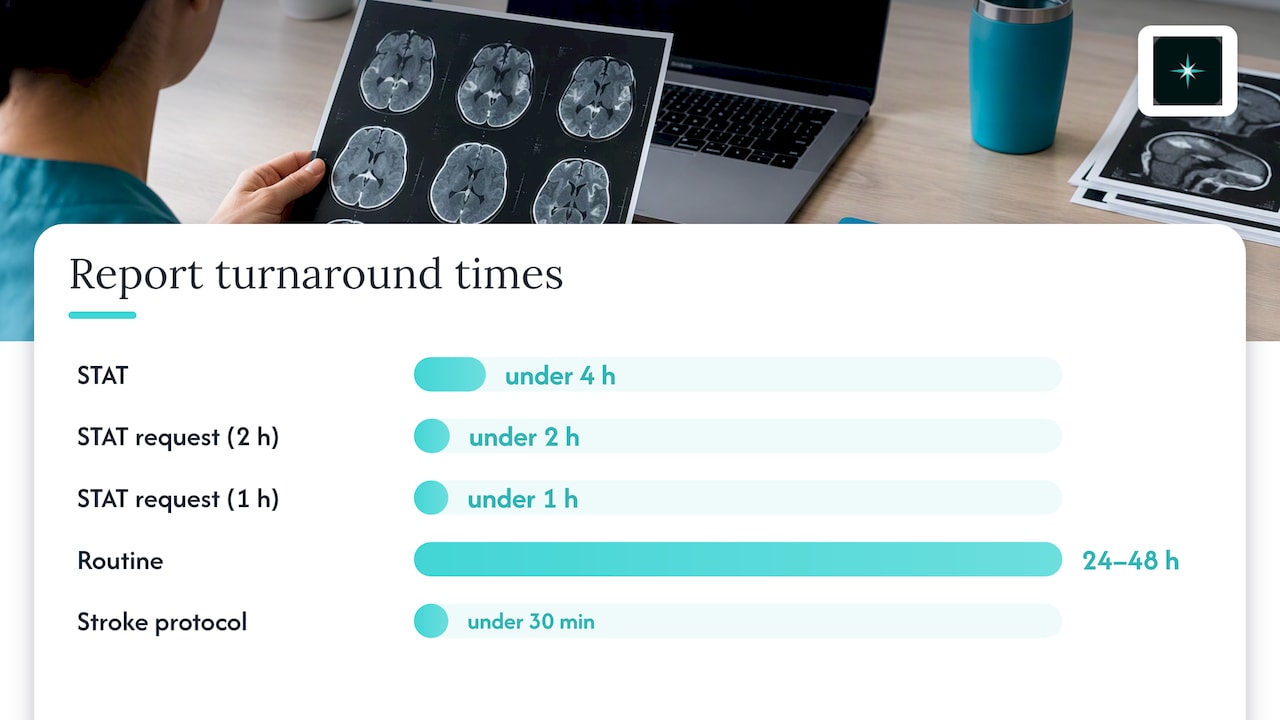
AstraRad commits to these terms in writing after a discovery call. Turnaround is committed by contract and measured from last-image arrival to radiologist signature: STAT under 4 hours, with under 2 hours or under 1 hour available on request, routine 24 to 48 hours, and stroke protocol under 30 minutes. Every read is performed inside the United States, radiologists are licensed in all 50 states, and 1 in 20 reports is independently double-read, blind, for peer review. We work as a business associate under a signed BAA and are HIPAA aligned. Pricing is per report with no minimums. For hospital-specific coverage models, see our teleradiology for hospitals page, and for how STAT tiers work in practice, see our STAT radiology reads page.
A contract term only helps if your own protocol uses it. If the partner commits to a STAT clock, your protocol should say who at your site is notified of a critical finding from that partner, and who covers that role at 3 a.m.
How do you measure whether a handoff protocol works?
You measure a handoff protocol by tracking whether information arrived complete, whether the receiver acknowledged it on time, and whether follow-up actually happened. Choose a few measures you can pull without extra work, review them monthly, and act on the failures instead of the averages.
Useful measures include:
- Acknowledgment time. The share of critical and urgent findings with a documented recipient inside your time limit.
- Documentation completeness. The share of critical communications that record person, time and method, the three elements Yale's policy asks radiologists to capture.
- Unacknowledged alerts. The number open at the end of each shift and how long they stayed open.
- Incomplete requests. The share of exam requests returned for missing clinical information or priors.
- Follow-up completion. The share of findings with a recommended follow-up that has a named owner and a scheduled action.
- Discrepancies. Differences between preliminary and final reports, reviewed for cause rather than blame.
The AHRQ report notes that the hospital it describes evaluated follow-up implementation as well as alert delivery. That is the right instinct: a communication that reached someone but led to no action is still a failure. Add one qualitative check each quarter. Ask radiologists and referring clinicians which handoff they trust least, then audit it first.
Radiology coverage without handoff gaps
AstraRad is a US teleradiology service that delivers final signed reports read by board-certified subspecialists. If your protocol has weak points at night, on weekends or during volume spikes, an outside reading partner can close them, provided the contract and the PACS connection are set up as described above.
Our studies are routed to a subspecialist matched to the modality and body part, on scheduled US shifts 24/7/365. Reports go directly into your existing PACS, DICOM conformant, so your clinicians do not log in to a separate portal.
If you read MRI in house but need subspecialty support, start with our MRI teleradiology service. To discuss coverage and a per-report rate card, contact us through our teleradiology services page. After a discovery call, we send a coverage plan with SLA terms in writing, and the first signed report arrives within 10 business days of countersignature.
FAQ
What is a handoff in radiology?
A handoff in radiology is any point where responsibility for an imaging order, a pending study or a result passes from one person or team to another. Common examples are the exam request, the radiologist shift change, the communication of a result and the transfer of follow-up to another clinician. Each one needs defined content and a named receiver.
What information is required in a radiology exam request?
An exam request should include the patient's name and date of birth, the exam and body part, the clinical question, relevant history and prior imaging, allergy and contrast or pregnancy status, and the ordering clinician's contact details. The clinical question matters most, because it tells the radiologist what to look for or exclude.
How fast must critical radiology findings be communicated?
No single national clock applies to every case. Yale's published guidelines set a 1-hour goal for critical findings and 6 hours for urgent ones, and the ACR BI-RADS requirements call for reasonable attempts within 3 business days for suspicious breast MR and ultrasound findings. Set your own limits in writing and document the recipient, time and method.
What is closed-loop communication in radiology?
Closed-loop communication means a result is sent, received, acknowledged and acted upon, with each step documented. In radiology it prevents the assumption that a posted report has reached the person responsible. A monitored alert, a read-back or a tracked acknowledgment can all serve as the closing step.
Should teleradiology handoffs be covered in the SLA?
Yes. The SLA should define the priority tiers, the turnaround clock, final signed report delivery, critical finding communication, discrepancy handling, peer review and PACS integration. Put the names and numbers of your own contacts in the agreement so an overnight critical finding reaches a person, not a general inbox.
Sources
- Critical Result Guidelines, Yale Radiology & Biomedical Imaging
- BI-RADS Requirements: Breast MR Module, American College of Radiology
- Automated Notification for Follow-Up Testing, AHRQ final report (2017)
- Warm Handoffs: a Novel Strategy to Improve End-of-Rotation Care Transitions, PubMed Central
- Transfer summary note, Interoperability Standards Platform (HealthIT.gov)
Related on AstraRad
- Resources
IMLC teleradiology licensing: what the compact does
The Interstate Medical Licensure Compact cuts a second state license to weeks. What it covers for teleradiology, and what it never replaces.
- Resources
Closed-loop critical results communication in teleradiology
Closed-loop critical results communication ends when a licensed provider verbally acknowledges the finding and five logged data points prove it happened.
- Resources
PACS-to-PACS teleradiology: how it works
PACS-to-PACS teleradiology routes studies between your PACS and a reading group's and returns signed reports; here is how to plan, secure and validate it.
Put a radiologist's name on your next read.
Tell us your modalities and monthly volume. A complete per-report rate card, with turnaround tiers and SLA terms in writing, lands in your inbox within one business day.