PACS-to-PACS teleradiology: how it works
PACS-to-PACS teleradiology routes studies between your PACS and a reading group's and returns signed reports; here is how to plan, secure and validate it.
PACS-to-PACS teleradiology is a model in which your picture archiving and communication system (PACS) sends studies directly to the reading group's PACS over DICOM, and the signed report returns to your systems. Radiologists read in their own environment, so you do not give them logins to yours. The result is a final signed report without a separate portal for your staff to check.
TL;DR
- PACS-to-PACS teleradiology moves studies between two PACS using DICOM, so the reading group works in its own viewer and worklist.
- The ACR,AAPM,SIIM technical standard (2022) names DICOM and IHE conformance, security safeguards and adequate bandwidth as the planning basics.
- The HIPAA Security Rule, as explained in NIST SP 800-66 Revision 2 (2024), requires written assurances from business associates, which in practice means a signed BAA.
- AstraRad commits to STAT, routine and stroke protocol turnaround by contract, with reports delivered into your existing PACS.
Table of Contents
- What is PACS-to-PACS teleradiology?
- How does PACS-to-PACS differ from remote access to your PACS?
- Who is AstraRad, and what is our interest in this topic?
- How do images, worklists and reports move between two PACS?
- What technical requirements does a PACS-to-PACS connection have?
- How are patient identity and orders matched across two PACS?
- What security and HIPAA rules apply?
- What goes wrong in PACS-to-PACS workflows, and how do you monitor it?
- What should you assess before going live?
- What affects the cost of PACS-to-PACS teleradiology?
- Which connection model suits which organization?
- How can AstraRad support your connection?
- FAQ
- Sources
What is PACS-to-PACS teleradiology?
PACS-to-PACS teleradiology is a workflow model in which an originating facility's PACS forwards imaging studies to a separate PACS operated by a remote reading group, and the interpretation comes back to the originating facility as a final report. Two systems exchange data. Neither side logs into the other.
A few terms matter for the rest of this article:
- A PACS is a system that stores, retrieves, distributes and displays medical images.
- DICOM is the standard format and network protocol for medical images and their metadata.
- A final signed report is a radiologist's completed interpretation, authenticated by signature, as opposed to a preliminary or wet read.
- A business associate agreement (BAA) is a contract under HIPAA in which a vendor handling protected health information agrees to safeguard it.
- A SLA (service level agreement) is the contract section that sets turnaround and reporting commitments.
For a hospital administrator, the practical meaning is simple. Your technologists keep acquiring studies as they do today. The study leaves your PACS or DICOM gateway, reaches the reader, and a signed report arrives where your referring clinicians already look.
How does PACS-to-PACS differ from remote access to your PACS?
In remote access, the radiologist connects to your PACS through a VPN or a web viewer and reads on your system. In PACS-to-PACS, the study is copied to the reading group's PACS and read there. The first model borrows your infrastructure. The second uses the reader's.
The difference shows up in four places:
| Factor | Remote access to your PACS | PACS-to-PACS exchange |
|---|---|---|
| Where the read happens | On your PACS, over VPN or web viewer | On the reading group's PACS |
| Credentials | You issue and manage accounts for each radiologist | No accounts on your system for readers |
| Worklist | Radiologist works from your list, site by site | Reader's worklist combines studies from many sites |
| Load on your IT | Higher: user provisioning, licenses, VPN support | Concentrated in the interface and routing rules |
| Report return | Often entered directly into your system | Sent back to your PACS, RIS or EHR |
The combined worklist is the main operational advantage for the reader. A 2010 paper on merging PACS and teleradiology workflow describes a global worklist that lets radiologists pick studies across sites without tracking where each came from. That is the reason groups handling many facilities prefer receiving studies into one platform.
Remote access still has a place. A small site with one overnight reader may find it simpler. When several readers, several modalities and committed turnaround are involved, exchange between systems tends to scale better because routing, prioritization and subspecialty matching happen on the reader's side.
Who is AstraRad, and what is our interest in this topic?
AstraRad is a US teleradiology service that delivers final signed reports read by board-certified subspecialists. We sell this service, so we have a commercial interest in the subject. We wrote this guide so that your team can judge any PACS-to-PACS arrangement, ours included, against clear technical and contractual criteria.
Our model works like this: every study is routed to a subspecialist matched to the modality and body part, across ten subspecialties and twelve study types. Reads happen on scheduled US shifts, 24/7/365, and every read is performed inside the United States. Reports go straight into your existing PACS with no extra portal, and our delivery is DICOM conformant. You can see the full service range on our teleradiology services page, and the end-to-end process on how teleradiology works from your PACS to a signed report.
Pricing is per report with no minimums. A complete per-report rate card is available on request through our pricing page, and a coverage plan with SLA terms in writing follows a discovery call.
How do images, worklists and reports move between two PACS?
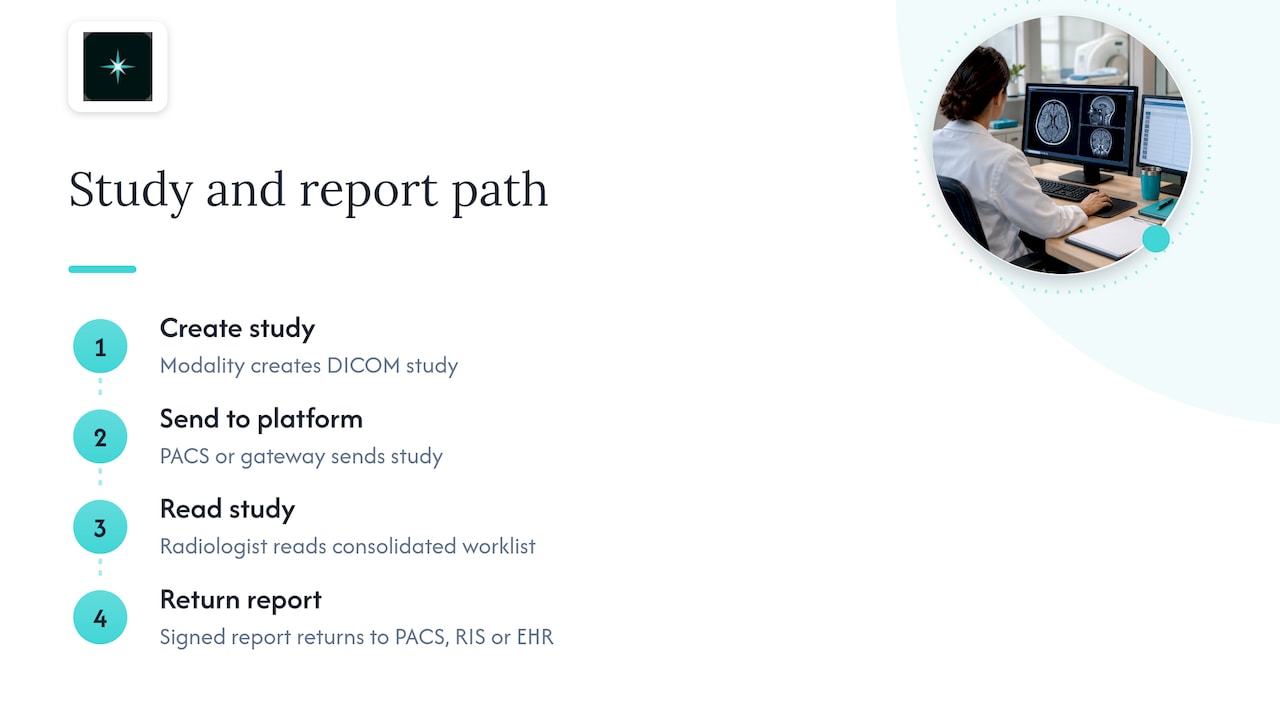
A study moves in four steps: the modality creates a DICOM study, your PACS or gateway sends it to the reading platform, the radiologist reads it from a consolidated worklist, and the signed report returns to your PACS, RIS or EHR. Each step has its own failure points and its own owner.
Step 1: Acquisition and forwarding
The modality produces a DICOM study and stores it on your local PACS. A routing rule then forwards it. Most facilities trigger forwarding on a status, such as a study becoming unread, or on a modality and location rule, so only the studies you outsource leave the building.
Step 2: Transfer to the reading group
The RSNA Image Sharing Network article (2015) explains that when two PACS can talk behind the same firewall, the sending PACS can push the examination to the interpreting PACS using DICOM. It also describes a gateway or buffer that can hold a study until the receiving order exists, then rewrite the DICOM header to match that order before import. Across a firewall, the same article lists physical media, VPN, or IHE web services such as XDS and XDS-I as options.
Step 3: Reading from a consolidated worklist
On the reading side, studies from all connected sites land in one worklist. Priors and clinical history should arrive with the study or be fetched on request. Routing then applies priority and subspecialty rules, so a neuro MRI goes to a neuroradiologist and a stroke protocol CT goes to the front of the queue.
Step 4: Report return
The signed report goes back to the system that ordered the study. Depending on your configuration, that is a result message to the RIS or EHR, a report attached in the PACS, or both. Confirm early which of these your referring clinicians actually open, because a report that is delivered but not visible is a delivery failure in practice.
For AstraRad clients, the destination is your existing PACS, so there is no second portal for ordering clinicians to learn.
What technical requirements does a PACS-to-PACS connection have?
A PACS-to-PACS connection needs DICOM conformance on both ends, agreed routing rules, a patient and order identity strategy, and a secure network path with enough bandwidth for your volume. The ACR,AAPM,SIIM technical standard (2022) names DICOM and IHE conformance, security and privacy safeguards, and bandwidth commensurate with expected volumes as assessment items.
Use this table as a requirements worksheet for your IT team:
| Requirement | What to confirm | Who owns it |
|---|---|---|
| DICOM conformance | Conformance statements from both PACS; supported SOP classes and transfer syntaxes | Both IT teams |
| Network path | VPN, TLS-encrypted transfer, or IHE web services; firewall rules and allowed endpoints | Both IT teams |
| Routing rules | Which studies leave, on what trigger, to which AE title | Your PACS administrator |
| Identity and orders | How accession numbers and patient IDs are matched | Your PACS and RIS administrators |
| Bandwidth | Peak study volume times average study size, with headroom | Your network team |
| Report return | Target system, format, and who sees the report | Both, plus your clinical leads |
| Downtime procedure | Queue behavior, alerts, manual fallback | Both |
Bandwidth deserves arithmetic, not guesswork. Multiply the number of outsourced studies in your busiest hour by their typical size (a CT with thin slices is far larger than a chest X-ray), and check that the upload link can move that amount within your STAT window with other traffic running.
The VA offers a concrete example of how strict conformance requirements can get. Its DICOM interface specification (2009) defines DICOM operations and requires IHE conformance for Scheduled Workflow and Patient Information Reconciliation. Your facility does not need the VA's profile, but asking vendors whether they support those two IHE profiles is a useful test.
How are patient identity and orders matched across two PACS?
Patient identity is matched by agreeing on an identifier and an order reference before the first study moves. DICOM transfers images, but the receiving organization remains responsible for reconciling demographics, associating or creating the local order, and profiling the study into its own systems. Unmatched studies are the most common reason a read is delayed.
The RSNA article (2015) frames image exchange as a delivery mechanism only. The receiving side still has to match demographics and create or link an order. That is why a buffer that waits for the order can be valuable: it stops a study from importing as an orphan.
The VA's specification shows one answer at enterprise scale. It uses the Integration Control Number, described as a VA-wide unique patient identifier used across sites. A private hospital system rarely has such an identifier across a reading partner, so most agreements fall back on three fields:
- Accession number, which ties the study to the order.
- Medical record number from the sending facility, kept stable across sites.
- Patient name and date of birth, used as a check rather than the primary key.
Decide in writing who corrects a mismatch, how fast, and through which channel. A mismatched study that sits in a queue silently is worse than one that fails loudly.
What security and HIPAA rules apply?
Both your facility and the reading group handle electronic protected health information (ePHI), so the HIPAA Security Rule applies to the exchange. It requires protection of ePHI that is created, received, maintained or transmitted, and written satisfactory assurances from business associates. In a teleradiology contract, that assurance is the BAA.
The NIST guide to implementing the HIPAA Security Rule (2024) describes the Security Rule's focus as confidentiality, integrity and availability, and notes that protection is against reasonably anticipated threats, hazards and impermissible uses or disclosures. Treat that three-part frame as your security checklist for the connection:
- Confidentiality: encrypted transfer, restricted endpoints, and access control on the reading side.
- Integrity: checks that the study and report arrive unaltered and attached to the right patient.
- Availability: a defined fallback if the link, a gateway or a reading platform goes down.
AstraRad is HIPAA aligned and works as a business associate under a signed BAA. Radiologists are licensed in all 50 states, and every read is performed inside the United States, which matters for teams whose policies restrict where ePHI can be accessed. Ask every prospective reader for the same facts in writing, and check that they match the contract.
Cloud-based exchange has largely moved from tunnel-based VPNs toward TLS-encrypted transmission. Either approach can be acceptable if your security team has reviewed it and documented the risk analysis.
What goes wrong in PACS-to-PACS workflows, and how do you monitor it?
The common failures are studies that never arrive, studies that arrive under the wrong patient or order, reports that return but never display, and silent queue buildup. A connection that shows as up can still be failing clinically, so monitor transactions, not just endpoints.
Practical monitoring covers both technical and business measures:
| Measure | What it catches |
|---|---|
| Message and study volume per hour | Sudden drops from a stalled routing rule |
| Success and failure counts, retries | Intermittent network or AE title problems |
| Queue depth and age of the oldest item | Backlogs building before anyone calls |
| Acknowledgements received | Studies sent but not accepted |
| Duplicate identifiers or missing fields | Orphans and mismatched orders |
| Sent versus read versus reported counts | Studies lost between steps |
The last row is the most useful. Reconcile what you sent against what came back signed, daily. Any study without a report beyond its turnaround window should trigger a call, not a ticket that waits.
Two habits cut most incidents. First, test with real study types, not only a sample CT: include a multi-series MRI, a study with priors and a study with a late-arriving image. Second, define what "last image arrival" means. Under AstraRad's contracts, turnaround is measured from last-image arrival to radiologist signature, so a sending rule that releases a study before all series are in will distort every number.
What should you assess before going live?
Before go-live, assess DICOM and IHE conformance, security and privacy safeguards, and bandwidth against expected volume, as the ACR technical standard (2022) outlines. Then validate with test studies, a reconciliation process and a written SLA. Treat the project as an interface and contract exercise together.
A workable sequence for a procurement team:
- Define scope. List modalities, sites, hours and the study types you will send. Separate overnight coverage from overflow, since they stress the connection differently.
- Collect conformance statements. Request DICOM conformance statements and ask about IHE profile support.
- Complete the BAA and security review. Run your standard vendor assessment, and keep the signed BAA with the contract file.
- Agree turnaround tiers in the SLA. Confirm the clock start, the clock stop and how exceptions are reported.
- Build and test routing. Send test studies from each modality, confirm patient and order matching, and confirm the report lands where clinicians look.
- Run a parallel period. Compare sent, read and reported counts for a defined window before relying on the connection overnight.
- Set up ongoing reporting. Decide on the cadence of compliance and turnaround reports and who reviews them.
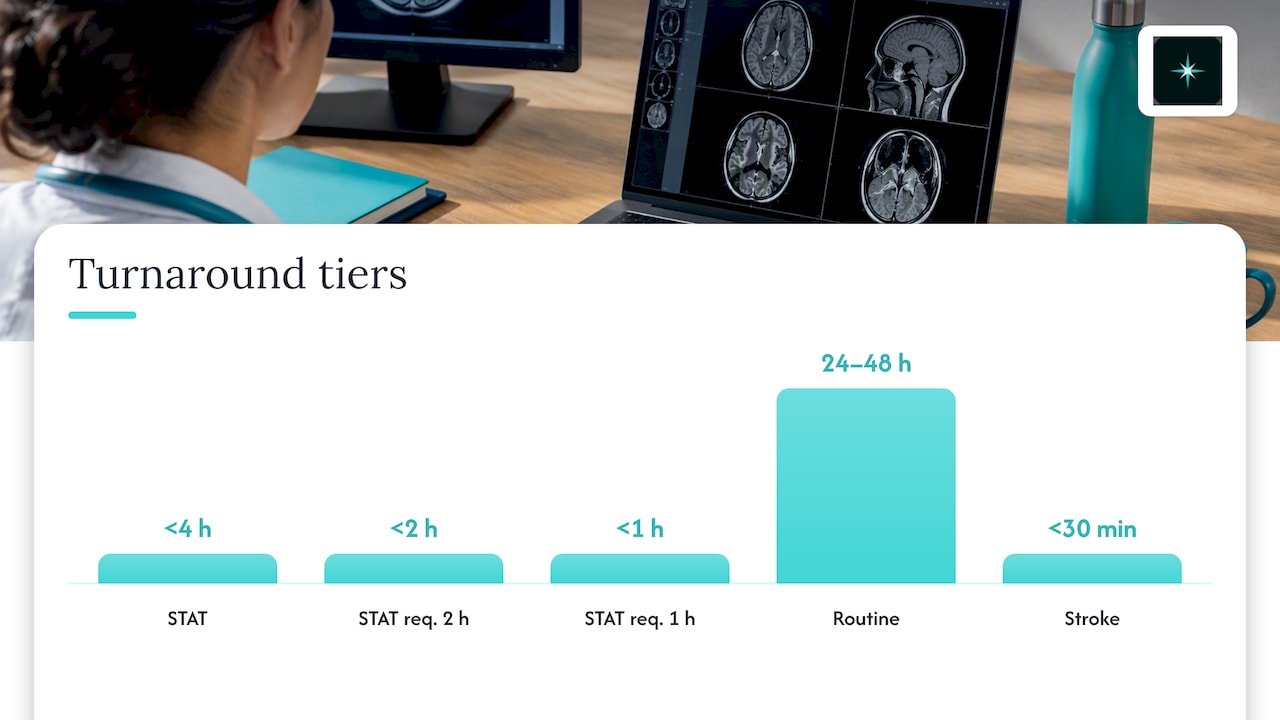
Our committed turnaround tiers are STAT under 4 hours (under 2 hours or under 1 hour on request), routine 24 to 48 hours, and stroke protocol under 30 minutes. Each is measured from last-image arrival to radiologist signature. The first signed report arrives within 10 business days of countersignature, which gives your IT team a defined target for connection testing.
What affects the cost of PACS-to-PACS teleradiology?
Beyond the reading fee itself, cost depends on interface options, network capacity, gateway or buffer needs, and the internal time to configure and test. Some PACS vendors sell result interfaces as optional extras, so confirm what your system includes before you budget.
One vendor workflow document, Konica Minolta's Symmetry Workflow sheet, lists inbound HL7 orders with modality worklist, HL7 results, physician-portal images and EHR image links or reports as optional purchases. That is one example of why your own PACS contract matters as much as the teleradiology contract.
A cost checklist keeps the budget honest:
| Cost area | Question to ask |
|---|---|
| Reading fees | Per report or per block of hours? Are there minimums? |
| PACS interfaces | Are order and result interfaces licensed separately? |
| Gateway or buffer | Do you need one for order matching or routing? |
| Network | Does your upstream link handle peak outsourced volume? |
| Staff time | Who configures, tests and monitors the connection? |
| Platform fees | Does the reader charge for portals, seats or storage? |
AstraRad prices per report with no minimums, and with no extra portal to license. We do not publish rates here. You can request a complete per-report rate card, delivered within one business day, and we send a coverage plan with SLA terms in writing after a discovery call.
Which connection model suits which organization?
The right model depends on volume, site count and your IT capacity. Small, single-reader arrangements can use remote access. Multi-site, multi-subspecialty or committed-turnaround needs usually point to PACS-to-PACS exchange. The table summarizes the trade-offs by type of arrangement, without naming any provider.
| Model | Best fit | Main trade-off |
|---|---|---|
| Remote access to your PACS | One or two readers, low volume | You manage accounts, licenses and VPN support |
| PACS-to-PACS exchange | Several sites, subspecialty routing, committed SLAs | Needs routing, identity matching and monitoring work up front |
| Cloud upload platform | Sites without a PACS gateway | Staff may need a separate portal for reports |
AstraRad uses the second pattern: studies are routed to the matched subspecialist and reports return to your PACS. For many buyers, the use cases that start the conversation are rural and critical access hospital overnight coverage and overflow reads during volume peaks.
How can AstraRad support your connection?
AstraRad is a US teleradiology service that delivers final signed reports read by board-certified subspecialists. If you are scoping a connection, start with the modality that creates the most backlog. MRI teleradiology reporting and X-ray and ultrasound overflow final reads are common starting points, and the full list is on our services page.
A discovery call covers your PACS, routing, volumes and the SLA you need. A coverage plan with terms in writing follows. Our stroke protocol, STAT and routine tiers, 1 in 20 blind double-read peer review and licensing in all 50 states are all part of that plan.
FAQ
What is PACS-to-PACS teleradiology?
It is a workflow where your PACS sends studies directly to a reading group's PACS over DICOM, and the signed report returns to your systems. Radiologists read on their own platform. Your staff do not need to manage reader accounts on your PACS.
Is PACS-to-PACS the same as remote PACS access?
No. Remote access lets a radiologist log into your PACS and read there. PACS-to-PACS copies the study to the reader's PACS, where it joins a consolidated worklist. The second model shifts account management and viewer support away from your IT team.
What standards does a PACS-to-PACS connection need?
DICOM is the base standard for image transfer. The ACR,AAPM,SIIM technical standard (2022) also points to IHE conformance, security and privacy safeguards, and bandwidth matched to volume. Ask both sides for DICOM conformance statements and for the IHE profiles they support before testing begins.
Does a PACS-to-PACS connection require a BAA?
Yes, when the reading group handles your ePHI. The HIPAA Security Rule calls for written satisfactory assurances from business associates, and a signed BAA is the standard contract form. AstraRad works as a business associate under a signed BAA and is HIPAA aligned.
How do I price a teleradiology connection?
Separate reading fees from interface, gateway, network and staff costs. AstraRad prices per report with no minimums. You can request a complete per-report rate card, delivered within one business day, or book a discovery call to scope your volumes and SLA.
Sources
- ACR,AAPM,SIIM Technical Standard for Electronic Practice of Medical Imaging (2022)
- NIST SP 800-66 Revision 2: Implementing the HIPAA Security Rule (2024)
- The RSNA Image Sharing Network (2015)
- VA Profiles for DICOM Interface Between VistA Imaging and PACS (2009)
- From shared data to sharing workflow: merging PACS and teleradiology (2010)
- Symmetry Workflow, Konica Minolta
Recommended
Related on AstraRad
- Resources
Closed-loop critical results communication in teleradiology
Closed-loop critical results communication ends when a licensed provider verbally acknowledges the finding and five logged data points prove it happened.
- Resources
Per-modality coverage hours in teleradiology
Per-modality coverage hours define when each imaging modality gets a subspecialist read. Learn how to set them in a teleradiology contract and SLA.
- Resources
Teleradiology RIS integration: orders in, reports back
Teleradiology RIS integration is two flows: the order out, the signed report back as HL7 ORU. Your worklist, order entry and MRNs all stay where they are.
Put a radiologist's name on your next read.
Tell us your modalities and monthly volume. A complete per-report rate card, with turnaround tiers and SLA terms in writing, lands in your inbox within one business day.