Per-modality coverage hours in teleradiology
Per-modality coverage hours define when each imaging modality gets a subspecialist read. Learn how to set them in a teleradiology contract and SLA.
Per-modality coverage hours are the specific days and times during which a teleradiology provider commits to reading each type of imaging study, such as CT, MRI, X-ray, ultrasound or PET-CT. The hours belong in your contract, next to a turnaround time for each study type, so that a head CT at 3 a.m. and a routine outpatient MRI on Saturday each have a written answer. Define them per modality, per shift and per priority tier before you sign.
TL;DR
- Per-modality coverage hours are a contract term that states when each study type is read, by which kind of reader, and within what turnaround.
- The American College of Radiology (ACR) advises that contracts specify shift start and stop times, weekend and holiday frequency, call arrangements, time-zone expectations and queue requirements (ACR Bulletin, 2026).
- AstraRad commits to scheduled US shifts 24/7/365, with final signed reports at every tier, including overnight.
- AstraRad's committed turnaround tiers are STAT under 4 hours, routine 24 to 48 hours and stroke protocol under 30 minutes.
- Pricing is per report with no minimums, and a per-report rate card is available at /pricing.
Table of Contents
- What does per-modality coverage hours mean in teleradiology?
- Who wrote this, and what is our interest?
- Which imaging modalities usually get distinct coverage hours?
- How are coverage hours scheduled for daytime, overnight, weekend and holiday periods?
- What staffing models can provide coverage across imaging modalities?
- What turnaround terms should you define for each modality?
- How does AstraRad commit to coverage hours and turnaround?
- What should a coverage hours checklist include before you sign?
- How do you compare providers on coverage hours?
- Is AstraRad the right fit for your coverage gap?
- FAQ
- Sources
What does per-modality coverage hours mean in teleradiology?
Per-modality coverage hours are the windows in which a provider commits to interpreting a given modality, written into the service agreement. A modality is a type of imaging technology, such as computed tomography (CT), magnetic resonance imaging (MRI), radiography (X-ray), ultrasound or positron emission tomography (PET-CT). Coverage hours are not the same as the hours a provider is "open." They describe who reads what, and when.
The distinction matters because a teleradiology agreement that says "24/7 coverage" can still leave questions open. Does every modality get a read at 2 a.m., or only emergency CT and plain films? Is a subspecialist assigned to a neuro MRI on a holiday, or does a general reader take it? Does a routine ultrasound ordered Friday evening wait until Monday? Per-modality coverage hours answer these in advance.
For a hospital administrator or imaging center director, three parts of the term do the work:
- The window: the days and clock times during which a modality is read, in a stated time zone.
- The reader: the credential and subspecialty expected for that modality and body part.
- The clock: the turnaround commitment and the points at which it starts and stops.
A final signed report is a completed interpretation that a radiologist has reviewed and signed, so it can enter the medical record without a second read. It is a different deliverable from a preliminary read, which is provisional and needs a later final. Your coverage hours should say which of the two each modality receives in each window.
Who wrote this, and what is our interest?
AstraRad is a US teleradiology service that delivers final signed reports read by board-certified subspecialists. We publish this guide because we sell the service it describes, and we want you to see that interest plainly. We wrote it to help you ask better questions of any provider, including us. Our own coverage model is described later in this article and on our teleradiology services page.
Which imaging modalities usually get distinct coverage hours?
Most buyers assign distinct hours to modalities that differ in urgency, volume and reader expertise. Emergency CT and plain radiography are usually the first to need around-the-clock cover, while scheduled MRI, PET-CT and ultrasound can follow different windows. The right split depends on your emergency department, your inpatient mix and your outpatient schedule.
The table below is a planning framework, not a rule. It shows the questions to answer for each modality, so that the agreement does not leave them to assumption.
| Modality | Why hours often differ | What to write into the agreement |
|---|---|---|
| CT (head, chest, abdomen) | Drives most emergency department demand, including stroke and trauma work | Hours of coverage, STAT and stroke protocol turnaround, escalation path |
| X-ray (radiography) | High volume, often from urgent care and the emergency department | Whether reads are continuous or batched, and the priority rules |
| MRI | Many studies are scheduled; some inpatient and neuro cases are urgent | Subspecialty assignment (neuro, MSK, body), after-hours rules |
| Ultrasound | Mix of scheduled outpatient and urgent inpatient studies | Which indications qualify for after-hours reads |
| PET-CT and nuclear medicine | Typically scheduled, oncology driven, needs specialized readers | Reader subspecialty, routine window, comparison study access |
Two points deserve emphasis. First, "urgent" is a clinical judgment and a contract definition, and the two should match. List the indications, such as suspected stroke, trauma or acute abdomen, that move a study into the fastest tier. Second, a provider's list of supported study types is not the same as its hours for each one. Ask for both.
You can see how AstraRad organizes its work by modality on the pages for MRI teleradiology, X-ray and ultrasound overflow reads and PET-CT and nuclear medicine reads.
How are coverage hours scheduled for daytime, overnight, weekend and holiday periods?
Coverage is scheduled in blocks: daytime, evening, overnight, weekend and holiday. Each block can be staffed differently, so the agreement should name the start and stop time of every block, how often weekend and holiday shifts occur, how calls are arranged, and the time zone the clock runs in.
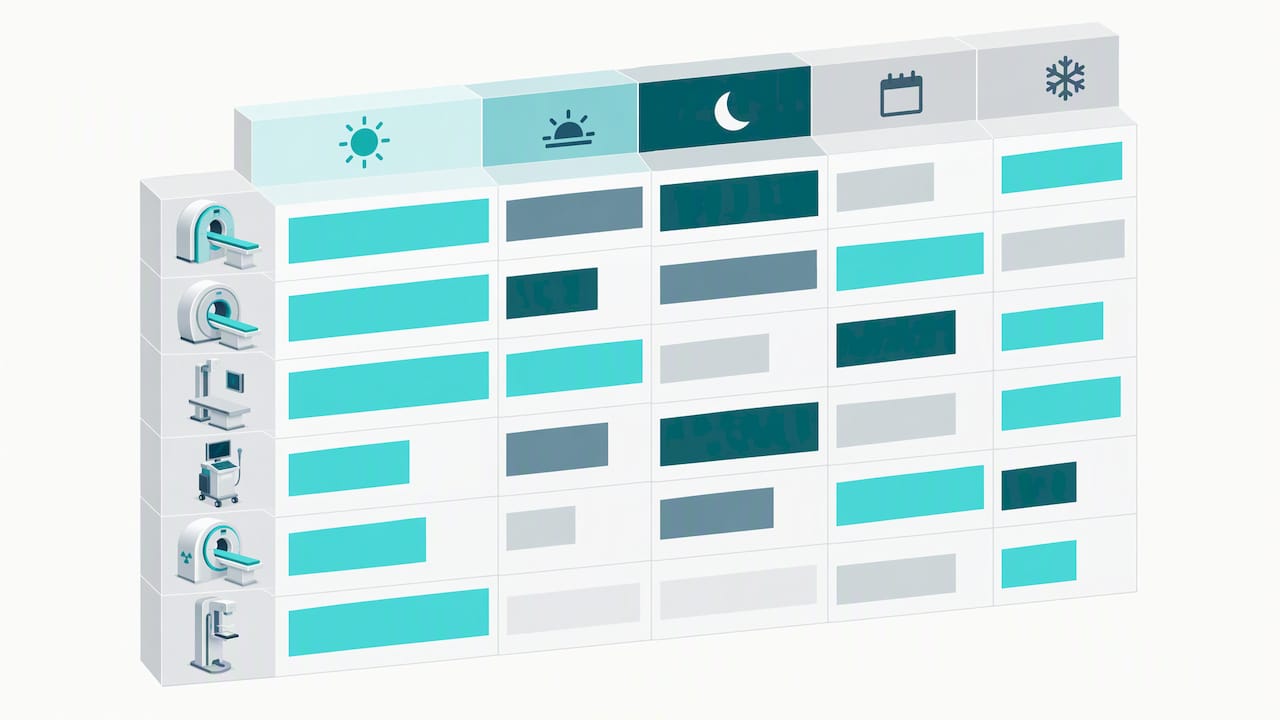
The ACR's guidance for physicians reviewing a first radiology contract says the same thing in procurement terms: contracts should specify shift start and stop times, weekend and holiday frequency, call arrangement, time-zone expectations and queue requirements. Those are the same items a buyer should check in a provider's service agreement, because they define what the provider is actually promising.
Daytime and evening blocks
Daytime coverage is where most scheduled outpatient work lands. Evening coverage has historically relied on extended shifts or on-call arrangements, and overnight cover has often been handled by contracted services, according to a 2022 review in Applied Radiology. If your own group covers days and evenings, your teleradiology agreement may only need to begin at a set hour. If you have no in-house readers, the agreement should span the full day.
Overnight blocks
Overnight is where the schedule design matters most, because fatigue affects quality. A 2021 academic review of overnight emergency radiology coverage suggests a 9 to 10 hour overnight shift, notes that shifts of 9 hours or less are associated with higher job satisfaction, and reports that errors peak 10 to 12 hours into a shift. For a buyer, the practical question is whether your provider rotates readers on scheduled shifts or stretches individuals across long stints. Ask how overnight shifts are built.
Weekend and holiday blocks
Weekends and holidays are the periods most often left vague. State which holidays are covered, whether the modality mix changes, and whether the turnaround commitments are the same as on weekdays. If you want to understand how a provider handles this without burning out its readers, our page on weekend and holiday radiology coverage explains our approach.
What staffing models can provide coverage across imaging modalities?
Coverage across modalities is provided by a mix of on-site radiologists, on-call arrangements, contracted teleradiology and subspecialty pools. A staffing model is the way a practice assigns readers to shifts and studies. The model you choose determines how well each modality is matched to a reader with the right training.
Practices have been changing these models. The ACR Bulletin describes variable full-time-equivalent tracks, centralized scheduling and subspecialty pools used to match capacity to demand and to individual preferences (2026). The same article frames the goal as redesigning work rather than redistributing exhaustion. That is a useful test for a provider: ask whether its schedule is designed or merely inherited.
Here are the common models, compared on what a buyer cares about.
| Model | How it works | Strength | Question for the buyer |
|---|---|---|---|
| In-house only | Your own radiologists cover all hours | Full control, local presence | Can you staff nights, weekends and holidays sustainably? |
| In-house days, contracted nights | Your group reads days; a provider reads overnight | Eases the hardest shift | Are the handoff and priority rules written down? |
| Overflow contract | A provider takes volume above your capacity | Flexible to demand | What triggers overflow, and what is the turnaround? |
| Full outsourcing | A provider reads all studies | One accountable partner | Does it cover every modality you perform, by subspecialty? |
Note that off-site coverage generally fits diagnostic reading, while procedures such as interventional work require a physician on site. Your agreement should separate the two, so that nobody assumes a remote reader can cover a procedure.
AstraRad works with several of these patterns. Our pages on nights, weekends and overflow coverage and overflow radiology reads describe how the service fits around an existing department, and the hospital page covers night, emergency department and rural cover.
What turnaround terms should you define for each modality?
For each modality, define the priority tier, the turnaround target, the exact start and stop of the clock, and the escalation path if the target is missed. Turnaround time is the elapsed time between a defined start event and a defined end event. If the agreement does not define those events, two parties can read the same number differently.
The ACR's white paper on teleradiology says turnaround times should follow accepted hospital and departmental requirements rather than a single universal standard (2013). So the benchmark is your own: what your emergency physicians, surgeons and referring clinicians need. Write that in, and ask the provider to commit to it.
The ACR's contract guidance also tells buyers to address required equipment and connectivity, PACS and VPN downtime rules, queue requirements, escalation pathways and how volume spikes are handled. Each of these affects whether a coverage hour is real. A reader on shift cannot report a study that has not arrived.
What a per-modality turnaround schedule can look like
The example below shows the structure of a schedule, with blanks where your own requirements go. It is a template, not a set of recommended numbers.
| Modality | Priority tier | Clock starts | Clock stops | Escalation if missed |
|---|---|---|---|---|
| Head CT, suspected stroke | Stroke protocol | Last image received | Radiologist signature | Phone call to the ordering clinician |
| CT, emergency department | STAT | Last image received | Radiologist signature | Provider operations contact |
| X-ray, urgent care | STAT or routine | Last image received | Radiologist signature | Defined in the agreement |
| MRI, outpatient | Routine | Last image received | Radiologist signature | Defined in the agreement |
| PET-CT | Routine | Last image received | Radiologist signature | Defined in the agreement |
What matters most in this schedule is that the clock is defined the same way for every row. Measuring from the last image arrival to the signature, as AstraRad does, avoids disputes over scanner time and transmission delays.
How does AstraRad commit to coverage hours and turnaround?
AstraRad is a US teleradiology service that delivers final signed reports read by board-certified subspecialists. Every study is routed to a subspecialist matched to the modality and body part, across ten subspecialties and twelve study types, on scheduled US shifts 24/7/365. Every read is performed inside the United States, and radiologists are licensed in all 50 states.
Our turnaround is committed by contract, measured from last-image arrival to radiologist signature:
- STAT: under 4 hours, with under 2 hours or under 1 hour available on request.
- Routine: 24 to 48 hours.
- Stroke protocol: under 30 minutes.
The same final signed report is delivered at every tier, including overnight. One in 20 reports is independently double-read, blind, for peer review. Reports go straight into your existing PACS with no extra portal, and our integration is DICOM conformant. We are HIPAA aligned and work as a business associate under a signed BAA.
For emergency CT in particular, see our page on STAT CT reads. For lower volume settings, the page on rural and critical access hospital overnight coverage shows how night cover can be arranged, and our page on urgent care X-ray and CT reads covers that setting.
What should a coverage hours checklist include before you sign?
A coverage hours checklist is a short list of contract items that you verify before signing a teleradiology agreement. It turns general promises into terms you can enforce. Use it with every provider you evaluate, and ask for each answer in writing.
- Modality list. Every modality and study type you perform, and whether each is covered in every block.
- Reader qualification. Board certification, subspecialty match by modality and body part, and state licensure for your facility's location.
- Credentialing. Who credentials the readers at your facility, what documents you will need, and how long that takes.
- Shift calendar. Start and stop times, time zone, and the weekend and holiday schedule.
- Final or preliminary. Whether the report in each block is a final signed report.
- Turnaround and clock. Tier definitions, targets, and the start and stop events.
- Escalation. How critical findings are communicated and who is called.
- PACS integration. How reports return to your system, and what happens during downtime.
- Quality assurance. The peer review method and how often it is applied.
- Volume terms. Minimums, surge handling and pricing basis.
The Joint Commission has published a case example of a missed follow-up of an abnormal finding in which follow-up relied on memory, and its safety strategies included automated follow-up and flags for unacknowledged results. The lesson for coverage agreements is to define how critical and unexpected findings are communicated and tracked, not only how fast the report is signed.
How do you compare providers on coverage hours?
Compare providers on the same grid, using their written terms rather than marketing summaries. Ask each one to fill in the same modality-by-block table. Gaps in the answers are information: a provider that cannot state hours per modality has not defined them.
A fair comparison covers these criteria:
| Criterion | What to ask | Why it matters |
|---|---|---|
| Coverage window | Which modalities are read in each block? | Avoids assuming 24/7 means everything |
| Report type | Is every report a final signed report? | Preliminary reads create rework |
| Subspecialty match | Who reads neuro MRI or PET-CT? | Accuracy and referring clinician confidence |
| Turnaround basis | Committed by contract or stated as a target? | Enforceability |
| Licensing and credentialing | Licensed in your state, credentialed at your facility? | Compliance before the first read |
| Integration | Does it deliver to your PACS without a separate portal? | Workflow and training burden |
| Pricing | Per report, with or without minimums? | Cost predictability |
If you want a ready answer to the last row from us, pricing is per report with no minimums. You can request a complete per-report rate card at /pricing, delivered within one business day.
Is AstraRad the right fit for your coverage gap?
AstraRad is a US teleradiology service that delivers final signed reports read by board-certified subspecialists, built for hospitals, imaging centers and radiology groups that need defined coverage by modality. If your gap is overnight CT, weekend backlog or subspecialty reads you cannot staff, a discovery call is the next step. A coverage plan with SLA terms in writing follows the call, and the first signed report arrives within 10 business days of countersignature. You can also review the full list of teleradiology services first.
FAQ
What are per-modality coverage hours?
They are the days and times at which a teleradiology provider commits to reading each imaging modality, such as CT, MRI, X-ray, ultrasound or PET-CT. They are written into the contract with a reader qualification and a turnaround for each. They are more specific than a general 24/7 statement.
Should every modality have 24/7 coverage?
Not necessarily. Emergency CT and urgent X-ray usually need continuous cover, while scheduled MRI or PET-CT may be read in defined windows. Match hours to your clinical need and your emergency department's demands, then write the decision into the agreement so that expectations are the same on both sides.
How should turnaround time be measured in a teleradiology contract?
Define both the start and the stop of the clock. AstraRad measures from last-image arrival to radiologist signature, which excludes scanner delays and counts only the reading interval. Whatever method you choose, put it in writing for each priority tier and modality, along with the escalation path.
What turnaround tiers does AstraRad commit to?
AstraRad commits by contract to STAT under 4 hours, with under 2 hours or under 1 hour available on request, routine in 24 to 48 hours, and stroke protocol under 30 minutes. Final signed reports are delivered at every tier, including overnight.
Does teleradiology cover weekends and holidays?
It can, if the agreement says so. Ask for the weekend and holiday calendar, the modalities included, and whether turnaround commitments are identical to weekdays. AstraRad works on scheduled US shifts 24/7/365, so coverage is not limited to weekday business hours.
Sources
- Your First Radiology Contract: What You Need to Know (ACR Bulletin, 2026)
- Workforce Economics: How Imaging Practices Are Adapting (ACR Bulletin, 2026)
- ACR White Paper on Teleradiology (2013)
- Update on establishing and managing an overnight emergency radiology service (PubMed Central, 2021)
- Around-the-Clock Radiology Coverage (Applied Radiology, 2022)
- Found too late: Missed diagnosis leads to delay in treatment (The Joint Commission)
Recommended
Related on AstraRad
- Resources
Teleradiology RIS integration: orders in, reports back
Teleradiology RIS integration is two flows: the order out, the signed report back as HL7 ORU. Your worklist, order entry and MRNs all stay where they are.
- Resources
Direct radiologist access: a five question buyer's test
Direct radiologist access means your clinician reaches the physician who signed the report in minutes. Five questions and contract clauses to enforce it.
- Resources
Image compression for teleradiology: a buyer's guide
Image compression for teleradiology explained for buyers: lossless vs lossy, ACR guidance, FDA limits, and what to put in your contract and SLA.
Put a radiologist's name on your next read.
Tell us your modalities and monthly volume. A complete per-report rate card, with turnaround tiers and SLA terms in writing, lands in your inbox within one business day.