Double reading radiology: a procurement guide for buyers
Procurement-first primer on vendor double reads. Compare delivery models, RFP questions, costs and SLAs, then pilot targeted cohorts like emergency CT

Yes, teleradiology vendors can build double reading into outsourced final-report services, and most serious ones offer it in more than one form. The common delivery models are a prospective second read before the report signs, a targeted second read triggered by case complexity or critical findings, or retrospective QA sampling after the fact. Each trades cost and turnaround time against accuracy, and the arbitration language in your contract decides who actually owns the final call.
TL;DR:
- Double reading should target high-discrepancy modalities such as emergency CT, complex neuro MRI, and oncology scans due to higher error rates.
- Prospective dual reads extend turnaround time and require subspecialist radiologists, whereas retrospective QA sampling offers a cost-effective, less disruptive alternative.
- Clear arbitration rules, including final signing authority and notification workflows, are essential to prevent disputes and ensure medicolegal protection.
- Implement PACS integration, structured reporting, and audit logging to support efficient, compliant double reading workflows and accurate discrepancy tracking.
- Targeted second reads provide a strong return on investment by focusing on studies where missed findings can significantly impact patient care and liability.
Table of Contents
- What Does Double Reading Mean in a Vendor Contract?
- How Do Vendors Actually Implement Double Reading?
- Which Studies Benefit Most From a Second Read?
- What Does Double Reading Cost You Operationally?
- What Should You Ask Vendors During RFP or Demo Calls?
- How AstraRad's Own Double-Read Program Works
- What Legal and Regulatory Rules Apply to Double Reading?
- What Training Do Radiologists Need to Perform Second Reads?
- What Technology Supports Modern Double Reading Workflows?
- How Does Double Reading Improve Patient Safety Metrics?
- Is Double Reading Worth the Added Cost?
- Start Narrow, Prove the Case, Then Scale
- Put the Same Questions to AstraRad
- Sources
What Does Double Reading Mean in a Vendor Contract?
In procurement terms, vendor-delivered double reading is a second, formal interpretation performed as part of the outsourced signed-report workflow, not an informal glance from a colleague down the hall. That distinction matters because the second read is contractually defined: it has a scope, a timeline, and a documented outcome that becomes part of the medical record.
This is different from internal peer review, which typically happens after the fact and rarely changes a signed report, and it is a different animal entirely from screening-program double reads used in mammography research. Vendor double reading exists to catch discrepancies before or shortly after a final report reaches the referring clinician, with a clear paper trail showing who read what and when.
Contractually, double reading tends to show up in three forms. A prospective dual read has two radiologists interpret the same study before either signs off, usually reserved for high-stakes modalities. A retrospective QA read with addenda lets the first report go out on schedule, then flags disagreements found in a later review, which get corrected through a formal addendum. A targeted second read applies only when specific triggers, like a critical finding or a subspecialty case outside the first reader's core expertise, activate a defined escalation rule.
How Do Vendors Actually Implement Double Reading?
The mechanics vary more than most RFPs anticipate, and the differences drive real cost and timeline consequences.
Prospective second reads run either in parallel, where both radiologists interpret independently before comparing notes, or sequentially, where the second reader sees the first interpretation before weighing in. Parallel reads catch more independent errors but extend turnaround time (TAT) because both radiologists need dedicated slots. Sequential reads move faster but risk anchoring bias, where the second reader unconsciously defers to the first.
Retrospective QA sampling is the workhorse model for cost-conscious programs. A structured quality assurance framework used by one cross-border teleradiology provider applied a minimum 5% continuous peer-review sampling rate as a baseline QA measure, layered with prospective second reads on higher-risk cases.
Targeted second reads activate on defined triggers: critical or unexpected findings, complex cross-sectional studies, or cases flagged for subspecialty confirmation.
Whatever the model, arbitration needs to be spelled out before disputes happen:
- Client-specified arbitration, where your own medical staff makes the final call
- Second-reader-prevails rules, common when the second read is the subspecialist
- Consensus panels for persistent disagreement on complex cases
- Defined addendum workflows that specify who notifies the referring clinician and within what window
None of this works without PACS-native integration that supports parallel worklists, structured reporting compatible with addenda, and audit logging that timestamps every read for compliance review.
Which Studies Benefit Most From a Second Read?
Not every study type needs a second look, and requiring double reads across your entire volume is usually the wrong call financially. The data points to a much narrower target.
CT abdomen/pelvis and MRI head/spine consistently show higher discrepancy rates than plain film or routine chest CT, largely because of case complexity and the volume of findings competing for attention in a single study. Emergency CT, in particular, has been studied closely because delayed or missed findings there carry outsized clinical risk.
By the Numbers: A US emergency teleradiology series found that dual reporting identified report-modifying errors in about 1 in 25 studies, a 3.8% rate, with error frequency varying meaningfully by modality. A separate, larger retrospective sample of outsourced CT and MR reports found a 21.4% overall disagreement rate on second reads, with 2.9% classified as major disagreements carrying potential clinical consequences.
Those two figures aren't contradictory; they're measuring different things. The 3.8% chest figure has a specific home in the literature: Petinaux et al. reviewed 151,693 emergency department radiographs and found discrepancies between the preliminary and final interpretation in roughly 3% of studies overall, with chest radiographs at 3.8%, so it measures plain-film discrepancy in the ED, a different denominator from the CT and MR disagreement sample. For procurement purposes, the practical takeaway is the same either way: prioritize oncology CTs, complex neuro and musculoskeletal MRIs, and high-volume emergency CT for double-read coverage before you consider extending it to lower-yield modalities.
What Does Double Reading Cost You Operationally?
Adding a second read touches three levers at once: turnaround time, staffing, and price. Getting the SLA design wrong on any of them creates friction you'll feel every week.
Prospective dual reads add real time to the signing process, since both interpretations need to land before a report goes out. Retrospective QA, by contrast, doesn't touch your primary TAT at all. It runs a separate addendum workflow with its own timeline, which needs to be fast enough to catch a clinically relevant discrepancy before it affects care.
Staffing is where subspecialty coverage earns its keep. A general radiologist reading a complex neuro MRI as a "second read" adds little value compared to a neuroradiologist doing the same job. Vendors that pool subspecialists across time zones handle after-hours and weekend second reads without the coverage gaps a single-site practice would face.
Pricing generally lands in one of three structures:
- A flat per-report fee for each double-read case
- A percentage-of-volume QA fee covering routine sampling
- Blended RFP pricing that folds double-read costs into an overall per-study rate
Pro Tip: Model your double-read spend against the highest-yield cohorts first. Paying for a second read on every routine chest X-ray dilutes your budget without moving your discrepancy numbers.
Whatever pricing model you choose, your contract should nail down the addendum workflow, an explicit arbitration clause, a reporting cadence for disagreement metrics, and SLA penalties tied to missed turnaround windows.
What Should You Ask Vendors During RFP or Demo Calls?
A double-reading pitch sounds good in a sales deck. The questions below separate a real capability from a marketing slide.
- Which delivery model do you offer: prospective dual read, retrospective QA sampling, targeted second reads, or some combination, and can the mix vary by modality?
- What sample rate do you apply for retrospective QA, and does it scale up automatically for high-risk study types?
- Who signs the final report when a prospective second read disagrees with the first, and what does the arbitration clause actually say?
- What's your addendum notification process: who contacts the referring clinician, and within what window after a discrepancy is confirmed?
- Can you share historical disagreement rates by modality, along with a sample QA report and SLA compliance history from the past year?
- Will you support a pilot period with defined metrics before committing to a full contract?
Get every answer in writing. A vendor that can't produce a sample QA report or historical SLA data on request is telling you something important about how mature their double-read program actually is.
How AstraRad's Own Double-Read Program Works
Since this guide tells you to put question 1 to every vendor, here is AstraRad's answer to it, in the plain form the question deserves: AstraRad does not sell a separately purchasable second-read service. What it runs is retrospective QA sampling as standing quality control on every account. One signed report in 20 is independently double-read blind by a second board-certified subspecialist, who works from the images and clinical history with the first interpretation withheld, and each major discrepancy is reviewed at a monthly discrepancy meeting and closed with the reader who signed. The sampling method is published on the SLA page.
The first control comes before any sampling: every primary read goes to a board-certified subspecialist matched to the modality and body part, which addresses the generalist-second-read problem at the first read. STAT cases carry a committed STAT tier under four hours, with 2-hour and 1-hour STAT on request, and routine studies a tier of 24 to 48 hours. If your facility needs a targeted, trigger-based second-read program of the kind described above, put the RFP questions to every vendor on your shortlist, this one included; AstraRad's honest answer is the paragraph you just read.
A sensible pilot starts narrow: pick one high-yield modality cohort, run it for a defined period, and track disagreement rate, addenda frequency, and TAT delta against your baseline before deciding whether to scale the requirement across your full volume.
What Legal and Regulatory Rules Apply to Double Reading?
Double-reading programs don't operate in a legal vacuum, and the rules that matter most are contractual and medicolegal rather than a single overarching federal mandate. The core exposure sits in who is legally responsible for the final signed report when two radiologists disagree.
Your contract needs to state, in plain language, who bears final signing authority and how that authority shifts if the second reader is a subspecialist correcting a general radiologist's read. Recommendations for peer review and arbitration in radiology note that pre-defined arbitration rules, often specified by the client rather than left to the vendor, should determine which interpretation prevails when the two reads conflict. Leaving that ambiguous invites disputes precisely when clarity matters most, in a case involving a missed or delayed diagnosis.
Licensing adds another layer. Radiologists interpreting studies for patients in a given state generally need to hold a license in that state, regardless of where they physically sit, which is why interstate teleradiology arrangements require careful attention to each state's specific rules. Confirm any vendor's licensing footprint covers every state where your patients are located before signing.
Finally, build in a defined addendum and referrer-notification workflow: who tells which clinician, through what channel, and within what timeframe. That documentation protects both the ordering physician's ability to act on the corrected finding and your organization's records if the case is ever reviewed after the fact.
What Training Do Radiologists Need to Perform Second Reads?
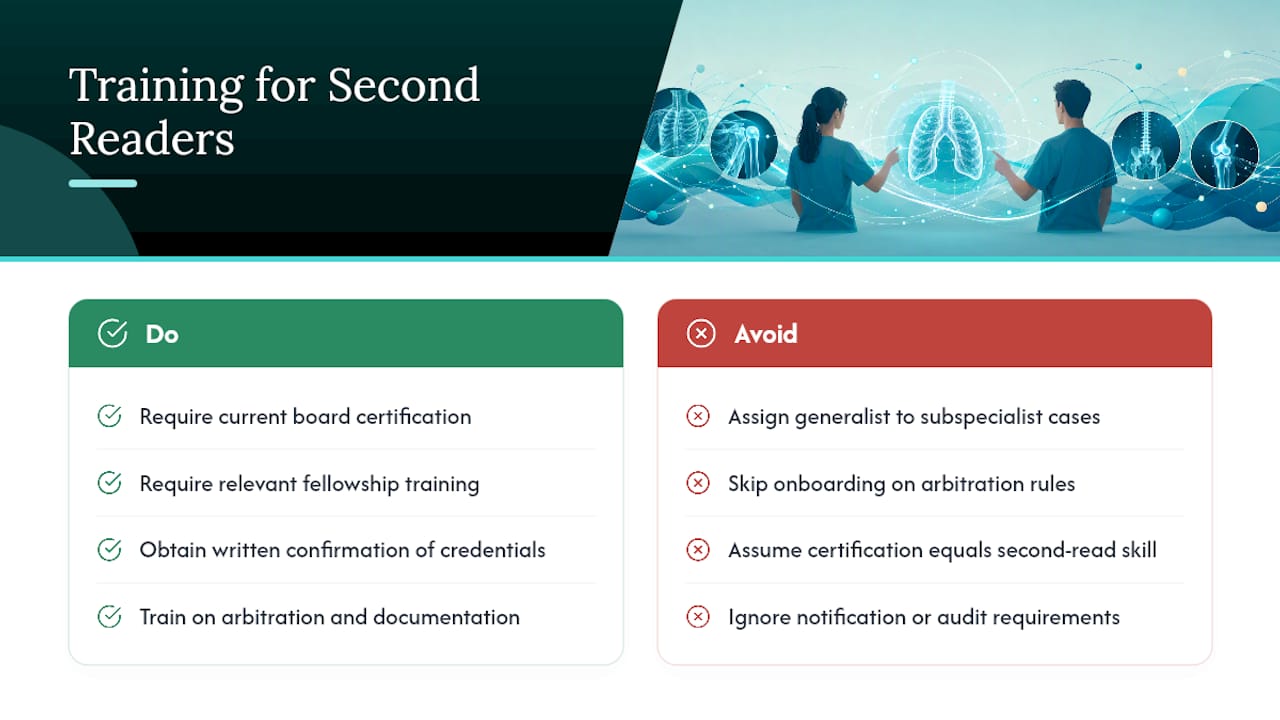
Board certification is the baseline, but a credential alone doesn't make someone a good second reader for every case type. Subspecialty fellowship training, in neuroradiology, musculoskeletal imaging, or abdominal imaging, matters more for double reading than it does for routine primary reads, because the entire point of a second read is catching what the first interpretation missed.
A general radiologist reviewing a complex spine MRI as a "second opinion" brings limited additional value if the case genuinely needs neuroradiology expertise. That's why vendor programs built around subspecialist reader pools tend to produce more clinically meaningful discrepancy catches than generalist-on-generalist double reads.
Beyond formal training, radiologists doing second reads need familiarity with the specific arbitration and documentation workflow they're operating in. A subspecialist who is a superb diagnostician but unfamiliar with how to file a proper addendum, or unclear on when their read overrides the first, creates operational friction even when their clinical judgment is sound. Vendor onboarding for double-read duty should include explicit training on the arbitration rules, the notification timeline, and the audit-logging requirements specific to that client relationship.
Continuing education requirements, tied to state licensure and board maintenance of certification, apply the same way to second readers as to any other practicing radiologist. There's no separate federal certification specifically for "double reading" as a discipline. What matters for buyers is confirming, in writing, that the subspecialists assigned to second reads on your contract hold current board certification and relevant fellowship training for the modalities you're prioritizing.
What Technology Supports Modern Double Reading Workflows?
The technical backbone of any double-read program starts with PACS integration that supports parallel worklists, so two radiologists can be assigned the same study without one blocking the other's access. Structured reporting templates matter too, since consistent formatting makes it far easier to compare a first and second interpretation and flag exactly where they diverge.
Some vendors deploy AI-based triage tools to decide which studies get a second look, flagging cases with a higher modeled likelihood of a missed or ambiguous finding and routing those toward a targeted second read. Treat that as a vendor-specific design choice to probe during the RFP, including what the tool was validated on. For clarity about this site's own vendor: AstraRad performs no AI pre-read or triage of any kind; study routing runs on modality, body part, and subspecialty, and its QA double-read sample is drawn blind at 1 in 20.
Audit logging is the quieter but equally important piece. Every read, addendum, and arbitration decision needs a timestamp and an attributable record, both for compliance purposes and for the QA reporting that lets you actually measure whether your double-read program is working. Vendors who can produce clean audit trails on demand are generally the ones with mature, well-tested workflows behind the marketing language.
How Does Double Reading Improve Patient Safety Metrics?
The clinical case for double reading rests on catching discrepancies before they affect patient management, and the published numbers back that up at a meaningful scale. The 21.4% overall disagreement rate found in a large sample of outsourced CT and MR reports included a 2.9% subset judged to carry real clinical consequence, the kind of discrepancy that changes a treatment plan or triggers additional workup.

Tracking these metrics over time turns double reading from a one-off QA exercise into an ongoing quality improvement program. The metrics that matter most for a hospital or imaging center to track internally are disagreement rate by modality, the percentage of disagreements classified as major versus minor, addendum turnaround time, and the rate at which flagged cases actually change patient management. A structured teleradiology QA program that tracked mean disagreement around 4% for prospective secondary readings used that figure as an ongoing benchmark, not a one-time snapshot.
For hospital administrators, these numbers double as a governance tool. A rising disagreement rate in a specific modality might signal a training gap, a staffing issue, or simply a cohort of unusually complex cases that quarter. Trending the data over consecutive reporting periods, rather than reacting to a single number, is what actually turns double reading into a functioning quality improvement loop instead of a compliance checkbox.
Is Double Reading Worth the Added Cost?
The honest answer is that it depends entirely on which studies you're applying it to. Blanket double reading across your full imaging volume rarely pencils out financially, because the marginal cost of a second read on a routine, low-complexity study almost never matches the marginal safety benefit.
The math changes when you target high-yield cohorts. If emergency CT abdomen/pelvis shows a 3.8% report-modifying error rate in your volume, and a modified report on a missed abdominal finding can mean the difference between same-day intervention and a delayed diagnosis, the cost of a targeted second read is small relative to the downstream clinical and liability exposure of missing it.
Building a real ROI case means comparing three numbers side by side: the per-report cost of the second read, the discrepancy rate for that specific modality in your own volume, and the downstream cost, clinical and financial, of the errors that double reading would have caught. Retrospective QA sampling at a low percentage, around 5% as a baseline, gives you ongoing visibility into your discrepancy rate without the cost of prospective dual reads on every case, which is usually the more defensible starting point for a budget-conscious pilot.
Start Narrow, Prove the Case, Then Scale
Broad double-read mandates sound rigorous in a board presentation and collapse under their own cost in year two. Pilot the highest-yield modalities first, emergency CT abdomen/pelvis, complex neuro MRI, and measure disagreement rate, addenda frequency, and TAT impact before you commit to anything wider.
Lock down arbitration rules and notification workflows before the first disagreement happens, not after. Ambiguity about who signs the final report is where these programs actually fail, not in the radiology itself.
Put the Same Questions to AstraRad
If you've been comparing vendors on subspecialist coverage, SLA history, and integration complexity, the six RFP questions above are the instrument, and they apply to AstraRad the same way they apply to everyone else. The documented answers: every study read by a board-certified subspecialist matched to the modality, a committed STAT tier under four hours with 2-hour and 1-hour STAT on request, and an internal 1-in-20 blind double-read protocol, reported to each client in a monthly quality report.
Review per-report pricing by study type to model costs against your own volume, or ask for a rate card and the current quality figures arrive with it.
Sources
For deeper review: the emergency dual-read discrepancy study, the outsourced CT/MR double-reading analysis, teleradiology QA program data, and arbitration and peer-review recommendations. For AstraRad's own service details, see our services overview and our radiologists.
- Utility of contemporaneous dual read in the setting of emergency teleradiology reporting
- Double reading of outsourced CT/MR radiology reports (Vendrell et al.)
- Quality assurance of a cross-border and sub-specialized teleradiology service (Telemedicine Clinic project report)
- Recommendations and practices for peer review and arbitration in radiology (PMC)
Recommended
Related on AstraRad
- Resources
2027 Medicare fee schedule: the radiology numbers explained
The CY2027 Medicare fee schedule cuts both conversion factors while ACR estimates radiology gains 2 percent. Both are true. Model your dollars per RVU.
- Resources
Clinician-radiologist communication: closing the loop
Clinician-radiologist communication fails when critical results reach a system but never reach the physician, and closed-loop standards close that gap.
- Resources
The hidden cost of the prelim-plus-overread model
The prelim-plus-overread model pays two radiologists and bills one report per overnight study. Cost the overread time, callbacks, and amendments first.
Put a radiologist's name on your next read.
Tell us your modalities and monthly volume. A complete per-report rate card, with turnaround tiers and SLA terms in writing, lands in your inbox within one business day.