HIPAA vs. HITRUST: what compliance teams need to know
HIPAA is federal law with no certificate behind it; HITRUST is a voluntary certifiable framework. What each governs, how they map, and what to ask vendors.

HIPAA is U.S. federal law that sets the legal floor for protecting patient data, enforced by the HHS Office for Civil Rights. HITRUST CSF is a voluntary, certifiable framework organizations use to operationalize those legal requirements and prove they've done it. Neither replaces the other, and some enterprise buyers ask about both during procurement.
TL;DR:
- HITRUST provides specific controls and documentation that clarify compliance requirements, making it easier for organizations to demonstrate adherence during audits.
- Certification for HITRUST r2 is valid for two years, requiring interim assessments, while HIPAA compliance is an ongoing legal obligation with no official certification.
- HITRUST certificates are independently issued and can support multiple compliance frameworks, but they do not replace or guarantee HIPAA legal compliance.
- HITRUST is often demanded by healthcare vendors and payers in procurement, especially for larger organizations, whereas HIPAA compliance is mandatory for all handling protected health information.
- Both frameworks demand continuous operational discipline, with HITRUST certification requiring regular updates, interim assessments, and active evidence collection.
Table of Contents
- HIPAA vs. HITRUST: The Legal Requirement vs. The Certification
- What Is HITRUST CSF and How Does It Work?
- HIPAA or HITRUST: Which One Actually Governs You?
- How Does HITRUST Mapping to HIPAA Actually Work?
- When Should You Pursue HITRUST Certification?
- How Do You Prepare for a HITRUST Assessment?
- What Assessors Actually Check Before Certifying You
- How Did HIPAA and HITRUST Develop Over Time?
- What People Get Wrong About HIPAA vs. HITRUST
- What Are the Actual Steps in the HITRUST Certification Process?
- How Do You Maintain Compliance After Certification?
- Which Industries Need HITRUST vs. HIPAA Alone?
- Why HIPAA and HITRUST Get Confused, and Why That Confusion Is Costly
- AstraRad's Approach to HIPAA and HITRUST Compliance
- Sources
HIPAA vs. HITRUST: The Legal Requirement vs. The Certification
HIPAA applies to two categories of organizations: covered entities (health plans, providers, clearinghouses) and business associates, the vendors and contractors who handle protected health information (PHI) on their behalf. If you touch PHI in the course of doing business with a covered entity, HIPAA applies to you, whether or not you signed up for it.
The law breaks into three operational pieces. The Privacy Rule governs how PHI can be used and disclosed. The Security Rule sets administrative, physical, and technical safeguards for electronic PHI. The Breach Notification Rule dictates what happens when something goes wrong, including who gets notified and how fast.
HHS enforces all three through the Office for Civil Rights, which investigates complaints, audits organizations, and issues penalties across escalating tiers based on the level of negligence involved. What HIPAA does not do is tell you exactly how to comply. It's deliberately principles based: it says you must have "reasonable and appropriate" safeguards without specifying which encryption standard, which logging tool, or which access control model satisfies that bar.
That ambiguity is precisely the gap HITRUST was built to close. Where HIPAA covers the legal essentials, security teams still need to work out:
- Which specific technical controls satisfy "reasonable and appropriate" safeguards
- How to document administrative safeguards in a way an auditor or business partner will accept
- How to prove compliance to a third party without an official government certification to point to
What Is HITRUST CSF and How Does It Work?
The HITRUST CSF is a private, prescriptive control framework maintained by the HITRUST Alliance, built specifically to translate abstract regulatory language into concrete, testable requirements. Instead of telling you to have "appropriate" access controls, HITRUST tells you which controls, at what strength, with what documentation.
HITRUST issues certifications through authorized external assessors, and it offers three main assessment tiers:
- e1 (Essentials): A smaller control set aimed at organizations that need a baseline security assurance quickly, often a starting point for smaller vendors.
- i1 (Implemented): A broader control set validating that security practices are actually in place and operating, not just documented.
- r2 (Risk-based): The most comprehensive tier, tailored to organizational risk, and the one enterprise healthcare buyers most often require.
Certifications are typically valid for two years, with an interim assessment required at the one-year mark to confirm controls haven't drifted. The framework's real utility comes from its cross-mapping. HITRUST controls tie back to NIST publications, ISO standards, and HIPAA Security Rule requirements simultaneously, which is why one certification can support multiple compliance conversations at once.
HIPAA or HITRUST: Which One Actually Governs You?
The distinction that trips up most compliance teams is authority. HIPAA is law. Ignore it and OCR can fine you, audit you, or refer the matter for further action, with no opt-out available. HITRUST is a voluntary program. Nobody outside your contracts requires it unless you've agreed to a business relationship that says otherwise.
Here's how the two frameworks diverge in practice:
- Legal standing. HIPAA carries the force of federal law. HITRUST carries the force of a signed contract or a procurement checklist item, nothing more, nothing less.
- Certification availability. There is no such thing as "HIPAA certified." OCR does not certify organizations. HITRUST does, through authorized external assessors, which is exactly why sales teams put the HITRUST seal on a homepage and never a HIPAA one.
- Specificity of controls. HIPAA's language stays deliberately broad so it can apply across wildly different organization types. HITRUST gets specific: control numbers, implementation levels, and evidence requirements you can hand to an auditor.
- Consequences of failure. Fall short of HIPAA and you're facing OCR penalties, corrective action plans, and potential breach litigation. Fall short of a HITRUST assessment and you don't get certified, which can mean losing a contract, but it isn't a federal violation by itself.
Compliance officers sometimes treat these as competing options, HIPAA vs. HITRUST as though you pick one. That framing misses the point. One is the law you can't avoid; the other is proof you're following it, structured in a form your business partners can verify.
How Does HITRUST Mapping to HIPAA Actually Work?
HITRUST doesn't just claim alignment with HIPAA. It documents the relationship control by control, publishing mapping reports, often called Insights, that show exactly which HITRUST requirements correspond to which HIPAA Security Rule provisions. That mapping is what lets a covered entity look at a business associate's HITRUST r2 certificate and reasonably infer that the underlying Security Rule safeguards are in place.
The gaps show up in three predictable places:
- Privacy Rule coverage. HITRUST leans heavily toward Security Rule and technical safeguards; Privacy Rule obligations around use, disclosure, and patient rights get thinner treatment.
- Business associate agreements. A HITRUST certificate says nothing about whether your BAAs are current, properly scoped, or even in place. That's a separate legal exercise.
- Scope exclusions. Certification only covers the systems and processes included in the assessment scope. A narrowly scoped HITRUST certificate can coexist with uncovered PHI-handling systems elsewhere in the organization.
A HITRUST certificate doesn't immunize you from OCR enforcement either. It can serve as supporting evidence if OCR ever comes asking questions, but your HIPAA obligations exist independently of any certification you hold.
Pro Tip: Before you lean on a HITRUST certificate in a vendor risk review, ask for the specific mapping report and check the assessment scope. A certificate covering only your production data center tells you nothing about the billing system running on a separate network.
When Should You Pursue HITRUST Certification?
HITRUST certification becomes worth pursuing the moment a buyer makes it a procurement requirement, not before. Hospital systems, health plans, and large enterprise health tech buyers increasingly build HITRUST validation into vendor risk assessments as a standard checkbox, and once that happens, certification stops being optional in any practical sense.
Which tier makes sense depends on where you're starting from and what the buyer expects:
- e1 suits smaller vendors needing a fast, credible baseline before their first enterprise deal.
- i1 fits organizations with mature operational controls that want validation without the full r2 lift.
- r2 is what most hospital systems and payers ultimately expect, with its multi-year validity and interim check carrying the most weight in procurement conversations.
Cost and effort scale with tier: r2 assessments typically run longer and cost considerably more than a SOC 2 Type II engagement, so weigh the ROI against how many deals actually require it before committing budget.
How Do You Prepare for a HITRUST Assessment?
Getting HITRUST ready starts with getting HIPAA basics genuinely operational, not just documented.
- Run a current HIPAA risk analysis. Document it, date it, and make sure your BAAs and privacy notices reflect your actual data flows.
- Scope your PHI systems precisely. Decide which systems, networks, and vendors fall inside your HITRUST assessment boundary before you engage an assessor.
- Collect operational evidence. Logging output, vulnerability scan results, penetration test reports, EDR alerts, and privileged access management records where applicable.
- Run a readiness assessment first. Use a self-assessment through MyCSF to find gaps and remediate them before paying an external assessor to find them for you.
Pro Tip: Skipping the readiness assessment to save time almost always costs more later. Assessors bill for the gaps they find, not just the report they write.
What Assessors Actually Check Before Certifying You
Assessors look for an active HIPAA program first, not a polished one. A risk analysis that's three years old, or BAAs that exist but don't match your current vendor list, tends to sink an assessment before controls testing even begins.

Documentation matters, but operational evidence carries more weight. Logs, scan results, and ticket histories showing controls in daily use decide most outcomes. Prep timelines vary widely: organizations with mature security programs sometimes move through r2 in a few months, while those starting from scratch can take considerably longer closing gaps before an assessor ever gets involved.
How Did HIPAA and HITRUST Develop Over Time?
HIPAA became law in 1996, though its most consequential provisions came later. The Privacy Rule took effect in 2003, and the Security Rule followed in 2005, establishing the administrative, physical, and technical safeguard requirements compliance teams still work from today. The Breach Notification Rule arrived in 2009 as part of the HITECH Act, adding the reporting obligations that make data breaches a public, auditable event rather than a private embarrassment.
HITRUST emerged in 2007, founded by a group of healthcare and technology organizations frustrated with a specific problem: HIPAA told them what to protect but not how, and every industry vendor risk questionnaire seemed to demand answers in a different format. The HITRUST CSF launched as an attempt to standardize that answer, pulling together requirements from HIPAA, NIST, ISO 27001, PCI DSS, and other frameworks into one certifiable structure.
The framework has been revised repeatedly since then, expanding its control catalog as new standards emerged and new threats justified new safeguards. The introduction of tiered assessments, e1 in particular, reflects a more recent shift toward accessibility. Early HITRUST certification demanded resources that put it out of reach for smaller healthcare vendors and startups. The tiered model acknowledges that a two-person digital health startup and a national hospital network have very different risk profiles and shouldn't necessarily face identical certification paths.
That evolution matters for compliance officers today because the framework keeps moving. A HITRUST CSF version from several cycles ago maps differently than the current one, which is part of why interim assessments and periodic recertification exist.
What People Get Wrong About HIPAA vs. HITRUST
The most persistent misconception is that HITRUST certification equals HIPAA compliance. It doesn't, and treating it that way creates real exposure. A HITRUST certificate demonstrates that a defined set of controls, within a defined scope, met a defined bar at a point in time. It says nothing about your Privacy Rule practices outside that scope, and it does not certify your organization's HIPAA compliance in any comprehensive legal sense.
A second common error: assuming HIPAA has a certification program at all. It doesn't, and never has. When a vendor claims to be "HIPAA certified," that phrase should raise questions, not confidence, since OCR issues no such credential.
Third, some teams assume HITRUST is only relevant to large hospital systems. In practice, mid-sized digital health companies and SaaS vendors serving healthcare clients increasingly need it too, since the procurement pressure comes from their customers' vendor risk programs, not from their own size.
Finally, there's a tendency to treat the two frameworks as sequential steps you complete once. Neither works that way. HIPAA compliance is an ongoing legal obligation that persists for as long as you handle PHI. HITRUST certification lapses on a fixed schedule and requires interim validation to stay current. Both demand continuous attention, not a one-time project with a finish line.
What Are the Actual Steps in the HITRUST Certification Process?
The certification path runs longer than most teams expect going in. It typically starts with a readiness assessment, often self-administered through the MyCSF platform, where an organization maps its existing controls against the CSF requirement set and identifies where gaps sit. This step alone can take weeks to months depending on how mature the existing security program is.
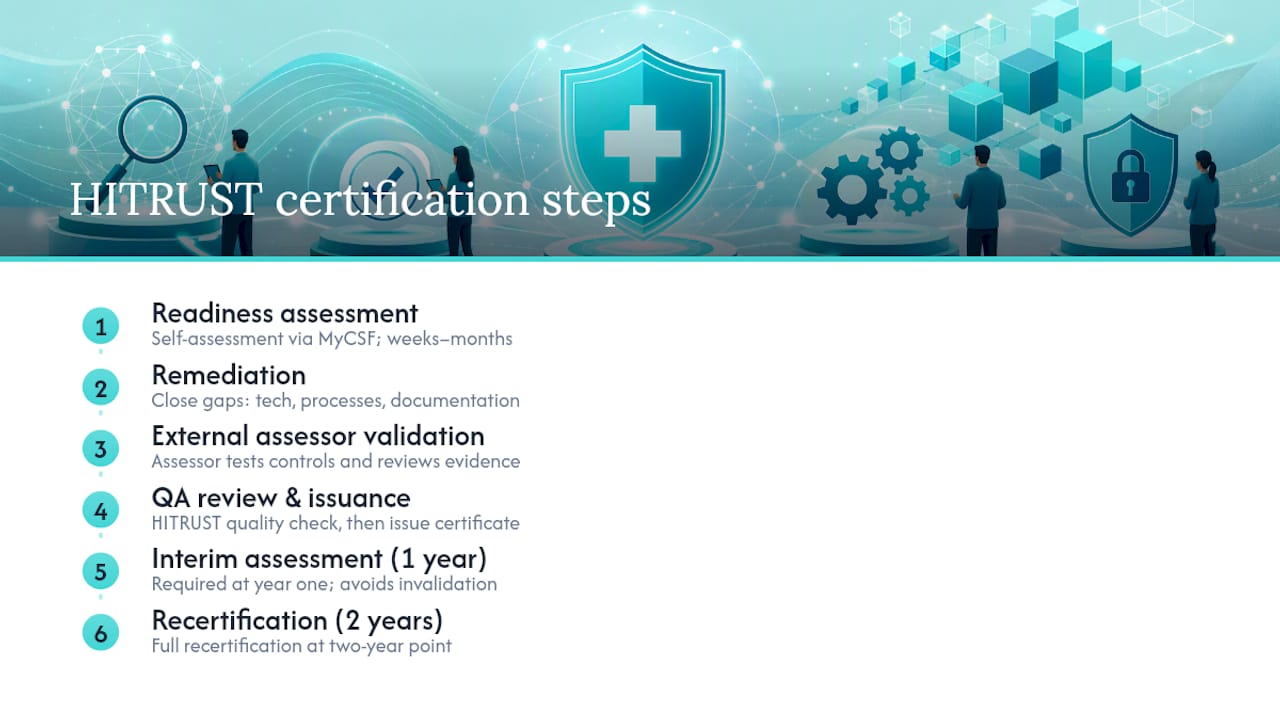
Remediation follows, and this is usually where timelines stretch. Closing gaps identified during readiness, whether that means implementing new logging infrastructure, formalizing incident response testing, or documenting access reviews that were previously informal, tends to consume more calendar time than the actual assessment.
Once an organization believes it's ready, it engages an authorized external assessor, one of the third-party firms HITRUST has vetted and licensed to perform validated assessments. The assessor reviews evidence, tests controls, and in many cases conducts interviews with staff responsible for specific safeguards. This validation phase is where paper policies get separated from operational reality; an assessor testing access control procedures wants to see actual account review logs, not just a policy document describing how reviews should happen.
The assessor submits results to HITRUST for quality assurance review, an internal check that catches inconsistencies before a certificate issues. Assuming the review clears, HITRUST issues the certification, which then carries its own maintenance obligations: an interim assessment at the one-year mark for most tiers, and full recertification at the two-year point. Skipping the interim check can invalidate the certification before its official expiration date arrives.
How Do You Maintain Compliance After Certification?
Certification is a snapshot, not a permanent state, and both frameworks demand continuous work to stay valid.
For HIPAA, that means repeating risk analyses on a regular cadence, not just after a breach or an audit trigger. Security Rule compliance is an ongoing posture: patch management, access reviews, workforce training, and incident response testing all need to keep running long after any initial assessment closes. Business associate agreements need periodic review too, particularly as vendor relationships change or new subcontractors enter the data flow.
For HITRUST, the interim assessment at the one-year mark is the structural anchor keeping certification alive. Organizations that treat certification as "done" once the assessor leaves often struggle at interim review, because the operational evidence, meaning logs, scan results, and access records, needs to show continuous operation, not just a snapshot from certification day. The organizations that handle this well tend to build control monitoring into regular operations rather than reviving it only when a deadline approaches.
Recertification at the two-year point functionally repeats the original process, though organizations with mature, continuously monitored programs tend to move through it faster than first-time applicants. The practical lesson: whatever evidence collection process got you certified should become part of how the security team runs day to day, not a project that spins up before each assessment cycle.
Which Industries Need HITRUST vs. HIPAA Alone?
Every organization handling PHI needs HIPAA compliance, full stop. That part isn't a choice. Where the paths diverge is in whether HITRUST certification adds enough value to justify its cost.
Smaller physician practices, individual providers, and organizations that don't hold enterprise contracts or handle third-party vendor relationships at scale often find HIPAA compliance alone sufficient. Their business relationships don't typically demand third-party certification, and the cost of an r2 assessment would outweigh any procurement benefit they'd realize.
The calculation shifts sharply for healthcare technology vendors, health information exchanges, cloud infrastructure providers serving healthcare clients, and any organization selling into hospital systems or payers. Some of these buyers have made HITRUST a hard requirement in their vendor risk questionnaires, while others accept a well-documented HIPAA program; the practical move is to ask any vendor directly what it holds and what it offers in place of a certificate. The same applies to organizations weighing infrastructure decisions, including comparisons like AWS vs. Azure HIPAA compliance capabilities, where cloud providers typically offer HITRUST-mapped configurations specifically to help downstream customers meet enterprise buyer expectations.
Radiology groups, imaging centers, and diagnostic services occupy an interesting middle ground. Many operate as business associates to hospital systems, which puts them squarely in the group facing HITRUST procurement pressure even though they might not have considered it necessary a few years ago.
Why HIPAA and HITRUST Get Confused, and Why That Confusion Is Costly
The conventional advice treats HIPAA and HITRUST as a binary choice, HIPAA vs. HITRUST, as if a compliance officer picks a lane. That framing has caused real damage in procurement conversations, where vendors have marketed "HIPAA certification" that does not exist and buyers have assumed HITRUST certification covers legal obligations it was never designed to touch.
The more useful mental model treats HIPAA as the destination and HITRUST as one well-documented route for getting there and proving you arrived, similar to how a SOC 2 vs. HIPAA comparison misses the point that SOC 2 addresses a different assurance question entirely. What gets underestimated is how much operational discipline both frameworks demand on an ongoing basis. Certification lapses matter less than most compliance officers fear; a gap in daily control operation matters more than most fear, because that's what actually creates breach risk and OCR exposure.
For healthcare organizations selecting imaging or diagnostic partners, this distinction has direct consequences. A vendor's HITRUST badge is worth investigating specifically: what scope, what tier, how recent was the last interim assessment. A vendor that can answer those questions in detail, rather than pointing at a logo, is telling you something real about how they run their security program day to day.
AstraRad's Approach to HIPAA and HITRUST Compliance
AstraRad builds its compliance posture around the same fundamentals this article covers: an active HIPAA program backed by operational evidence, with signed BAAs before the first study moves and the detailed compliance reporting hospital procurement teams ask for during vendor risk reviews.
The disclosure that belongs here in plain words: AstraRad holds no HITRUST certification, no SOC 2 report, and no ISO 27001 certification, and claims none of them. There is no such thing as HIPAA certification for anyone to hold, either. What AstraRad operates, and can evidence, is a set of HIPAA-aligned controls as a business associate under a signed BAA with every client: TLS encryption in transit, AES-256 at rest, role-based access tied to named individual accounts, append-only audit logging, and a written breach notification procedure on a contractual clock. The full posture, and every document behind it, is described on the compliance page.
If your procurement gate requires a HITRUST certificate, that disclosure settles the question before a first call. If it can accept verified controls, what a buyer reviews in place of a certificate is the written safeguards summary mapped to the Security Rule categories, the standard BAA and DPA templates, a completed security questionnaire in your own format, and current SLA performance data. Request the package through the contact page and it arrives with the rate card within one business day.
Sources
Recommended
Related on AstraRad
- Resources
2027 Medicare fee schedule: the radiology numbers explained
The CY2027 Medicare fee schedule cuts both conversion factors while ACR estimates radiology gains 2 percent. Both are true. Model your dollars per RVU.
- Resources
Clinician-radiologist communication: closing the loop
Clinician-radiologist communication fails when critical results reach a system but never reach the physician, and closed-loop standards close that gap.
- Resources
The hidden cost of the prelim-plus-overread model
The prelim-plus-overread model pays two radiologists and bills one report per overnight study. Cost the overread time, callbacks, and amendments first.
Put a radiologist's name on your next read.
Tell us your modalities and monthly volume. A complete per-report rate card, with turnaround tiers and SLA terms in writing, lands in your inbox within one business day.