ED radiology coverage for hospital leaders
Procurement guide for hospital leaders. Run a 30 day gap analysis, pilot 90 days of overnight ED radiology coverage, and use SLA, contract, and PACS
Continuous, attending-level ED radiology coverage comes down to matching the model to your volume: dedicated in-house overnight divisions for high-acuity and academic centers, hybrid staffing for mid-size community hospitals, and vetted teleradiology partnerships for smaller and rural facilities. Start with a gap analysis of your current after-hours turnaround times, then pilot a 90-day overnight coverage change before committing to a long-term contract. Teleradiology partners can fill the hybrid or full-outsource role once you know where your gaps actually sit.
TL;DR:
- Hospitals with moderate ED volume typically benefit from hybrid staffing models that combine in-house peak coverage with teleradiology overflow to optimize costs and subspecialty access.
- Short overnight shifts, capped at around one week followed by rest periods, help reduce radiologist fatigue and lower discrepancy rates, improving accuracy and safety.
- Implementing tiered turnaround expectations for STAT, urgent, and routine cases ensures timely reads for critical patients and reduces unnecessary delays.
- Rural hospitals should incorporate backup radiologists and clear escalation procedures into contracts to maintain coverage during staffing disruptions or volume surges.
- Most studies show that adding overnight subspecialty coverage increases CT utilization, so budget planning must account for higher imaging costs when expanding after-hours services.
Table of Contents
- What are the main ED radiology coverage models?
- How should you schedule overnight radiology shifts?
- What turnaround times should you expect and require?
- How does overnight coverage change ED radiology in rural and critical access hospitals?
- Does overnight coverage actually change CT utilization and ED throughput?
- What belongs in a radiology coverage contract or RFP?
- What governance and QA metrics should leadership track?
- Choosing between models
- What to ask AstraRad or any teleradiology partner before signing
- Sources
- FAQ
What are the main ED radiology coverage models?
Every hospital deciding how to staff overnight and weekend reads is really choosing among four structural options, and each one carries a different cost and risk profile. Get this choice wrong and you either overpay for coverage you don't need or leave your ED waiting on preliminary reads until morning.
In-house dedicated overnight division. A hospital employs radiologists specifically for night and weekend shifts, separate from the daytime staff rotation. This model delivers the fastest turnaround because the reader is on-site or immediately reachable, and it works best for Level I and II trauma centers and academic medical centers with high overnight volume. The trade-off is recruitment difficulty. Night-shift radiology jobs are a hard sell, and a review of overnight emergency radiology division management notes that many programs now favor attending-level overnight staffing specifically because trainee-only coverage creates diagnostic gaps.
After-hours-only division. A subset of radiologists covers nights and weekends exclusively, often on a rotating block schedule, while a separate daytime group handles regular hours. This splits the workforce into two cultures, which can create scheduling friction, but it lets a hospital scale night coverage without disrupting daytime subspecialty reading assignments.
Hybrid staffing. In-house radiologists cover peak hours and predictable overnight windows, while a teleradiology partner absorbs overflow, deep overnight hours (typically midnight to 6:00 a.m.), or specific modalities like MRI and PET-CT. This is the most common model for community hospitals with moderate ED volume, since it avoids paying full-time salary for hours with lower study counts.
Full teleradiology coverage. A hospital contracts out all overnight, weekend, or even full-time reading to a remote group of board-certified radiologists. This is the default for critical access hospitals and many community facilities without the volume to justify an in-house night shift.
The ACR practice parameters state plainly that ED radiology coverage can be delivered on-site or via teleradiology, and the choice should be made collaboratively among radiology, emergency medicine, and hospital medical staff, not unilaterally by one department.
Here's how the trade-offs typically stack up:
- Turnaround speed: In-house dedicated divisions win on speed; full teleradiology depends entirely on the vendor's contractual SLA.
- Cost structure: In-house means fixed salary and benefits regardless of volume; teleradiology is usually per-report, scaling with actual study counts.
- Staffing complexity: Dedicated overnight divisions require recruiting radiologists willing to work nights long-term, a persistent bottleneck.
- Recruitment risk: Hybrid and teleradiology models insulate a hospital from single-radiologist departure, since a vendor absorbs staffing continuity.
- Subspecialty access: Teleradiology partners typically offer broader subspecialty matching (neuro, MSK, body) than a single in-house night shift can staff.
A Level I trauma center with steady overnight CT and MRI volume usually justifies a dedicated division. A 150-bed community hospital with variable overnight census often does better with a hybrid arrangement. A 25-bed critical access hospital almost never has the volume to support in-house night radiology and should plan around a teleradiology contract from the outset.
How should you schedule overnight radiology shifts?
Shift length is not a minor scheduling detail. It directly affects read accuracy, and hospitals that ignore this tend to see it show up later in discrepancy rates.
Research on sustainable overnight coverage points to a few consistent patterns. Continuous overnight reading shifts should be capped, since fatigue measurably increases error risk on long stretches without breaks, and programs that build in coverage overlap tend to hold up better over time than those that don't. On rotation structure, the PMC review on managing overnight emergency radiology divisions points to block scheduling, such as one week on followed by two weeks off, as a pattern that supports retention better than scattered single-night shifts spread across a month.
A workable staffing mix for a mid-size hospital moving toward 24/7 attending-level coverage typically looks like this:
- Core overnight attendings who work in fixed blocks (one week on, two weeks off, or a similar pattern) rather than isolated single-night assignments.
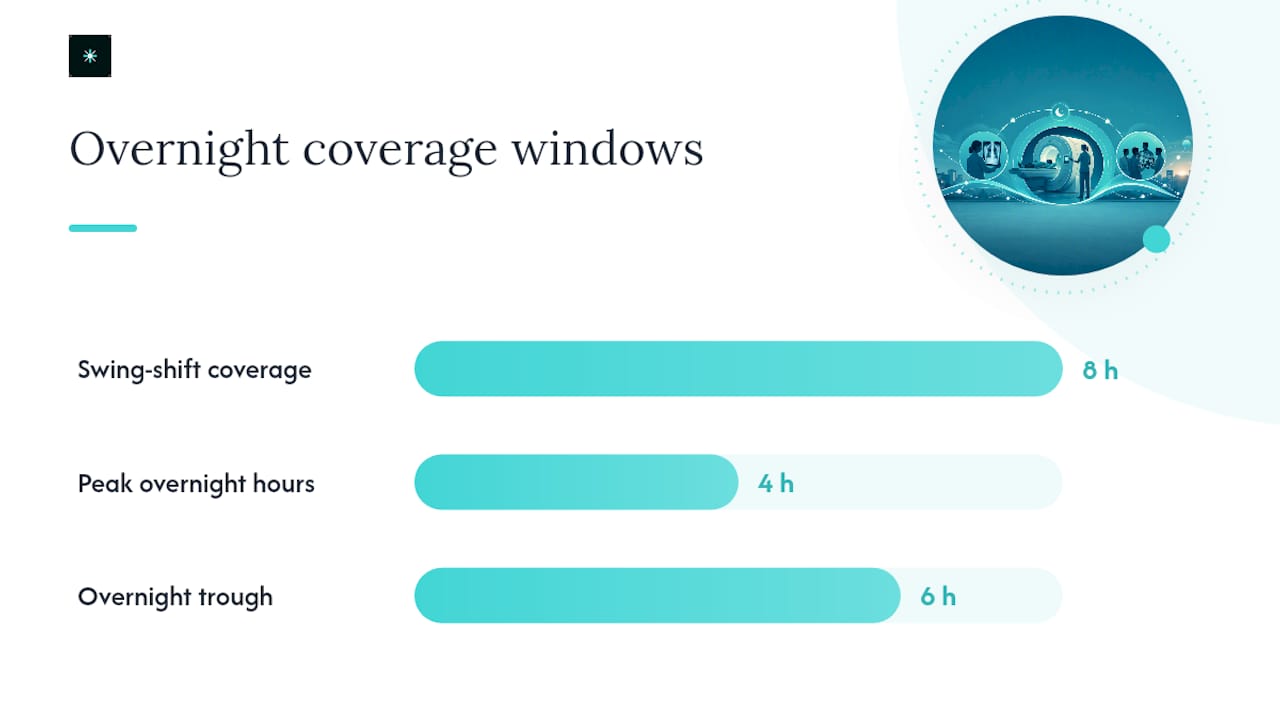
- Short-call backup radiologists who take overflow calls during peak overnight hours, usually 10:00 p.m. to 2:00 a.m., when ED volume spikes.
- Swing-shift coverage bridging the gap between daytime and full overnight staffing, typically 4:00 p.m. to midnight.
- Per diem radiologists who fill vacation gaps, sick coverage, and seasonal volume increases without disrupting the core rotation.
- A teleradiology overflow partner contracted for true overnight troughs (midnight to 6:00 a.m.) or as full backup when the primary schedule has an open slot.
Burnout is the quiet failure mode of every overnight coverage plan. Radiologists who take consistent night shifts for years without relief tend to leave, and losing one overnight reader can collapse an entire schedule built around a small pool. The fix isn't complicated, but it is often skipped: build in guaranteed time-off blocks after night rotations, pay a real shift differential rather than a token one, and actively reduce non-interpretive tasks (protocoling, phone triage, portal messages) during overnight hours so radiologists spend their shift reading, not administering.
Pro Tip: Track your overnight radiologist turnover separately from your overall staff turnover. A department that loses one night-shift reader every 18 months is running on borrowed time, even if its total staffing numbers look stable on paper.
What turnaround times should you expect and require?
Turnaround time is the metric that actually determines whether your coverage model is working, and it needs to be tiered rather than treated as a single number.
Most departments organize expectations into three tiers. STAT cases, things like suspected stroke, active trauma, or acute abdomen, need a preliminary or final read within minutes, not hours. Urgent cases, moderate-acuity ED studies without immediate life threat, tolerate a longer window, often under two hours. Routine cases, including many outpatient-referred or lower-acuity ED studies, can reasonably wait up to 24 hours for a final signed report.
A quality-improvement report on optimizing emergency radiology found that switching from preliminary trainee reads to dedicated after-hours attending coverage measurably reduced turnaround times for after-hours neuroradiology exams.
That finding matters because it isolates the variable: the same volume, the same ED, but a different coverage structure produced faster reads. If your department still relies on trainee prelims overnight with attending overread the next morning, that gap is where your turnaround problem lives.
On the technical side, integration determines whether fast reads actually reach the ED fast. Your coverage partner, whether internal or contracted, needs full PACS integration so radiologists work from the same worklist your technologists populate, not a separate portal that requires manual upload. HL7 and FHIR messaging standards should carry order and result data automatically between your electronic health record and the reading radiologist's system, and a single point of access, one worklist, one report destination, one place to check status, prevents the kind of dropped studies that happen when techs have to remember which modality goes to which portal.
Communication protocols matter just as much as the technology. Critical findings need a defined callback process: who calls the ED physician, within what window, and how the call gets documented. Ask any coverage option, in-house or contracted, these questions before signing anything:
- What is the contractual turnaround for STAT cases, in minutes, not a vague "as soon as possible"?
- Who is reachable by phone for a contemporaneous read discussion when an ED physician needs to talk through a finding in real time?
- How are critical results documented and closed out to confirm the ED actually received and acted on them?
- What happens to turnaround guarantees during a volume surge, mass casualty event, or system outage?
How does overnight coverage change ED radiology in rural and critical access hospitals?
Rural and critical access hospitals face a version of this problem that larger facilities never encounter: they often cannot staff a radiologist on-site at all, day or night, yet still need to offer contrast-enhanced CT and other advanced imaging.
Virtual contrast supervision solves the specific regulatory gap here. Contrast administration traditionally required a physician immediately available on-site, which most critical access hospitals cannot staff around the clock. Remote supervision models let a physician oversee contrast administration by phone or video, with on-site staff (typically a nurse or technologist) handling the physical administration under that remote physician's direction. A critical access hospital using this model still needs qualified on-site personnel to administer contrast and manage an adverse reaction, but it no longer needs a physician physically in the building.
Teleradiology partnerships extend this same logic to reading coverage. A rural hospital that cannot recruit even one radiologist can contract teleradiology coverage for rural and critical access facilities to handle nights, weekends, and full-time reads, which keeps imaging available locally instead of transferring patients to a larger facility purely to get a study read.
The American Hospital Association's guidance on rural radiology frames this directly: hospitals should anticipate volatility in staffing and volume, build contingency plans before a crisis hits, and use partnerships and technology, including virtual supervision, to keep imaging services local rather than losing them to consolidation.
A contract that actually protects a small hospital from operational fragility should include:
- A backup radiologist roster named in the contract, not just a promise of "coverage," so a single reader's vacation or illness doesn't create a gap.
- A defined response-time SLA for both routine and STAT studies, with financial or contractual consequences if missed.
- Written escalation procedures for what happens if the primary coverage partner cannot fulfill a shift.
- Clear scope on which modalities and which hours the contract actually covers, so nothing is assumed.
Does overnight coverage actually change CT utilization and ED throughput?
Yes, and the direction of that change is one administrators frequently get backwards. Adding attending-level overnight coverage tends to increase CT utilization, not decrease it, at least in the near term.
An AJR study on overnight subspecialty radiology coverage found that community emergency departments saw increased CT utilization after institutions moved to overnight subspecialty attending coverage, with a measurable rise in on-call CT intensity. The likely mechanism isn't hard to guess: when ED physicians trust that a subspecialist, not a trainee awaiting morning overread, is reading the study immediately, they order more imaging with more confidence rather than holding a patient for a morning scan.
That utilization increase has real budget implications, and it needs to go into your ROI model before you sign a coverage contract, not after volume shows up on an invoice.
| Factor to model | Direction of impact | Why it matters for budgeting |
|---|---|---|
| CT order volume | Increases after overnight subspecialty coverage begins | Drives per-study contract costs up even if per-unit pricing stays flat |
| Callback and repeat-read rate | Decreases with final (not preliminary) overnight reads | Fewer redundant morning overreads reduces total interpretation cost |
| ED length of stay for imaged patients | Can shorten for patients whose final read arrives overnight instead of the next morning | Faster disposition frees ED beds sooner |
| Patient transfer rate (rural/CAH) | Decreases when local reading coverage replaces "transfer to read" practices | Keeps imaging revenue and patient volume local |
Final overnight reads, rather than preliminary reads awaiting morning overread, cut down on the callback cycle where a radiologist has to re-contact the ED after the fact to correct or confirm a trainee's preliminary interpretation. That single change, final instead of preliminary, is often the difference between a patient going home overnight and a patient waiting in an ED bed until the morning read confirms the plan.
What belongs in a radiology coverage contract or RFP?
Whether you're building an internal staffing plan or evaluating an outside partner, the same checklist applies. Skipping any of these items is how hospitals end up locked into coverage that looks fine on paper and fails during an actual overnight surge.
- Tiered SLA commitments in writing. STAT, urgent, and routine turnaround windows need specific numbers, not general language, and the contract should specify what happens (credits, escalation, termination rights) if those windows are missed.
- State licensing and credentialing proof. Any radiologist reading your studies, in-house or remote, must hold an active license in your state and current privileges at your facility, and you should require documentation before go-live, not after.
- Redundancy and escalation clauses. What happens if the assigned reader is unavailable? A contract without a named backup process is a contract with a single point of failure.
- PACS and HL7/FHIR integration testing. Require a sample-case go-live validation period, not just a vendor's assurance that "integration is seamless." Test actual order-to-report flow with real studies before full cutover.
- Peer review and QA reporting cadence. Ask how often the partner runs peer review, what scoring system it uses, and how often you'll receive compliance reports.
- Security and compliance assurances. HIPAA compliance is table stakes; ask specifically about HITRUST certification status and how the partner handles data encryption and access logging.
- Malpractice coverage confirmation. Confirm the partner or employed radiologist carries adequate malpractice coverage and that your facility understands where liability sits contractually.
Pro Tip: Ask any prospective coverage partner for three sample reports on studies similar to your typical ED case mix before you sign anything. A vendor confident in its quality will hand these over without hesitation; one that hedges is telling you something.
What governance and QA metrics should leadership track?
A coverage model is only as good as the data proving it works, and that data needs to reach hospital leadership on a set schedule, not just when something goes wrong.
Four metrics belong in every monthly or quarterly radiology governance report:
- Turnaround time by urgency tier (STAT, urgent, routine), tracked against the contractual SLA, not just an internal average.
- Critical-result acknowledgment time, measuring how long it takes an ED physician to confirm receipt of a critical finding after the radiologist flags it.
- Report discrepancy rate, comparing preliminary and final reads or flagging cases sent for peer re-review.
- Overall SLA compliance percentage, the single number that tells leadership whether the coverage model is meeting its contractual promises month over month.
QA structure matters as much as the metrics themselves. A RADPEER-style scoring system, where a sample of reads gets scored by a second radiologist against defined discrepancy categories, gives you a consistent, comparable QA signal over time rather than anecdotal complaints. That peer review process should also feed into your hospital's morbidity and mortality review process when a discrepancy has clinical consequence, so radiology QA isn't siloed from broader patient safety review.
Documentation discipline around preliminary versus final reads deserves its own line in every governance report. Every preliminary read needs a clear final overread, timestamped, with any discrepancy documented and communicated back to the ordering physician. This is where liability risk concentrates when coverage models get complicated across shifts, sites, or vendors, and it is the detail hospital risk management teams check first after any adverse event.
Choosing between models
The honest answer is that most hospitals overthink the model choice and underthink the transition plan. A Level I trauma center clearly needs a dedicated in-house overnight division; a 20-bed critical access hospital clearly needs a teleradiology contract. The genuinely hard cases, the 100 to 300 bed community hospitals, usually do better with a hybrid model than administrators initially assume, because the volume rarely justifies full in-house staffing but the acuity mix still demands subspecialty depth a single night-shift generalist can't provide.
The immediate next step isn't picking a vendor. It's running a 30-day gap analysis on your current after-hours turnaround data, then piloting a changed coverage arrangement for 90 days before locking in a multi-year contract. Track turnaround and discrepancy rates before and after. Protect your workforce by building relief and backup into whatever schedule you choose, because the model that looks efficient on a spreadsheet fails fast if it burns out the one radiologist holding your overnight schedule together.
What to ask AstraRad or any teleradiology partner before signing
AstraRad staffs every study with US board-certified subspecialists matched to modality and body part, with contractual turnaround under four hours for STAT reads, 2-hour and 1-hour STAT available on request at a higher multiplier, and 24 to 48 hours for routine studies, and direct integration into your existing PACS with no extra portal to manage.
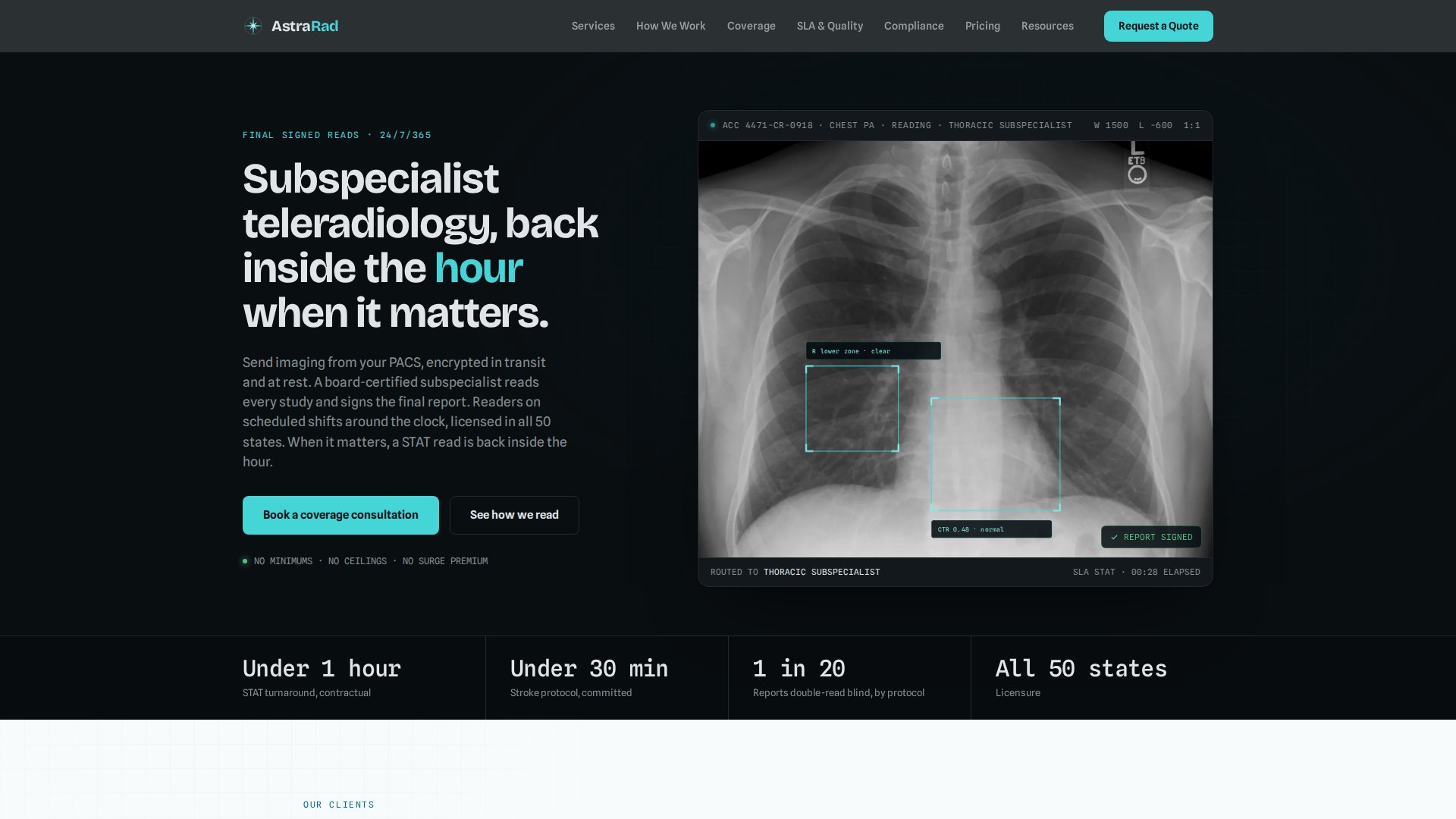
That combination, subspecialist matching plus written SLA commitments, is exactly what the procurement checklist above asks you to verify in any coverage conversation. Whether you're evaluating AstraRad or comparing partners, put these questions on the table: What is your actual STAT turnaround, measured, not promised? Are your radiologists licensed in every state where my facility operates? How does your report reach my PACS, and do my technologists need a second login? What does your peer review process look like, and can I see a compliance report? AstraRad's pricing runs per-report with no volume minimums, which matters if your coverage need is a genuine overnight gap rather than a full staffing replacement. If your hospital is weighing rural coverage specifically, AstraRad's teleradiology services for critical access facilities is the place to start that conversation and request sample reports for your typical case mix.
Sources
The recommendations in this guide draw on the ACR practice parameters on ED radiology coverage models, a PMC review on managing overnight emergency radiology divisions, and an AJR study on CT utilization changes after overnight subspecialty coverage begins. Operational turnaround data comes from an RSNA quality-improvement report, and rural strategy guidance comes from the American Hospital Association. Each source informed a specific recommendation above. It does not represent the article as a whole.
This article is general information, not a substitute for advice from a qualified doctor. Consult a qualified healthcare professional about your own circumstances before acting on anything here.
- ACR practice parameters (guidance document)
- Update on establishing and managing an overnight emergency radiology division (PMC review)
- Overnight subspecialty radiology coverage: practice model and impact on CT utilization (AJR)
- RSNA quality improvement report on optimizing emergency radiology
- Keeping care local: radiology as a catalyst for rural transformation (AHA)
FAQ
Is ED radiology coverage covered by insurance?
Radiology reads performed for ED patients are billed as part of the overall ED encounter and are typically covered by insurance under standard imaging benefits, subject to the patient's plan design. Coverage details, copays, and prior authorization rules vary by insurer and plan, so hospitals should confirm billing codes align with their specific coverage model, whether in-house or contracted.
Why won't the ER give me an MRI?
Emergency departments generally reserve MRI for cases where the finding will change immediate management, since MRI takes longer to schedule and read than CT or X-ray and is often not available overnight at smaller facilities. If your hospital lacks 24/7 MRI reading coverage, a teleradiology partner offering subspecialist MRI reporting can close that specific gap without adding in-house overnight staff.
What is the 15% rule in radiology?
Definitions of this rule vary by context, and it is not a single standardized industry benchmark referenced consistently across radiology coverage literature. Hospitals should ask their billing or compliance team for the specific rule they're referencing rather than assume a universal definition applies.
How much does it cost to go to the ER for a CT scan?
The total ER cost for a CT scan depends on facility fees, physician fees, and the radiologist's interpretation charge, which vary widely by hospital and region and are separate from the radiology coverage contract a hospital signs with its reading provider. Teleradiology arrangements like AstraRad's per-report pricing model affect what the hospital pays for the read itself, not what a patient is billed for the full ED visit.
Recommended
Related on AstraRad
- Resources
Multilingual radiology reports for hospitals: PARROT, HIPAA
Learn how hospitals build multilingual radiology reporting workflows using open datasets, LLM evidence, HIPAA alignment, and clinical validation steps.
- Resources
Hospital radiology surge capacity: act before queues grow
Build a radiology surge plan using evidence on activation thresholds, a readiness checklist, and AstraRad SLA and PACS details to clear backlogs faster.
- Resources
Site neutral imaging payment 2027: what to model now
CMS proposed PFS equivalent rates for non contrast imaging at excepted off campus departments in CY2027. Model your site neutral payment exposure now.
Put a radiologist's name on your next read.
Tell us your modalities and monthly volume. A complete per-report rate card, with turnaround tiers and SLA terms in writing, lands in your inbox within one business day.