DICOM proof for patients, clinicians
Plain-language primer for patients and clinicians on final signed radiology reports: how DICOM verification makes the report official, expected

A final signed radiology report is the electronically authenticated version of an imaging interpretation, verified by the reading radiologist and locked into the medical record as the official diagnostic document. It supersedes any preliminary or wet read, and once signed, it becomes the version your doctor treats, your insurer processes, and your chart retains. AstraRad, a teleradiology provider, produces exactly this kind of report for hospitals and imaging centers, which is worth knowing as you read on.
TL;DR:
- The final signed radiology report is the official diagnostic document, verified by the radiologist, which replaces preliminary readings and becomes part of the medical record.
- Electronic signatures speed up report finalization, with median times decreasing from around 10 to 11 days for routine studies to under 5 days in some cases.
- Most preliminary reads have small wording differences from final reports, but critical findings are more likely to be accurate and should be confirmed before changing treatment.
- Urgent or unexpected findings are usually communicated directly to the clinician by phone, not through the portal, to ensure rapid patient management.
- Teleradiology providers like AstraRad produce final reports with guaranteed turnaround times, integrating directly into existing systems, and their signed reports hold legal and clinical weight.
Table of Contents
- What are the sections of a final radiology report?
- How does a report become final and signed?
- Preliminary vs final: how much actually changes?
- How do you get your final signed radiology report?
- What if the final report shows something unexpected?
- AstraRad and what a signed report from a teleradiology partner looks like
- Why the final signature carries more weight than people assume
- Getting reliable final signed reports without expanding your radiology staff
- Sources
- FAQ
What are the sections of a final radiology report?
Every final signed radiology report follows a recognizable structure, whether it comes from a hospital's in-house radiologist or a teleradiology partner reading remotely at 2 a.m. Radiologyinfo that patients and providers should expect to see, and knowing them turns a wall of medical text into something you can actually navigate.
The type of exam names the study and body part, something like "CT abdomen and pelvis with contrast." The clinical history or indication states why the scan was ordered, often a phrase like "evaluate for appendicitis" or "follow-up known mass." Technique describes how the images were acquired, including contrast use and slice thickness. Comparison notes any prior studies the radiologist reviewed against the current one, which matters enormously for tracking change over time.
Then come the two sections that carry the real weight:
- Findings describe what the radiologist actually observed, organ by organ or region by region, in descriptive language.
- Impression is the diagnostic summary, the radiologist's bottom-line interpretation and often the section your treating physician reads first.
A chest X-ray report might run four or five short lines. An MRI of the brain with multiple sequences can stretch to a full page of findings before the impression distills it down. The impression is where a phrase like "no acute intracranial abnormality" or "findings concerning for malignancy" actually lives, and it's the part worth reading twice.
How does a report become final and signed?
A radiology report moves through a defined technical pathway before it earns the "final" label. The DICOM Standard governs this process by defining what it calls the "prevailing final version," identified through three data elements: a Verification DateTime, a Verification Flag set to VERIFIED, and a Preliminary Flag set to FINAL. Any system reading that metadata knows, without ambiguity, which version of the report is authoritative.
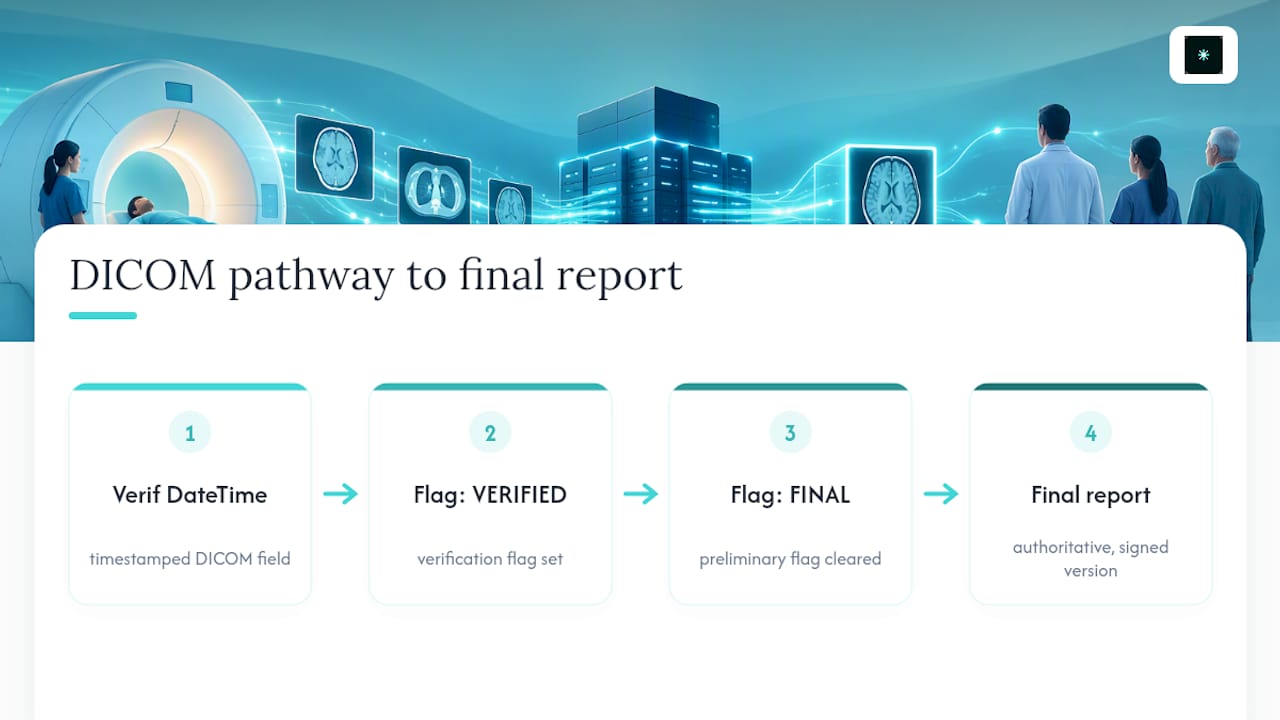
In practice, the radiologist dictates or types the interpretation, reviews the images one more time, and applies an electronic signature, a legally binding action similar to signing a paper chart but recorded and timestamped in the reporting system. That signature event updates the RIS, PACS, and typically the connected EHR simultaneously, replacing any preliminary flag with the final one.
Electronic signing measurably speeds this up. A before-and-after study of RIS turnaround times found that adding electronic signature capability cut median transcription-to-signature time dramatically. Abdominal ultrasound reports dropped from an 11-day median to 3 days; chest radiographs went from 10 days to 5. That gap between dictation and signature is exactly the window where a preliminary read sits unresolved.
Preliminary vs final: how much actually changes?
Most preliminary reads hold up well, but "most" isn't "all," and the size of the gap depends heavily on modality and context. A study of 34,661 preliminary and final neuroradiology report pairs measured a mean percentage character change of 14.8%, with a median of just 6.6%. That means the typical edit between a preliminary read and the final signed version touches a small fraction of the report's wording, usually clarifying phrasing rather than reversing a diagnosis.
The exception matters. Reports where the preliminary version missed a critical finding showed substantially larger character changes, which tells you the edits that count tend to cluster around the cases that count.
A separate AJR review of 11,908 after-hours examinations found that most discrepancies between resident preliminary reads and attending final reads had no meaningful effect on patient care. Cases with some negative clinical impact were uncommon, and major detrimental outcomes were rare.
Practical takeaways for clinicians and patients alike:
- Preliminary reads are generally reliable for immediate triage decisions in urgent settings.
- Any finding that would change management, admission, or discharge should be confirmed against the final signed version once available.
- Incidental findings and minor wording differences rarely change treatment, but they still belong in the permanent record.
Pro Tip: If you're discharged based on a preliminary read, ask your provider whether the final signed report has been reviewed yet. A one-day follow-up call to confirm no changes were made costs you nothing and closes the loop.
How do you get your final signed radiology report?
- Check your patient portal first. Most hospitals and imaging centers post reports to online health records, and the status label, preliminary or final, appears right on the document per RadiologyInfo.org's guidance.
- Call the radiology department or medical records office if the portal shows nothing after a few days, or if you need a copy for a referral or second opinion.
- Expect turnaround to vary by urgency and modality. STAT reads for stroke or trauma often finalize within an hour; routine outpatient MRI or CT studies typically finalize within 24 to 48 hours, longer for complex multi-sequence studies read after hours.
What if the final report shows something unexpected?
Critical or unexpected findings trigger a different communication path than routine results. Radiologists are expected to notify the ordering clinician directly, often by phone, rather than letting the finding sit in a portal queue.
If you're a patient facing an unexpected finding, contact your ordering physician first, ask whether a radiology consultation would help clarify next steps, and request a copy of the final signed report for your own records.
If you're a clinician, three things matter:
- Document the notification, including time and method.
- Confirm the follow-up plan is actually scheduled, not just recommended.
- Request an addendum or amendment from radiology if new clinical information changes the read.
AstraRad and what a signed report from a teleradiology partner looks like
AstraRad reads and signs final reports for hospitals, imaging centers, and radiology groups that need reliable coverage beyond their own staff's hours or capacity. Every study is interpreted by a US board-certified subspecialist matched to the modality, not a general radiologist covering everything overnight.
A teleradiology provider may offer guaranteed turnaround under one hour for STAT cases and under 24 hours for routine studies, often backed by peer review and high SLA compliance. Reports integrate directly into the client's existing PACS, with no separate portal to manage.
For administrators vetting any teleradiology partner, checking accreditation status through the ACR accredited facility search is a reasonable first step before signing a contract.
Why the final signature carries more weight than people assume
The medicolegal reality is straightforward: a signed report is the version that shows up in a malpractice review, an insurance audit, or a continuity-of-care handoff five years later. Nobody pulls up the wet read in a courtroom. What gets scrutinized is whether the signing radiologist actually reviewed the images before attaching their name, and the discrepancy data on missed critical findings shows why that review can't be skipped, even under volume pressure. Patients and referring physicians who treat the final signature as a formality are missing the one document in the entire imaging workflow that everyone downstream is legally and clinically relying on.
Rafael Vieira
Getting reliable final signed reports without expanding your radiology staff
Hospitals and imaging centers that can't staff every shift with in-house subspecialists still need final signed reports, not preliminary placeholders, delivered on a schedule they can plan around. AstraRad fills that gap with US board-certified subspecialists reading every modality, contractual turnaround commitments, and direct PACS integration, so there's no new portal for your techs to learn and no volume minimum locking you into a plan that doesn't fit your caseload.
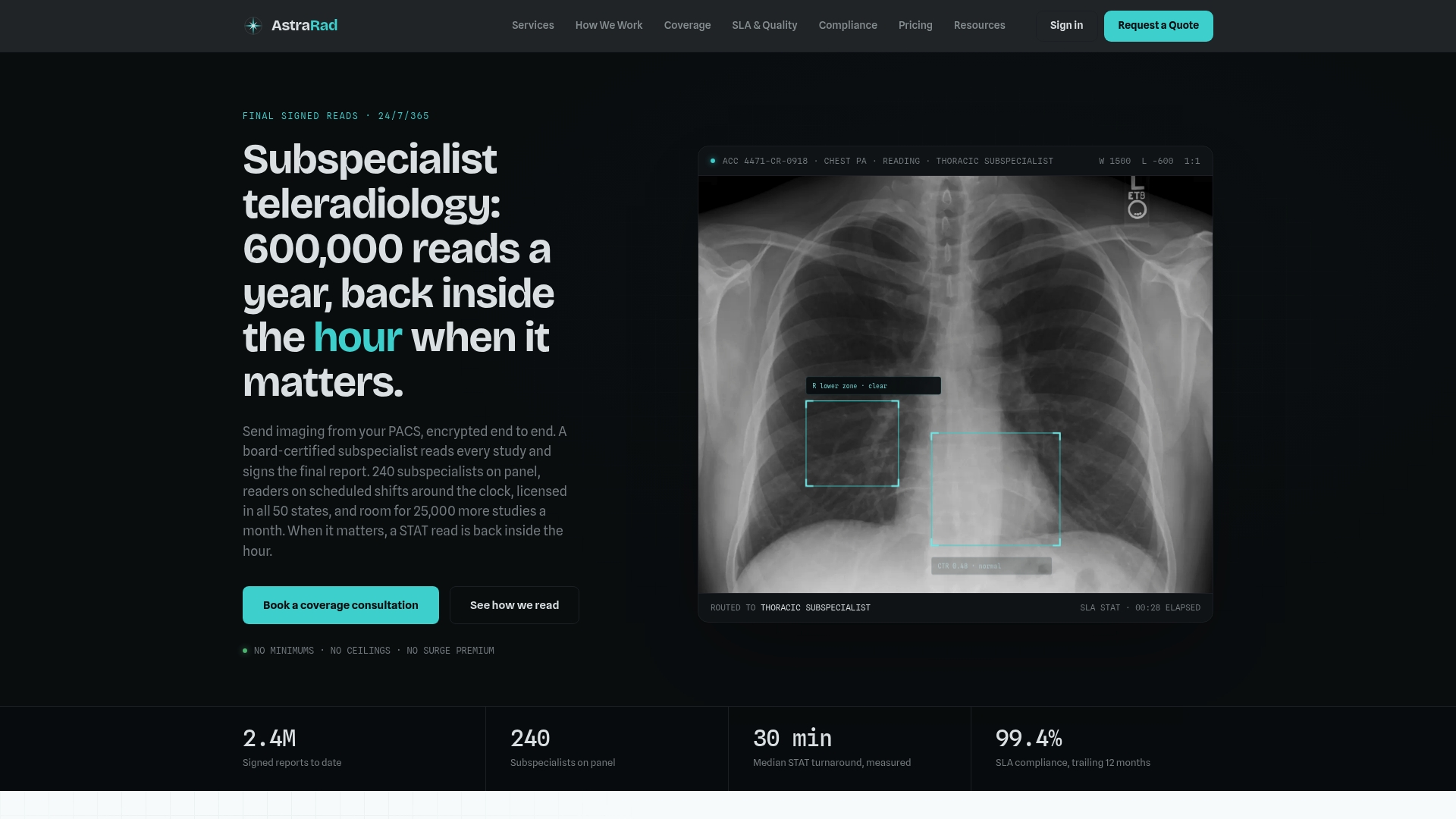
Pricing runs per report, visible upfront on the AstraRad pricing page, rather than buried in a negotiated retainer. If your radiology group is carrying overnight backlog or evaluating coverage for a new site, review how AstraRad's workflow connects to your existing systems and request an evaluation for your specific study volume and modality mix.
This article is general information, not a substitute for advice from a qualified doctor. Consult a qualified healthcare professional about your own circumstances before acting on anything here.
Sources
- DICOM Standard
- Impact of electronic signature on radiology report turnaround time
- All about your radiology report: what to know (RadiologyInfo)
- Preliminary radiology resident interpretations versus final attending radiologist interpretations and the impact on patient care (AJR)
FAQ
How long does it take for a radiology report to come back?
Turnaround depends on urgency and modality. STAT cases can finalize in under an hour, while routine studies typically finalize within 24 to 48 hours, with complex MRI or after-hours reads sometimes taking longer.
What are considered radiology reports?
A radiology report is the written interpretation of an imaging study, structured around exam type, clinical history, technique, comparison to priors, findings, and impression. It exists as either a preliminary version or the final signed version once a radiologist verifies and signs it.
What are some common critical radiology results?
Critical findings typically include things like acute stroke, pneumothorax, bowel perforation, aortic dissection, or a new mass suspicious for malignancy. These require direct, immediate communication to the ordering clinician rather than routine report delivery.
How do I get a radiology report?
Check your online patient portal first, since most facilities post reports directly to electronic health records. If it isn't there, call the radiology department or medical records office and request a copy of the final signed report.
Recommended
Related on AstraRad
- Resources
Teleradiology coverage for critical access hospitals
Teleradiology coverage for critical access hospitals: CMS conditions of participation, credentialing by proxy, coverage design, and per-read economics.
- Resources
Teleradiology PACS workflow for hospital imaging
Practical PACS to teleradiology workflow mapping for hospital imaging teams. Follow a six step workflow, compliance checklist, and AstraRad's 99.4% SLA
- Resources
Teleradiology SLA metrics for procurement
This procurement checklist sets SLA clock-start rules, median+90th targets, audit logs, surge tests, and uptime/security terms to protect patients.
Put a radiologist's name on your next read.
Tell us your modalities and monthly volume. A complete per-report rate card, with turnaround tiers and SLA terms in writing, lands in your inbox within one business day.