Joint commission teleradiology for u.S. Hospitals
Procurement checklist for Joint Commission teleradiology: exact SLA language, subspecialty reads, PACS integration, licensing, and verification documents
Meta description: A practical guide to evaluating teleradiology providers on SLA performance, subspecialty reads, PACS integration, and compliance documentation.
When hospitals and imaging centers search for guidance on joint commission teleradiology, the real question is procurement, not accreditation: which capabilities should a contract lock in before you sign. The answer is straightforward. Demand documented SLA turnaround times, board-certified subspecialists for every read, structured peer review, and PACS integration with no added portal. Anything less shifts risk onto your emergency department and your patients.
TL;DR:
- Contracts should specify STAT turnaround times under one hour and routine reports within 24 hours, with documented SLA performance metrics from the provider.
- Ensure all radiologists are board-certified subspecialists matched to each modality, and verify structured peer review processes are in place for quality assurance.
- PACS integration must be direct and seamless, with no need for separate portals, and systems should be compatible with existing DICOM and health data standards.
- Request actual SLA logs, signed sample reports, discrepancy-tracking summaries, and licensure matrices from the provider before finalizing any agreement.
- Outsourcing is best suited for overnight coverage gaps, complex subspecialty needs, or when local capacity is insufficient, but requires thorough licensing and transition support verification.
Table of Contents
- Why operational performance and clinical quality matter to hospitals and imaging centers
- What should a teleradiology contract require? A procurement checklist
- How AstraRad meets the procurement checklist
- Should you outsource radiology reads or build in-house coverage?
- Get your SLA and compliance package from AstraRad
- Sources
- FAQ
Why operational performance and clinical quality matter to hospitals and imaging centers
A missed turnaround window in radiology is not a paperwork problem. It is a patient sitting in your emergency department waiting for a decision that depends on a signed report. When a STAT chest CT takes three hours instead of one, admitting physicians either act on incomplete information or hold a bed that could serve someone else. Both outcomes cost money and, worse, cost time that matters clinically.
Subspecialist reads change the math on the back end. A general radiologist reading a complex musculoskeletal MRI or a subtle pediatric abnormality is more likely to generate an equivocal report, which triggers a repeat study, a second opinion, or a delayed treatment plan. Applied Radiology's guidance on selecting a teleradiology provider points to error rate and internal quality assurance as one of the six keys that separate dependable partners from ones that create downstream liability. Structured peer review catches discrepancies before they become a chart note in a malpractice file.
Service categories are not interchangeable, and your contract should treat them that way:
- STAT reads need sub-hour turnaround because they drive ED disposition decisions.
- Routine reads tolerate a same-day or next-day window but still need a firm deadline.
- Nighthawk coverage fills the gap when your on-site group sleeps, and it needs the same clinical rigor as daytime reads.
- Subspecialty reads (Euro, musculoskeletal, body, breast imaging) require radiologists credentialed specifically in that area, not general coverage stretched thin.
What should a teleradiology contract require? A procurement checklist
Before you sign anything, run the vendor through five categories of scrutiny. Treat this as the floor, not a nice-to-have.
- Operational metrics. Get exact SLA definitions in writing: STAT median and 95th percentile turnaround, routine reporting windows, the reporting cadence for SLA compliance (monthly is standard), and the remediation process when a target is missed. A vendor that will not commit to numeric percentiles is asking you to trust marketing language instead of a contract.
- Clinical quality. Confirm board certification for every radiologist reading your studies, subspecialty coverage matched to your case mix, structured peer review with discrepancy tracking, and a defined loop for clinician feedback. Teleradiology Consultants' guidance on selecting a US provider frames this as a balance of diagnostic accuracy, speed, and compliance, not any single metric in isolation.
- Technical and workflow fit. Require direct PACS integration with no separate viewing portal for your radiologists or referring physicians, confirmed DICOM and HL7/FHIR compatibility with your existing systems, and a realistic integration testing timeline before go-live.
- Contract terms. Nail down per-report pricing by modality, blackout dates around holidays or planned outages, indemnity language, onboarding milestones, and transition assistance if you ever switch vendors.
- Due diligence documents. Request sample signed reports, a recent SLA performance report, provider references from comparable facilities, and a state licensure matrix for every jurisdiction you operate in.
Experity's teleradiology buyer's guide frames turnaround time, subspecialty access, quality assurance, and integration as the primary axes for comparing providers, and that framework holds up well against real contract negotiations.
Pro Tip: Ask for the vendor's discrepancy tracking log format before signing, not after. A provider with a mature quality program will show you a redacted sample without hesitation. One that hedges is telling you something about how seriously it takes peer review.
How AstraRad meets the procurement checklist
Final signed reports are read by board-certified subspecialists matched to each modality and body part, with contractual STAT turnaround under one hour and routine turnaround under 24 hours, backed by structured peer review. Reports integrate directly into a client's existing PACS with no additional portal to log into. Over the past year, AstraRad has held 99.4% SLA compliance across its reporting volume, a figure worth asking any vendor to match with its own documented number.
99.4% SLA compliance over the past twelve months, measured against contractual STAT and routine turnaround commitments.
For an RFP or contract draft, procurement teams can adapt language like this: "Vendor shall guarantee STAT interpretation turnaround of under 60 minutes and routine turnaround of under 24 hours, with monthly SLA compliance reporting and a remediation plan triggered at any compliance rate below 97%." That kind of specificity is what separates an enforceable agreement from a sales deck.
Before finalizing any vendor, request these verification items regardless of who you're evaluating:
- Exported SLA performance logs covering at least the prior six months.
- Sample final signed reports across your highest-volume modalities.
- A peer-review or discrepancy-tracking summary showing methodology, not just a stated rate.
- A state licensure matrix confirming coverage in every state where your facilities operate.
- A HIPAA and data security compliance package, including how imaging data is encrypted in transit and at rest.
AstraRad's radiologist credentials and service coverage by modality are documented for exactly this kind of review, and its per-report pricing structure is published rather than quoted case by case, which shortens the diligence cycle for finance teams.
Should you outsource radiology reads or build in-house coverage?
The honest trade-off comes down to five variables: speed, subspecialty coverage, cost predictability, management overhead, and regulatory burden. Building an in-house nighthawk program means recruiting radiologists willing to work overnight shifts indefinitely, which is a retention problem more than a staffing problem. Most facilities that try it end up outsourcing the overnight hours anyway within a few years.
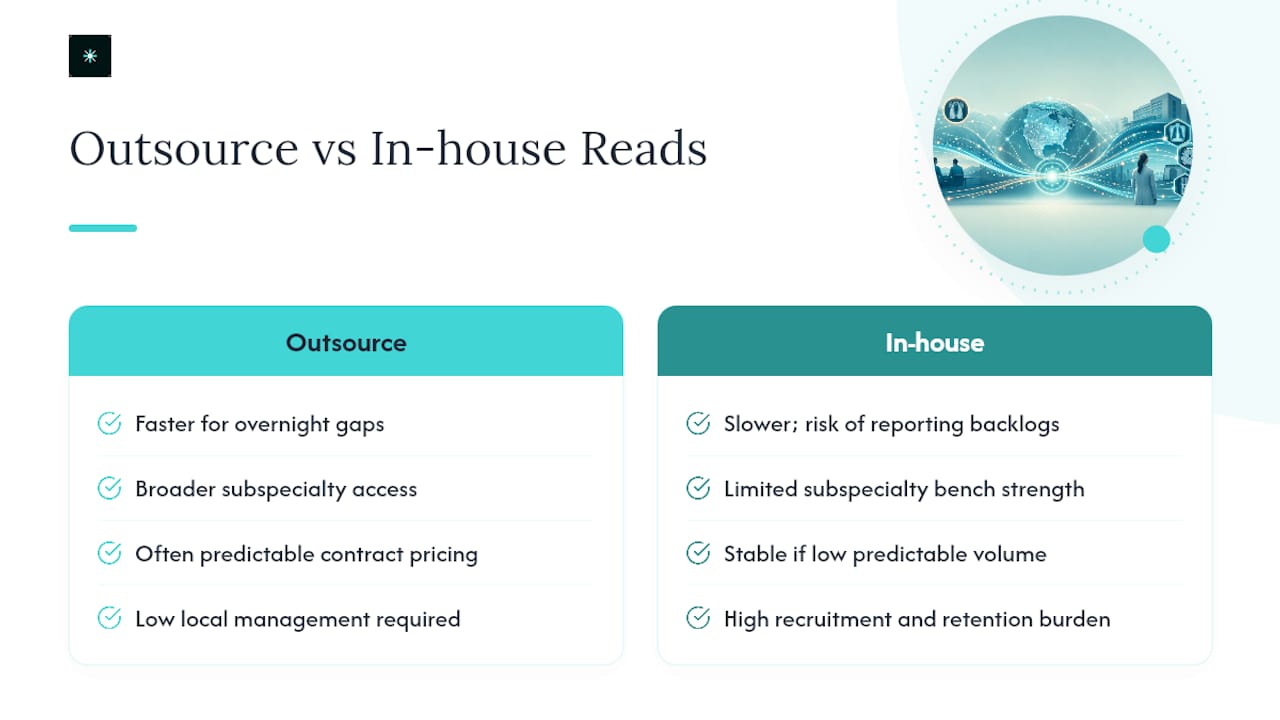
Outsourcing makes the most sense when you face overnight coverage gaps, a reporting backlog that's affecting throughput, or a subspecialty need your local group simply doesn't have the bench strength to cover. It makes less sense if your volume is low and predictable enough that a small in-house group can absorb it without overtime.
Before committing to any partner, verify state licensing coverage for every facility you operate, ask for realistic credentialing timelines, and get transition support terms in writing. A vendor that can't tell you how long onboarding takes hasn't done it enough times to know.
Rafael Vieira
Get your SLA and compliance package from AstraRad
This vendor offers an alternative to juggling multiple radiologist contracts and unpredictable coverage gaps by providing board-certified subspecialists on every study and documented performance instead of a promise. STAT reads come back in under an hour, routine studies in under 24 hours, every report passes through peer review, and reports integrate directly into existing PACS systems without additional logins for staff to manage. That combination held at 99.4% SLA compliance over the past year.
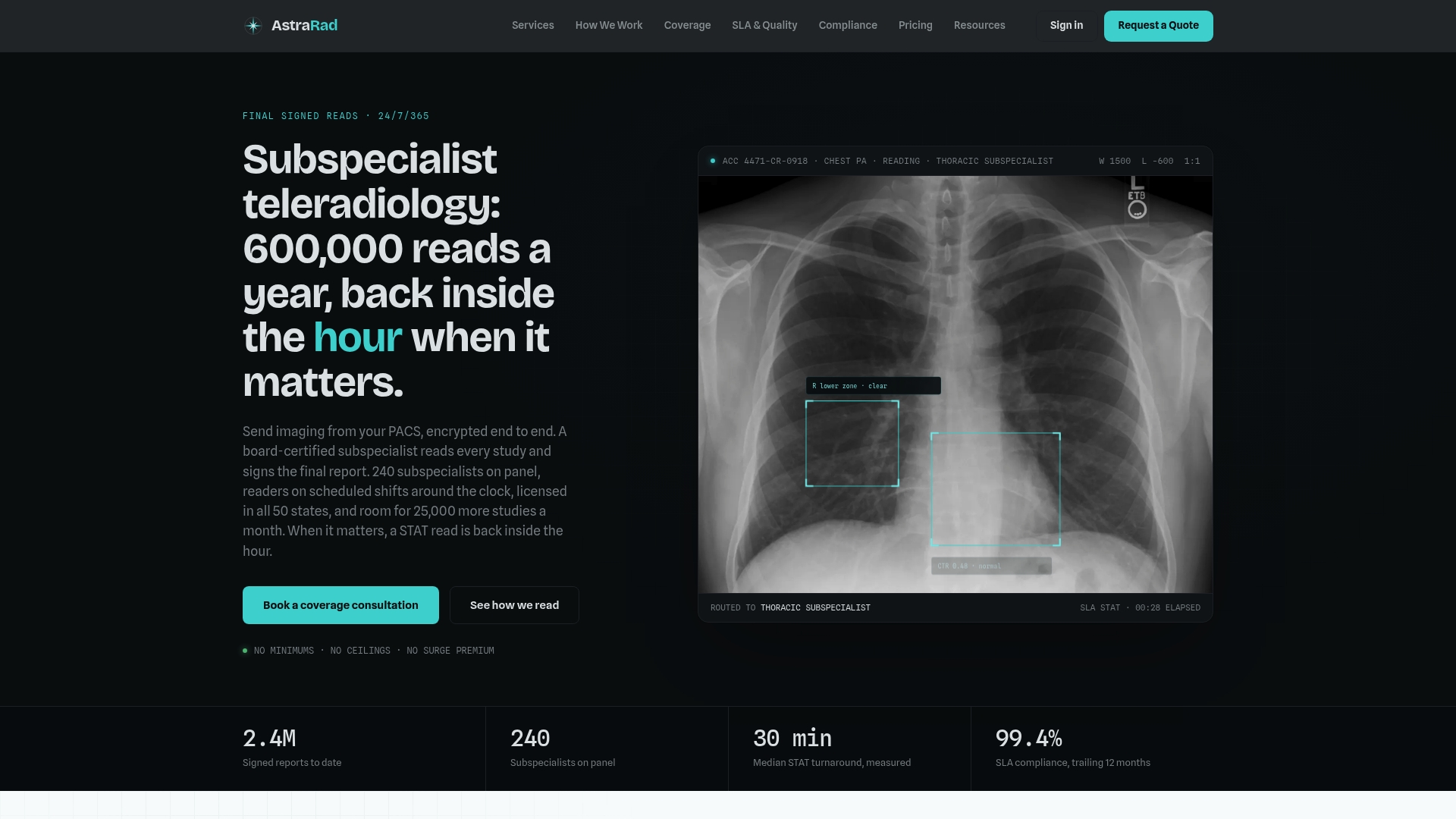
If you're building an RFP or renewing a contract this quarter, request AstraRad's SLA performance report, HIPAA compliance package, and onboarding timeline directly. Review coverage options for nights, weekends, and holidays or check STAT read performance data to see how the numbers hold up against your current provider before your next renewal date arrives.
Sources
Joint Commission digital guidance document For deeper criteria on vendor selection, see Experity's buyer's guide and Applied Radiology's six keys to selection. For compliance documentation practices, review HIMShield's telehealth coding compliance checklist.
How to Choose the Best Teleradiology Company: A Buyer’s Guide | Experity®
6 Keys to Selecting a World-Class Teleradiology Provider | Applied Radiology
Choosing the Right Teleradiology Company in the USA - Key Criteria
FAQ
What SLA turnaround should a teleradiology contract require?
A strong contract specifies STAT turnaround under one hour and routine turnaround under 24 hours, with monthly compliance reporting. AstraRad documents 99.4% SLA compliance against these exact windows over the past year.
Do teleradiology reports need to come from board-certified subspecialists?
Yes. Subspecialty-matched, board-certified radiologists reduce equivocal reads and repeat imaging compared to general coverage stretched across every modality. Confirm credentials and subspecialty assignments before signing any contract.
How does PACS integration affect teleradiology workflow?
Direct PACS integration means radiologists and referring physicians never need a separate login or portal to view or sign reports. AstraRad reports flow into a client's existing PACS, which shortens the time from study completion to signed report.
What does AstraRad charge per report?
Pricing is per-report and varies by modality and study type. Current rates are published on AstraRad's pricing page rather than quoted case by case.
What should procurement teams request before signing a teleradiology contract?
Request exported SLA logs, sample signed reports, a peer-review or discrepancy summary, and a state licensure matrix. These documents verify vendor claims instead of relying on marketing language alone.
Recommended
Related on AstraRad
- Resources
ED radiology coverage for hospital leaders
Procurement guide for hospital leaders. Run a 30 day gap analysis, pilot 90 days of overnight ED radiology coverage, and use SLA, contract, and PACS
- Resources
Vacation coverage for radiology reads: a planning guide
How to plan vacation coverage for radiology reads: cross-cover math, locum and teleradiology costs, credentialing lead times, and a 90-day calendar.
- Resources
5 priority rules for imaging IT
This playbook for Imaging IT covers five DICOM image routing rules, plus monitoring and spool policies that stop misroutes and reduce STAT delays.
Put a radiologist's name on your next read.
Tell us your modalities and monthly volume. A complete per-report rate card, with turnaround tiers and SLA terms in writing, lands in your inbox within one business day.