Multilingual radiology reports for hospitals: PARROT, HIPAA
Learn how hospitals build multilingual radiology reporting workflows using open datasets, LLM evidence, HIPAA alignment, and clinical validation steps.
Multilingual radiology reporting is safest when vetted multilingual datasets, domain-aware translation, standards alignment, and clinical review by a radiologist work together. AstraRad is a US teleradiology service that delivers final signed reports read by board-certified subspecialists. We cover datasets, LLM evidence, standards, a HIPAA-aligned workflow, and validation below, and we state our commercial interest openly.
TL;DR:
- Use PARROT’s 2,658 fictional reports across 13 languages for open benchmarking, but reserve production model training for consented local clinical data.
- Translations increased misinformation in a GPT-4 study, though critical errors did not rise significantly; bilingual radiologists should review each language direction and prompt version.
- Lock ACR RADS categories and numbers outside the model, use vetted translations, and record source terms, translated terms, and reviewer provenance.
- Keep PHI within local systems or services covered by a BAA, retain the signed original as the legal record, and require radiologist approval before patient release.
- Validate every batch with readability and translation metrics, review the first 100 cases bilingually, then audit a rolling 1% sample or weekly batch.
Table of Contents
- What are the key facts about multilingual radiology reporting?
- Which open datasets should you use for multilingual radiology reporting?
- How well do LLMs translate and simplify radiology reports?
- Why do RadLex and ACR RADS matter for translated reports?
- How do you build a HIPAA-aligned multilingual reporting workflow?
- How do you validate translated radiology reports?
- Can AstraRad support multilingual radiology reporting?
- Where can you get a signed report to anchor your multilingual program?
- FAQ
- Sources
What are the key facts about multilingual radiology reporting?
Multilingual radiology reporting is the production of radiology reports, or companion patient-facing versions, in more than one language while preserving diagnostic meaning. These facts anchor the rest of the article:
- PARROT is the largest openly available multilingual radiology-report dataset, with 2,658 reports from 21 countries in 13 languages, according to its GitHub repository.
- PARROT's modality mix is 36.1% CT, 22.8% MRI, 19.0% radiography and 16.8% ultrasound, according to its dataset repository.
- In a GPT-4 feasibility study, Flesch reading ease rose from 41.9 to 73.0 and layperson comprehension from 2.5 to 4.3 out of 5 after summarization and translation.
- ACR Reporting and Data Systems (RADS) provide standardized terminology and vetted translations that practices should follow.
- AstraRad is a US teleradiology service that delivers final signed reports read by board-certified subspecialists.
Which open datasets should you use for multilingual radiology reporting?
A dataset is a curated collection of reports, and sometimes images, used to benchmark, fine-tune or validate a model. Pick by task, not by size alone.
- PARROT: Use it for multilingual benchmarking and testing. Its reports are fictional, which makes it open and shareable, but it is not a substitute for clinical data.
- PadChest-GR: This bilingual chest X-ray dataset provides sentence-level English and Spanish findings with bounding boxes. It suits image-linked bilingual report generation and localization.
- MOSAIC: This multilingual classification approach targets efficient local deployment and was evaluated across English, Spanish, French and Danish.
For selection strategy, balance language representation when fine-tuning, because English data usually dominates other languages. Prefer datasets with aligned English versions so you can test cross-lingual fidelity. Fictional corpora are acceptable for open benchmarking. Production fine-tuning needs local, consented clinical data.
How well do LLMs translate and simplify radiology reports?
LLM translation of radiology reports can raise readability and comprehension, but fidelity varies by language and prompt. The GPT-4 interventional radiology study found improved comprehension with minimal misinformation. Translations increased instances of misinformation but did not significantly increase critical errors.
A comparative evaluation of LLMs translating reports into Hindi showed that different models led on different metrics (BLEU, METEOR, TER) and that prompt design materially changed outcomes.
Reading ease in the cited GPT-4 study rose from 41.9 to 73.0 after summarization and translation (2024 study). Simplification, not translation alone, drives most of the readability gain.
Treat every automated output as a draft. A validation checklist should include:
- A bilingual expert review of an initial sample before go-live
- Targeted checks of critical findings, laterality and measurements
- Separate review of each language direction and prompt version
Why do RadLex and ACR RADS matter for translated reports?
RadLex is a radiology lexicon that standardizes imaging terms. RADS is a family of ACR classification systems with defined categories and management language. Both keep meaning stable across languages.
Naive machine translation often mismatches ontology terms, so curated mapping and human review are necessary. Vetted RADS translations, where available, should replace ad hoc phrasing.
- Maintain a translation provenance log recording the source term, the translation and the reviewer
- Use working-group vetted RADS translations before generating your own
- Reconcile local phrasing to standard terms and codes
Pro Tip: Lock RADS category names and numbers outside the model's reach, and have the pipeline insert the vetted translation rather than letting the model rewrite them.
How do you build a HIPAA-aligned multilingual reporting workflow?
A workflow works when the radiologist's signature sits between model output and any patient-facing release. A direct, PHI-safe sequence looks like this:
- Capture the findings in a structured template or free text.
- Run translation and simplification in an on-premises module or a BAA-covered environment.
- Have a bilingual or language-matched radiologist review, correct and sign the output.
- Deliver the companion patient-facing report to the EMR or portal with provenance markers.
For integration, send the plain-language companion as a separate, linked text object through your DICOM or FHIR pipeline, and deliver directly into the existing PACS. Our How Teleradiology Works page describes these integration patterns.
On privacy, use BAA-bound services only, never send PHI to public endpoints, log every model call and keep audit trails. Open fictional datasets are fine for prompt development and benchmarking. Real clinical data enters only under consent and governance.
Pro Tip: Keep the original-language signed report as the legal record and label the translation as a companion, so no one mistakes a draft for the source.
How do you validate translated radiology reports?
Validation combines automated metrics at scale with human audit. Automated checks include Flesch reading ease and FKRL for readability, and BLEU, METEOR and TER for translation fidelity. Metrics cannot catch a flipped laterality or a dropped negation, so bilingual radiologists must also check clinical concordance.
- Run readability and fidelity metrics on every batch
- Review an initial 100 cases bilingually, then audit a rolling 1% sample or a weekly batch, depending on volume
- Log every error and feed it back into prompt and model updates
FKRL fell from 10.7 to 7.0 after summarization in the 2024 interventional radiology study. Readability gains are measurable, but they say nothing about accuracy.
Acceptance rules should require radiologist sign-off before any patient release, and critical errors should be escalated for review. A human-in-the-loop recommendation supports this review step.
Can AstraRad support multilingual radiology reporting?
AstraRad is a US teleradiology service that delivers final signed reports read by board-certified subspecialists. We provide the signed report that your translation and companion-report workflow builds on. For procurement and technical teams, our relevant commitments are:
- Final signed reports at every tier, with every read performed inside the United States
- Direct delivery into your existing PACS, DICOM conformant, with no extra portal
- Contractual turnaround tiers: STAT, routine and stroke protocol
- Per-report pricing with no minimums
- HIPAA aligned operation, as a business associate under a signed BAA
See our teleradiology services, how we work, pricing and SLA terms for the details.
Where can you get a signed report to anchor your multilingual program?
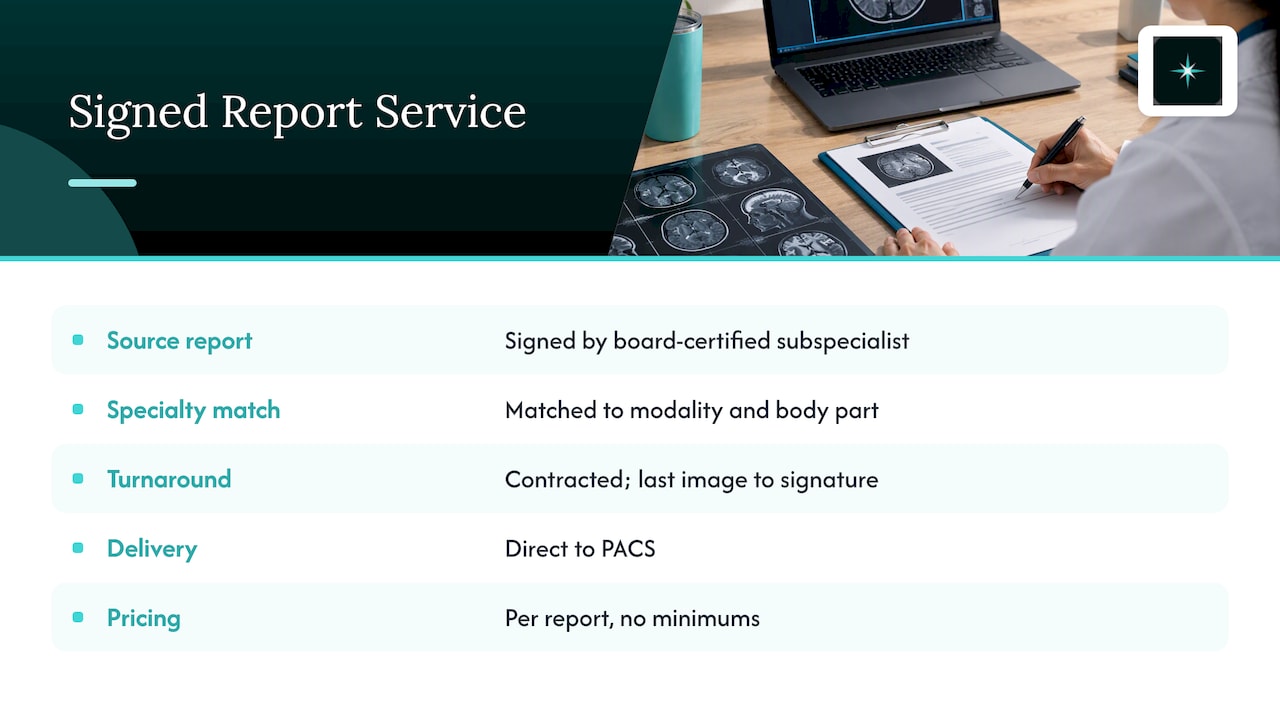
A multilingual program is only as reliable as the report it starts from. If you run a hospital, imaging center or radiology group, we deliver the final signed report from a board-certified subspecialist matched to the modality and body part. Your language workflow then translates and reviews from a stable, signed source.
We commit to turnaround by contract, measured from last-image arrival to radiologist signature, and we deliver straight into your PACS. Pricing is per report with no minimums. Because our subspecialists sign the source report, your reviewers can focus on translation fidelity instead of questioning the original read.
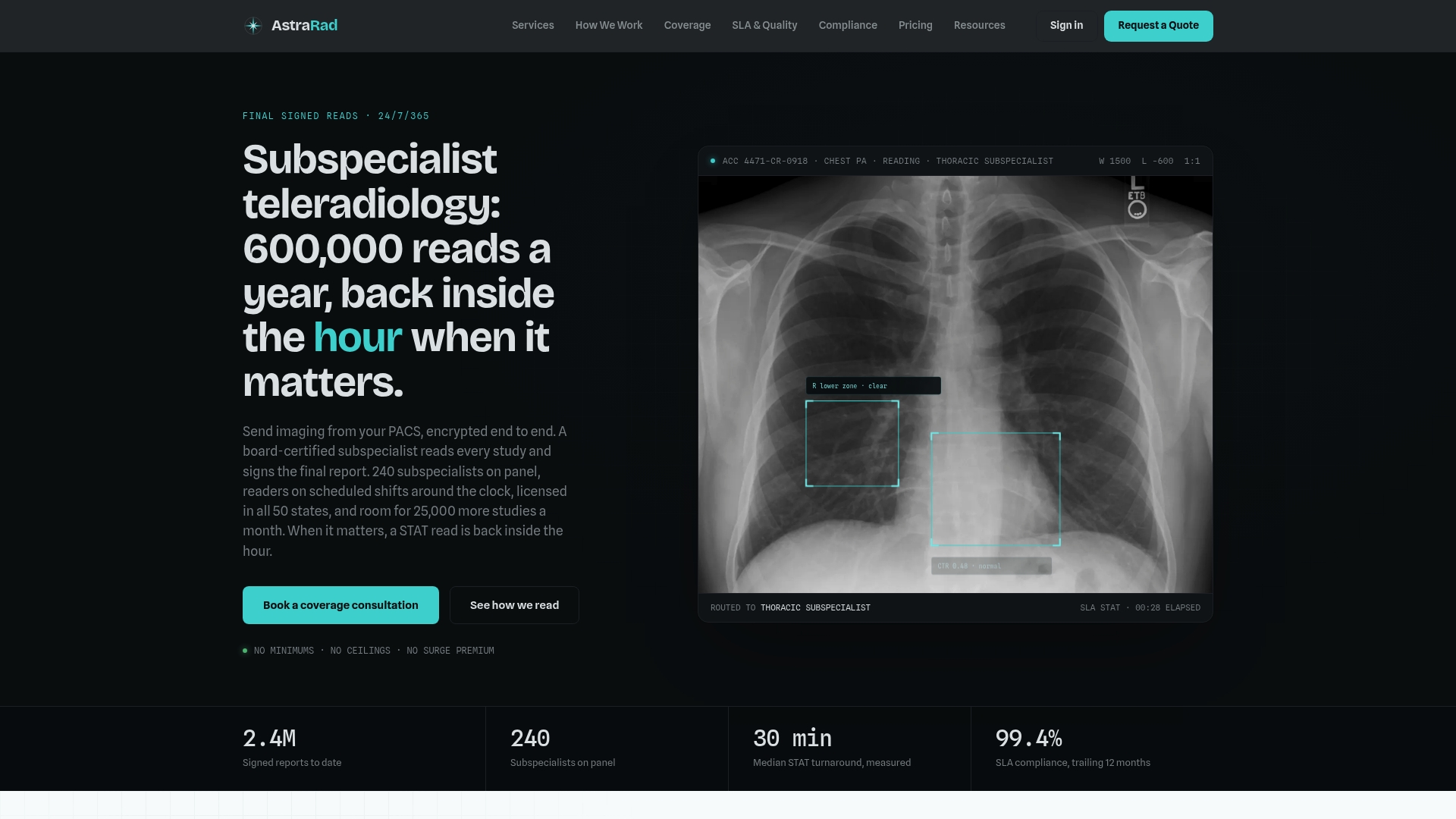
Review our teleradiology services to see the modalities we cover, then request a per-report rate card or book a discovery call. A coverage plan with SLA terms in writing follows the call.
FAQ
What is multilingual radiology reporting?
Multilingual radiology reporting is producing radiology reports, or patient-facing companions, in more than one language while keeping diagnostic meaning intact. It typically combines simplification, translation, standardized terminology and radiologist review before release.
Can GPT-4 translate radiology reports accurately?
GPT-4 can improve readability and comprehension, but accuracy varies by language and prompt. A feasibility study found minimal misinformation and no significant rise in critical errors, yet a radiologist should still review output before release.
Which dataset is best for multilingual radiology benchmarking?
PARROT is the largest open multilingual option, with 2,658 fictional reports across 13 languages. PadChest-GR suits bilingual image-linked tasks in English and Spanish. Neither replaces consented local clinical data for production fine-tuning.
Do translated radiology reports need radiologist review?
Yes. Automated translation should be treated as a draft, and a radiologist should review it before clinical or patient release. This protects against translation-introduced errors such as altered laterality, measurements or negations.
How does RadLex help with translation?
RadLex standardizes radiology terms so that meaning maps consistently across languages. Machine translation without domain mapping often mismatches terms, so curated mapping and human review are needed to preserve clinical consistency.
Sources
- Github
- Evaluation of Multilingual Simplifications of IR Procedural Reports Using GPT-4 - PubMed
- Reporting and Data Systems (RADS)
- Comparative Evaluation of Large Language Models for Translating Radiology Reports into Hindi
Recommended
Related on AstraRad
- Resources
2027 Medicare fee schedule: the radiology numbers explained
The CY2027 Medicare fee schedule cuts both conversion factors while ACR estimates radiology gains 2 percent. Both are true. Model your dollars per RVU.
- Resources
Clinician-radiologist communication: closing the loop
Clinician-radiologist communication fails when critical results reach a system but never reach the physician, and closed-loop standards close that gap.
- Resources
The hidden cost of the prelim-plus-overread model
The prelim-plus-overread model pays two radiologists and bills one report per overnight study. Cost the overread time, callbacks, and amendments first.
Put a radiologist's name on your next read.
Tell us your modalities and monthly volume. A complete per-report rate card, with turnaround tiers and SLA terms in writing, lands in your inbox within one business day.