Portable ultrasound teleradiology: 3 models, SLA decisions
Portable ultrasound teleradiology compares three delivery models and covers equipment, connectivity, ACR documentation, procurement, and SLA needs.
Portable ultrasound teleradiology is a workflow in which scans acquired with handheld or cart-based devices are sent to remote specialists for guidance or interpretation. For point-of-care use, we recommend starting with real-time telementoring, then adding asynchronous reads or telerobotic sonography where staffing, geography or exam volume call for them.
AstraRad is a US teleradiology service that delivers final signed reports read by board-certified subspecialists. We have a commercial interest in this topic, and we say so openly.
- The ACR,SPR,SRU practice parameter defines diagnostic ultrasound as protocol-driven, with documented images and formal quality assurance.
- A prospective tele-mentored handheld ultrasound study followed 708 patients in remote and rural communities, published in 2023.
- Real-time telementoring pairs a remote expert with a local operator; asynchronous reads send a completed study for later interpretation.
- Telerobotic sonography lets a remote sonographer control the probe, and it needs the most infrastructure of the three models.
- A final signed report is the contractual deliverable that separates a diagnostic read from informal image review.
TL;DR:
- Choose synchronous telementoring when local operators need coaching, asynchronous reads when connectivity limits live video, and telerobotic scanning when no local sonographer is available.
- A final signed report requires protocol driven views, retained images, qualified interpretation, and formal quality assurance; bedside POCUS without that structure supports triage, not diagnosis.
- Match handheld devices to mobile, focused exams and cart systems to broader probe needs; test connectivity, encrypted uploads, and low bandwidth fallbacks before launch.
- Put licensing, a signed business associate agreement, PACS delivery, and turnaround targets in the contract, then pilot against nondiagnostic study rates and peer review results.
Table of Contents
- What is portable ultrasound teleradiology and which terms matter?
- How do synchronous, asynchronous and telerobotic models compare?
- What equipment and connectivity do you need?
- How do ACR practice parameters apply to portable ultrasound?
- What does the path from image arrival to final signed report look like?
- Where does tele-ultrasound deliver measurable value?
- What should your implementation checklist include?
- How does AstraRad fit into portable ultrasound teleradiology workflows?
- FAQ
- Sources
What is portable ultrasound teleradiology and which terms matter?
Tele-ultrasound is an imaging workflow that transmits ultrasound images or live video to a remote clinician for guidance or interpretation. Portable ultrasound teleradiology applies that workflow to compact devices used outside a fixed imaging suite, from rural clinics to emergency departments. Getting the vocabulary right early prevents mismatched expectations between clinicians, IT and procurement.
- Diagnostic ultrasound is a protocol-driven exam with standardized, documented views and a formal interpretation, as the ACR practice parameter describes.
- Point-of-care ultrasound (POCUS) is a focused, bedside exam performed by the treating clinician to answer a specific clinical question quickly.
- Synchronous tele-ultrasound is a live session in which a remote mentor watches the scan and coaches the operator in real time.
- Asynchronous tele-ultrasound is store-and-forward: the operator acquires images, packages them and uploads them for later interpretation.
- Telerobotic sonography is a model in which a remote sonographer controls a robotic arm holding the probe at the patient's side.
The distinction between POCUS and diagnostic ultrasound drives most downstream decisions. A bedside triage exam can live inside a clinician's own workflow. A study that must produce a final signed report needs defined protocols, retained images and a qualified interpreter.
For a plain-language walkthrough of how images become reports on our side, see how our teleradiology workflow runs.
How do synchronous, asynchronous and telerobotic models compare?
Each model trades speed, staffing and infrastructure differently. Synchronous telementoring suits settings with a capable operator who needs coaching. Asynchronous reads suit settings with trained sonographers and no need for live guidance. Telerobotic clinics suit communities with no local sonographer at all.
| Model | Who acquires the images | When the expert engages | Main infrastructure need |
|---|---|---|---|
| Synchronous telementoring | Local clinician or nurse | Live, during the exam | Stable audio and video link |
| Asynchronous store-and-forward | Local sonographer or trained clinician | After the exam | Secure upload and PACS routing |
| Telerobotic sonography | Remote sonographer via robotic arm | Live, throughout the exam | Low-latency link and robotic hardware |
A typical synchronous session runs in this order:
- The remote mentor and local operator connect over a secure audio and video channel.
- A camera captures the operator's hands and probe position while the ultrasound screen is shared as a second view.
- The mentor directs probe placement and confirms each required view.
- The operator saves the key images and clips.
- The study is routed for interpretation and a final signed report.
An asynchronous workflow skips the live coaching: the operator follows a written protocol, packages the images, uploads them through an encrypted channel and waits for the interpretation. A telerobotic ultrasound clinic model reported diagnostic sufficiency for a majority of examined cases in rural and remote communities.
On evidence, a comparative review of teleultrasound and in-person ultrasound reports that real-time teleultrasound is often comparable to in-person exams for diagnostic consistency and image quality, though real-time exams commonly take longer. A systematic review of remotely supervised ultrasound found variable but often high agreement across exam types, with audio-visual quality and operator training as recurring concerns.
Pro Tip: Choose the model around your weakest link. If operator skill is the gap, start with telementoring; if connectivity is the gap, start with asynchronous reads.
What equipment and connectivity do you need?
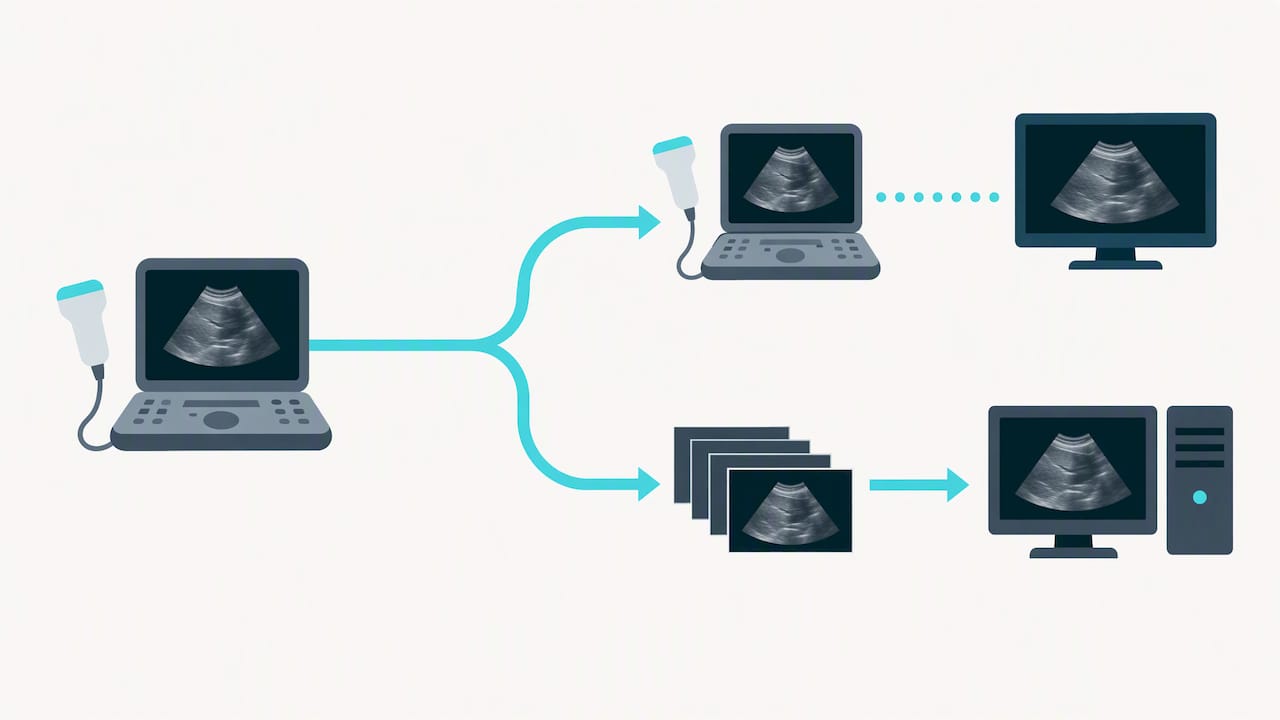
Equipment and network choices decide whether a tele-ultrasound program produces usable studies or frustrating ones. Handheld devices favor mobility and low cost. Cart-based systems favor image capability and probe range. Connectivity matters more than device sophistication: a strong link and standardized probe-handling protocols beat an expensive device on a weak network.
- Handheld versus cart-based: handheld devices are portable and quick to deploy but offer fewer probe options; cart-based systems support broader exam menus and typically richer image tools. Match the device to the exam types you will support.
- Network provisioning: synchronous mentoring needs a stable two-way video link with low latency, while asynchronous uploads tolerate slower connections but need reliable, encrypted transfer of full studies. Test both on the actual site network before go-live.
- Low-bandwidth fallbacks: plan a degraded mode, such as audio plus still images, so a weak connection does not cancel the exam.
- Image capture method: DICOM-capable output keeps images and metadata intact for PACS storage and documentation. Screen-camera workarounds can work for mentoring but degrade image quality and weaken the documentation trail.
- Mentoring video: capture the operator's hands, the probe and the patient position in one view, plus a separate feed of the ultrasound screen, so the mentor can correct probe angulation as it happens.
A narrative review of tele-ultrasonography identifies operator error in acquisition and data-security concerns among the adoption barriers, which is why capture method and encryption belong in the purchase specification and not in an afterthought.
How do ACR practice parameters apply to portable ultrasound?
The ACR practice parameter treats diagnostic ultrasound as a protocol-driven exam with documented views and a formal quality assurance program. The ACR,SPR,SRU practice parameter also sets expectations for physician and sonographer qualifications, equipment monitoring and documentation. A portable device does not lower that bar when the goal is a final signed report.
Per-study documentation should include:
- Patient identification and the performing facility
- Exam date and sonographer initials
- Image orientation labeling
- Retention of the images supporting the interpretation
Quality assurance is what makes remote reads defensible. Require your program and any partner to document these mechanisms:
- Peer review of a sample of completed reports
- Double-reads on a defined share of studies
- Written acquisition protocols for each exam type
- Equipment monitoring and maintenance records
- Facility or practitioner accreditation where applicable
Protocol-driven views matter more in remote settings than in-house ones. A remote reader cannot ask the operator to rescan after the patient leaves, so a missing view becomes a non-diagnostic study. Standardized views also protect the organization medico legally, because the record shows what was acquired, by whom and against which protocol.
We read studies against these expectations, with board-certified subspecialist interpretation.
What does the path from image arrival to final signed report look like?
A study becomes a final signed report through a defined chain: image receipt, assignment to a matched subspecialist, interpretation, signature and delivery into your record system. Each link should be a contractual item, because gaps between them are where turnaround and accountability disappear. Our PACS-to-report workflow follows this chain.
Routing options typically fall into three patterns:
- Direct DICOM send to PACS, then onward to the reading service
- Secure upload to a teleradiology service from a portable device or workstation
- Hybrid routing, where a site sends some studies directly and uploads others
Specify these terms in the contract:
- SLA tiers: STAT, routine and stroke protocol, each with turnaround measured from last-image arrival to radiologist signature. We offer STAT, routine and stroke protocol tiers, with turnaround commitments specified in the contract.
- Business associate agreement (BAA): a signed BAA under a HIPAA aligned arrangement, covering how protected health information is stored, transmitted and returned.
- Licensing and credentialing: confirmation that reading radiologists hold license for your state and meet your credentialing requirements. Confirm that reading radiologists hold the required state licenses and meet your credentialing requirements.
- Final signed report delivery: reports returned straight into your existing PACS, with no extra portal for clinicians to check.
Direct PACS integration and DICOM conformance reduce clinician friction, because results appear where they already work. For service scope on this modality, see our X-ray and ultrasound overflow service.
Where does tele-ultrasound deliver measurable value?
Tele-ultrasound delivers the clearest value where access to imaging expertise is limited by distance, staffing or hours. Evidence concentrates in rural and resource-limited settings, where remote guidance lets local clinicians perform exams that would otherwise require patient travel or delay.
- Rural and critical access hospitals: remote interpretation reduces patient travel and keeps care local. Our rural and critical access use case describes the operational pattern.
- Tele-mentored handheld exams: general practitioners performed useful exams with remote expert guidance, and the study reported effects on referral recommendations.
- Telerobotic clinics: diagnostic sufficiency was reached for many exam types in remote communities.
- Resource-limited settings: a systematic review of tele-ultrasound in resource-limited settings found diagnostically useful images from portable devices and low-cost platforms, with improved access to subspecialist interpretation.
Statistic: The 2023 prospective tele-HHUS study enrolled 708 patients across multiple rural sites, and remote guidance enabled general practitioners to perform useful exams while changing referral recommendations.
Be candid about the caveats. Comparative reviews note that real-time exams often take longer than in-person scanning, and image-quality rates vary with operator training and audio-visual quality. Build training and quality checks into the plan from the start.
What should your implementation checklist include?
A tele-ultrasound launch succeeds when scope, equipment, contracts, training and measurement are decided before the first patient is scanned. Work through the steps in order, and assign an owner to each.
- Define scope. Decide whether you are supporting POCUS, diagnostic studies or both, and list the exam types in scope.
- Specify equipment. Require DICOM output, a camera capture setup for mentoring, probe coverage for your exam list, and warranty and service terms.
- Test the network. Validate video and upload performance at each site before go-live.
- Negotiate the contract. Confirm the BAA, SLA tiers, PACS integration, credentialing requirements and per-report pricing with no minimums. Our pricing page explains how to request a per-report rate card.
- Train and credential operators. Set a training pathway, a telementoring schedule and written acquisition protocols.
- Set QA metrics. Track non-diagnostic study rates, turnaround against SLA and peer review outcomes.
- Pilot, then scale. Run a limited pilot with acceptance criteria, review the metrics, then expand.
Pro Tip: Write acceptance criteria before the pilot starts, such as a maximum non-diagnostic rate and a turnaround target, so the scale decision rests on data and not on impressions.
For coverage patterns during nights, weekends and overflow, review our coverage use cases.
How does AstraRad fit into portable ultrasound teleradiology workflows?
AstraRad is a US teleradiology service that delivers final signed reports read by board-certified subspecialists. We built our service around the contract terms this guide asks you to demand, so your procurement team can compare us against your checklist line by line.
What we offer maps to the requirements above:
- Final signed reports at every tier, including overnight
- Reports delivered straight into your existing PACS, DICOM conformant
- Contractual SLA tiers for STAT, routine and stroke protocol
- Per-report pricing with no minimums
- HIPAA aligned operation under a signed BAA
- Subspecialist matching by modality and body part, with every read performed inside the United States
Your next step is simple. Review our X-ray and ultrasound teleradiology service and our services overview, then request a per-report rate card or book a discovery call. A coverage plan with SLA terms in writing follows the call.
This article is general information, not a substitute for advice from a qualified doctor. Consult a qualified healthcare professional about your own circumstances before acting on anything here.
FAQ
Do portable ultrasound machines exist?
Yes. Portable ultrasound devices range from pocket-sized handheld units to compact cart-based systems. Handheld devices suit point-of-care exams and mentoring, while cart-based systems offer broader probe options. Studies of tele-mentored handheld ultrasound show these devices can support useful exams in rural communities when paired with remote expert guidance.
What are some popular teleradiology platforms?
Teleradiology platforms generally fall into two types: software that routes images to a reading team, and services that supply the radiologists and the final signed report. Evaluate any option on PACS integration, DICOM conformance, SLA tiers, BAA terms and who signs the report. We offer a service model with final signed reports and contractual turnaround.
How much does a portable ultrasound machine cost?
Cost depends on device class, probes and software, and published prices vary widely by vendor and configuration, so request written quotes. Budget beyond the device for training, mounting or camera capture equipment, network upgrades and interpretation. For reading costs, we price per report with no minimums; request our rate card at /pricing.
What is the difference between tele-mentoring and asynchronous reads?
Tele-mentoring is a live session in which a remote expert coaches the operator during the exam. Asynchronous reads send a completed study for later interpretation. A comparative review notes real-time exams often take longer, so choose based on operator skill, connectivity and how quickly you need guidance.
Does a portable ultrasound study produce a final signed report?
It can, when the exam follows a documented protocol with retained images and a qualified interpreter. The ACR practice parameter describes diagnostic ultrasound as protocol-driven with formal quality assurance. A bedside POCUS exam without that structure typically supports clinical triage and not a final diagnostic report.
Sources
Related on AstraRad
- Resources
2027 Medicare fee schedule: the radiology numbers explained
The CY2027 Medicare fee schedule cuts both conversion factors while ACR estimates radiology gains 2 percent. Both are true. Model your dollars per RVU.
- Resources
Clinician-radiologist communication: closing the loop
Clinician-radiologist communication fails when critical results reach a system but never reach the physician, and closed-loop standards close that gap.
- Resources
The hidden cost of the prelim-plus-overread model
The prelim-plus-overread model pays two radiologists and bills one report per overnight study. Cost the overread time, callbacks, and amendments first.
Put a radiologist's name on your next read.
Tell us your modalities and monthly volume. A complete per-report rate card, with turnaround tiers and SLA terms in writing, lands in your inbox within one business day.