Radiation safety policies for teleradiology: buyer's guide
Radiation safety policies for teleradiology: what to write into your contract, who owns dose, protocols and monitoring, and which US rules apply.
Radiation safety policies for teleradiology are written and owned by the facility that operates the scanner, and they cover protocols, dose monitoring, staff protection and communication with the interpreting radiologist. A teleradiology contract should state where each duty sits, so the reading service and the imaging site never assume the other one holds it. This guide gives US buyers a checklist built on ACR, CRCPD, OSHA and FDA material.
TL;DR
- The ACR Practice Parameter for remote CT and MR imaging says remote exams belong in the same quality assurance and performance monitoring as on-site imaging, including peer review and periodic audit.
- Dose indices should be measured periodically by a Qualified Medical Physicist and compared with national benchmarks such as the ACR Dose Index Registry and NCRP Report No. 172.
- OSHA's ionizing radiation standard (29 CFR 1910.1096) sets a whole-body limit of 1.25 rem per calendar quarter in restricted areas and requires monitoring devices once a worker is likely to exceed 25 percent of a limit.
- The 2024 CRCPD guidance on remote CT asks who is responsible for protocol management, routine QA and patient safety during the scan, and expects a secondary communication channel.
- AstraRad is a US teleradiology service that delivers final signed reports read by board-certified subspecialists, with pricing per report and no minimums.
Table of Contents
- What is a radiation safety policy for teleradiology?
- Who is responsible for radiation safety when reading is remote?
- Where does AstraRad fit, and what is our interest here?
- What should a teleradiology radiation safety policy cover?
- How should imaging sites monitor patient dose?
- What staff exposure rules and training apply?
- Which federal and state rules apply?
- How should sites and remote radiologists communicate about safety?
- What should you put in a teleradiology contract about radiation safety?
- FAQ
- Sources
What is a radiation safety policy for teleradiology?
A radiation safety policy for teleradiology is a written set of rules that assigns responsibility for patient dose, scanning protocols, staff protection and communication when the scan is performed at one site and interpreted at another. It governs the scanner and the people near it. It does not govern the reading itself.
Two terms are worth fixing before you draft or review one.
- Teleradiology is the interpretation of medical images by a radiologist at a different location from the patient and the scanner, with images and reports moving electronically.
- Remote CT or MR scanning is a model where the technologist operating the scanner console is in a different place from the patient and the equipment, often with a second technologist on site. The CRCPD (Conference of Radiation Control Program Directors) addresses it in its 2024 guidance document for remote CT scanning.
The distinction matters for buyers. Most teleradiology contracts cover reading only. The ionizing radiation is produced at your site, by your equipment, under your state's registration and your protocols. A remote reader who views images at a workstation is not in the scan room, so the staff exposure rules in the sections below apply to the people who work around the source. Your policy should say so in plain words, and your contract should match.
Who is responsible for radiation safety when reading is remote?
The site that performs the scan is responsible for the radiation produced, the protocol used and the dose recorded. The interpreting radiologist is responsible for the diagnostic quality of the read and for flagging image or protocol concerns. Put both in writing, because the CRCPD guidance lists these ownership questions as the ones inspectors ask.
The CRCPD document says an inspection of remote CT technology should review patient identification, protocol management and emergency procedures. Its key questions are who is responsible for protocol management, who performs routine quality assurance, and who is responsible for patient safety during the scan. A clean policy answers each by role, not by a person's name, so it survives staff turnover.
| Duty | Typical owner | What the policy should state |
|---|---|---|
| Scanner protocols and dose settings | Imaging site, with its Qualified Medical Physicist | Who approves protocol changes and how often they are reviewed |
| Patient identification before the scan | Imaging site technologist | The identification steps and who verifies them |
| Routine equipment QA | Imaging site and physicist | Schedule, records and who signs them |
| Dose index review against benchmarks | Imaging site and physicist | Review interval and which benchmarks are used |
| Staff dosimetry and training | Employer at the imaging site | Who wears badges, review frequency, training cadence |
| Image quality feedback and protocol concerns | Interpreting radiologist, reported to site | How concerns are raised and who answers |
| Final signed report and peer review | Reading service | Report standard, peer review rate, delivery into the PACS |
A table like this belongs in the exhibit to your agreement. It turns an abstract policy into assignments you can audit.
Where does AstraRad fit, and what is our interest here?
AstraRad is a US teleradiology service that delivers final signed reports read by board-certified subspecialists. We sell reads, so we have a commercial interest in this topic, and we say so openly. We also think a buyer is better served by a contract that draws the line between scanning duties and reading duties.
Here is what our side of that line looks like. Each study is routed to a subspecialist matched to the modality and body part, across ten subspecialties and twelve study types, on scheduled US shifts 24/7/365, with every read performed inside the United States. Radiologists are licensed in all 50 states, and 1 in 20 reports is independently double-read, blind, for peer review. Reports go into your existing PACS, DICOM conformant, with no extra portal. We work as a business associate under a signed BAA and are HIPAA aligned.
Turnaround is committed by contract and measured from last-image arrival to radiologist signature: STAT under 4 hours (under 2 hours or under 1 hour on request), routine 24 to 48 hours, and stroke protocol under 30 minutes. Pricing is per report with no minimums. The services overview lists the modalities we read, and you can request the per-report rate card to see rates.
For a hospital weighing night and emergency department cover, the page on teleradiology for hospitals describes how coverage is structured. The scanner, its protocols and its dose records remain with your facility under any reading arrangement, and the policy elements below are written with that in mind.
What should a teleradiology radiation safety policy cover?
A sound policy covers six things: protocol adaptation, dose reduction technology, dose measurement, benchmark comparison, quality assurance for remote exams, and emergency and identification procedures. The ACR Practice Parameter for remote CT and MR imaging and the CRCPD guidance supply the language, and both are written for US facilities.
The ACR Practice Parameter says facilities should adapt ionizing-radiation protocols to diagnostic requirements and to patient body habitus. It also says automated dose-reduction technologies should be used unless inappropriate. Turn those two points into policy lines:
- Protocol library. Name the approved protocols by exam and patient size category, the person or role who approves changes, and the review interval.
- Dose-reduction technology. State that automated dose-reduction features are enabled by default and require a documented reason to turn off.
- Dose measurement. Assign a Qualified Medical Physicist to measure radiation exposures or dose indices periodically.
- Benchmark comparison. Say which national references you compare against (see the next section).
- QA for remote exams. Include remote examinations in the ongoing QA program, with peer review and periodic audit of image quality, adherence to protocols and documentation accuracy. The parameter says remote scanning should be held to the same QA and performance monitoring as on-site imaging.
- Identification and emergencies. Document patient identification steps and emergency procedures, which the CRCPD guidance names as inspection items.
A Qualified Medical Physicist is a physicist who meets the qualification standards the ACR sets for performing and supervising medical physics duties for imaging equipment. Naming one in the policy, by role and contract, is the single most useful concrete step a site can take.
How should imaging sites monitor patient dose?
Sites should have a Qualified Medical Physicist measure dose indices periodically and should compare facility dose information with national benchmarks. The ACR Practice Parameter names the ACR Dose Index Registry, NCRP Report No. 172 and the CRCPD National Evaluation of X-ray Trends as examples of benchmarks for that regular review.
Two definitions help here, both from NCRP Report No. 172, published in 2015.
- A diagnostic reference level (DRL) is a dose value used in medical imaging to indicate whether the patient dose or administered activity for a specific procedure is unusually high or low for that procedure.
- An achievable dose is an optimization goal based on survey data, typically the median (50th percentile) of the dose distribution for standard techniques in widespread use.
A DRL is a flag, not a pass mark. If your median dose for an adult head CT sits well above the benchmark, the policy should require a protocol review. If it sits near or below the achievable dose, the policy should still require periodic repeat measurement, since protocols drift when equipment is updated.
What should the dose review record include?
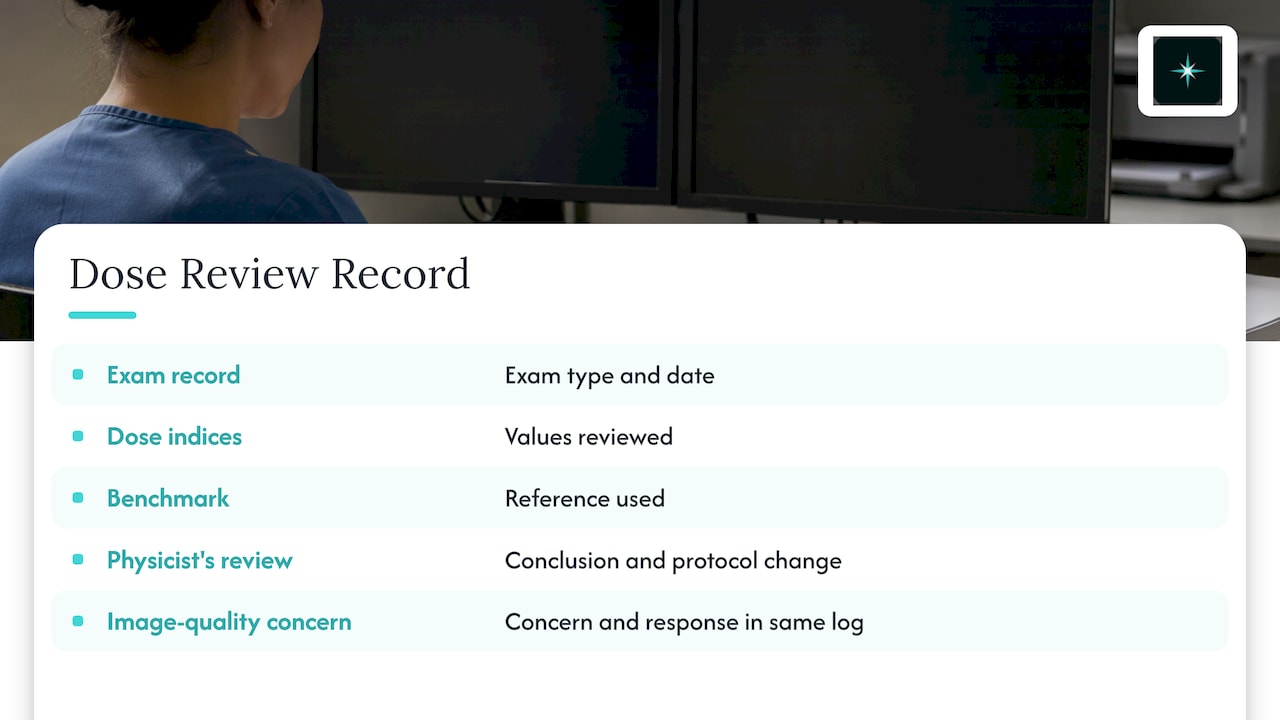
Keep the record simple enough that it gets done. For each reviewed exam type, log the date, the dose index values reviewed, the benchmark used, the physicist's conclusion and any protocol change that followed. Store the log where your accreditation and state inspection files live. If a reading service raises a protocol concern about image quality, record that concern and the answer in the same log, so one document shows the full loop.
Who responds when a patient dose concern is raised?
Name a role, not a committee. A patient dose concern, whether from a referring clinician, a technologist or an interpreting radiologist, should go to the radiation safety officer or the physicist named in the policy. Set a response interval in the policy and say what gets documented. The remote reader's part is to report what they see in the images or the dose information they receive, and your part is to review the protocol.
What staff exposure rules and training apply?
Staff exposure rules attach to the employees who work near radiation sources, which means technologists, nurses and physicians at the scanning site. OSHA's ionizing radiation standard sets quarterly dose limits, requires personal monitoring above a threshold, and its hospital guidance recommends radiation safety training for exposed workers.
The OSHA ionizing radiation standard, 29 CFR 1910.1096, has two provisions that policy writers cite most:
- In a restricted area, no employer may cause an individual to receive more than 1.25 rem in one calendar quarter to the whole body (head and trunk, active blood-forming organs, lens of the eyes or gonads). The limits are 18.75 rem for hands, forearms, feet and ankles, and 7.5 rem for the skin of the whole body.
- Employers must supply personnel monitoring equipment, and require its use, for each employee who enters a restricted area and is likely to receive more than 25 percent of the applicable limit in a calendar quarter.
OSHA's radiology eTool for hospitals adds practical detail. It says employers must provide personal dosimeters in certain circumstances, including TLDs, OSL body dosimeters or film badges, and that staff in high-dose fluoroscopy settings may be asked to wear two. It recommends radiation safety training for workers who operate or are exposed to radiation-generating equipment, radiation sources or radioactive materials.
A dosimeter is a device worn to record the radiation dose a person receives over a monitoring period. It measures exposure and does not shield the wearer. Your policy should say who wears one, how often badges are read, and who reviews the results.
How often should badges be reviewed?
The ACR-AAPM Radiation Safety Officer Resources (2021 revision) says monitoring frequency can be monthly or quarterly, depending on the employee's radiation use, and that prior dosimetry can inform the frequency. Write that rule into the policy as a role-based schedule: higher-use roles monthly, others quarterly, with the radiation safety officer able to change the assignment after reviewing past readings.
Does remote reading expose radiologists to radiation?
A radiologist interpreting images at a workstation is not operating the scanner and is not in the scan room, so the OSHA monitoring provisions above attach to staff who work near the source. Your reading contract does not need a dosimetry clause for remote readers. It does need a clause on how the reader reports image-quality or protocol concerns to the site.
Which federal and state rules apply?
Both levels apply, and the state layer does most of the day-to-day work. The FDA regulates mammography under MQSA and has regulations on the safety and radiation control of x-ray imaging devices, while states regulate users, practitioners, prescribers and facilities. The CRCPD publishes model language that states may adopt voluntarily.
The FDA's page on facility guidelines and personnel qualifications says the agency regulates mammography personnel qualifications, quality control and quality assurance, and facility accreditation and certification under the Mammography Quality Standards Act (MQSA). For mammography programs, the reading arrangement therefore sits inside a federal framework. Our page on telemammography describes that service.
For everything else, the state is the authority. Two practical consequences follow:
- Registration and inspection are state matters. The scanner's registration, the inspection and the state's rules on remote operation are set where the patient is scanned. Check your state radiation control program before you design a remote workflow.
- Licensure follows the patient. Radiologists generally need a license in the state where the patient is located, so a reading partner should hold licenses across the states you serve. Our radiologists are licensed in all 50 states, and the coverage by metro market and state rules page shows how that maps to markets.
Use the table below to sort which authority a policy line answers to.
| Policy topic | Primary reference | Level |
|---|---|---|
| Quarterly dose limits and monitoring | OSHA 29 CFR 1910.1096 | Federal |
| Mammography QA and personnel | FDA, MQSA | Federal |
| Remote CT inspection items | CRCPD guidance (2024) | Model guidance for state programs |
| Remote CT and MR QA | ACR Practice Parameter | Professional |
| Dose benchmarks | ACR Dose Index Registry, NCRP Report No. 172 | Professional |
| Scanner registration and facility rules | State radiation control program | State |
How should sites and remote radiologists communicate about safety?
Communication should run on a named primary channel with a secondary channel ready if the first fails, and everyone involved should be trained in the procedure. The CRCPD guidance says it is vital to determine how the on-site technologist communicates with the remote technologist, and it asks for a backup form of communication.
That language is written about technologist-to-technologist links in remote CT, but the same discipline helps in a reading relationship. A workable communication section of the policy covers four items:
- Primary channel. The phone line or secure messaging route technologists and radiologists use for urgent protocol or image-quality questions.
- Secondary channel. A second route, documented, for when the primary one is unavailable.
- Escalation. Who at your site receives a protocol concern, and who at the reading service receives a request from you.
- Incident record. Where each concern, answer and any protocol change is logged.
For emergency reads, the same clarity matters. If you buy stroke or trauma coverage, the contract should say how a technologist flags a study as STAT, how the reading service acknowledges it and what happens if the acknowledgment does not arrive. Our STAT CT reads page describes our STAT workflow, and our stroke protocol turnaround is committed under 30 minutes by contract.
What should you put in a teleradiology contract about radiation safety?
Put the duty split, the QA obligations, the communication protocol and the turnaround terms into the agreement or its exhibits. A radiation safety clause in a reading contract should be short and specific: it says who owns scanning duties, what the reader reports back, and how quality is reviewed.
Use this checklist when you negotiate or renew.
| Contract item | What to ask for |
|---|---|
| Scope statement | Reading service interprets images, imaging site retains scanner operation, protocols and dose management |
| Protocol concerns | A defined route for the reader to raise image-quality or protocol concerns, and a response expectation |
| Peer review | The rate and method of peer review, and how results are shared. Ours is 1 in 20 reports independently double-read, blind |
| Credentialing and licensing | Evidence of board certification and state licensure for each state served |
| Turnaround | Interval, start point and end point stated in the SLA. Ours is measured from last-image arrival to radiologist signature |
| PHI and BAA | A signed business associate agreement before any study is sent |
| Final signed report | Confirmation that every tier, including overnight, returns a final signed report |
| PACS delivery | Reports delivered into your PACS, DICOM conformant, with no separate portal |
| Pricing | Per-report fee structure and whether minimums or platform fees apply |
Subspecialty matching also affects safety in a practical sense: a CT of the chest, an MRI of the spine and a PET-CT each carry different protocol and quality questions, and a matched reader is better placed to spot a technique problem in the images. Our MRI teleradiology and PET-CT and nuclear medicine pages explain how studies are routed by modality and body part. For smaller sites that lack overnight cover, the page on rural and critical access hospital coverage shows the model.
Sources
- ACR Practice Parameter for the Supervision and Performance of Remote CT and MR Imaging
- CRCPD Guidance Document for Remote CT Scanning, February 2024
- OSHA 29 CFR 1910.1096, Ionizing radiation
- OSHA Hospitals eTool, Radiology
- FDA, Facility Guidelines and Personnel Qualifications
- NCRP Report No. 172, Reference Levels and Achievable Doses in Medical and Dental Imaging
- ACR-AAPM Radiation Safety Officer Resources, 2021 revision
If you are writing or renewing a teleradiology agreement, book a discovery call to walk through coverage and SLA terms with AstraRad, or request the per-report rate card and receive it within one business day.
Frequently asked questions
What is a radiation safety policy in teleradiology?
It is a written document that assigns responsibility for scanner protocols, patient dose, staff protection and communication when scanning and interpretation happen at different sites. The imaging facility owns the scanner-side duties. The reading service owns the quality of the read and reports concerns back to the site.
Does teleradiology change who is responsible for patient dose?
No. The facility that performs the scan remains responsible for the protocol used and the dose delivered, working with its Qualified Medical Physicist. The ACR says remote exams should sit inside the same QA and performance monitoring as on-site imaging, so the reading arrangement does not move the dose duty.
How often should dose indices be reviewed?
The ACR Practice Parameter says dose indices should be measured periodically by a Qualified Medical Physicist and compared with national benchmarks. It does not fix one interval for every site, so your policy should set a schedule by exam type and record each review, along with any protocol change that follows.
Do remote radiologists need dosimetry badges?
OSHA's standard requires monitoring for employees who enter restricted areas and are likely to exceed 25 percent of a limit in a calendar quarter. A radiologist who reads images at a workstation is not in the scan room, so the requirement attaches to staff who work near the source at the scanning site.
Which rules govern remote CT scanning?
States regulate users, practitioners and facilities, and the CRCPD's 2024 guidance helps state programs review remote CT operation, including patient identification, protocol management and emergency procedures. The ACR Practice Parameter adds professional QA expectations. Check your state radiation control program for the rules that bind your site.
Related on AstraRad
- Resources
Image quality requirements for teleradiology
Image quality requirements for teleradiology: the ACR-based specs, QC checks and contract terms US buyers should set before they send studies.
- Resources
Turnaround time SLA language for teleradiology contracts
A turnaround time SLA binds only when the contract defines the start event, stop event, statistic, exclusions, and remedy. Clause language for all five.
- Resources
How to audit a teleradiology QA program
Audit a teleradiology QA program with four numbers: double read rate, written discrepancy definition, measured rate, and the workflow after a miss.
Put a radiologist's name on your next read.
Tell us your modalities and monthly volume. A complete per-report rate card, with turnaround tiers and SLA terms in writing, lands in your inbox within one business day.