Radiology addendum policy: how to write one that works
A radiology addendum policy defines when to amend a signed report, who notifies the ordering provider, and how you audit it; here is how to write one.

A radiology addendum policy is a written procedure that says when a signed report may be amended, who must be told, and how the change is documented and audited. A sound policy separates clerical fixes from clinical changes and requires direct communication with the ordering provider for anything that could alter patient management. This guide covers each element, including what to require from an outsourced teleradiology partner.
- The ACR defines an addendum as supplementary text added to an approved report, and the official interpretation includes any addenda that attach to the permanent medical record.
- A 2021 study found addenda on about 1.1% of approved cross-sectional reports, and 71.2% of those addenda were caused by errors.
- The same 2021 study found that 82.3% of addenda had no significant clinical impact, so a tiered policy avoids over-escalating routine fixes.
- The ACR practice parameter on communication calls for notification that reasonably confirms receipt when a significant discrepancy or new urgent finding emerges.
- AstraRad commits to final signed reports at every tier, including overnight, which keeps addenda a true exception rather than a routine step.
TL;DR
- Define an addendum in your policy as text added to a finalized report, and keep the original report intact and visible.
- Split addenda into clerical corrections and clinical updates, and give each its own notification rule.
- Name who closes the loop: the radiologist communicates, the ordering clinician acknowledges, and both are documented.
- Do not rely on EMR or PACS alerts alone, because many systems do not flag an addendum the way they flag an initial report.
- When you outsource reads, write addendum turnaround, notification and audit terms into the contract and SLA.
Table of Contents
- What is a radiology addendum policy?
- Who is the author of this guide, and what is our interest?
- Why do radiology reports need addenda?
- What should a radiology addendum policy include?
- How should you separate clerical corrections from clinical updates?
- Who is responsible for closing the loop on an addendum?
- Is an automated alert enough to notify the ordering provider?
- How should an addendum be documented in the report?
- How long must radiology reports and addenda be retained?
- How do you audit and improve addendum practice?
- What should a teleradiology contract say about addenda?
- How does AstraRad handle final reads and quality review?
- What does a step-by-step addendum workflow look like?
- Which mistakes make addendum policies fail?
- Where can you see which studies teleradiology can cover?
- FAQ
- Sources
What is a radiology addendum policy?
A radiology addendum policy is a governance document that controls how a finalized radiology report is corrected or expanded after signature. It names the triggers, the approvers, the notification steps, the documentation format and the audit cycle. It protects patients first and gives your compliance team a defensible record.
An addendum is a supplement appended to a previously approved report to correct or expand on an original statement, according to a 2021 review of radiology reporting errors. The original text stays in the record. The addendum is dated, attributed and signed, so anyone reading the chart can see what was known when, and who said it.
The record matters legally and clinically. The American College of Radiology (ACR) treats the official interpretation as the written report, including any supplements or amendments, that attaches to the patient's permanent record, signed by a physician with appropriate clinical privileges, as described in the ACR practice parameter for communication of diagnostic imaging findings. Your policy should echo that language so internal and external reviewers read it the same way.
Addendum, amendment and preliminary report: how the terms differ
A preliminary report is an initial read issued before the final interpretation, often overnight or during a busy shift. A final report is the signed interpretation that becomes the official record. An addendum is anything added after that signature. Your policy should define all three in plain sentences, because disputes often start when a department uses one word for two things.
Who is the author of this guide, and what is our interest?
AstraRad is a US teleradiology service that delivers final signed reports read by board-certified subspecialists. We publish this guide because addendum handling is one of the first things hospital administrators, imaging center directors and radiology group leaders ask us to define when they outsource reads, and we have a commercial interest in being a contract option you consider.
Our reads are routed to a subspecialist matched to the modality and body part, and we commit to final signed reports at every tier. You can see how a study moves from your PACS to a signature on our how teleradiology works page, or review the full range of teleradiology services we offer. The rest of this guide applies whether you read in-house, outsource, or do both.
Why do radiology reports need addenda?
Reports need addenda because new information arrives after signature: a prior study is located, a clinical history is clarified, a typographical error is caught, or the radiologist recognizes a missed or misdescribed finding. Most addenda are minor, but a few change management, and the policy exists mainly for those.
The numbers help you size the process. In the 2021 study, addenda were generated for roughly 1.1% of all approved cross-sectional reports, and errors accounted for 71.2% of them. Communication errors (29.3%) and observational errors (20.8%) were the most common causes. Meanwhile 82.3% of addenda had no significant clinical impact, and 46.8% were issued one to seven days after the original report.
Two lessons follow. First, a low rate does not mean a low-stakes process, because the few clinically significant addenda are the ones that harm patients if missed. Second, a one-to-seven-day gap means the ordering provider may already have acted on the first report. That gap is where your notification rule earns its keep.
What should a radiology addendum policy include?
A radiology addendum policy should include eight elements: definitions, triggers, tiers, authorship rules, notification requirements, documentation format, turnaround expectations and an audit cycle. Each element should be short enough to quote alone and specific enough that a new radiologist or coordinator can follow it without asking.
| Element | What it should say |
|---|---|
| Definitions | Preliminary report, final report, addendum, critical result, clerical correction |
| Triggers | New information, error identified, prior comparison found, history clarified |
| Tiers | Clerical versus clinical, with escalation rules for each |
| Authorship | Only the interpreting radiologist or a designee with delineated privileges signs |
| Notification | Who is contacted, by what method, and how receipt is confirmed |
| Documentation | Date, time, author, reason, original text preserved, communication logged |
| Turnaround | Time targets for issuing and communicating each tier |
| Audit | Review cadence, metrics, and a blame-free case review forum |
Keep the policy to a few pages. Long policies are not read, and an unread policy cannot be followed at 3 a.m.
How should you separate clerical corrections from clinical updates?
You separate them by asking one question: could this change affect patient management? If yes, it is a clinical update and needs direct communication. If no, it is a clerical correction and can be appended and logged. Effective policies draw this line in writing, so staff do not improvise under pressure.
| Category | Examples | Required action |
|---|---|---|
| Clerical correction | Typographical error, wrong laterality in a non-critical sentence that is clearly contradicted elsewhere in the report, patient demographic fix | Append addendum, log reason, notify per routine workflow |
| Clinical update, non-urgent | Newly available comparison changes an interval statement, clarified history refines the impression | Append addendum, notify ordering provider, document the contact |
| Clinical update, significant or urgent | Missed finding, change in impression, new critical finding | Append addendum and communicate directly in a way that reasonably confirms receipt, then document |
The ACR practice parameter describes the principle: when a discrepancy between a preliminary and final report, or an addendum, introduces a new urgent finding, updating the digital record is not enough. The radiologist must communicate it to the referring provider in a manner that reasonably confirms receipt. Define in your policy what counts as significant, and let the radiologist escalate when unsure.
A caution on laterality: a left-right error is rarely merely clerical if the clinical team may have acted on it. Your policy should tell staff to treat any laterality or location error as a clinical update unless the radiologist documents why it cannot affect care.
Who is responsible for closing the loop on an addendum?
The radiologist who issues the addendum is responsible for communicating a significant change, and the ordering clinician is responsible for acknowledging it and acting on it. Your policy should state both duties explicitly, because unclear ownership of follow-up is a recognized cause of missed results.
The Joint Commission's National Patient Safety Goal 2 requires timely communication of critical test results to the responsible caregiver, including written procedures that define each critical result, as discussed in a peer-reviewed analysis of assigning responsibility to close the loop. Addenda that add a critical finding fall squarely under that expectation.
A practical way to write this section is a short responsibility list:
- Issuing radiologist: appends the addendum, contacts the responsible provider for significant changes, and records the name, time and method of contact.
- Ordering clinician or designee: acknowledges receipt, confirms the plan, and tells the radiologist or coordinator if the patient has already been discharged or has changed care teams.
- Radiology coordinator or technologist lead: tracks open addenda that lack documented acknowledgment and escalates them after a defined interval.
- Medical director or quality lead: reviews exceptions and approves changes to the policy.
When the ordering provider cannot be reached, the policy should name a fallback, such as the covering clinician, the department on call, or the facility's critical-results contact, and require that the attempt be documented.
Is an automated alert enough to notify the ordering provider?
No. An automated EMR or PACS alert is a supplement to direct communication, not a substitute. Many systems are not configured to flag an addendum the way they flag an initial report, so a clinician who already reviewed the first version may never see the update unless someone tells them.
The 2021 addenda study notes that an addendum often triggers a need for manual outreach for this reason, and that relying only on automated alerts can leave significant findings unread. The risk sits in the asynchronous gap: the report was reviewed, acted on, and then changed.
Your policy should therefore pair each tier with a method:
- Clerical: system notification or routine inbox flag is acceptable.
- Non-urgent clinical: system notification plus a message to the ordering provider's office that is logged.
- Significant or urgent clinical: a phone call or secure live message to a person, with read-back or acknowledgment, logged with name and time.
The European Society of Radiology's communication guidelines for radiologists similarly support direct verbal communication when findings call for urgent action, with local protocols defining the circumstances. If your PACS or EMR integration can display an addendum banner or re-open the result for review, document that capability, but test it before relying on it.
How should an addendum be documented in the report?
An addendum should be documented as a clearly labeled, dated and signed block appended to the original report, with the original text left intact. It should state what changed, why, and who was notified. A reader scanning the chart should understand the change in seconds.
A workable template includes these fields:
- The word ADDENDUM, with the date and time of the addendum.
- The reason, in one sentence (for example, new comparison available or error identified).
- The corrected or added statement, written so it reads on its own.
- Whether the impression changed, and the new impression if so.
- The communication note: name and role of the person notified, method, date and time.
- The electronic signature of the interpreting radiologist.
The ACR's reporting guidance, available through ACR Assist, places observations in Findings and conclusions in the Impression. If the addendum changes a conclusion, update the Impression within the addendum, so a clinician who reads only that section is not misled.
How long must radiology reports and addenda be retained?
Radiology reports and addenda must be retained according to federal and state rules, and your policy should cite the governing requirement rather than restate it from memory. For hospitals, the CMS interpretive guidance treats radiologic records, including original reports and amendments, as records to maintain for a minimum of five years under the federal standard cited in the CMS manual transmittal.
State law and your malpractice carrier may require longer retention, and rules for minors often differ. Have your compliance officer or counsel confirm the retention period for each setting you operate in, and state it in the policy with the date it was last reviewed. Make sure the retention rule covers the audit trail, such as who signed, when, and who was notified, not just the report text.
How do you audit and improve addendum practice?
You audit addenda by sampling them on a fixed schedule, classifying cause and clinical impact, and reviewing patterns in a blame-free forum. The aim is to find systemic causes, such as missing priors or unclear histories, and reduce future addenda without discouraging radiologists from issuing them.
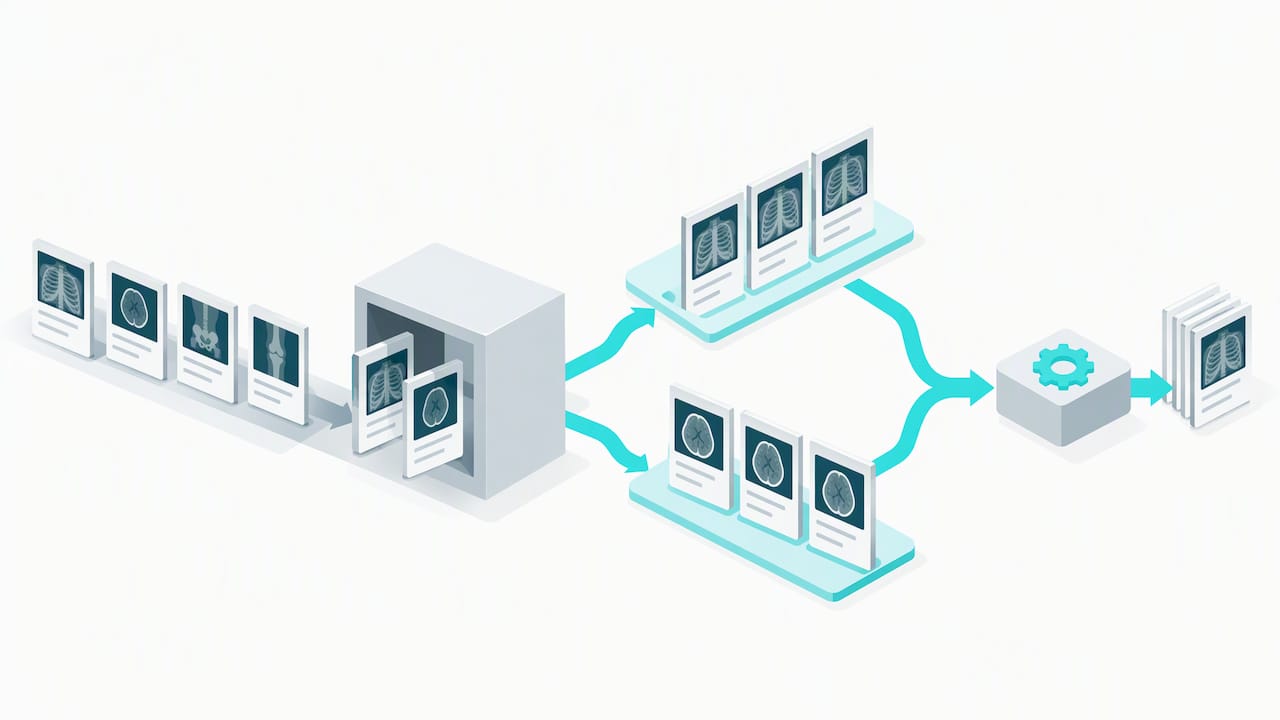
The ESR communication guidance and related peer-reviewed literature recommend treating addenda as learning opportunities rather than punitive events, and holding blame-free intradepartmental error meetings to review them. If radiologists fear consequences, they may delay or avoid correcting a report, which is the worst outcome.
Useful metrics for a quarterly review:
| Metric | Why it matters |
|---|---|
| Addenda per 1,000 final reports | Shows overall volume and trends |
| Share classified clinical versus clerical | Confirms the tiers are used consistently |
| Share with documented provider acknowledgment | Measures whether the loop is closing |
| Time from error identification to addendum | Flags delays |
| Cause categories (communication, observational, history, prior comparison) | Directs process fixes |
Use the 2021 study's categories as a starting vocabulary, so your internal data can be compared against published work. Share trends with referring clinicians too, since many communication errors start with an incomplete order or history.
What should a teleradiology contract say about addenda?
A teleradiology contract should say who may issue addenda, how quickly, how the ordering site is notified, and how the work is logged and audited. If your reads are outsourced, the addendum policy has to bridge two organizations, and gaps between them are where significant changes get lost.
| Contract term | What to specify |
|---|---|
| Authorship | Addenda signed by the original interpreting subspecialist or a credentialed designee |
| Credentialing | Radiologist licensure for the state of the patient and privileges at your facility |
| Notification | Named contact at your site, method by tier, and read-back for significant changes |
| Turnaround | Time target for issuing an addendum after an error is recognized, by tier |
| Delivery | Addendum posted to your PACS or RIS with the same identifiers as the original report |
| Audit | Log of every addendum with reason, time and notification, available on request |
| Peer review | Independent double-read program and how discrepancies feed into addenda |
| Privacy | HIPAA aligned handling under a signed business associate agreement (BAA) |
Also decide how you will handle disagreement. If your own radiologist disagrees with a teleradiology read, the policy should specify who contacts whom, whether a second opinion is documented as an addendum or a separate consult, and who owns the final record.
How does AstraRad handle final reads and quality review?
AstraRad is a US teleradiology service that delivers final signed reports read by board-certified subspecialists. Every study goes to a subspecialist matched to the modality and body part, across ten subspecialties and twelve study types, and every read is performed inside the United States on scheduled shifts, 24/7/365. Radiologists are licensed in all 50 states.
Because final signed reports are delivered at every tier, including overnight, you are not depending on preliminary reads that must be reconciled later. Turnaround is committed by contract and measured from last-image arrival to radiologist signature: STAT under 4 hours (under 2 hours or under 1 hour on request), routine 24 to 48 hours, and stroke protocol under 30 minutes. One in 20 reports is independently double-read, blind, for peer review.
Reports go straight into your existing PACS, DICOM conformant, with no extra portal, so an addendum appears where your clinicians already look. AstraRad works as a business associate under a signed BAA and is HIPAA aligned. After a discovery call, a coverage plan with SLA terms in writing follows, which is the right place to set your addendum, notification and audit terms. For urgent workflows, see our STAT radiology reads page.
What does a step-by-step addendum workflow look like?
A step-by-step addendum workflow starts when someone identifies new information and ends when the change is acknowledged and logged. Writing it as numbered steps makes it easy to train on and to audit, and each step should have one named owner.
- Identify. Any staff member who spots a possible error or new information reports it to the interpreting radiologist, with the accession number and the reason.
- Review. The radiologist re-reads the study and decides whether the report needs a change.
- Classify. The radiologist assigns the tier: clerical, non-urgent clinical or significant clinical.
- Draft and sign. The radiologist appends the addendum with the template fields and signs it. The original text remains.
- Communicate. For clinical tiers, the radiologist contacts the responsible provider using the method the tier requires.
- Confirm. The provider acknowledges and the radiologist or coordinator logs name, time and method.
- Escalate. If no acknowledgment arrives within the defined interval, the coordinator uses the fallback contact.
- Review. The addendum enters the quarterly audit sample.
Test this workflow with two or three real cases before you finalize it. Gaps usually show up in step 5, where the radiologist does not know who is on call at the referring site.
Which mistakes make addendum policies fail?
Addendum policies fail when they are vague about ownership, when they treat every change identically, or when they depend on software alone. Each failure has a simple fix in the policy text.
- No tiers. If every addendum triggers a phone call, staff stop calling. If none does, significant changes are missed. Use the tiers above.
- Silent edits. Overwriting the original report destroys the record. Always append.
- Ambiguous follow-up. Without a named owner, each party assumes the other will act. The Joint Commission-related literature on closing the loop identifies this ambiguity as a core risk.
- Punitive culture. Fear leads to delayed corrections.
- No audit. A policy you never measure drifts.
- Outsourcing gaps. A read performed off-site still needs a named contact at your facility and a path for the addendum to reach your PACS.
Where can you see which studies teleradiology can cover?
If you are scoping outsourced reads, match the policy to the study types you send. MRI reads often involve prior comparisons, which is a frequent reason for addenda, so confirm how priors are supplied. Our MRI teleradiology reporting page describes subspecialist reads, and the X-ray and ultrasound overflow page covers high-volume overflow. For centers handling walk-in volume, see teleradiology for urgent care centers.
To see how AstraRad would fit your addendum, notification and SLA requirements, start with our teleradiology services overview. Our pricing is per report with no minimums, and a coverage plan with SLA terms in writing follows a discovery call.
FAQ
What is the difference between an addendum and an amended report?
An addendum is new text appended to a signed report, with the original left visible. An amended or corrected report usually replaces or revises content, and policies differ on the term. Many departments call any correction after signature an addendum, which is why your policy should define the word explicitly and require that the original remain in the record.
Who can sign a radiology addendum?
The interpreting radiologist normally signs it. A designee may sign when the policy allows it and the person holds appropriate clinical privileges. The ACR describes the official interpretation, including addenda, as signed by a qualified physician with delineated privileges. Your policy should name who may sign and how the signature is recorded.
Does every addendum require a phone call to the ordering provider?
No. Clerical corrections can follow routine notification. Direct communication is expected when a discrepancy or new finding could affect patient management, especially an urgent one. The ACR practice parameter calls for communication that reasonably confirms receipt. Define tiers in writing so staff know which changes need a call and which do not.
How often do radiology reports get addenda?
A 2021 study of cross-sectional reports found addenda on about 1.1% of approved reports, with most caused by errors and most having no significant clinical impact. Your own rate depends on case mix, priors availability and workflow. Track addenda per 1,000 reports and classify them, so you can compare against published figures.
What should I ask a teleradiology provider about addenda?
Ask who signs addenda, how fast they are issued, how your site is notified, how they reach your PACS, and whether a log is available for audit. Also ask about peer review and credentialing. Put the answers into the contract and SLA, so expectations are written rather than assumed.
Sources
- Radiology Reporting Errors: Learning from Report Addenda (PubMed Central, 2021)
- ACR Practice Parameter for Communication of Diagnostic Imaging Findings
- Assigning responsibility to close the loop on radiology test results (PubMed Central)
- ESR communication guidelines for radiologists (PubMed Central)
- CMS Manual System transmittal on hospital radiologic services
- ACR Assist reporting guidance
Related on AstraRad
- Resources
2027 Medicare fee schedule: the radiology numbers explained
The CY2027 Medicare fee schedule cuts both conversion factors while ACR estimates radiology gains 2 percent. Both are true. Model your dollars per RVU.
- Resources
Clinician-radiologist communication: closing the loop
Clinician-radiologist communication fails when critical results reach a system but never reach the physician, and closed-loop standards close that gap.
- Resources
The hidden cost of the prelim-plus-overread model
The prelim-plus-overread model pays two radiologists and bills one report per overnight study. Cost the overread time, callbacks, and amendments first.
Put a radiologist's name on your next read.
Tell us your modalities and monthly volume. A complete per-report rate card, with turnaround tiers and SLA terms in writing, lands in your inbox within one business day.