Audit ready radiology escalation policy for administrators
Copy-ready radiology escalation policy templates for administrators, with acuity tiers, KPI tracking, the 60 minute critical-alert benchmark, and a 90 day
A radiology escalation policy must define acuity tiers, set measurable notification timelines including approximately 60 minutes for life-threatening findings, and require documented closed-loop verification with a clear escalation chain if the receiving clinician does not acknowledge the result, as outlined in Brain Scan for Concussion: What You Need to Know. Administrators should treat these as the minimum structural requirements, not optional refinements. The immediate action is straightforward: audit your current policy against these elements, then build tracked workflows so every notification produces a timestamp, a name, and a documented outcome.
TL;DR:
- Critical findings require direct notification within approximately 60 minutes, with escalation protocols in place if the initial contact is unacknowledged.
- Communication channels must be matched to acuity, using verbal confirmation for critical results and read receipts for urgent ones, with automated timestamps to track response times.
- The escalation chain should include defined roles and backup contacts, with automation preventing reliance on memory and ensuring timely follow-up.
- KPIs such as acknowledgment rates and time to notify should be monitored weekly to ensure compliance and identify any gaps in the process.
- Outsourcing overflow or after-hours coverage to a teleradiology partner with contractual turnaround commitments can help maintain escalation timeliness when internal staffing falls short.
Table of Contents
- Core components every radiology escalation policy needs
- Acuity levels and timelines: what to expect and why 60 minutes matters
- Communication methods and closed-loop verification
- An adjacent option: how a teleradiology partner supports escalation and QA
- Roles, responsibilities, and the escalation chain
- How does escalation work across different radiology settings?
- Measuring compliance: KPIs, audits, and QA processes
- Policy template: clauses and checklists you can adapt
- Why escalation policy is a system, not a memo
- Sources
- FAQ
Core components every radiology escalation policy needs
A workable policy starts with categories, not paragraphs. Radiologists and referring clinicians both need a shared vocabulary for how urgent a finding is, paired with a notification method that matches that urgency and a documentation trail that proves it happened.
The four building blocks below apply regardless of your imaging volume or PACS vendor.
- Acuity definitions with clinical examples, distinguishing critical findings such as tension pneumothorax or acute stroke from urgent findings like an unexpected mass, and from significant incidental findings that need outpatient follow-up.
- Notification methods matched to acuity, specifying when a phone call is required versus when a secure message with a read receipt is sufficient.
- Documentation fields for every notification, capturing the recipient's name and role, the time and date, the method used, and the reporting radiologist's identity.
- Escalation triggers and backup contacts, naming who gets called next when the ordering clinician does not answer within the defined window.
These four elements form the skeleton that everything else in this article builds on. Skip any one of them and the policy leaves a gap: a radiologist can flag a critical finding correctly and still have it stall if there is no backup contact named for when the ordering physician is unreachable. Hospital Radiology Communication Centers, or RCCs, exist largely to close that gap by centralizing tracking of unacknowledged alerts and applying the escalation ladder automatically rather than leaving it to memory, according to Yale's critical result guidelines.
A teleradiology service that provides final signed reports interpreted by board-certified subspecialists builds these same acuity tiers and documentation habits into its reporting workflow. That matters here because a hospital or imaging center evaluating its escalation policy is often also weighing whether internal radiologist coverage, overflow reads, or a teleradiology partner can meet the notification timelines this policy demands. The distinction is worth naming early: escalation policy governs communication after a report is signed, while turnaround time governs how fast that report gets signed in the first place. Both affect patient safety, and both deserve scrutiny in the same review cycle.
Acuity levels and timelines: what to expect and why 60 minutes matters
Timelines only work when they are tied to acuity tiers, not applied uniformly across every finding. A tension pneumothorax and an incidental thyroid nodule do not belong on the same clock.
- Critical, life or limb threatening: attempt direct contact within approximately 60 minutes wherever feasible.
- Urgent, same-day actionable: notify within a defined shorter window, commonly 4 to 24 hours, with escalation if unacknowledged.
- Non-urgent or significant incidental: track follow-up over days to weeks, often through a registry rather than an individual page.
Radiology programs commonly set a goal for initiating direct notification of life- or limb-threatening findings within about an hour. That benchmark comes from critical test result communication practices summarized in UAB's critical result communication guidance, and it functions as a floor, not a suggestion: hospitals running Radiology Communication Centers report similar tiered goals, with critical results targeted near one hour, urgent results handled within a few hours to the same day, and non-urgent findings tracked over days to weeks, per Yale's critical result guidelines.
Measurement depends on system logs, not staff recollection. Every notification attempt should generate a timestamp automatically, whether through a PACS alert, a secure messaging platform, or an EMR inbox receipt. Audits should define "time to notify" consistently: the clock starts when the radiologist finalizes the interpretation, not when someone happens to place the call. Without that fixed starting point, compliance numbers drift and become impossible to compare month over month.
Communication methods and closed-loop verification
The channel you choose should match the acuity, and the verification step should never be optional. A phone call that goes unanswered is not a completed notification, it is an attempt, and the policy needs to say so explicitly.
- Verbal contact for critical findings, confirmed by the recipient repeating back the finding.
- Secure electronic messaging with read receipts for urgent and significant findings, tracked automatically through the EMR or PACS.
- Defined fallback contacts when the ordering clinician is unavailable, including on-call coverage and delegation to a covering physician.
- Acuity-specific channels so low-urgency findings do not compete with critical alerts for the same pager or inbox.
Closed-loop communication means the sender confirms the recipient received and understood the result, and it is a patient-safety expectation from The Joint Commission specifically because unacknowledged results are a recurring source of diagnostic error, according to Quick Safety Issue 52. The same guidance stresses that manual retries alone are unreliable and that automated escalation to clinical leadership needs to trigger once an alert sits unacknowledged past a preset window.
This is also where alert fatigue gets designed out or designed in. Routing every finding, regardless of severity, through the same phone tree guarantees that staff start ignoring pages. Separating channels by acuity, and automating the escalation step rather than relying on a person to remember to follow up, is what keeps the critical channel meaningful.

Pro Tip: Route critical and non-urgent alerts through physically separate channels, phone for critical, secure inbox for the rest, so staff never learn to treat every alert as background noise.
An adjacent option: how a teleradiology partner supports escalation and QA
Internal policy fixes the process, but backlog, night coverage gaps, and subspecialist shortages still create the conditions where a critical finding sits unacknowledged too long. Outsourcing overflow or after-hours volume to a partner with contractual turnaround commitments is one way to close that gap without adding headcount.
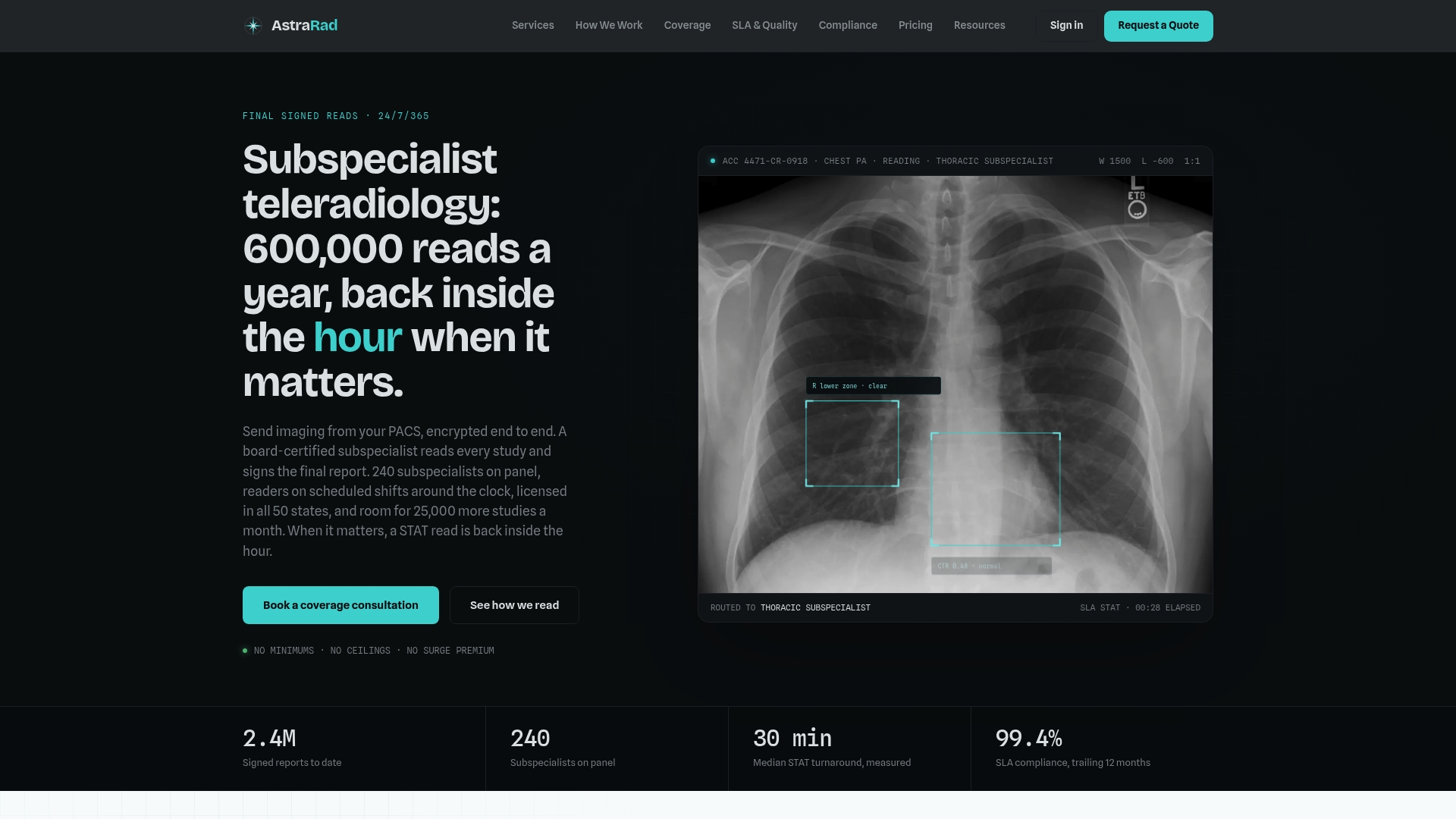
A teleradiology service provides final signed reports interpreted by US board-certified subspecialists matched to each modality, with committed turnaround ceilings: STAT under 4 hours (under 2 hours or 1 hour on request), routine 24 to 48 hours, and stroke protocol under 30 minutes, backed by peer review that double-reads 1 in 20 studies. Reports integrate directly with existing PACS systems, so the escalation documentation your policy requires still flows through the same system your staff already uses.
Consider outsourcing one tool among several, not a replacement for the policy work this article covers. Departments weighing the fit can review AstraRad's STAT radiology reads and turnaround commitments to see whether a pilot on overflow volume would tighten the notification timelines this article covers.
Roles, responsibilities, and the escalation chain
Every notification failure traces back to an undefined handoff. The policy needs to name who owns each step before the first critical result ever needs it.
- Radiologists flag the acuity tier, attempt the initial notification, and document the contact or the failed attempt.
- Radiology administrative or PACS staff monitor for unacknowledged alerts and trigger the next step in the escalation ladder, ideally through automation rather than manual review.
- Ordering clinicians acknowledge receipt and, when delegating coverage, confirm that the covering physician is reachable through the same channel.
- The escalation ladder moves from on-call backup to the department's service chief, then to the medical director, and finally to direct patient contact when no clinician can be reached and the finding demands immediate action.
National quality improvement guidance on incident reporting in radiology reinforces this ladder structure directly, recommending that unacknowledged alerts escalate to clinical directors and governance rather than dead-ending with the original radiologist, per recommendations for reporting and learning from patient-related incidents. Writing the ladder into the policy document, with named roles rather than generic titles, is what turns it from an aspiration into something staff can actually execute at 2 a.m.
How does escalation work across different radiology settings?
The same policy skeleton plays out differently depending on where the finding turns up. Four short scenarios show the pattern.
- Emergency department, tension pneumothorax on chest X-ray. The radiologist calls the ED attending directly within minutes, documents the verbal confirmation, and logs the time in the report addendum.
- MRI suite, patient deterioration during a contrast study. On-site staff escalate immediately to the ordering physician and, when the situation is acute, to on-site emergency response rather than waiting on a standard notification window.
- Outpatient imaging, unexpected abdominal aortic aneurysm on a routine CT. The finding routes as urgent, the ordering clinician gets a same-day call, and the case enters a follow-up tracking log if contact is not confirmed within the defined window.
- Teleradiology reads integrated into local workflow. A remote subspecialist flags the acuity tier exactly as an on-site radiologist would, then hands the notification duty to local staff or, depending on the service agreement, completes the direct call and documents it before the local team takes over follow-up tracking.
Outpatient and urgent care settings often carry the highest risk of a finding falling through the cracks, since there is no bedside nurse to catch a missed callback. Coverage models built for that specific gap, including teleradiology support for urgent care centers, typically build the notification and documentation handoff into the read itself rather than treating it as a separate downstream task.
Measuring compliance: KPIs, audits, and QA processes
A policy without measurement is a memo. Four KPIs give administrators a working dashboard for whether the escalation process is actually functioning.
- Acknowledgement rate, the percentage of critical and urgent notifications confirmed by the recipient within the defined window.
- Time to notify by acuity tier, measured from report finalization to the first documented contact attempt.
- Unacknowledged alerts escalated, tracking how many notifications required a step up the escalation ladder.
- Discrepancy rates by modality, comparing preliminary and final reads to catch systematic interpretation gaps.
An estimated 7.5 to 15% of radiology reports and images go unopened by the referring clinician in EHR-based assessments. That figure, drawn from the ACR's summary of AI use cases for ensuring referring clinicians read reports, is the strongest argument for read-receipt tracking rather than trusting that a report landing in an inbox equals a report read.
Audits should combine two methods: continuous, real-time monitoring of notification timestamps for critical results, and a weekly retrospective sample of signed reports to catch the slower-moving problem of missed follow-up on non-urgent findings. A structured 90-day QA pilot, running both audit types in parallel with a defined corrective-action workflow for every miss, gives most departments enough data to see whether the policy is holding up under real volume before committing to a permanent monitoring structure.
Policy template: clauses and checklists you can adapt
Copy-ready wording saves a department from drafting acuity definitions from scratch. A workable clause reads something like: "Critical findings are life or limb threatening and require prompt direct notification within a short timeframe. Urgent findings require same-day notification. Non-urgent significant findings are tracked for follow-up within 30 days."
Documentation logging should follow a fixed template, recommended in guidelines from TRA-MINW's critical result communication guideline: "Results communicated to [name, role, NPI] at [time and date] via [phone, secure message, or EMR inbox]. Reporter: [name]. If unacknowledged after [X minutes or hours], escalate to [role]."
- Escalation flow checklist: name the backup contact, the time trigger, and the next role up the ladder before the first critical case occurs.
- IT integration checklist: confirm PACS and EMR can generate automatic timestamps and read receipts without manual entry.
- Staff training checklist: walk every radiologist and coordinator through the ladder using a real prior case before go-live.
Why escalation policy is a system, not a memo
Too many departments treat escalation policy as a document to file after accreditation season rather than a system that needs daily attention. The policy only works when IT, clinical operations, and department leadership all own a piece of it, and when someone is watching the KPIs every week rather than once a year. That usually means investing in an alerts coordinator role or automation that catches what a busy radiologist cannot, because a policy nobody monitors quietly becomes a policy nobody follows.
Sources
- Quick Safety Issue 52: Advancing safety with closed-loop communication of test results
- Critical Result Guidelines | Radiology & Biomedical Imaging (Yale)
- ACR: Ensure referring clinician reads the radiology report (AI use case summary)
- UAB critical result communication practice (summary)
This article is general information, not a substitute for advice from a qualified doctor. Consult a qualified healthcare professional about your own circumstances before acting on anything here.
FAQ
What is the 60-minute rule in radiology?
It refers to the common goal of initiating direct notification within approximately 60 minutes for life or limb-threatening findings, a benchmark used in critical result communication programs described by UAB. It is a notification target, not a formal regulatory mandate, so individual hospital policies set the exact wording.
What are the most common errors that trigger escalation?
Missed or delayed communication of an actionable finding is one of the most frequent triggers, often because a report went unopened rather than because the interpretation itself was wrong. The ACR notes that an estimated 7.5 to 15% of reports and images go unread by the referring clinician, which is precisely the gap escalation policies exist to close.
How does CMS guidance affect radiology escalation billing?
CMS coding manuals do not set clinical escalation timelines, but they do require that administrative processes tied to reporting, including repeat imaging or corrected reports, align with documentation and billing rules described in the NCCI Medicare Policy Manual. Escalation policy and coding compliance should be reviewed together rather than treated as separate workflows.
What is the rule of two in radiology escalation?
Definitions vary by institution, but a common version calls for two independent notification attempts through two different contacts, such as the ordering clinician and a covering physician, before an alert escalates further up the chain. Departments should confirm the specific version used locally rather than assume a single universal standard.
Why does documentation matter as much as the notification itself?
Documentation is what turns a notification into evidence that the closed loop actually closed, capturing who was contacted, when, and by what method. Guidelines such as TRA-MINW's critical result communication template recommend logging this in the report addendum itself so the record travels with the study permanently.
Recommended
Related on AstraRad
- Resources
Inside a teleradiology company: how the machine works
How a teleradiology company actually operates behind the reading room: worklist engines, night staffing, licensing operations, credentialing, and QA.
- Resources
Radiology compliance reporting for compliance officers
Checklist for compliance officers to make radiology reports audit ready: required fields, PACS risk analysis, ACR RADS, MIPS dose capture, audit cadence
- Resources
Teleradiology provider expectations: SLAs, QA, reporting
What to expect from a teleradiology provider once the contract starts: SLA mechanics, monthly reporting, escalation paths, and the QA cadence to demand.
Put a radiologist's name on your next read.
Tell us your modalities and monthly volume. A complete per-report rate card, with turnaround tiers and SLA terms in writing, lands in your inbox within one business day.