Teleradiology to reclaim time for radiology peer learning
Operations first guide for radiology leaders: use ACR and AJR evidence to set up peer learning, measure impact, and reclaim conference time with...
Radiology peer learning replaces score-based grading with a nonpunitive review of interesting or unexpected cases, shared openly among colleagues to improve diagnostic skill and department culture. The core benefit: higher learning yield, stronger safety culture, and measurable gains in improvement projects. Two data points back the shift: a 2022 ACR member survey and a peer-reviewed implementation study in AJR.
TL;DR:
- Peer learning significantly increases the number of monthly case submissions and boosts engagement compared to traditional score-based review.
- Implementing a program requires a clear submission process, regular meetings, anonymized cases, and documentation that integrates with existing quality workflows.
- Securing leadership support relies on framing peer learning as risk management and starting with a short pilot involving five to eight participants.
- Teleradiology partnerships can free up radiologist time by handling overflow reports, enabling more focus on case discussions and learning activities.
- Success metrics should track participation, submissions, departmental distribution of learning points, improvement projects, and CME credits, with regular review checkpoints.
Table of Contents
- Why peer learning: evidence and core concepts
- Core components of an effective peer learning program
- How do you launch or convert to a peer learning program?
- Measuring success: metrics, accreditation, and reporting
- Common barriers and change-management tactics
- How a teleradiology partner can support peer learning programs
- Perspective: next steps and a short roadmap for leaders
- AstraRad as an operational partner for peer learning at scale
- Sources
- FAQ
Why peer learning: evidence and core concepts
Score-based peer review asks radiologists to grade a random sample of each other's old reports, usually months after the fact, with a number that rarely changes practice. Peer learning does something different: it asks radiologists to flag cases worth discussing, right after they see them, without a grade attached.
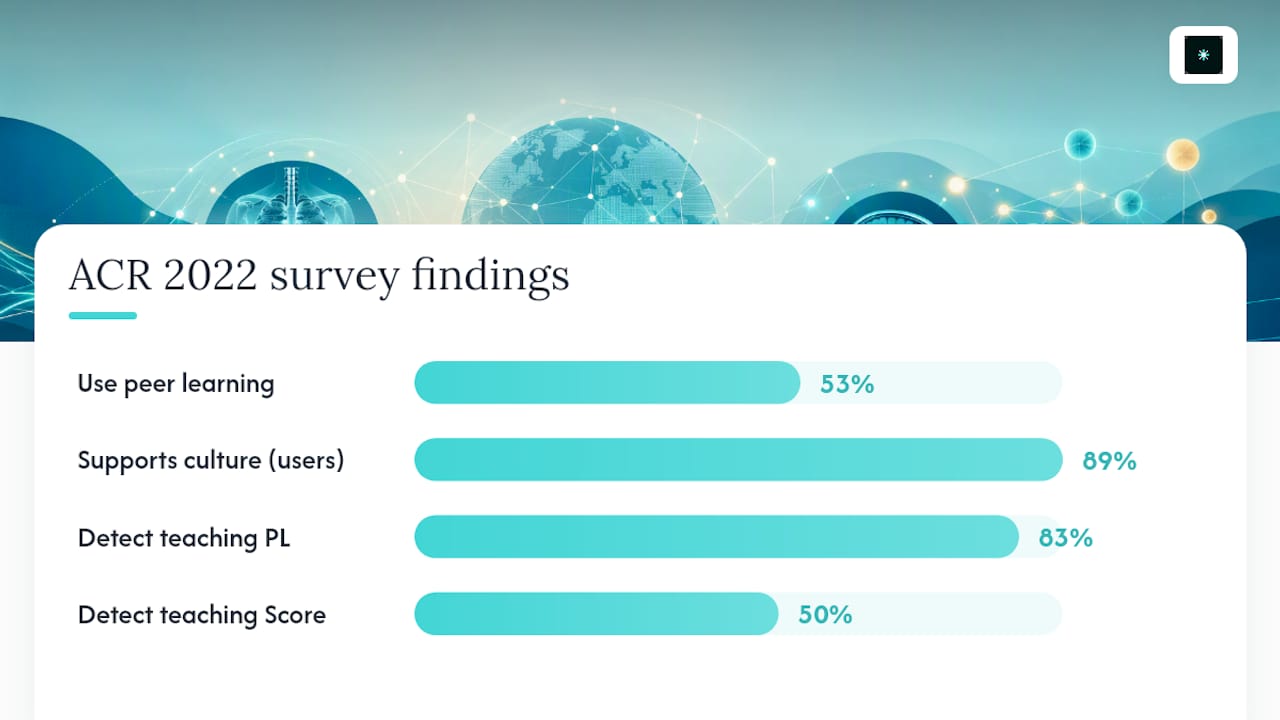
The ACR's 2022 survey of 1,153 members found that 53% of respondents already use some form of peer learning. Among those users, 89% said it supports a better culture of safety and wellness in their department. Radiologists using peer learning were also far more likely to spot teaching cases in routine practice: 83% versus 50% for those still under score-based review.
The AJR implementation study puts numbers behind that culture shift. After one multispecialty practice switched formats, mean monthly learning case submissions increased significantly, along with a notable rise in improvement projects.
Three ideas hold this together:
- Just culture: cases are framed as "interesting" or "unexpected," never as evidence of negligence.
- Anonymized presentation: the reporting radiologist's identity stays out of the discussion.
- Systems focus: the group asks what process allowed a miss, not who made it.
Peer learning activity also counts toward ABR continuing certification requirements and CME credit when documented properly, which gives departments a second reason to formalize it beyond culture alone.
Core components of an effective peer learning program
A program needs three working parts: a submission pathway, a meeting structure, and a way to close the loop on what gets learned.
- Submission workflow. Any radiologist can flag a case, at any point in a shift, through a lightweight form capturing modality, a short description, and why it's worth discussing. Cases stay anonymized before the reporting radiologist's name is stripped from the record shown to the group.
- Meeting formats. Most programs run a recurring case conference, weekly or biweekly, sometimes split into modality-specific modules. Multidisciplinary sessions that pull in referring clinicians tend to produce the highest learning yield, because they close the loop with the actual clinical outcome.
- Roles and governance. A program lead sets policy and reports to department leadership. A rotating facilitator runs each session. Someone keeps minutes, since documentation is what turns a good conversation into a tracked quality activity.
- Documentation and distribution. Learning points get written up and distributed to the full department, not just attendees, and logged in a tracker that mirrors or plugs into existing QA workflows like RADPEER QI.
On tools: most successful programs reuse existing PACS viewing stations with a modified profile to present anonymized cases live in conference, rather than adopting new software from scratch.
Pro Tip: Capture the referring clinician's follow-up outcome whenever possible. A case without the eventual diagnosis is a discussion point; a case with it is a teaching file.
How do you launch or convert to a peer learning program?
- Build the case for leadership. Bring the ACR survey numbers and the AJR submission data to the table. Frame it as risk management, not just education. The ACR's Peer Learning Resources page includes talking points built for exactly this conversation.
- Design a pilot. Pick one subsection, timebox it to 90 days, and recruit five to eight willing participants rather than mandating the whole department at once.
- Set policy first. Decide on anonymity rules, how submissions link to focused professional practice evaluations, and who sees raw data versus aggregated learning points.
- Operationalize. Stand up the intake form, lock in a meeting cadence, assign a minutes keeper, and build a one-page dashboard.
- Set review checkpoints. Revisit metrics at 30, 60, and 90 days.
Track from day one:
- Number of submissions per month
- Meeting attendance rate
- Learning points distributed department-wide
- Improvement projects opened
Measuring success: metrics, accreditation, and reporting
A useful dashboard tracks five numbers: participation rate, monthly submissions, distributed learning points, improvement projects opened, and CME credits logged. The AJR study recorded gains in CME credit activity alongside the submission increase, which gives leaders a second, provider-facing metric to report.
- Present trend lines, not single snapshots. A quarter of flat numbers after a strong pilot is a signal, not noise.
- Federal and state peer review protections generally extend to peer learning discussions when documented as a quality activity, though department counsel should confirm specifics for your state.
- Feed recurring themes from case conferences directly into formal improvement projects. That's the loop that turns a discussion into a fix.
Common barriers and change-management tactics
The usual resistance points: fear of exposure, time pressure on already-busy schedules, uneven participation across the group, and thin support from department leadership.
- Run a short pilot before asking for full buy-in.
- Anonymize aggressively in the first six months to build trust.
- Tie CME credit to participation to give busy radiologists a concrete reason to show up.
- Document and circulate early wins, even small ones, to build momentum.
- Protect time on the schedule for peer learning; if it's not blocked, it gets skipped.
Adoption tends to run higher among younger radiologists and in urban academic centers, so tailor your pitch by audience: junior staff may need less convincing than senior physicians used to score-based review.
Pro Tip: If uneven engagement is your biggest problem, publish a simple leaderboard of submission counts by section, not by name. Friendly competition between subsections moves the needle faster than department-wide mandates.
How a teleradiology partner can support peer learning programs
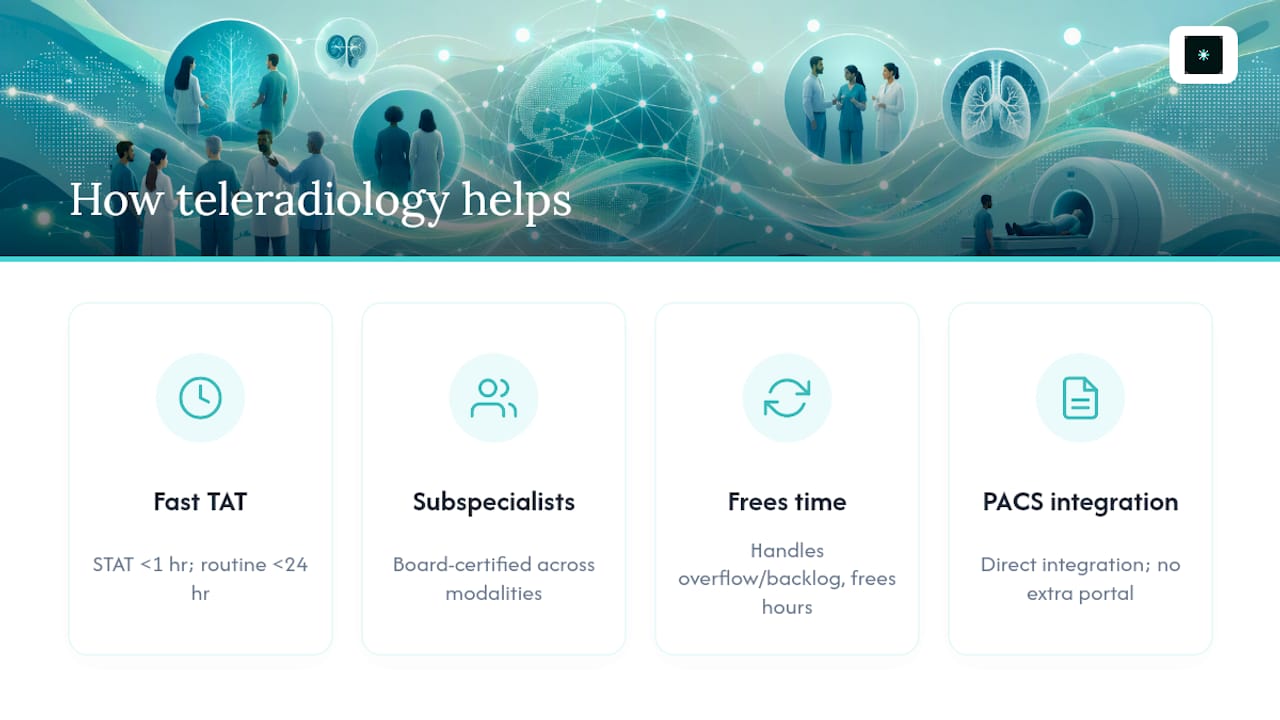
Peer learning takes time, and time is the resource most radiology departments have the least of. A teleradiology partner can provide final signed reports through board-certified subspecialists across major modalities, with guaranteed turnaround under one hour for STAT studies and under 24 hours for routine work. That capacity matters here for one specific reason: when overflow and backlog reads move off a department's plate, local radiologists get protected hours back for case conferences and submission review. Such a partner may integrate directly with existing PACS systems, so reports flow into the workflow radiologists already use, with no separate portal and no disruption to the documentation trail peer learning programs depend on.
Perspective: next steps and a short roadmap for leaders
Peer learning is moving from optional to expected. RADPEER QI integration is pushing programs toward shared tracking, and national shared-learning efforts are starting to pool cases across institutions rather than keeping them siloed by department. That trajectory rewards leaders who move now instead of waiting for a mandate.
Three steps for the next 12 months: pilot in one subsection before rolling out department-wide, tie participation to CME credit from day one, and report metrics to leadership quarterly, not annually. Publish what you learn internally, even the failed experiments. Programs that iterate in public build faster trust than ones that announce success once a year.
Rafael Vieira
AstraRad as an operational partner for peer learning at scale
There's no single fix for the time crunch peer learning creates, but freeing up radiologist hours is the lever most departments underuse. A teleradiology service with subspecialist-read final reports, guaranteed turnaround, and direct PACS integration can help by ensuring overflow and backlog volume stops competing with case conference time on the calendar.
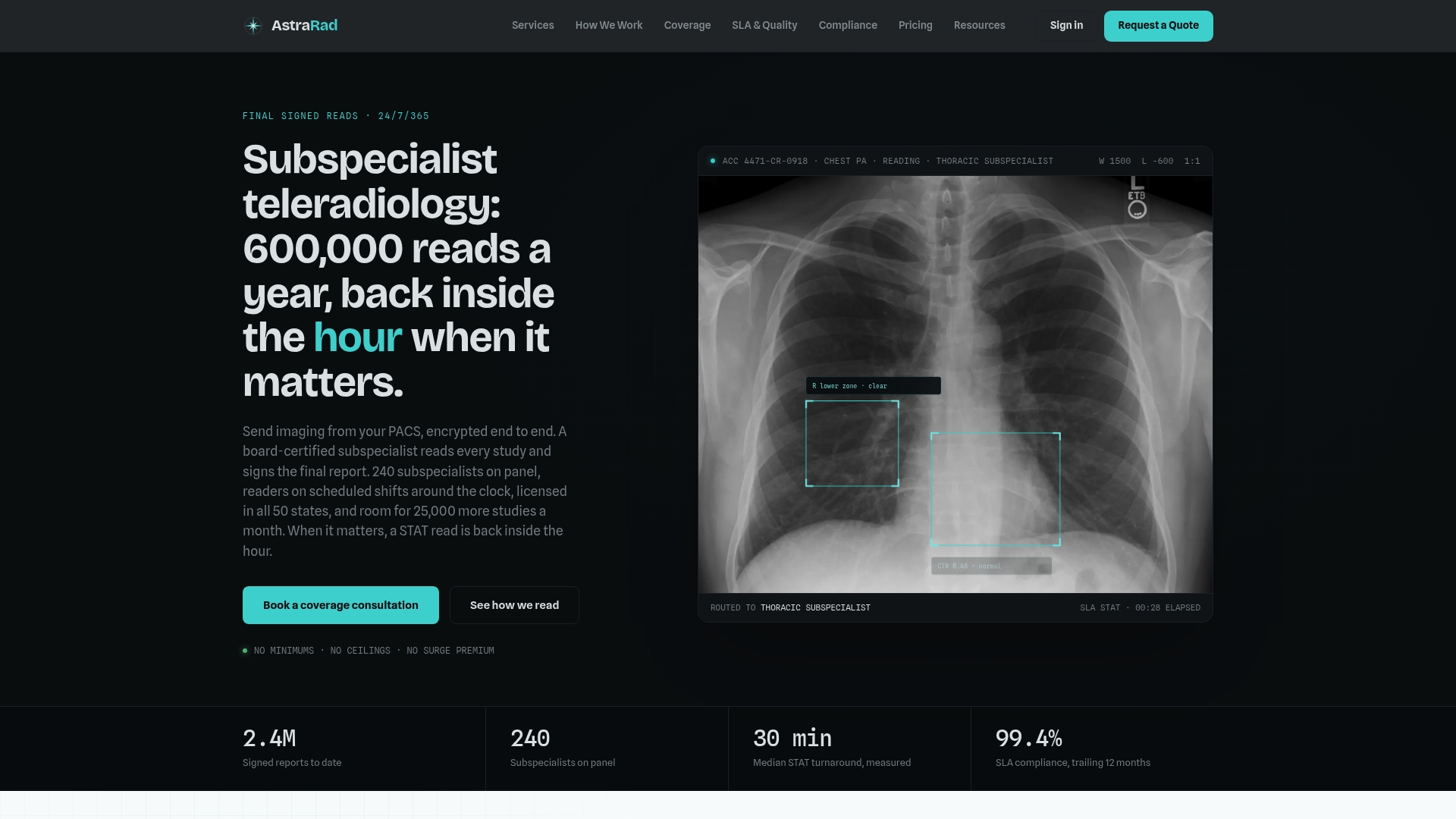
In practice, that support may include subspecialist reads on modalities the local team doesn't cover alone, compliance reporting that documents itself instead of adding paperwork, and per-report pricing that scales with volume instead of flat contracts. AstraRad has maintained 99.4% SLA compliance over the past year, a number worth knowing if turnaround reliability is what's currently eating into protected education time. If overflow volume is the thing keeping your team out of the conference room, see how per-report pricing works and check whether it fits your department's caseload.
Sources
- Current State of Peer Learning in Radiology: A Survey of ACR Members
- Implementation of a Peer Learning Program Replacing Score-Based Peer Review in a Multispecialty Integrated Practice
FAQ
What is a peer learning "rad peer" case?
It's a case a radiologist flags for group discussion because it's unexpected, instructive, or reveals a systems issue, not because someone graded it poorly. The label is intentionally neutral, unlike score-based peer review's numeric grading system.
What are some examples of peer learning in practice?
Common formats include weekly case conferences, modality-specific learning modules, and multidisciplinary sessions with referring clinicians present. The AJR implementation study documented an increase in mean monthly learning submissions after one practice adopted this model.
What is the best app or platform for learning radiology?
There's no single dominant platform; most programs run peer learning through their existing PACS viewing workflow with a modified profile, supplemented by the ACR's Peer Learning Resources hub and CEBI's case conference templates.
What is the highest paid type of radiologist?
Compensation varies by subspecialty, geography, and practice setting, and no figure in the research supporting this article addresses that question reliably enough to state one here.
How does peer learning differ from score-based peer review?
Score-based peer review assigns a numeric rating to a random sample of past reports, often long after the fact. Peer learning captures teaching cases as they happen and discusses them without a grade, which the ACR survey links to a stronger perceived safety culture among 89% of users.
Recommended
Related on AstraRad
- Resources
Structured radiology reporting for leaders
For radiology leaders: an evidence based, clinician first playbook showing when templates suffice, when to adopt DICOM SR/FHIR, and how to run governance
- Resources
Teleradiology price list: how to read one line by line
A teleradiology price list needs study lines, printed multipliers, fees, and definitions. What a complete list includes and what most lists leave out.
- Resources
How much does teleradiology cost? 3 worked budgets for 2026
How much teleradiology costs depends on mix and volume: roughly $6,000 a month for an urgent care clinic to $48,000 for an imaging center, worked out here.
Put a radiologist's name on your next read.
Tell us your modalities and monthly volume. A complete per-report rate card, with turnaround tiers and SLA terms in writing, lands in your inbox within one business day.