Structured radiology reporting for leaders
For radiology leaders: an evidence based, clinician first playbook showing when templates suffice, when to adopt DICOM SR/FHIR, and how to run governance

Structured radiology reporting organizes findings into a standardized, hierarchical format instead of free-text prose. It exists on two levels: structured layout, which uses templates and section headers, and structured content, which captures findings as coded, machine-readable data. The evidence favors it for completeness and clarity; proof of better patient outcomes is still thin. This guide covers the standards, the rollout steps, and where the approach breaks down.
TL;DR:
- Implementing true machine-readable structured content (level 2) significantly enhances data mining, registry submissions, and AI training compared to layout-only templates.
- Most radiology groups operate between level 1 and 2, and progressing to structured content requires standards like DICOM SR and FHIR for optimal interoperability.
- Effective rollout depends on strong governance, focusing on clinical utility, setting clear success metrics, and avoiding over-complication or excessive mandatory fields.
- Coordination with existing PACS and workflows, along with phased pilots and peer review, are essential to prevent adoption failures and improve report quality.
- Prioritizing structured coded fields for guideline adherence and outcome-related metrics is key, while a basic level 1 template can still improve report clarity without complex coding.
Table of Contents
- What Is Structured Radiology Reporting, Exactly?
- Does Structured Reporting Actually Improve Radiology Reports?
- Which Standards and Templates Should You Actually Adopt?
- Building the Rollout: A Governance-First Roadmap
- Why Do Structured Reporting Rollouts Fail?
- AstraRad's Operational Model as a Structured-Reporting Reference Point
- What I'd Prioritize If I Were Running This Rollout
- How AstraRad Supports Structured Reporting in Practice
- Where to Go Deeper on Structured Reporting
- Sources
- FAQ
What Is Structured Radiology Reporting, Exactly?
Structured radiology reporting is an IT-supported method for organizing diagnostic findings into standardized formats rather than dictated, narrative prose. A systematic review published in PMC frames it as existing on two distinct levels, and the distinction matters more than most implementation guides admit.
Level 1 is structured layout. This is what most radiologists picture when they hear "structured reporting": a template with fixed section headers (Clinical History, Technique, Findings, Impression), consistent subheadings by organ system, and a predictable order every time. The content inside each section is still free text. A radiologist dictates or types sentences under "Liver" and "Pancreas" the same way they always have. The structure is organizational, not computational.
Level 2 is structured content, sometimes called coded or computable reporting. Here the findings themselves are captured as discrete data elements: dropdown menus, checkboxes, decision trees, and standardized value sets instead of sentences. A nodule's size becomes a numeric field with a unit. A BI-RADS category becomes a coded value, not a typed phrase that might read "BI-RADS 4" in one report and "category 4" in another. This is the level that makes a report queryable, poolable across a health system, and usable for machine learning or registry submission.
The gap between these two levels explains a lot of implementation confusion. A radiology group can roll out beautiful templates, call the project "structured reporting," and still produce reports that are just as hard to mine as free dictation, because the content underneath the headers is still prose. If a stated goal is data mining, registry participation, or feeding an AI model, level 1 alone will not get there. Level 2 is the one that does.
That is where DICOM Structured Report (SR) objects and HL7 FHIR come in. DICOM SR, described in detail by SIIM's OTPedia, is a composite object format that encodes coded observations, numeric measurements, and direct references to image coordinates. It is the most direct route to a report a machine can parse without guessing, because a measurement in a DICOM SR object is tied to units, a coded concept, and often the exact pixel location it came from. FHIR resources, including the ImagingReport and DiagnosticReport structures described in the HL7 FHIR imaging implementation guide, serve a different but complementary role: moving report data (structured or narrative) into electronic health record workflows and downstream systems.
Four reference points worth keeping straight as you plan your own approach:
- Level 1 (layout): Fixed template, section headers, free text inside. Improves consistency and readability. Does not, on its own, enable data mining.
- Level 2 (content): Coded fields, dropdowns, controlled vocabularies. Enables computability, registry submission, and AI training data.
- DICOM SR: Encodes findings with measurement units and image coordinate links. The standard when machine-readability tied to the image itself matters.
- FHIR ImagingReport/DiagnosticReport: Moves structured or narrative report data into EHR and registry systems for downstream use.
Most radiology groups sit somewhere between level 1 and level 2 today, and that middle ground is not a failure state. It is a reasonable place to be while you decide which fields actually need to be coded.
Does Structured Reporting Actually Improve Radiology Reports?
The short answer: yes, for completeness and clarity. No, not yet, for hard patient-outcome data. The systematic review in PMC that established the level 1/level 2 taxonomy also concluded that structured reporting consistently improves report completeness and clarity across the studies it reviewed, but that high-quality evidence directly linking structured reporting to improved patient outcomes remains limited.
That gap between "better reports" and "better outcomes" is not a knock against the method. It reflects how hard outcomes research is to design when the intervention is a documentation format rather than a drug or a device. Most of the studies feeding these reviews measure proxies: does the report contain the elements a guideline says it should contain? Does a referring physician rate it as clearer? Does turnaround time change? Those are legitimate, measurable signals. They are just one step removed from mortality or treatment-change data, which is much harder to isolate from everything else happening in a patient's care.
The evidence in one line: Structured reporting reliably improves report completeness and clarity across the systematic review's pooled studies. The evidence connecting it directly to improved patient outcomes is still limited, not absent, meaning practice leaders should track process metrics honestly rather than promise outcome gains they cannot yet document.
Guideline adherence is where structured templates show up most convincingly in the literature. When a template forces a radiologist to address a specific measurement, staging element, or follow-up recommendation because the field exists and is visible, adherence to reporting guidelines tends to improve simply because the omission becomes harder to miss. Free dictation depends entirely on the radiologist remembering to include every required element, every time, on every case type. A template does that remembering for them.
Efficiency claims are more mixed and worth treating with some skepticism if a vendor pitches them as a given. Point-and-click templates can speed up straightforward, high-volume studies where the findings map cleanly onto pre-built options. They can slow down complex or unusual cases where the radiologist spends more time hunting for the right dropdown option than they would have spent typing a sentence. This is the practical argument for hybrid reporting, which shows up repeatedly in implementation literature: use coded fields for the elements that matter for billing, staging, or registry capture, and leave narrative space for everything else.
What should a practice leader actually track when rolling this out? A short, honest list beats a long, aspirational one:
- Report completeness against a defined checklist for the study type, before and after template adoption.
- Turnaround time, watched for both improvement and unintended slowdown on complex cases.
- Referrer feedback on clarity, gathered informally or through a structured survey, since referring physicians are the primary consumer of the report.
- Critical-finding communication timeliness, since structured fields for follow-up recommendations tend to make these harder to bury.
- Peer review flags, since RADPEER and similar programs can surface whether structured fields are actually catching errors free text used to miss.
None of those metrics requires a randomized trial. They require a baseline measurement, a defined pilot period, and the discipline to look at the numbers honestly instead of assuming the new templates worked because everyone likes the layout better.
Which Standards and Templates Should You Actually Adopt?
Four names come up in almost every serious structured reporting implementation: RadReport, RadLex/RadElements, DICOM SR, and FHIR. Each solves a different part of the problem, and picking the right one depends on what "structured" needs to mean for your practice.
RSNA RadReport is the most practical starting point for most groups. RadReport.org offers a searchable, vetted library of reporting templates covering most modalities and organ systems, built and reviewed by working radiologists rather than a single vendor. Many of these templates already incorporate RadLex terminology, the RSNA's controlled radiology lexicon, and RadElements, which define common data elements so that a "tumor size" field means the same thing across institutions. Starting from RadReport instead of building templates from scratch saves months and avoids reinventing terminology that already has a standard.
DICOM Structured Report (SR) is the format to reach for when the goal is genuine machine-readability tied to the image itself. DICOM SR objects, as SIIM's OTPedia explains, can encode coded findings, numeric measurements with units, and direct spatial references (SCOORD) to the exact location on an image where a finding sits. That last part is what narrative text and even most level 1 templates cannot do. If your reporting needs to feed a PACS-integrated measurement tool, a tumor-tracking application, or an AI model that needs to know precisely where a nodule sits, SR is the export format to target, not a narrative summary. DICOM Supplement 23 lays out the SOP classes that make this kind of coded, image-linked encoding possible.
FHIR ImagingReport and DiagnosticReport resources handle the EHR side of the equation. Even a report that is beautifully structured in your RIS or PACS is only as useful downstream as its ability to reach the referring physician's EHR, a research registry, or a population-health dashboard. FHIR is the interoperability layer that carries report data, structured or narrative, into those systems in a format they can parse consistently.
Specialty society templates, particularly the Society of Interventional Radiology's standardized reports, fill gaps that general radiology templates do not cover well. SIR publishes downloadable, version-controlled template bundles built specifically for interventional procedures, with fields tuned to what billing, registry participation, and quality measurement actually require in that subspecialty.
A practical note that trips up a lot of first-time implementations: template licensing and interoperability profiles matter more than they seem to at first glance. The MRRT (Management of Radiology Report Templates) profile and related IHE integration profiles exist specifically so templates built in one authoring tool can be imported into another vendor's RIS or reporting platform without a manual rebuild. Before committing to a template library, confirm your reporting platform actually supports MRRT import and export. A template you cannot move is a template you are stuck maintaining twice, once in the source library and once in whatever your vendor's proprietary format requires.
Building the Rollout: A Governance-First Roadmap
Skipping governance is the single most common reason structured reporting rollouts stall after a promising pilot. Implementation reviews consistently point to the same root cause: teams jump straight to configuring templates in the RIS before anyone has agreed on what the templates should actually contain. Standardize the content first, automate second.
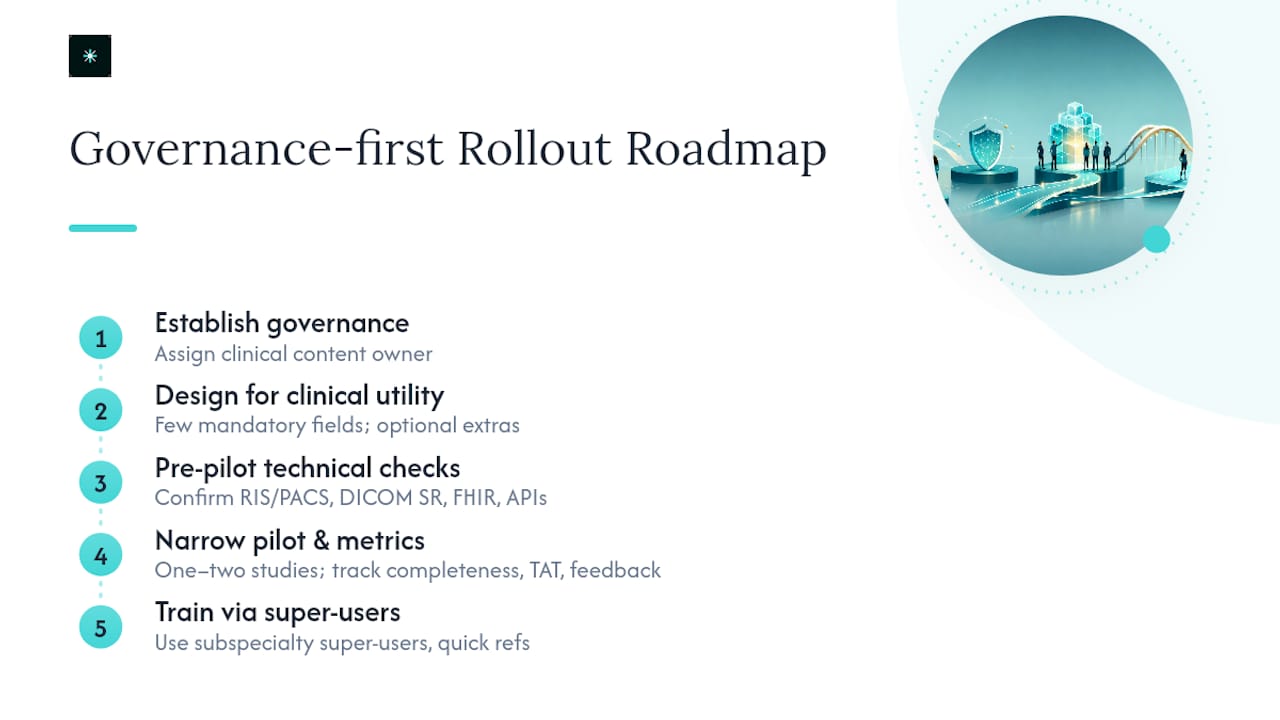
1. Establish governance and a clinical content owner. Someone, usually a subspecialty lead or informatics-minded radiologist, needs authority to decide what fields are mandatory for a given study type and why. This person also needs a direct line to referring physicians and coding or billing teams, because the fields that matter most for reimbursement and the fields that matter most for clinical clarity are not always the same fields, and someone has to reconcile that before templates get built.
2. Design templates around clinical utility, not comprehensiveness. The instinct to capture everything is the enemy here. A short, mandatory field set for the elements that drive clinical decisions or billing, paired with optional fields for secondary research or quality data, keeps the interface usable. A template with forty required fields for a routine chest X-ray will get abandoned or gamed within a month. Build in conditional logic so fields for, say, a suspicious lung nodule only appear when a nodule is actually flagged, rather than cluttering every normal-chest report with irrelevant prompts.
3. Run the technical integration checklist before the pilot, not during it. Confirm RIS and PACS compatibility with the template format you have chosen. Verify whether your platform can export DICOM SR alongside or instead of narrative text, and whether it can produce FHIR-compliant output for EHR integration. Check vendor API documentation for whether templates can be imported via MRRT or require manual rebuilding. This step is tedious and almost always takes longer than the vendor's sales materials suggest, which is exactly why it belongs before the pilot launches, not during it when clinical volume is already flowing through the new system.
4. Choose a narrow pilot scope with defined success metrics. Pick one or two study types, ideally high-volume and relatively standardized ones like screening mammography or CT pulmonary angiography, rather than launching structured templates across every modality simultaneously. Track completeness against a checklist, turnaround time, and referrer feedback for a defined period, typically four to eight weeks, before deciding whether to expand.
5. Train through super-users and quick-reference tools, not a single kickoff meeting. Identify one or two radiologists per subspecialty who learn the new templates first and can answer colleagues' questions in real time. One-page quick-reference cards covering the most common fields for each study type do more for adoption than a formal training deck. Fold structured-field accuracy into existing RADPEER or peer review workflows so template quality gets the same scrutiny report accuracy already receives.
6. Iterate before you scale. A pilot that reveals problems is doing its job. Expect to revise mandatory field lists, adjust conditional logic, and possibly remove fields nobody is filling in accurately. Scale only after the pilot's metrics look stable, not after the pilot's timeline simply runs out.
Pro Tip: Run your pilot on a study type where you already have a completeness checklist from an accreditation body, like mammography under MQSA. You will not need to build a baseline measurement from scratch, and you will have an external standard to validate your template against instead of guessing whether it is good enough.
A realistic timeline for a mid-sized group: two to three months for governance and template design, four to eight weeks for a focused pilot, and another two to three months before a full-scale rollout across additional study types feels stable. Anyone promising a working, scaled structured reporting program in under two months is skipping a step, usually the governance one.
Why Do Structured Reporting Rollouts Fail?
Three failure patterns show up again and again, and all three are avoidable if you know to watch for them.
Over-standardization is the most common one. A template built with too many mandatory fields, or fields that force a finding into a category that does not quite fit the actual clinical picture, pushes radiologists to either misuse a field to make it fit or abandon the structured section entirely and bury the real finding in a free-text comment box. The fix, well documented in implementation literature, is hybrid reporting: code the handful of elements that genuinely need to be discrete and machine-readable, and leave a free-text narrative section for clinical nuance that does not compress well into a dropdown. A radiologist should never feel like the template is fighting the finding in front of them.
Data-entry burden kills adoption quietly. If a structured template takes meaningfully longer to complete than free dictation did, radiologists will find workarounds, whether that means dictating into a single "impression" free-text field and ignoring the structured sections, or rushing through dropdowns without real attention to accuracy. Smart defaults, pre-populated normal findings that the radiologist only needs to change when something is actually abnormal, and macros for common combinations of findings cut this burden substantially. The goal is a template that is faster than free dictation for the majority of normal or straightforward cases, not just theoretically more complete.
Automating before standardizing content is a sequencing error, not a technology error. Groups that configure elaborate IT workflows around templates before anyone has agreed on what fields are actually mandatory end up rebuilding the same templates two or three times as governance decisions get made after the fact instead of before. Standardize the content, then automate around it, not the reverse.
Measurement pitfalls deserve a mention too, because they are easy to miss until the incentives have already gone sideways:
- Tracking only completeness can reward radiologists for filling every field regardless of clinical relevance, inflating report length without improving usefulness.
- Tracking only turnaround time can push radiologists to skip optional fields that actually mattered for downstream care.
- Tracking neither leaves you flying blind on whether the rollout is working at all.
Pro Tip: Pair every completeness metric with a referrer satisfaction check, even an informal one. A report can hit 100 percent of its checklist fields and still read as less useful to the ordering physician than the free-text version it replaced, if the structure buries the clinical bottom line under boilerplate.
AstraRad's Operational Model as a Structured-Reporting Reference Point
Structured reporting does not live in a vacuum. It has to run inside an actual reporting workflow, with real turnaround pressure and real PACS constraints, or it stays a template exercise nobody scales. AstraRad, a teleradiology service delivering final signed reports for imaging centers, hospitals, and radiology groups, built its operation around board-certified subspecialists reading every study in their specific modality, integrated directly into a client's existing PACS rather than requiring a separate portal. That combination, subspecialty routing plus PACS-native workflow, is a useful reference point for any group thinking through how structured reporting fits into a real production environment rather than a pilot spreadsheet.
The SLA structure is the clearest example. AstraRad guarantees turnaround under one hour for STAT cases and under 24 hours for routine studies, backed by a 99.4% SLA compliance rate over the past year. That kind of measurable, tracked commitment is exactly the discipline structured reporting implementation needs internally: a defined metric, a target, and honest tracking against it, rather than a vague sense that things have gotten better since the templates went live.
A few operational lessons map directly onto the implementation checklist covered above:
- PACS integration without a new portal mirrors the technical integration principle: structured workflows succeed when they slot into existing systems rather than forcing staff to learn a parallel interface.
- Subspecialty-matched reads echo the governance principle of assigning clinical content ownership to the person best positioned to know what a report for that modality actually needs.
- Stringent peer review built into the workflow reflects the same discipline RADPEER integration brings to structured field accuracy, checking not just whether fields got filled in, but whether they got filled in correctly.
- Published SLA compliance data, tracked and reported rather than assumed, is the same measurement rigor a structured reporting pilot needs to justify scaling past its initial rollout.
None of this means outsourcing reads is the only path to structured-reporting maturity. It does show that the disciplines, subspecialty content ownership, tight PACS integration, and measured performance against defined targets, are the same whether a group builds structured reporting in-house or works with a partner already running that model at scale.
What I'd Prioritize If I Were Running This Rollout
If I had to compress this entire guide into a sequence, it would be: standardize content first, pilot narrow, instrument honestly, and resist the urge to code every field just because you can.
Most groups that struggle with structured reporting do not have a technology problem. They have a sequencing problem. They buy a template library, turn it on for every modality at once, and then spend the next six months fielding complaints about clicks and mandatory fields nobody agreed to require. The fix is not a better vendor. It is doing the governance work, deciding which fields actually change clinical decisions or billing outcomes, before any template gets built.
I would also push back gently on the assumption that more coded structure is automatically better structure. Level 2, computable reporting is the right target if a registry submission, an AI training pipeline, or population-health analytics genuinely depend on it. If the goal is simply a clearer, more complete report for the referring physician, a well-designed level 1 template with consistent headers may get you substantial benefit at a fraction of the data-entry cost. Match the ambition to the actual downstream use case, not to what sounds most sophisticated in a vendor demo.
On timelines: expect real governance and template design to take a full quarter, not a sprint. Expect the pilot to surface at least one field that needs to be cut or redesigned. Treat that as the pilot working, not failing. Success at scale looks like stable completeness metrics, referrers who notice the reports got clearer rather than longer, and radiologists who stopped fighting the template within the first month.
Whether you build this internally or explore a vendor-assisted pilot, the standards, RadReport, DICOM SR, FHIR, are stable enough now that you are not betting on emerging technology. You are betting on your own governance discipline to use them well.
Rafael Vieira
How AstraRad Supports Structured Reporting in Practice
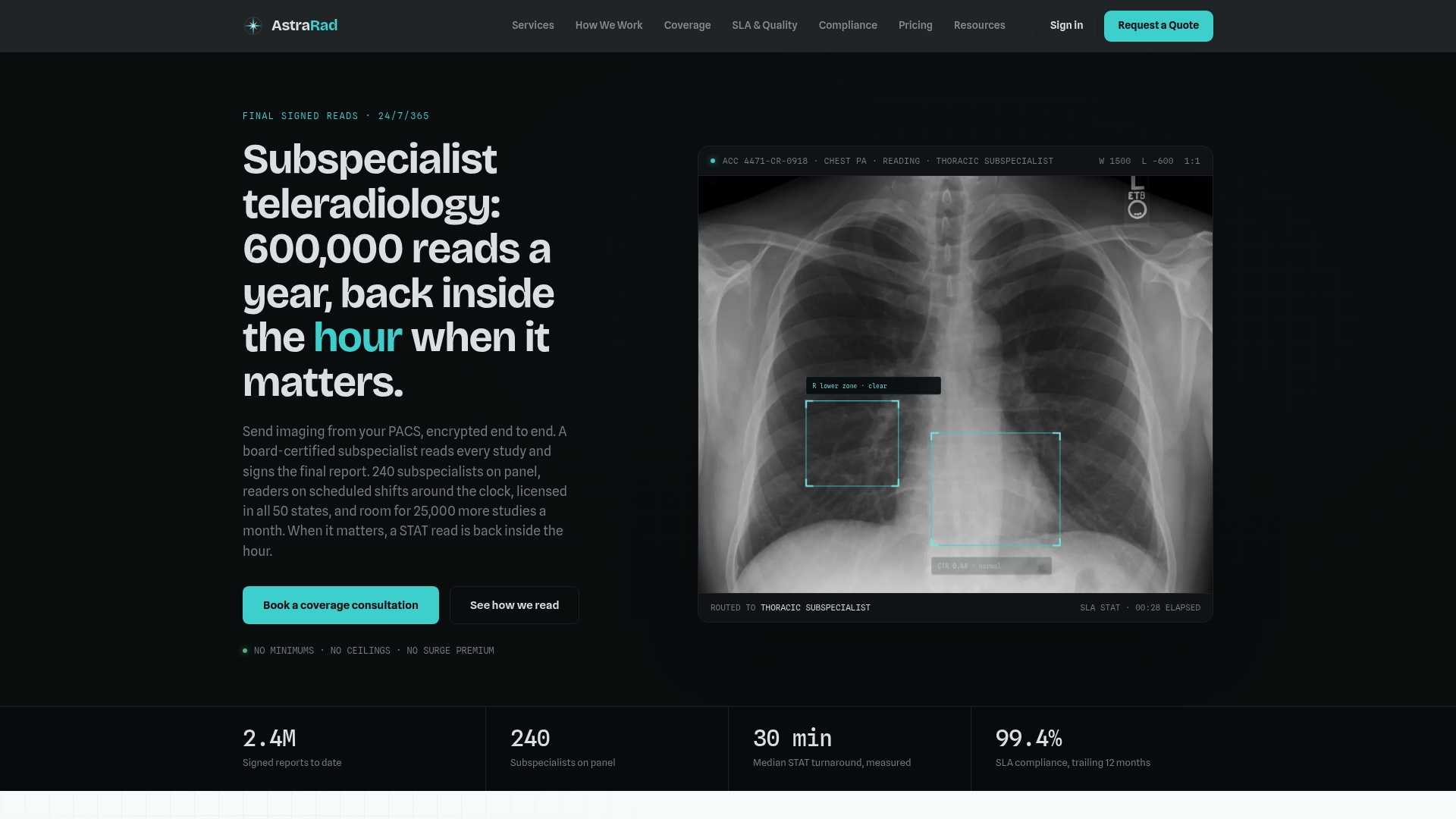
For groups weighing whether to build structured reporting capacity internally or lean on a partner already operating at scale, AstraRad delivers final signed reports across CT, MRI, X-ray, ultrasound, and PET-CT, with every study read by a board-certified subspecialist in that modality. That subspecialty-matched model, combined with SLA-backed turnaround, gives imaging centers, hospitals, and radiology groups a structured, measurable reporting partner rather than an unpredictable overflow arrangement.
AstraRad's operational structure lines up with the same checklist items covered throughout this guide:
- PACS-native integration, with reports flowing into your existing system rather than a new portal to manage.
- Subspecialty routing on every study, so a chest CT reaches a chest specialist and a musculoskeletal MRI reaches an MSK specialist.
- Peer review built into the workflow, catching the accuracy issues that structured fields alone cannot guarantee.
- SLA-backed turnaround, under one hour for STAT cases and under 24 hours for routine studies, tracked against a 99.4% compliance rate.
If your group is weighing a backlog problem, a coverage gap, or simply wants a second read pattern that already runs on this kind of measured discipline, review AstraRad's per-report pricing by study type to see how it fits your volume and modality mix.
Where to Go Deeper on Structured Reporting
Four resources cover most of what a practice leader needs to move from concept to pilot:
- RSNA RadReport for a vetted, searchable template library built on RadLex and RadElements.
- Nobel et al.'s systematic review for the level 1/level 2 taxonomy and the evidence base on completeness, clarity, and outcome gaps.
- SIIM's OTPedia entry on DICOM SR for the technical detail on coded, image-linked structured report objects.
- SIR's standardized report templates for specialty-specific, version-controlled templates tuned to interventional radiology billing and registry needs.
Coding and billing teams evaluating how structured fields map to reimbursement workflows may also find value in reviewing medical coding and HCC compliance resources built specifically around that translation layer.
Sources
- Structured reporting in radiology: a systematic review to explore its potential
- RadReport reporting templates | RSNA
- Structured Report (SR) , SIIM OTPedia
- SIR standardized reports , Society of Interventional Radiology
FAQ
What Is Structured Reporting in Radiology?
Structured radiology reporting organizes findings into standardized formats instead of free dictation, existing on two levels: structured layout with templates and fixed headers, and structured content with coded, machine-readable fields, as defined in the systematic review by Nobel et al.
What Should a Radiology Report Include?
A complete radiology report includes clinical history, technique, systematic findings by organ system or region, an impression summarizing key findings, and any follow-up recommendations. Structured templates from sources like SIR help ensure these elements are consistently present rather than left to memory.
Is There an AI That Can Read Radiology Reports?
AI and natural language processing tools can extract data from both free-text and structured radiology reports, but structured, coded content, particularly DICOM SR objects, is far easier for these systems to parse accurately than narrative dictation. Groups planning AI integration should prioritize level 2 structured content specifically because of this parsing advantage.
Recommended
Related on AstraRad
- Resources
Teleradiology to reclaim time for radiology peer learning
Operations first guide for radiology leaders: use ACR and AJR evidence to set up peer learning, measure impact, and reclaim conference time with...
- Resources
Teleradiology price list: how to read one line by line
A teleradiology price list needs study lines, printed multipliers, fees, and definitions. What a complete list includes and what most lists leave out.
- Resources
How much does teleradiology cost? 3 worked budgets for 2026
How much teleradiology costs depends on mix and volume: roughly $6,000 a month for an urgent care clinic to $48,000 for an imaging center, worked out here.
Put a radiologist's name on your next read.
Tell us your modalities and monthly volume. A complete per-report rate card, with turnaround tiers and SLA terms in writing, lands in your inbox within one business day.