Same-day imaging reads: hospital buyers' final report SLA
Hospital and imaging center buyers can define same-day imaging reads, set SLA terms, check PACS integration, and assess credentialing and quality.
Same-day imaging reads are final signed radiology reports completed on the calendar day a study is received, not preliminary impressions or verbal reads, as described in the ACR GRID definition. Buyers can contract for this outcome directly: service level agreements with named tiers such as STAT, routine, and stroke protocol, measured from exam completion to radiologist signature, make same-day turnaround an enforceable commitment rather than a hope. AstraRad is a US teleradiology service that delivers final signed reports read by board-certified subspecialists, and it represents one direct option for buyers evaluating this capability.
TL;DR:
- Set each SLA tier with a target and allowed exceptions, measure from exam completion to signed report, and define escalation and remedies for missed targets.
- A 2026 cloud based model reported a mean PET CT turnaround of 20.06 hours across 1,137 scans; use modality specific targets in procurement.
- Require direct PACS report insertion and measure transfer delays for large CT and MRI studies; validate formatting, HL7 mapping, and complete workflow with test cases.
- Require worklist rules to weigh order priority, patient location, and acuity flags, with a named stroke tier, direct clinical escalation, and transfer handoff expectations.
- RFPs should require board certification, subspecialty matching, licensing evidence, peer review details, corrective action procedures, and a signed business associate agreement with audit rights.
Table of Contents
- Key facts for buyers evaluating same-day imaging reads
- What counts as a same-day final read, and why it matters for ED and stroke care
- Which SLA terms should a same-day read contract include?
- What technical integration does same-day reading require?
- How should STAT and stroke cases be prioritized on the worklist?
- What credentialing and quality checks belong in an RFP?
- What does onboarding look like from contract signing to first same-day read?
- AstraRad as a direct option for same-day final reads
- FAQ
- Sources
Key facts for buyers evaluating same-day imaging reads
A handful of figures and standards shape how procurement teams should think about turnaround commitments before signing anything.
- The ACR General Radiology Improvement Database defines turnaround time as the interval between exam completion and final report completion, tracked across six standard modalities.
- A 2026 teleradiology model reported a mean PET-CT interpretation turnaround of 20.06 hours (95% CI 19.35 to 20.78) across 1,137 scans read by board-certified radiologists via a cloud-based server.
- A retrospective study found that 24/7/365 attending radiologist coverage significantly reduced CT report turnaround time in an emergency and trauma radiology department.
- The Joint Commission identifies failures to close the communication loop on test results as a patient safety risk and recommends backup escalation procedures for unacknowledged reports.
- Network download time for large CT and MRI series is a measurable component of total turnaround and belongs in any realistic SLA.
What counts as a same-day final read, and why it matters for ED and stroke care
A same-day imaging read is a final signed radiology report, not a preliminary interpretation, completed on the same calendar day the study arrives for reading. That distinction matters because preliminary reads do not close the loop on patient care decisions the way a signed final report does.
For emergency departments, a same-day final read can support timely disposition and transfer decisions. Stroke pathways are time-sensitive, and imaging findings can inform treatment and transfer decisions. The Joint Commission's guidance on closed-loop communication recommends procedures for communicating results and escalating unacknowledged reports.
Which SLA terms should a same-day read contract include?
An SLA for same-day imaging reads should name specific tiers, define exactly when the clock starts and stops, and specify what happens when a target is missed. Vague language like "fast turnaround" is not enforceable and should be replaced with measurable commitments.
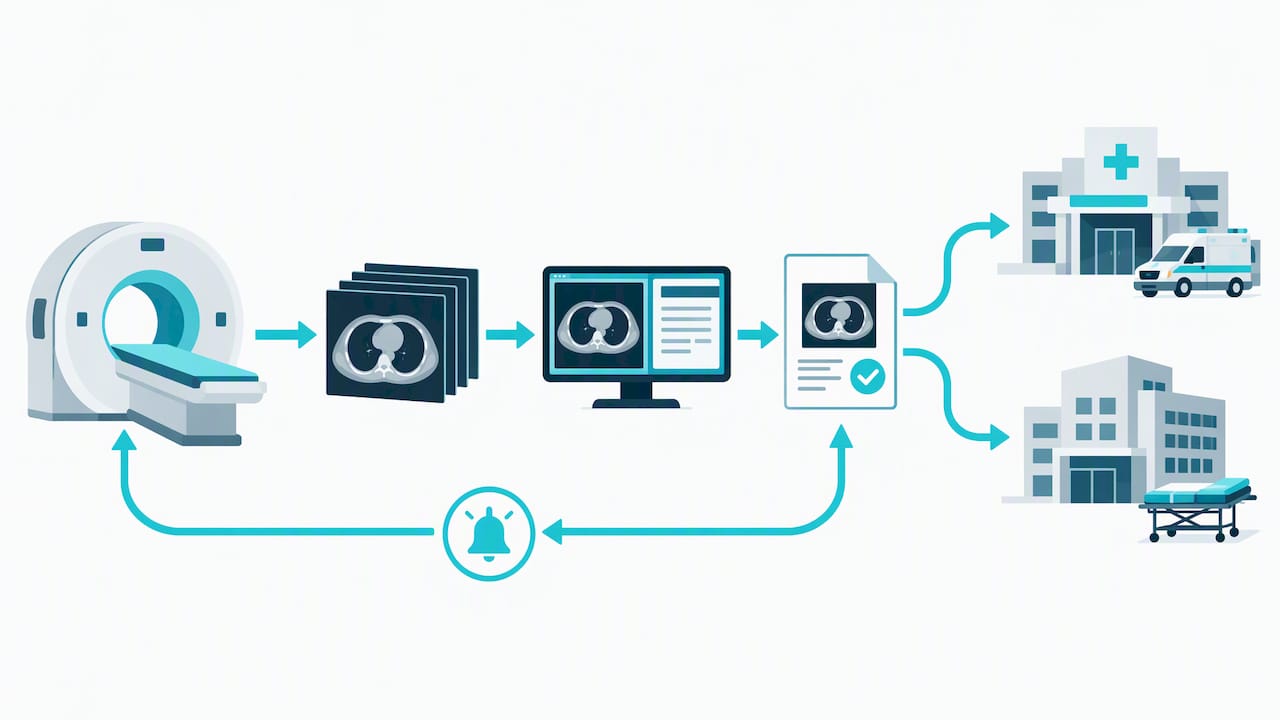
Start with the ACR GRID convention: turnaround is measured from exam completion to final signed report, not from order placement or from when a preliminary read is issued. Build tiers around that measurement point.
- Name tiers explicitly: STAT, routine, and stroke protocol, each with its own turnaround target and allowed exceptions.
- Specify the clock start and stop events in the contract text itself.
- Consider requesting facility- and exam-level dashboards to review turnaround claims.
- Define remedies and escalation paths for missed targets, including who gets notified and how quickly.
Contracts that skip these specifics tend to produce disputes later, usually when a delayed report coincides with an adverse outcome.
What technical integration does same-day reading require?
Same-day final reads depend on infrastructure choices made well before the first study is sent. A vendor that cannot insert reports directly into your existing PACS, or that requires a separate login portal, adds friction that works against same-day goals.
- Request the vendor's PACS integration specifications in writing during evaluation.
- Quantify expected image transfer and download latency, particularly for large CT and MRI series, since network download time is a real component of turnaround that generic SLAs often ignore.
- Consider EMR-integrated referral workflows; a study of overnight ED CT turnaround examined delays between preliminary reads and teleradiology requests.
Pro Tip: Request a small batch of real test-send cases before go-live, and validate report formatting, HL7 field mapping, and PACS insertion end to end rather than relying on a vendor's sample setup.
See how PACS-to-signed-report flow works in practice through this teleradiology integration overview.
How should STAT and stroke cases be prioritized on the worklist?
Worklist prioritization determines whether a stroke case or another acute finding gets read ahead of a routine outpatient study, and this should be specified in the contract, not left to vendor discretion. Order priority alone is not enough; location and acuity signals matter too.
- Require worklist logic that factors in order priority, patient location, and image-based acuity flags, consistent with ACR guidance on exam prioritization.
- Name the stroke protocol tier explicitly in the contract, with a defined turnaround measurement and a direct escalation path to the clinical team.
- Specify handoff expectations for interfacility transfer scenarios, since stroke door-in-door-out timing often depends on how quickly imaging findings reach the receiving facility.
What credentialing and quality checks belong in an RFP?
RFPs can request credentialing and quality assurance documentation.
- Require board certification and subspecialist matching by modality and body part, with evidence of state licensing where your facility operates.
- Request details of the vendor's peer review and corrective action processes.
- Require a signed business associate agreement and HIPAA-aligned operations, with audit rights and periodic QA reporting tied to the SLA terms.
What does onboarding look like from contract signing to first same-day read?
Buyers often underestimate how much lead time integration and validation require before same-day reads become reliable. A realistic onboarding plan has clear milestones, not a single go-live date.
- Request RFP answers covering integration specifications, exact SLA text, sample signed reports, security posture, peer review process, and per-report pricing with no minimums.
- Ask for supporting documents: sample contract language, an integration checklist, a technical test plan, and a completed security questionnaire.
- Expect a sequence of countersignature, technical integration, test sends, validation against real cases, and finally production-ready signed reports, with a written coverage plan and timeline provided by the vendor.
Total cost should be evaluated beyond the per-report rate: ask whether expedited tiers carry any additional charge, whether there are setup fees, and whether volume minimums apply anywhere in the agreement.
AstraRad as a direct option for same-day final reads
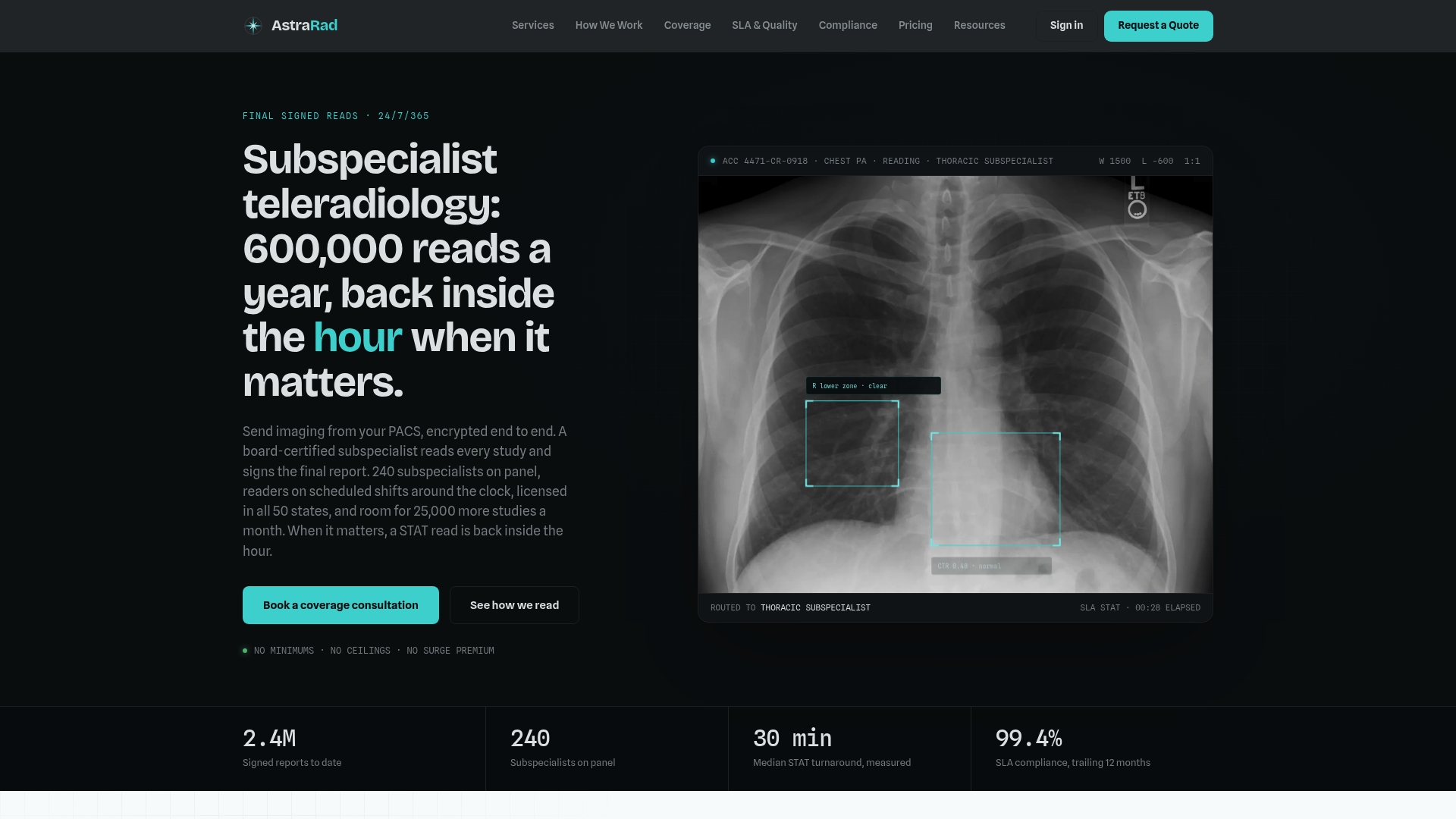
AstraRad is a US teleradiology service that delivers final signed reports read by board-certified subspecialists. Its contractual turnaround tiers are STAT, routine and stroke protocol.
AstraRad's operations are HIPAA aligned as a business associate under a signed BAA.
- Pricing is per report with no minimums, so costs scale with actual volume rather than a committed floor.
- Request per-report pricing.
- A discovery call can begin a discussion about coverage and SLA terms.
- Modality coverage spans CT, MRI, X-ray, ultrasound, and PET-CT services, with dedicated MRI subspecialist reporting for facilities with concentrated MRI volume.
Review the STAT read use case and contact AstraRad to discuss a coverage plan.
FAQ
What is the difference between a preliminary read and a same-day final read?
A preliminary read is an initial impression, while a final signed report is the radiologist's completed interpretation. Same-day imaging reads refer specifically to the final signed version being completed the same calendar day the study is received, which is the version that closes the communication loop under Joint Commission guidance.
How is turnaround time measured for same-day imaging reads?
Turnaround time is measured from exam completion to the completion of the final signed report, following the ACR GRID convention. This start-to-stop definition should appear explicitly in any SLA, since measuring from order placement instead produces inconsistent and unenforceable turnaround claims.
Does 24/7 radiologist coverage actually reduce turnaround time?
Yes. A retrospective study found that implementing 24/7/365 attending radiologist coverage significantly reduced CT report turnaround time in an emergency and trauma radiology department compared with non-continuous coverage models.
What SLA tiers should a same-day reads contract specify?
A contract can name distinct tiers rather than a single blanket turnaround promise. AstraRad's tiers are STAT, routine and stroke protocol; buyers can define clock start and stop rules and escalation procedures in the contract.
What does AstraRad charge for same-day imaging reads?
AstraRad pricing is per report with no minimums. Contact AstraRad to request pricing.
What technical requirements affect whether same-day reads are achievable?
Direct PACS report insertion, DICOM conformance, and manageable network latency for large image series are the core technical requirements. A study of overnight ED CT bottlenecks examined delays between study completion and the start of teleradiology reads.
Sources
- Nrdrsupport
- Pmc
- Impact of 24/7/365 Attending Radiologist Coverage on the Turnaround Time in an Emergency and Trauma Radiology Department
- Quick Safety Issue 52: Advancing safety with closed-loop communication of test results
Recommended
Related on AstraRad
- Resources
2027 Medicare fee schedule: the radiology numbers explained
The CY2027 Medicare fee schedule cuts both conversion factors while ACR estimates radiology gains 2 percent. Both are true. Model your dollars per RVU.
- Resources
Clinician-radiologist communication: closing the loop
Clinician-radiologist communication fails when critical results reach a system but never reach the physician, and closed-loop standards close that gap.
- Resources
The hidden cost of the prelim-plus-overread model
The prelim-plus-overread model pays two radiologists and bills one report per overnight study. Cost the overread time, callbacks, and amendments first.
Put a radiologist's name on your next read.
Tell us your modalities and monthly volume. A complete per-report rate card, with turnaround tiers and SLA terms in writing, lands in your inbox within one business day.