STAT radiology reporting: median and 90th percentile
Operations first playbook to standardize STAT radiology reporting: set objective criteria, track median and 90th TAT, and pilot teleradiology.

STAT radiology reporting means prioritized, time-sensitive interpretation and closed-loop communication for imaging findings that require immediate clinical action. The operational goal is simple: get an accurate diagnosis to the treating clinician fast enough to change what happens next. Getting there consistently depends on three controls: objective criteria for what actually qualifies as STAT, closed-loop notification for critical results, and measurable turnaround-time targets your department actually tracks.
TL;DR:
- Departments should objectively define and consistently track specific criteria for STAT designations rather than relying on clinical judgment alone.
- Median STAT turnaround times are often under 30 minutes, but it is crucial to monitor the 90th percentile to identify cases exceeding useful clinical thresholds.
- Effective closed-loop communication requires direct, documented contact with the responsible clinician and confirmation of receipt for critical findings.
- Implementing direct PACS-to-reader workflows and using AI triage tools can significantly shorten STAT reporting times without sacrificing accuracy.
- Overly aggressive TAT targets can strain staffing, increase burnout, and dilute true emergencies, so balanced staffing and regular volume audits are essential.
Table of Contents
- What Counts as a STAT Read in Radiology
- Turnaround-Time Benchmarks Administrators Should Actually Track
- Closed-Loop Communication: What ACR Guidance Actually Requires
- Building an Operational Playbook for STAT Triage
- Technology That Actually Shortens STAT Turnaround
- The Trade-offs Nobody Puts on the Dashboard
- What Actually Moves the Needle in Implementing STAT Workflows?
- How AstraRad Fits Into a Serious STAT Coverage Strategy
- Sources
What Counts as a STAT Read in Radiology
"STAT" comes from the Latin statim, meaning "immediately." In radiology, it designates an imaging study that requires interpretation ahead of the routine queue because the findings could change immediate patient management. That's a clinical judgment, not a convenience label.
Common STAT-reportable findings include:
- Acute stroke on CT or MRI
- Active intracranial or major visceral hemorrhage
- Unstable or displaced fractures requiring urgent orthopedic input
- Suspected aortic dissection or other vascular emergencies
- Pneumothorax, bowel perforation, or other acute surgical findings
STAT flags are rarer than most departments assume. A peer-reviewed cohort from the Tohoku Medical Megabank Brain MRI Study found technologists flagged STAT findings in a small percentage of brain MRIs, and a subset of those flags were ultimately confirmed as medically significant urgent findings by radiologists. That gap between "flagged" and "truly urgent" is exactly why codifying objective, exam-specific criteria locally, rather than leaving STAT designation to individual judgment, matters more than any technology investment you'll make.
Turnaround-Time Benchmarks Administrators Should Actually Track
Turnaround time isn't one number. It's three distinct intervals, and conflating them hides where your bottlenecks actually live:
- Acquisition-to-interpretation: the gap between image capture and a radiologist opening the study.
- Interpretation-to-signoff: how long dictation, review, and signature take once reading starts.
- Report-to-communication: the time from a signed report to the ordering clinician actually receiving and acknowledging it.
Industry benchmark: Teleradiology providers commonly report median STAT turnaround under 30 minutes, with stroke CT frequently read in under seven minutes and trauma CT under roughly twelve.
Median TAT alone tells you an incomplete story. A department can hit a strong median while its slowest 10% of cases blow past clinical usefulness. Audit both the median and the 90th percentile, then measure what share of STAT reads fall inside your defined SLA window. Useful internal KPIs to review monthly:
- Median and 90th-percentile TAT by modality
- SLA compliance rate against your contracted or internal target
- Volume of STAT orders as a percentage of total studies (a proxy for STAT overuse)
Closed-Loop Communication: What ACR Guidance Actually Requires
A signed report sitting in PACS isn't communication. The ACR practice parameter for communication of diagnostic imaging findings requires documented, direct communication for critical and unexpected findings, and emergency medicine groups echo the same urgency from the receiving end: the American College of Emergency Physicians treats rapid result communication as core to acute patient management, not an administrative afterthought.
A defensible closed-loop protocol has four steps:
- Identify the finding as critical using pre-defined, exam-specific criteria.
- Contact the ordering provider or a designated covering clinician directly, by phone or a documented secure messaging channel.
- Document the time of the attempt, the method used, and who was reached.
- Confirm receipt with a read-back or explicit acknowledgment, not just a delivery confirmation.
Pro Tip: Build a standing list of acceptable escalation recipients (attending, on-call resident, charge nurse) before you need it. Deciding who counts as "reachable" during an actual STAT event wastes minutes you don't have.
Documentation should capture attempt timestamps and outcomes in a searchable field, not buried in free-text dictation. That's what makes a quality audit or regulatory review defensible months later.
Building an Operational Playbook for STAT Triage
Objective criteria beat clinical judgment calls made under pressure, because judgment calls vary by shift, by ordering provider, and by how busy the ED happens to be that hour.
- Define criteria by scenario, not by exam type alone. A head CT for suspected stroke is STAT; a head CT for chronic headache follow-up is not, even though it's the same modality.
- Set triage checkpoints. Decide in advance who can flag a study STAT, whether that's the ordering physician, a triage radiologist, or a trained technologist working from a defined checklist.
- Empower technologists to escalate mid-scan. If a technologist spots an unexpected finding while a patient is still on the table, there should be a direct line to a radiologist before the patient leaves, not after images are archived.
- Audit STAT volume regularly. If STAT orders climb above roughly 15 to 20% of total volume, something has broken in your criteria or your ordering culture.
Pro Tip: Order-priority scoring software that reviews STAT flags against exam type and clinical indication catches inappropriate STAT orders before they hit the reading queue, protecting your true emergencies from getting buried in the noise.
Provider education closes the loop. Ordering clinicians who understand what actually qualifies as STAT order it less reflexively.
Technology That Actually Shortens STAT Turnaround
The fastest STAT workflows route studies directly from PACS to a subspecialist reader through a zero-footprint viewer, eliminating manual file transfers or portal logins that add minutes to every case.
- Primary path: direct PACS-to-reader integration with automated worklist prioritization for STAT-flagged studies.
- Fallback path: DICOMweb or share-link workflows for sites without full PACS deployment. Cloud PACS platforms built for urgent care can make studies viewable by a remote reader within minutes of acquisition, no PACS-to-PACS connection required.
- Vendor requirements: any teleradiology partner you evaluate should disclose a measured median TAT and 90th-percentile TAT, not just an average; deliver final signed reports rather than preliminary reads; and hold active licensing in every state where your patients are located.
- AI triage tools can flag likely-critical findings for reader prioritization, but they don't replace subspecialist interpretation. Treat automated triage as a queue-sorting aid, not a diagnostic shortcut.
Security and licensing deserve the same scrutiny as speed. A fast reader who isn't licensed in your state is a compliance problem waiting to surface.
The Trade-offs Nobody Puts on the Dashboard
Aggressive TAT targets carry real costs. A review of turnaround-time impact found that chasing speed without adequate staffing strains radiologists, cuts into resident teaching time, and raises burnout risk.
- Understaffed STAT coverage often means routine reads slow down to compensate, a pattern sometimes called the "STAT trap."
- Residents pulled toward STAT queues for speed lose supervised teaching cases.
- Overusing STAT designation dilutes its urgency, so true emergencies wait behind noise.
Mitigate this with balanced staffing models, a governance committee that reviews STAT volume and TAT data monthly, and KPI-based staffing adjustments rather than blanket speed mandates. Speed without governance just moves the bottleneck somewhere else.
What Actually Moves the Needle in Implementing STAT Workflows?
Departments that improve STAT performance don't start with new software. They start by writing down, in plain language, exactly which findings trigger STAT designation for each major exam type, then rehearsing the closed-loop contact sequence until it's automatic rather than improvised at 2 a.m.
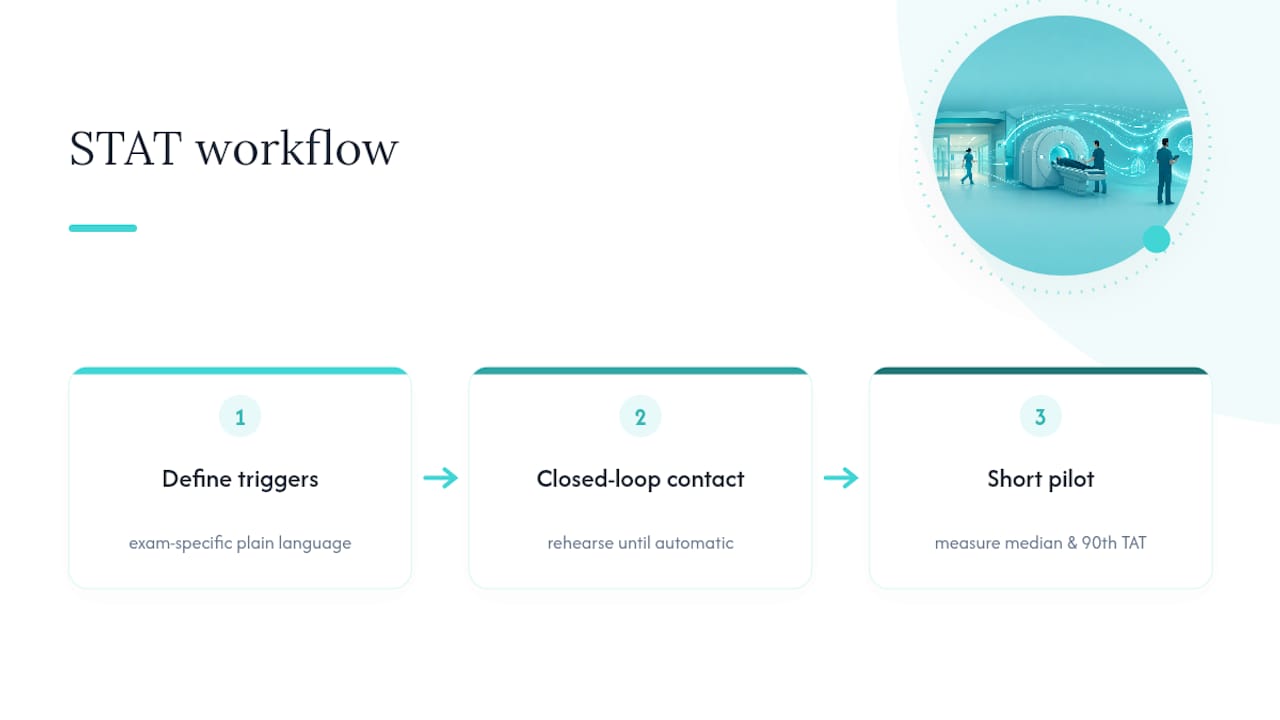
A short pilot works better than a department-wide overhaul. Pick one modality, one shift pattern, or one off-hours coverage gap, and measure your actual median and 90th-percentile TAT against a defined SLA for 60 to 90 days before rolling changes further.
Testing a teleradiology partner for off-hours or overflow STAT coverage is a comparatively low-risk way to close a specific gap. You're adding capacity at the margin, not replacing your existing group, and you get hard data on whether an outside partner's turnaround claims hold up against your own volume and case mix.
How AstraRad Fits Into a Serious STAT Coverage Strategy
If you're building or auditing a STAT program, the partner conversation should start with numbers, not marketing language. AstraRad's contract commits to STAT cases in under 4 hours, with 2-hour and 1-hour STAT available on request at a higher multiplier, each measured from last-image arrival to radiologist signature, so the commitment can be checked against the department-level benchmarks discussed above.
Studies are read out as final signed reports from board-certified subspecialists, not preliminary reads requiring a second pass, and integration can run through existing PACS without adding another portal for technologists to learn.
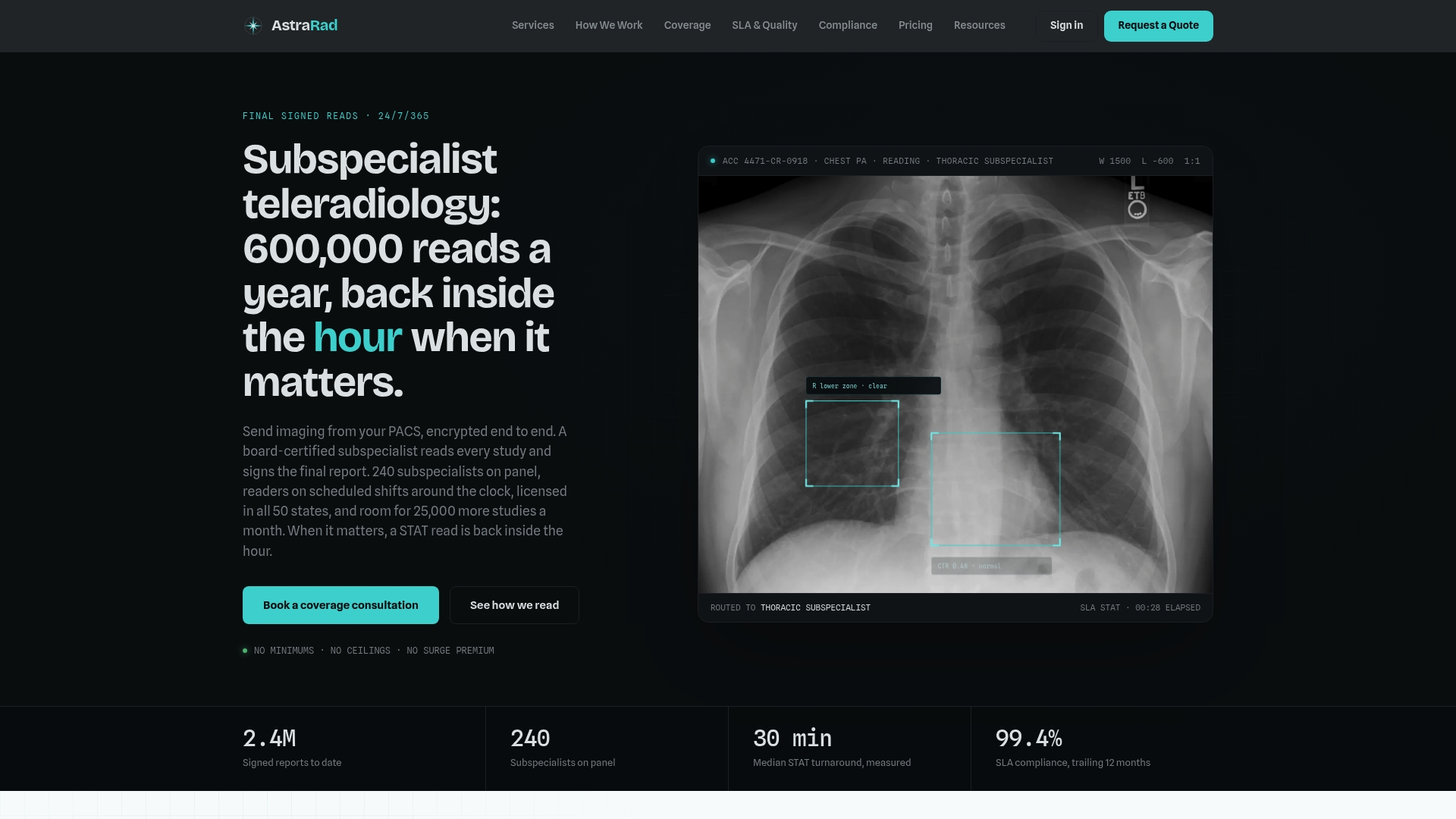
Before contracting any teleradiology partner, require the same things this article recommends you build internally: a measured median and 90th-percentile TAT, final signed reports rather than drafts, subspecialty coverage matched to your modality mix, and active state licensing everywhere you operate. AstraRad publishes state-by-state licensing coverage and per-report pricing by study type so administrators can check fit before committing. If your gap is specifically STAT overflow or off-hours coverage, the STAT reads use-case page lays out exactly how the SLA works and how to start a pilot.
This article is general information, not a substitute for advice from a qualified doctor. Consult a qualified healthcare professional about your own circumstances before acting on anything here.
Sources
- ACR practice parameter for communication of diagnostic imaging findings
- STAT image reporting in a large-scale cohort: types, frequency, and insights from the Tohoku Medical Megabank Brain MRI Study
Recommended
Related on AstraRad
- Resources
Audit teleradiology report quality: a 12-point scorecard
Audit teleradiology report quality before you sign: score 20 blinded reports against 12 criteria, with pass thresholds and a quarterly cadence.
- Resources
ED imaging turnaround: what to put in your contract
ED imaging turnaround is measured from exam completion to final signature; here is how to define, benchmark and contract it with a teleradiology partner.
- Resources
Teleradiology contract terms: a buyer's checklist
Teleradiology contract terms every US hospital, imaging center and radiology group should define: SLA, BAA, credentialing, PACS downtime and pricing.
Put a radiologist's name on your next read.
Tell us your modalities and monthly volume. A complete per-report rate card, with turnaround tiers and SLA terms in writing, lands in your inbox within one business day.