Operations first teleradiology workflow for administrators
For administrators: an operations first teleradiology workflow to hit contracted STAT turnaround, secure PACS integration, and enforce licensure.
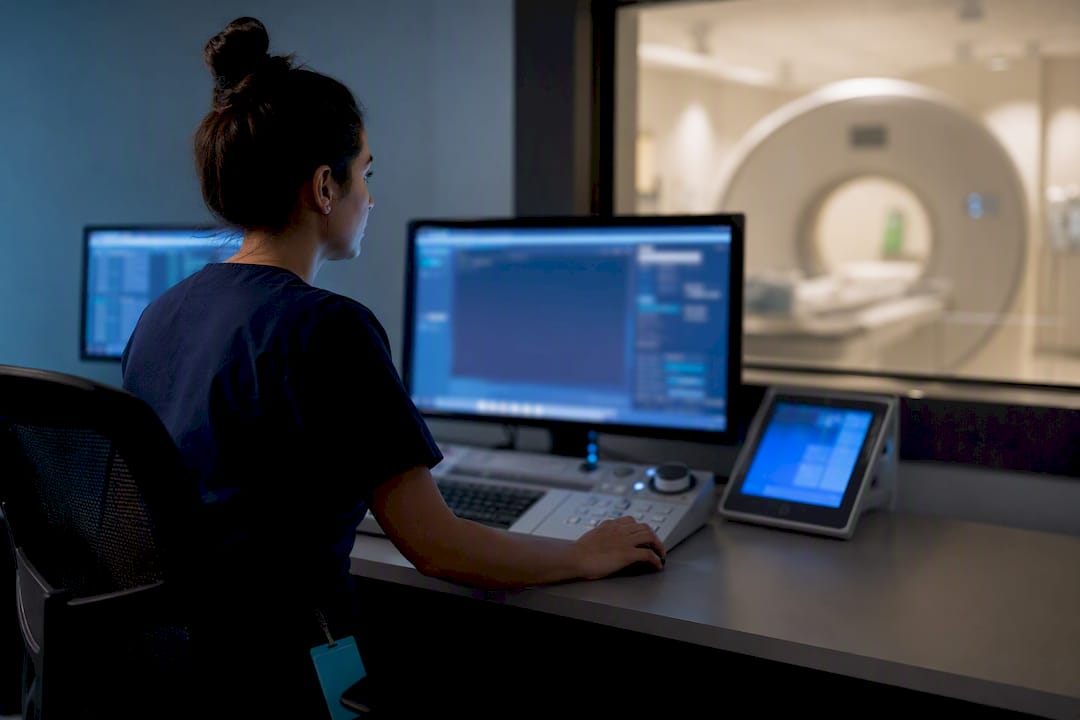
A teleradiology workflow is the end-to-end operational pipeline that reliably delivers a signed diagnostic report from image capture to the ordering clinician, measured by turnaround time, diagnostic quality, and secure compliance. A workflow only counts as "working" if it hits its contracted STAT turnaround, routes every study to a subspecialist qualified to read it, and keeps every transmission auditable under HIPAA and a signed business associate agreement. The American College of Radiology's practice parameters and AstraRad's high SLA compliance rate set a benchmark for administrators to consider when evaluating performance.
TL;DR:
- Ensuring metadata remains accurate at the source prevents most report delays and is crucial for efficient workflow execution.
- Implementing end-to-end encryption, multi-factor authentication, and regular vulnerability scans are essential for securing transmission and protecting patient data.
- Successful multi-state coverage requires early licensure, hospital privileging, and centralized license tracking to avoid administrative delays.
- A phased rollout starting with a narrow pilot, clear service level agreements, and standardization of metadata improves scalability and reliability.
- Continuous staff training, routine competency reviews, and disaster recovery planning are critical to maintaining workflow health and resilience.
Table of Contents
- The Teleradiology Workflow, Step by Step
- Network, Workstation, and PACS Requirements That Protect Image Quality
- Licensure, Credentialing, and Compliance Checkpoints
- Rolling Out Teleradiology Without Breaking What Already Works
- Metrics That Keep a Teleradiology Workflow Honest
- What This Looks Like When a Provider Executes It Well
- Disaster Recovery Planning for When the Primary Path Fails
- Patient Consent and Communication in a Remote Reading Model
- Keeping Remote Radiologists and Staff Current
- Security and Encryption Standards Beyond Baseline HIPAA Compliance
- Where Do Teleradiology Leaders Get Priorities Wrong?
- Get Your Teleradiology Workflow Running With AstraRad
- Sources
The Teleradiology Workflow, Step by Step
Every teleradiology workflow breaks into five sequential stages: image acquisition, DICOM packaging, secure transmission, remote interpretation, and report delivery. This is the operational backbone that telehealth standards bodies describe, and it holds true whether you're sending three overnight X-rays or clearing a 400-study MRI backlog.
1. Image capture and metadata capture at the originating site
The technologist acquiring the study has to get more than pixels right. Patient demographics, ordering physician, clinical indication, and modality-specific protocol details all need to travel with the image, because a radiologist reading blind, without context, reads slower and flags more unnecessary callbacks. Missing or garbled metadata is one of the most common causes of report delay, and it's almost always preventable at the source.
2. DICOM packaging, compression, and priors handling
Studies get packaged into DICOM format with compression settings appropriate to the modality. Lossless compression is standard for anything that could hide a subtle fracture or nodule; lossy compression at higher ratios is sometimes acceptable for referential prior comparisons but rarely for the primary diagnostic set. Prior studies need to travel with the current exam whenever they exist. A radiologist comparing a new chest CT against one from eight months ago reads faster and more confidently than one working from a single snapshot in time.
3. Secure, auditable transmission
Every image transfer needs to be encrypted in transit, logged, and traceable to a specific sender and receiver. This is where your business associate agreement stops being a legal formality and becomes an operational document: it should specify exactly how images move, who can access them, and how long transmission logs are retained.
4. Study routing and orchestration
Once a study lands in the reading queue, routing logic decides who reads it. Effective orchestration weighs subspecialty match (a pediatric chest film shouldn't land on a musculoskeletal specialist's worklist), SLA priority (STAT cases jump the queue), and current radiologist workload. Some platforms now layer AI-assisted triage on top of this logic. AI systems that flag likely intracranial hemorrhage or pneumothorax can push a critical study to the top of the worklist before a human has even opened it, shaving real minutes off time-to-first-read on the cases where minutes matter most.
5. Remote interpretation
The reading radiologist needs more than the image. Access to relevant EMR context, prior reports, and a structured reporting template all shape how fast and how consistently the report gets written. Structured reporting, using standardized templates keyed to modality and body part, reduces variability between radiologists and speeds up report generation without sacrificing detail.
6. Report delivery and acknowledgment
Preliminary reports for STAT cases typically go out first, verbally or through a flagged EMR entry, with the final signed report following once dictation is transcribed and reviewed. The transmitting site needs a clear acknowledgment step. Someone has to confirm the report was received and reviewed by the ordering clinician, not just delivered into a queue nobody checked.
Administrators auditing their own process should walk a single study through all six steps and time each handoff. Delays almost always cluster at the seams: metadata that didn't travel with the image, a routing rule that sent a pediatric study to the wrong queue, or a report that sat unacknowledged for four hours because nobody was watching the fax line.

Network, Workstation, and PACS Requirements That Protect Image Quality
A teleradiology workflow lives or dies on infrastructure most administrators never see directly, but its absence shows up immediately in reader complaints and slow turnaround.
PACS integration comes in two flavors. A unified reading environment consolidates images from multiple originating PACS into a single worklist, which is generally the more scalable pattern. Site adapters that connect radiologists to each individual facility's PACS work fine at small volumes but multiply administrative overhead as you add sites. Intelerad's work with ARA Health Specialists found that consolidating PACS into one unified environment cut workflow friction enough to expand remote coverage without adding daytime radiologist headcount.
Bandwidth and latency matter more than most IT teams initially budget for. Home-based and remote reading workstations need sustained bandwidth in the 50 to 100 Mbps range for general teleradiology, with heavier modalities like CT and MRI pushing toward the higher end. Intelligent prefetching of likely-needed priors, paired with adaptive streaming for anything requested on demand, balances bandwidth load against how responsive the workstation feels to the radiologist sitting at it.
Diagnostic display environment follows ACR-referenced standards: ambient lighting in the 25 to 75 lux range, acoustic conditions under 40 dB, and calibrated monitors tested on a regular schedule. A radiologist reading a mammogram under office fluorescent lighting is working at a real disadvantage compared to one in a properly darkened, calibrated reading room.
- Encrypt every transmission in transit and at rest, not just at the network perimeter.
- Enforce multi-factor authentication for every radiologist and technologist workstation.
- Run scheduled vulnerability scans against PACS and reading-station endpoints.
- Build redundancy into transmission paths so a single ISP outage doesn't stall the queue.
- Monitor SLA compliance in real time, not through a monthly retrospective report.
Studies on home-based reading environments have found that properly configured setups can match in-hospital diagnostic performance, which matters given how much of the teleradiology workforce now reads from outside a hospital building.
Pro Tip: Before onboarding a new reading radiologist, have them run a test study through their actual home setup during peak evening bandwidth hours, not a quiet Sunday morning. That's when contention with the rest of the household's internet use will actually show up.
Licensure, Credentialing, and Compliance Checkpoints
The single biggest source of teleradiology delay isn't technology. It's paperwork. State licensure and hospital privileging create real administrative friction, and radiologists generally need to be licensed in the state where the patient is physically located, not where the radiologist happens to be sitting.
Administrators building a multi-state coverage plan should work through these checkpoints in order:
- Map patient-location licensure requirements for every state you serve, since rules and reciprocity agreements vary and change without much notice.
- Establish hospital privileging early. Credentialing a remote radiologist at a new facility typically takes weeks, sometimes longer if the hospital's medical staff office has a backlog, so start this well before go-live.
- Document HIPAA compliance and execute a business associate agreement with clear language covering transmission logging, access controls, and breach notification timelines.
- Evaluate telemedicine license variants where your state allows them. Some jurisdictions offer a lighter-weight telemedicine license that can substitute for full licensure in specific circumstances, cutting paperwork for high-volume multi-state groups.
- Centralize license and credential tracking in one system rather than a spreadsheet per radiologist. Operationalizing multi-state coverage works best with a centralized tracking mechanism that flags renewal deadlines before they become a service interruption.
Build an onboarding checklist that captures license status, hospital privileges, BAA execution, and workstation certification in a single record per radiologist. Repeated paperwork requests are the number one complaint radiologists have about multi-facility coverage, and a clean checklist eliminates most of it.
Rolling Out Teleradiology Without Breaking What Already Works
Scaling a teleradiology program works best as a phased rollout, not a single cutover weekend.
Start with a narrow pilot: one modality, one site, a defined volume ceiling, and measurable KPIs (turnaround time, discrepancy rate, technologist satisfaction) tracked from day one. Run technical dry runs, actual test transmissions at realistic file sizes, before a single live study crosses the wire.
Data standardization matters more than it sounds like it should. Inconsistent study labeling and display protocols between sites create per-case inefficiency that compounds at scale; standardizing hanging protocols and metadata conventions before you add the second and third site pays for itself quickly.
Configure routing and fallback behavior explicitly. What happens when the primary subspecialist is unavailable? Who gets the study, and how fast? Exception handling that's undefined at launch becomes a crisis during the first busy weekend.
- Set a training and support model for technologists and radiologists before go-live, not after.
- Track KPIs weekly during the pilot, not quarterly.
- Use early volume and turnaround wins as internal proof points to secure buy-in for the next phase.
- Add sites incrementally, validating bandwidth and PACS integration at each step.
Pro Tip: Resist the urge to onboard every department simultaneously. A radiology group that pilots with X-ray overflow first, proves the SLA, then expands to CT and MRI builds internal trust far faster than one that tries to do everything at once.
Metrics That Keep a Teleradiology Workflow Honest
Turnaround time by priority tier, STAT, urgent, routine, is the metric every stakeholder asks about first, but it's not the only one that matters. Discrepancy rates from peer review, SLA compliance percentage, and queue depth during peak hours together give a fuller picture of whether the workflow is actually healthy or just fast on paper.
Automated monitoring should surface failed transmissions and timeout events in real time rather than in a weekly digest. Peer-review workflows need a closing loop: findings get reported back to the transmitting site, not filed away in a QA database nobody reads. Auditable, private peer-review systems remain one of the better-documented levers for maintaining diagnostic quality over time.
| Metric | What it signals |
|---|---|
| STAT turnaround time | Speed of critical-finding reporting |
| Routine turnaround time | Baseline operational throughput |
| Discrepancy rate | Diagnostic accuracy and peer-review outcomes |
| SLA compliance percentage | Contractual and operational reliability |
| Queue depth at peak hours | Capacity strain and staffing adequacy |
An incident response process for downtime or a critical miss needs to exist before it's needed, with a defined escalation path and a clinical leadership dashboard reviewed on a set cadence, weekly at minimum during a pilot, monthly once stable.
What This Looks Like When a Provider Executes It Well
Integration happens directly through your existing PACS, with no extra portal for technologists or radiologists to learn. That model has proven itself for rural and critical access hospitals and urgent care centers needing dependable overnight coverage without hiring a full night shift.
Disaster Recovery Planning for When the Primary Path Fails
A teleradiology workflow that only works when everything goes right isn't a workflow, it's a liability waiting for a bad night. Business continuity planning for teleradiology needs to address three failure modes specifically: transmission path outages, reading-site unavailability, and PACS or network downtime at the originating facility.
Redundant transmission paths, ideally across two different internet service providers or connection types, prevent a single point of failure from stalling the entire queue. If your primary transmission route goes down at 2 a.m., there should be a secondary path that activates automatically, not one that requires someone to notice and manually reroute.
Reading-site redundancy matters just as much. If your primary group of subspecialists is unavailable, whether from a regional outage, a staffing gap, or a platform failure on their end, there needs to be a documented failover to a secondary reading resource with the same subspecialty coverage. This is where working with a teleradiology partner with deep bench strength across subspecialties pays off versus relying on a single small group.
Test your disaster recovery plan the same way you'd test a fire drill: on a schedule, not just in theory. Run a simulated outage during a low-volume period and time how long it takes to detect the failure, notify the right people, and reroute studies. If that number is longer than your STAT SLA window, the plan has a gap that needs fixing before a real outage exposes it.
Patient Consent and Communication in a Remote Reading Model
Patients rarely think about who's reading their imaging study until someone asks them directly, and most facilities handle this with minimal friction: a line in the standard imaging consent form disclosing that studies may be interpreted by a radiologist outside the physical facility, sometimes in a different state.
The communication burden falls mostly on the ordering clinician and front desk staff, who should be prepared to answer a simple, predictable question: "Who's reading my scan?" The honest answer, a board-certified subspecialist matched to the exact modality and body part, is usually a better answer than "whichever radiologist happens to be on-site today," but it needs to be delivered with confidence rather than treated as something to downplay.
Facilities that handle this best build a short, plain-language explanation into their existing consent workflow rather than treating remote interpretation as a separate disclosure requiring its own conversation. Something as simple as "your images will be reviewed by a specialist radiologist, which may include remote subspecialists, to make sure the right expert reads your specific type of scan" tends to land well, because it frames remote reading as a quality decision rather than a cost-cutting one.
Documentation matters here too. Keep a record of consent language and confirm it's reviewed whenever your reading arrangement changes, particularly if you add a new teleradiology partner or expand into a new modality where patients might reasonably ask more questions.
Keeping Remote Radiologists and Staff Current
A teleradiology workflow only stays reliable if the people running it keep their skills current, and remote work makes that easier to overlook than it would be in a shared reading room where informal knowledge transfer happens constantly.
Remote radiologists need the same continuing medical education requirements as any board-certified subspecialist, but teleradiology groups should layer on platform-specific training: how the routing logic works, how to flag a technical issue with an incoming study, and how escalation paths function when something looks off. New radiologists joining a teleradiology group benefit from a structured shadowing period, reviewing real cases alongside an experienced remote reader, before going live independently.
Technologists at transmitting sites need parallel training focused on metadata accuracy and DICOM packaging, since errors introduced at capture are the hardest ones to fix downstream. A technologist who understands why clinical indication fields matter to a remote reader packages studies more carefully than one who sees it as a box to check.
Ongoing competency reviews, tied to the same discrepancy-rate data used for peer review, help identify where additional training would help before a pattern turns into a quality problem. Groups that treat training as a one-time onboarding event rather than a continuing practice tend to see skill and process drift creep in over eighteen to twenty-four months, right around the point when the original onboarding material has been half-forgotten.
Security and Encryption Standards Beyond Baseline HIPAA Compliance
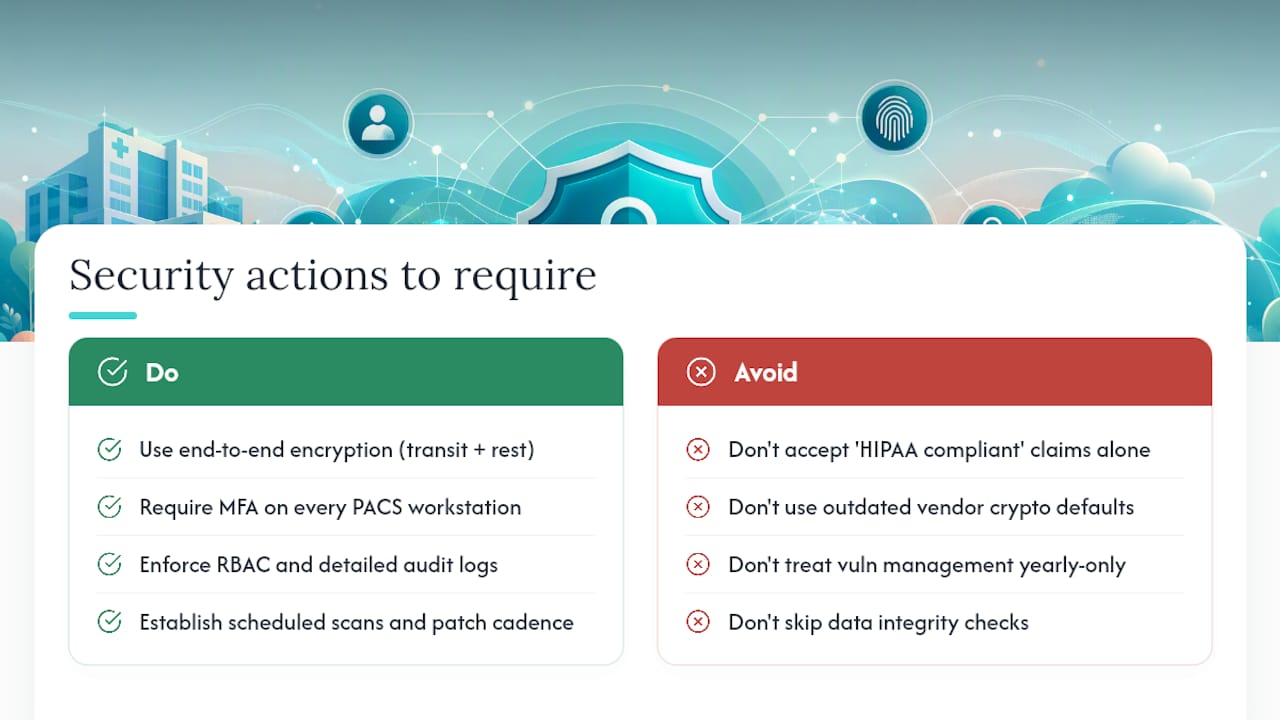
HIPAA sets a compliance floor, not a security ceiling, and administrators building a serious teleradiology workflow need to think past the minimum. End-to-end encryption should cover data in transit and at rest, using current industry-standard protocols rather than whatever the PACS vendor shipped with five years ago and never updated.
Multi-factor authentication belongs on every workstation with PACS access, not just administrative accounts. Role-based access controls should limit exactly who can view which studies, and audit logs need to capture every access event with enough detail to reconstruct a full chain of custody if a question ever comes up.
Vulnerability management can't be a once-a-year checklist item. Scheduled scans against PACS endpoints, reading workstations, and transmission gateways catch problems before they become incidents, and a documented patching cadence keeps known vulnerabilities from sitting open for months.
Data integrity checks, confirming that a transmitted study arrives complete and unaltered, protect against both technical corruption and any question of tampering. This matters for legal defensibility as much as clinical accuracy: a report is only as trustworthy as the chain of custody behind the image it was based on.
Any vendor evaluation should ask specifically how encryption, authentication, and audit logging are implemented, not just whether the vendor waves a compliance badge. Those claims get used loosely enough in vendor marketing that it's worth pushing for specifics on protocol versions, key management, and breach notification timelines in writing.
Where Do Teleradiology Leaders Get Priorities Wrong?
Most administrators treat teleradiology adoption as primarily a technology procurement problem, and that's backwards. The workflows that actually perform well prioritize information access, getting prior studies and clinical context reliably into the radiologist's hands, before they layer on anything resembling automation or AI triage. A brilliant worklist prioritization algorithm sitting on top of incomplete metadata just produces confident-looking wrong answers faster.
The second mistake is under-designing the pilot phase. Administrators tend to want to prove scale immediately instead of proving reliability first. A narrow pilot with clear SLAs and a simple, boring escalation path teaches you more about where your workflow will break than a wide rollout ever will, because problems surface at low volume where they're cheap to fix.
The third: teams underinvest in standardization. Metadata labeling and display protocol consistency feel like housekeeping compared to choosing a routing algorithm, but they're the difference between a workflow that scales smoothly to a third and fourth site and one that requires custom troubleshooting every time you add one.
Get Your Teleradiology Workflow Running With AstraRad
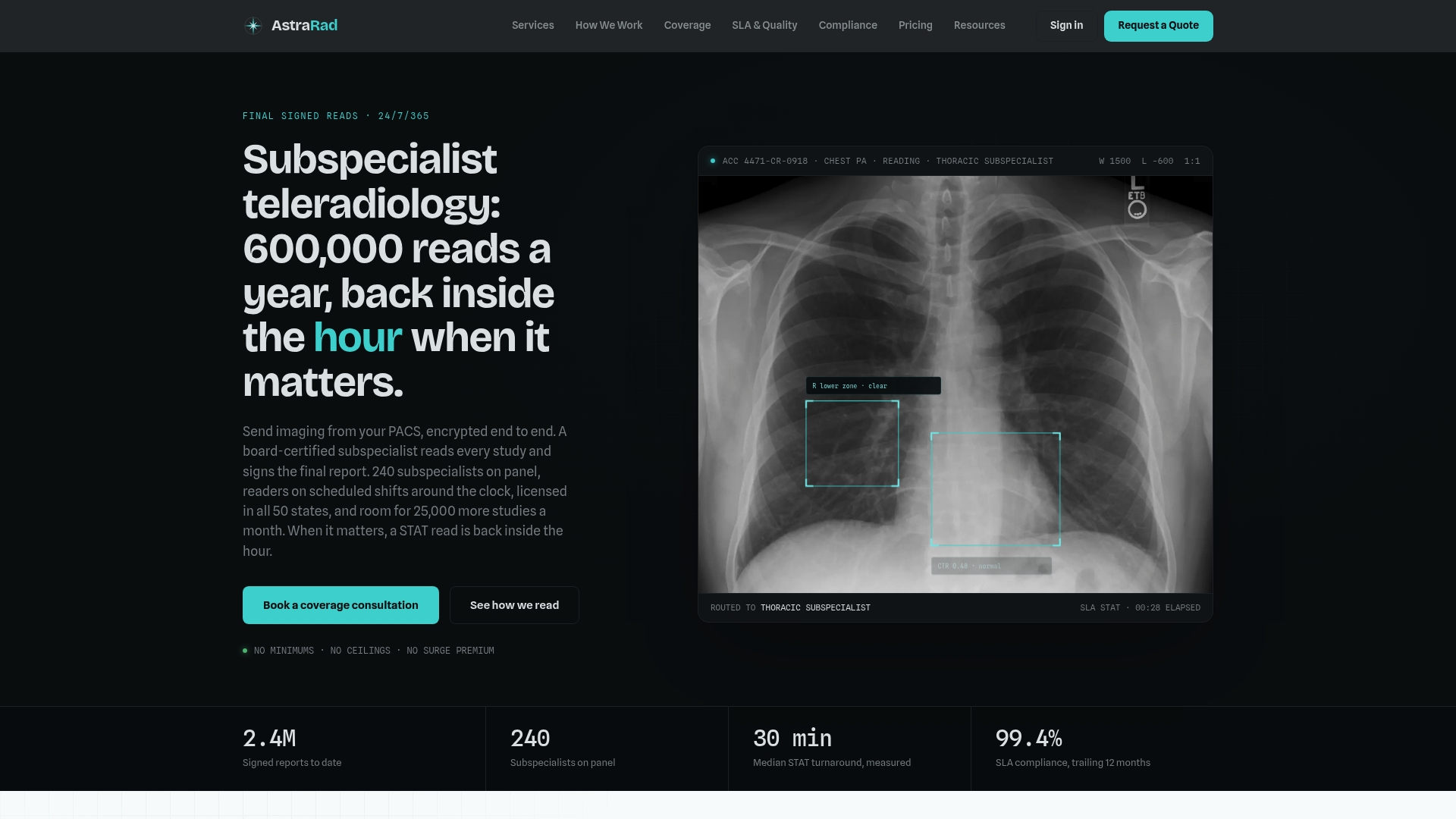
Integration runs directly through your existing PACS, so there's no separate portal for your technologists to learn and no workflow disruption during onboarding. Rural hospitals, urgent care centers, and high-volume imaging groups all use the same core setup described throughout this guide, adjusted for their specific modality mix and coverage windows.
If state licensing has been the sticking point in your own planning, check how AstraRad handles state-by-state coverage before assuming multi-state reads mean months of paperwork. And if the deciding factor is cost predictability, the per-report pricing structure makes it straightforward to model your own ROI against current overflow or after-hours staffing costs. Request a pilot to see the workflow run against your own study volume before committing to anything larger.
Sources
Building compliance documentation or a technical spec sheet for your own workflow gets easier with a few primary sources on hand:
- Emerging Challenges and Opportunities in the Evolution of Teleradiology | AJR
- Teleradiology Services and Standards | National Telehealth Authority
Recommended
Related on AstraRad
- Resources
ED imaging turnaround: what to put in your contract
ED imaging turnaround is measured from exam completion to final signature; here is how to define, benchmark and contract it with a teleradiology partner.
- Resources
Teleradiology contract terms: a buyer's checklist
Teleradiology contract terms every US hospital, imaging center and radiology group should define: SLA, BAA, credentialing, PACS downtime and pricing.
- Resources
2027 Medicare fee schedule: the radiology numbers explained
The CY2027 Medicare fee schedule cuts both conversion factors while ACR estimates radiology gains 2 percent. Both are true. Model your dollars per RVU.
Put a radiologist's name on your next read.
Tell us your modalities and monthly volume. A complete per-report rate card, with turnaround tiers and SLA terms in writing, lands in your inbox within one business day.