Hospital radiology surge capacity: act before queues grow
Build a radiology surge plan using evidence on activation thresholds, a readiness checklist, and AstraRad SLA and PACS details to clear backlogs faster.
Surge capacity radiology is the ability to scale diagnostic imaging interpretation quickly when case volume outpaces on-site staffing, using teleradiology, threshold-based activation, and backlog clearance to keep turnaround times stable. Done well, it trims mean turnaround and clears unread queues before they affect care. A discrete-event simulation of large-scale sporting events found that threshold-based teleradiology support cut mean CT turnaround significantly during short, high-volume surges, substantially reducing wait times.
That kind of result depends on the mechanics working before the surge hits, not during it. We designed our service around that exact problem: when an emergency department or imaging center hits its limit, studies still need a board-certified subspecialist behind every read, not just an available one. Turnaround is committed by contract, so a surge plan built around that starts with a known ceiling on wait time. The rest of this article walks through how to design that plan for your own facility.
TL;DR:
- Direct EMR integration of teleradiology requests cut the interval between preliminary reads and requests by 29.2%, and total CT order to result time by 17.4% across 12,126 patients.
- Set activation thresholds for unread backlogs or breached turnaround times; simulation cut cases delayed beyond 60 minutes from 47.4 to 2.0, and retain manual overrides.
- Begin privileging paperwork when selecting a vendor and run it alongside technical testing; readiness takes four to six weeks, and licensure follows the patient’s state.
- Track mean and 90th percentile turnaround, unread backlog, delays beyond 60 minutes, and SLA compliance against regular operation baselines, not arbitrary targets.
Table of Contents
- Core components of an effective radiology surge-capacity program
- Activation: threshold-based triggers and operational workflows
- Operational checklist to prepare a facility for rapid scaling with a teleradiology partner
- Compliance, credentialing, and billing considerations for surge reads
- Measuring success: KPIs, dashboards, and reporting to prove surge capacity works
- How a high-capacity teleradiology provider supports STAT, overflow, and urgent-care reads
- Practical pitfalls and pragmatic advice from a radiology leader
- AstraRad as an option for surge-capacity teleradiology
- FAQ
- Sources
Core components of an effective radiology surge-capacity program
A surge-ready program rests on three pillars: technical integration, clinical coverage, and quality oversight. Each has to work without manual intervention, because surges are exactly when staff have the least time to troubleshoot a broken interface.
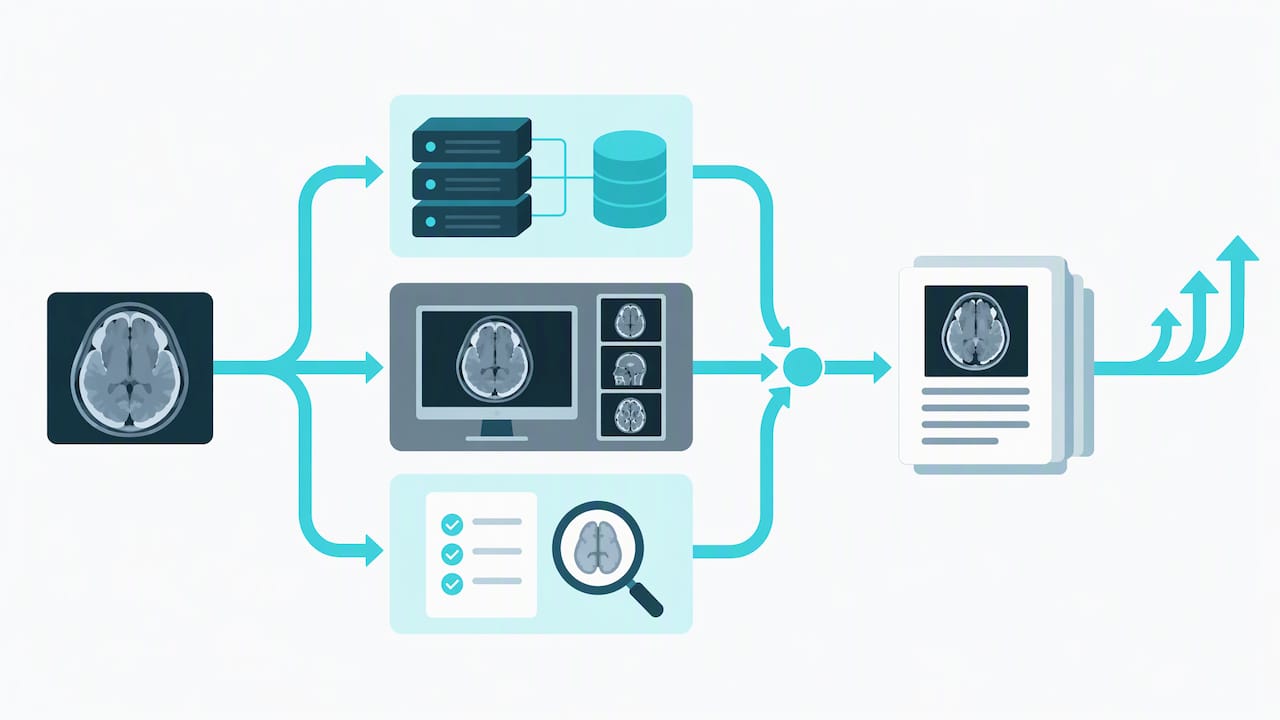
PACS and EMR integration matters most. DICOM routing and HL7 messaging should move studies to a reading queue automatically, without a tech placing a manual request. A quality improvement initiative that integrated teleradiology requests directly into the EMR cut the interval between preliminary read and request by 29.2% and reduced total CT order-to-result turnaround by 17.4% across 12,126 patients. Subspecialty-matched readers and clear SLA tiers for STAT versus routine studies come next: a chest CT and a pediatric neuro MR should never share the same queue priority. Secure image transmission, structured peer review, and operational reporting round out the picture, giving administrators a paper trail when volumes spike.
A procurement checklist should cover:
- DICOM and HL7 connectivity tested end to end, not just configured.
- SLA tiers defined separately for STAT, urgent, and routine studies.
- Subspecialty matching rules documented for each modality.
- Peer review and QA reporting built into the vendor contract, not added later.
Pro Tip: Ask any teleradiology partner to show you a live SLA dashboard before signing, not just a sample report.
Activation: threshold-based triggers and operational workflows
Surge activation works best when it is triggered by a number, not a feeling. The same simulation study found that threshold-based activation reduced cases delayed beyond 60 minutes from 47.4 to 2.0, a 95.8% reduction by engaging remote support before the backlog became visible to clinicians.
A workable activation protocol includes:
- Set a trigger: an unread backlog count or a turnaround-time breach that automatically flags the on-shift lead.
- Assign authority: one named role, usually the radiology on-shift lead, who authorizes surge engagement without waiting for committee sign-off.
- Log the event: timestamp when surge support starts and ends, tied to the trigger that caused it.
- Escalate if needed: a second threshold that pulls in additional external capacity if the first response does not clear the backlog.
Automated triggers catch surges faster than manual judgment, but they can misfire during planned downtime or data outages, so a manual override should always sit alongside them. Most facilities blend internal on-call staff with external teleradiology, using internal capacity for the first wave and routing overflow externally once the threshold holds for a set period.
Operational checklist to prepare a facility for rapid scaling with a teleradiology partner
Readiness is a sequence, not a single approval. Credentialing typically takes the longest, so it should start in parallel with technical onboarding rather than after it.
Credentialing and privileging
- Submit privileging paperwork to the medical staff office as soon as a vendor is selected, aligned to CMS Conditions of Participation.
- Confirm state licensure status for every reading radiologist before the first test case.
Technical validation
- Run end-to-end DICOM and HL7 test cases, not just connectivity pings.
- Verify VPN or secure gateway failover under simulated load.
- Confirm PACS routing rules send the correct modality to the correct queue.
Workflow configuration
- Set auto-referral rules so STAT studies route without manual tagging.
- Define worklist priority so urgent cases never sit behind routine volume.
- Keep an updated contact list for on-shift leads and vendor escalation contacts.
A realistic timeline runs four to six weeks: two weeks for credentialing submission, two weeks for technical testing run in parallel, and a final week for a live drill before declaring surge-ready status.
Pro Tip: Schedule your first surge drill on a low-volume day, so a routing error shows up as a test result instead of a delayed read.
Compliance, credentialing, and billing considerations for surge reads
Surge capacity only works if the compliance groundwork is already in place. CMS guidance (S&C-15-38) confirms hospitals may furnish diagnostic radiologic services under contractual arrangement, but every teleradiologist reading for that hospital must be privileged consistent with governing-body and medical-staff Conditions of Participation. There is no shortcut around that requirement, including during a surge.
Licensure follows the patient's location, not the radiologist's, so a reading physician needs an active license in the state where the study originated. Billing follows place-of-service rules for the professional and technical components, with the interpretation typically billed from where the technical component was performed.
Contracts with a teleradiology partner should spell out:
- Privileging turnover time, stated in business days, not "as soon as possible."
- Audit access to turnaround and QA data on request.
- Indemnity language covering remote interpretation specifically.
- SLA reporting cadence, ideally monthly at minimum.
Measuring success: KPIs, dashboards, and reporting to prove surge capacity works
A surge program is only as credible as the numbers behind it. Track mean turnaround time, 90th percentile turnaround time, unread backlog count, cases delayed beyond 60 minutes, and SLA compliance rate as a baseline set.
Threshold-based teleradiology support reduced mean CT turnaround time by 63%, from 48.7 to 18.0 minutes, during simulated high-volume surges, according to published modeling. That figure gives administrators a benchmark for what a well-integrated surge response should look like against a baseline period.
Compare surge-period metrics against a non-surge baseline rather than against an arbitrary target, since volume and acuity shift the numbers independently. Dashboards should reach radiology leadership and ED leadership in real time and reach the C-suite on a monthly or quarterly cadence tied to contract review. Peer-review and QA findings should roll into vendor performance scoring, not sit in a separate compliance file.
How does a high-capacity teleradiology provider support STAT, overflow, and urgent-care reads?
A multicenter evaluation of teleradiology for pediatric emergency neuroradiology across 107 hospitals reported CT turnaround averaging 37.5 minutes and MR turnaround averaging 61.2 minutes, showing that remote subspecialty reads can hold up at scale rather than degrade under volume.
AstraRad contracts turnaround from last-image arrival to radiologist signature: STAT under 4 hours (under 2 hours or under 1 hour on request), routine 24 to 48 hours, and stroke protocol under 30 minutes. Coverage runs 24/7/365, with subspecialty-matched radiologists assigned by modality and body part, and integration into your existing PACS rather than a separate portal.
Facilities use this model for:
- Overnight ED CT reads when on-site staff coverage thins out.
- Urgent care X-ray and CT reads during walk-in volume spikes.
- Backlog clearance after a multi-day surge, without adding permanent headcount.
Practical pitfalls and pragmatic advice
Credentialing lead times catch most facilities off guard. Start that paperwork the day you pick a vendor, running it alongside technical onboarding rather than waiting for one to finish before starting the other.
Run drills on a schedule, not just before an audit, and check that SLA telemetry reflects real-time performance rather than a monthly summary. Surge policies need to protect staff wellbeing too: predictable, compensated engagement keeps a surge roster willing to answer the call next time. Teleradiology works best as the buffer it is. Keep baseline local capacity intact and let external capacity absorb the spike, not the steady-state workload.
AstraRad as an option for surge-capacity teleradiology
If your facility is weighing how to handle the next volume spike without overloading your own staff, AstraRad covers exactly that gap. Every study goes to a board-certified subspecialist matched to the modality, with turnaround committed by contract (STAT under 4 hours (under 2 hours or under 1 hour on request), routine 24 to 48 hours, and stroke protocol under 30 minutes) and 1 in 20 reports independently double-read for peer review. Integration runs through your existing PACS, with no added portal and no volume minimum to meet before a surge plan makes sense.
A sensible next step is a routing test against your own PACS before committing to a full pilot.
- Request a readiness checklist review before your next peak season.
- Run a routing test through our integration process to confirm end-to-end connectivity.
- Review our per-report pricing to model surge costs against a contract pilot.
Start with our primary service overview to see which modalities fit your current gap.
FAQ
What does "surge capacity" mean in radiology operations?
It describes the ability to scale diagnostic imaging interpretation quickly when case volume exceeds on-site staffing, typically using teleradiology and threshold-based activation to avoid backlog. The goal is to keep turnaround times stable rather than letting wait times climb during a spike.
How fast should a STAT read turn around during a surge?
Turnaround expectations should hold during a surge. Write the tiers into the contract: AstraRad commits to STAT under 4 hours (under 2 hours or under 1 hour on request), routine 24 to 48 hours, and stroke protocol under 30 minutes, measured from last-image arrival to signature, as set out in our service terms.
What triggers should hospitals use to activate external teleradiology support?
Common triggers include a defined unread backlog count or a turnaround-time breach sustained over a set period. A discrete-event simulation found threshold-based activation cut cases delayed beyond 60 minutes by 95.8% compared with reactive, manual activation.
What credentialing steps does a hospital need before using a teleradiology partner?
Hospitals must privilege every reading radiologist consistent with governing-body and medical-staff Conditions of Participation, per CMS guidance (S&C-15-38). This applies whether the arrangement is permanent or activated only during surge periods.
Which metrics prove a surge-capacity program is working?
Mean turnaround time, 90th percentile turnaround time, unread backlog count, and SLA compliance rate are the core metrics to track. Comparing surge-period results against a non-surge baseline, rather than an arbitrary target, shows whether the program is actually holding up under load.
Sources
- Modeling emergency radiology demand for FIFA 2026 and the Los Angeles 2028 Olympic Games using discrete-event simulation
- Breaking the bottleneck: a quality improvement initiative to reduce overnight CT turnaround times in the emergency department
- Center for Clinical Standards and Quality /Survey & Certification Group Ref: S&C-15-38-Hospitals
- Multicenter evaluation of teleradiology for emergency pediatric neuroradiology (2026)
Recommended
Related on AstraRad
- Resources
2027 Medicare fee schedule: the radiology numbers explained
The CY2027 Medicare fee schedule cuts both conversion factors while ACR estimates radiology gains 2 percent. Both are true. Model your dollars per RVU.
- Resources
Clinician-radiologist communication: closing the loop
Clinician-radiologist communication fails when critical results reach a system but never reach the physician, and closed-loop standards close that gap.
- Resources
The hidden cost of the prelim-plus-overread model
The prelim-plus-overread model pays two radiologists and bills one report per overnight study. Cost the overread time, callbacks, and amendments first.
Put a radiologist's name on your next read.
Tell us your modalities and monthly volume. A complete per-report rate card, with turnaround tiers and SLA terms in writing, lands in your inbox within one business day.