Teleradiology SLA metrics for procurement
This procurement checklist sets SLA clock-start rules, median+90th targets, audit logs, surge tests, and uptime/security terms to protect patients.
Three metrics determine whether a teleradiology contract works: median and 90th-percentile turnaround time, critical-result notification timing, and QA discrepancy rate. Before signing anything, require the vendor to define clock start precisely, set tiered targets by urgency, cap breach outliers, and hand over audit logs on demand. The American College of Radiology (ACR) and The Joint Commission both publish standards worth citing directly in the contract.
TL;DR:
- Vendors should define the clock start at confirmed image receipt and report separate sub-intervals for routing, interpretation, and delivery to accurately track delays.
- Turnaround benchmarks vary by modality and urgency, with STAT cases targeting a median of 15,60 minutes and routine inpatient CT typically 2,6 hours, always paired with the 90th percentile.
- Contracts must include specific clauses such as breach caps, audit log access, precise escalation paths, and coverage of holiday, after-hours, and timezone considerations to ensure enforceability.
- Support response and resolution times should be tiered by issue severity, with documented escalation authority and regular reporting of ticket volume and resolution metrics.
- Security commitments must specify encryption standards, breach notification timelines, data retention policies, and compliance with regulations like HIPAA and accreditation standards.
Table of Contents
- What does teleradiology SLA metrics turnaround time actually measure?
- What are reasonable SLA benchmarks by urgency and modality?
- Which contract clauses matter more than the numbers?
- What KPIs should show up on the monthly report?
- How do you test performance under surge conditions?
- AstraRad's approach and the proof to demand from any vendor
- What SLA commitments cover system uptime?
- How should data security and confidentiality be written into the SLA?
- What regulatory and accreditation standards should the SLA reference?
- How fast should vendor support respond to issues?
- Negotiation checklist for procurement and clinical leaders
- How AstraRad supports these SLA commitments
- Sources
- FAQ
What does teleradiology SLA metrics turnaround time actually measure?
"Turnaround time" sounds simple until you ask when the clock starts. Vendors sometimes measure from the moment their radiologist opens the study, quietly excluding the minutes or hours a study sat in a routing queue. That gap can flatter a report card while patients wait.
The more defensible standard starts the clock at confirmed image receipt, not interpretation start. From there, break the interval into stages: acquisition-to-routing, routing-to-open, interpretation, dictation, signature, and final delivery. This decomposition matters because averaging the whole pipeline hides where delays actually occur.
Research on PACS workflow bears this out directly. In one documented case, image-dispatch-to-dictation time dropped from 38 to 23 minutes, while request-to-dispatch time increased over the same period , a shift that end-to-end TAT alone would have masked entirely. A single blended number would have told administrators nothing about which stage to fix.
When you request sub-interval data, ask for:
- Clock-start timestamp method (image-available vs. confirmed receipt)
- Routing-to-open interval, isolated from interpretation time
- Dictation-to-signature gap, which flags documentation bottlenecks
- Signature-to-delivery time, especially for PACS or EHR push failures
What are reasonable SLA benchmarks by urgency and modality?
Benchmarks vary by modality and clinical urgency, but defensible ranges exist. STAT and emergent studies commonly target a median turnaround of 15 to 60 minutes, with the 90th percentile held under 120 minutes. Routine inpatient CT typically runs a median of 2 to 6 hours, with the 90th percentile under 24 to 48 hours, though these figures shift with case complexity and site volume.
STAT/Emergent: median 15,60 min, 90th percentile under 120 min Urgent: median 1,4 hours, 90th percentile under 8 hours Routine (CT/MRI): median 2,6 hours, 90th percentile under 24,48 hours Routine (X-ray/ultrasound): median under 2 hours, 90th percentile under 12 hours
Reporting the median alone hides tail risk. A vendor can hit a fast median while a meaningful share of studies drift far past it, which is exactly why percentile reporting matters:
- Always pair median with 90th percentile, never one without the other
- Add an absolute breach cap (a maximum outlier count per month), not just a percentage compliance figure
- Break targets out by modality, since a chest X-ray and a contrast MRI have entirely different acquisition and reconstruction timelines
Large file sizes, cross-timezone coverage gaps, and case complexity all push effective turnaround beyond the advertised number. Build that variability into the contract rather than discovering it during a dispute.
Which contract clauses matter more than the numbers?
The timing targets get the attention, but the clauses around them decide whether those targets are enforceable. A median TAT with no clock-start definition is just a marketing number.
- Define clock start in writing. Specify whether the timer begins at image availability or confirmed receipt, and require timestamped confirmation for each study.
- Set explicit clinical criteria for urgency tiers. ACR guidance recommends aligning STAT definitions with actual clinical decision points rather than accepting a vendor's internal labeling, and specify who has authority to reclassify a study's tier.
- Spell out coverage hours and blackout periods. Include holiday schedules, shift-change windows, and how timezone differences affect after-hours coverage.
- Define breach thresholds with teeth. A percentile promise like "90% within 30 minutes" still permits real outliers; pair it with an absolute cap on severe delays and require corrective-action plans tied to breach triggers.
- Require audit log access on demand. Notification records, timestamped acknowledgments, and delivery receipts should be available for review, not summarized only in a monthly PDF.
Pro Tip: Ask the vendor to walk you through what happens the moment a STAT study breaches its target, not just what the SLA promises when everything goes right. The escalation path tells you more than the headline number.
Selection criteria worth building into any RFP include QA processes, accreditation status, turnaround performance, and discrepancy handling, evaluated together rather than in isolation.
Rafael Vieira
What KPIs should show up on the monthly report?
A contract is only as good as its reporting. If the report doesn't break performance down by modality, priority tier, and time of day, you can't tell whether a strong average is hiding a weak overnight shift.
Primary KPIs worth requiring on every report:
- Median and 90th-percentile TAT, segmented by modality and urgency tier
- Critical-result notification time, from finding identification to referring-provider acknowledgment
- QA discrepancy rate per 1,000 reads
- Subspecialty coverage ratio (what share of reads matched to the relevant subspecialist)
- Radiologist utilization rate during surge windows
Cadence matters as much as content. A real-time dashboard should track STAT cases as they happen; weekly exception reports should flag any breach; monthly compliance reports should show full denominators, not just pass rates. A 7-day rolling 90th-percentile alert catches drift before it shows up as a monthly failure, which gives you time to intervene rather than explain after the fact.
How do you test performance under surge conditions?
The SLA that holds up on a quiet Tuesday afternoon is not the one that matters. Overnight surges, mass-casualty events, and seasonal volume spikes are where turnaround commitments actually get tested, and where worklist prioritization rules need to keep working exactly as designed.
- Require stratified reporting that separates after-hours performance from daytime baseline
- Ask for documented surge drills or stress-test exercises, not just historical averages
- Confirm that acuity-based routing holds during volume spikes, since prioritization algorithms should preserve clinical urgency ordering even under load
- Require monthly QA/QC audits with discrepancy-rate reporting per 1,000 reads, broken out separately from routine QA
Pro Tip: Ask specifically for the audit trail format on a critical finding: finding classification, contact attempts, timestamps, acknowledgment status, and final disposition. If a vendor can't produce that structure on request, their closed-loop process probably isn't as tight as the sales deck suggests.
AstraRad's approach and the proof to demand from any vendor
AstraRad is a teleradiology provider delivering final signed reports through US board-certified subspecialists, matched by modality, with direct PACS integration and per-report pricing rather than platform fees. That model puts AstraRad squarely in the conversation when administrators evaluate the metrics above.
AstraRad reports a median STAT turnaround under one hour, routine studies under 24 hours, and 99.4% SLA compliance over the past year. Take those figures as a starting point for due diligence, not a substitute for it: ask any vendor, AstraRad included, for percentile datasets (not just medians), notification audit logs, and monthly QA discrepancy reports before signing.
What SLA commitments cover system uptime?
Turnaround targets mean nothing if the system routing studies to the radiologist is down. Uptime commitments deserve their own line item in the contract, separate from clinical performance metrics.
A defensible uptime SLA specifies a percentage commitment (commonly expressed as "four nines" or "five nines" of availability) measured monthly, along with a clear definition of what counts as downtime versus scheduled maintenance. Ask whether the percentage covers the vendor's core reading platform only, or the full chain including PACS connectivity and image transmission.
Scheduled maintenance windows should be disclosed in advance, ideally with a minimum notice period and a preference for low-volume hours. Unscheduled outages need their own reporting requirement: time to detect, time to notify the client, and time to restore service. A vendor who can tell you their mean time to recovery has a mature operations program; one who can't is asking you to trust a number they haven't measured themselves.
Redundancy architecture matters more than the uptime percentage itself. Ask whether the vendor operates from a single data center or maintains geographically distributed failover capacity, and whether radiologists can access the worklist from a backup system if the primary routing tool fails. A single percentage buried in an appendix doesn't tell you whether a regional outage takes down your entire STAT queue or gets absorbed by a failover site within minutes.
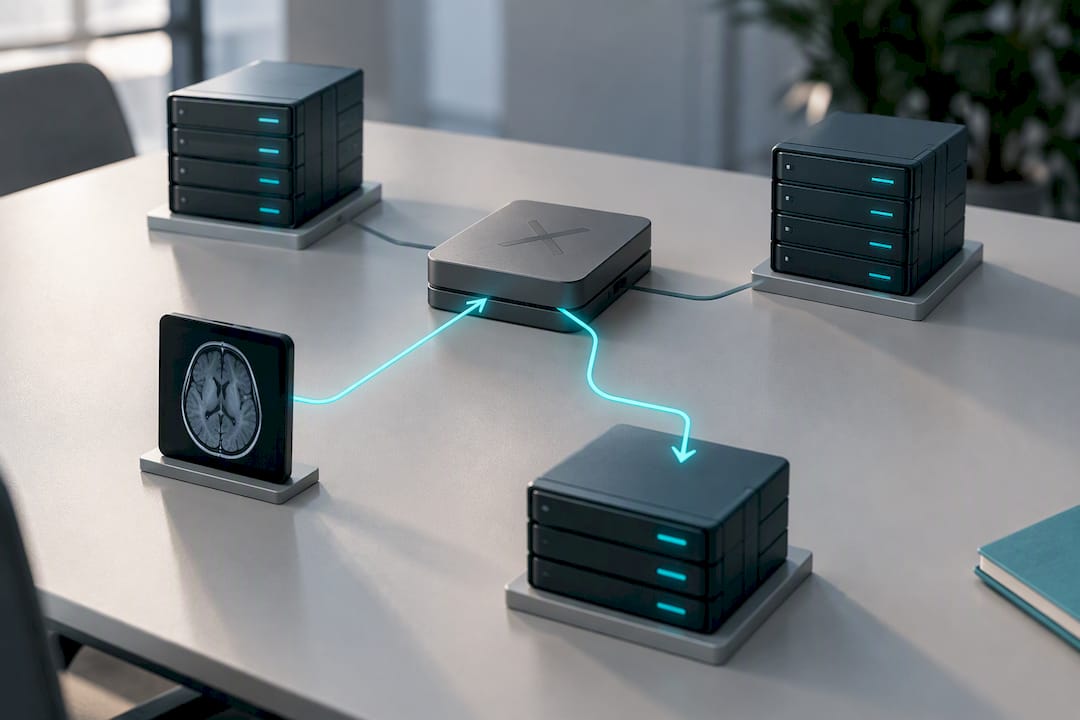
Image transmission and reception times deserve separate tracking from interpretation turnaround. A study that takes 90 seconds to transmit from your PACS to the vendor's platform, versus one that takes 15 minutes because of file size or bandwidth constraints, changes the effective clock start even before a radiologist opens the case.
How should data security and confidentiality be written into the SLA?
Every teleradiology contract touches protected health information, which means the SLA needs security commitments as specific as its turnaround targets. Vague assurances about "industry-standard encryption" are not a metric. A measurable security SLA specifies encryption standards for data in transit and at rest, access-control auditing frequency, and breach-notification timelines.
Ask the vendor to specify their encryption approach for image transmission (commonly TLS for transit and AES for storage), and how often they run access-log reviews to confirm only authorized personnel viewed a given study. Confirm whether third-party security audits happen annually and whether results are shared with clients, even in summary form.
Breach-notification timing belongs in the contract explicitly, not left to general assurance. HIPAA sets outer bounds for notification, but a strong SLA commits to a tighter internal timeline and specifies exactly who gets notified, in what format, and how quickly after discovery. Ask, too, how long the vendor retains images and reports, and under what conditions data gets purged or returned upon contract termination.
Business Associate Agreements are standard in this industry, but the SLA should reference the specific BAA terms rather than assuming they're implied. If the vendor stores data with a subcontractor or cloud provider, the SLA should disclose that relationship and confirm the subcontractor is bound by equivalent security terms.
What regulatory and accreditation standards should the SLA reference?
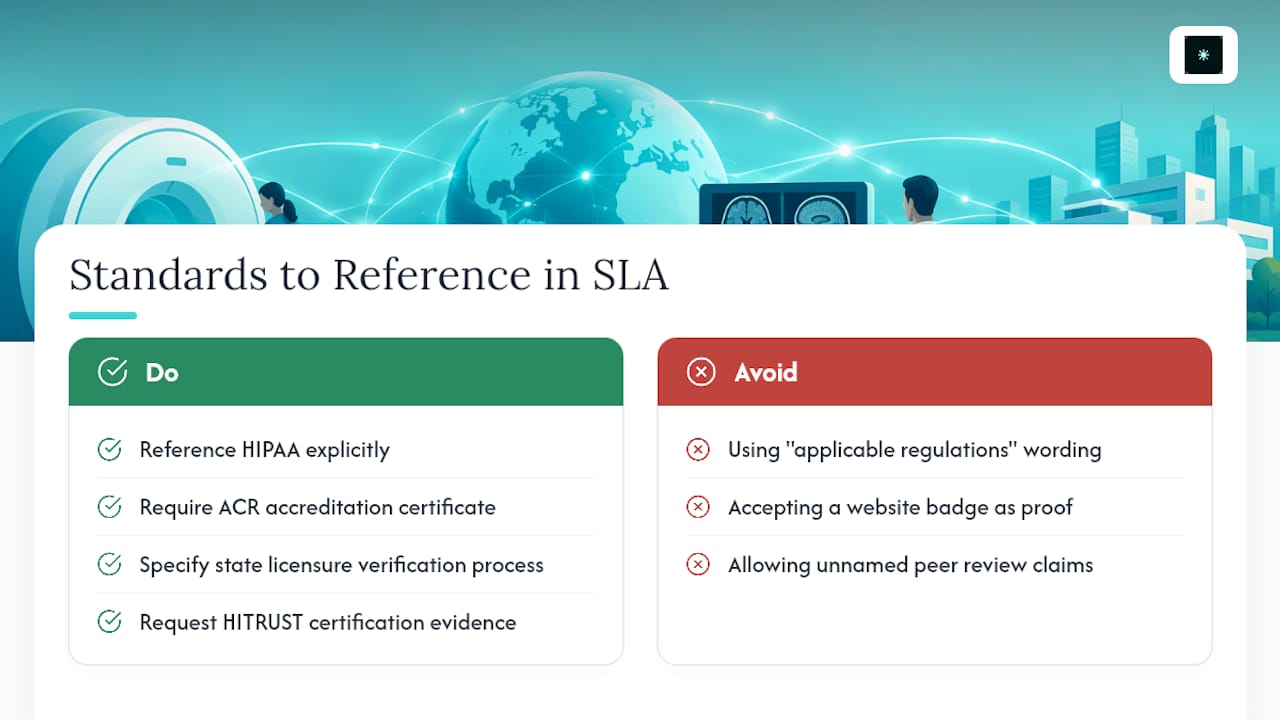
A teleradiology SLA that doesn't reference specific regulatory frameworks is missing its enforcement backbone. HIPAA governs the baseline for protected health information handling, but the contract should name it explicitly rather than gesturing at "applicable regulations."
Accreditation status deserves its own clause. Confirm whether the vendor's radiologists and facility hold current ACR accreditation for the modalities they read, and ask for the accreditation certificate rather than a website badge. The Joint Commission's standards on closed-loop communication and result reporting apply directly to how critical findings get relayed, and a vendor aligned with those standards should be able to describe their process in the same terminology the standards use.
State licensing is its own compliance layer, separate from federal regulation. Radiologists reading studies for a hospital in a given state generally need to hold an active license in that state, and the SLA should specify how the vendor verifies and maintains licensure across every jurisdiction it serves. Ask for a documented process for how licensing gaps get handled if a radiologist's credentials lapse or a new state requirement changes coverage.
HITRUST certification, where a vendor holds it, signals a formal security and privacy framework audited by a third party rather than a self-reported checklist. It's not universal in this industry, but its presence is a meaningful signal worth asking about directly. RADPEER or an equivalent structured peer-review program should also be named specifically, since "we do peer review" without a named methodology is difficult to verify or benchmark against.
How fast should vendor support respond to issues?
Clinical performance metrics get most of the attention in SLA negotiations, but the support relationship determines how quickly problems actually get fixed when something goes wrong at 2 a.m.
Support response time should be tiered the same way clinical urgency is tiered. A PACS integration failure blocking STAT reads needs a different response commitment than a billing question. Ask the vendor to specify response-time targets by issue severity: critical system failures, degraded performance, and routine administrative requests each deserve their own target and their own escalation path.
Issue resolution metrics matter more than initial response time. A vendor who answers the phone in five minutes but takes three days to resolve a routing failure hasn't actually solved your problem. Ask for mean time to resolution by issue category, and whether that data gets reported alongside clinical KPIs or kept separate.
Confirm who the client-facing point of contact is during an active issue, and whether that contact has authority to escalate internally without requiring the hospital to chase multiple departments. A named account manager with documented escalation authority is a meaningfully different commitment than a generic support ticket queue. Ask, too, whether the vendor tracks and reports support-ticket volume and resolution time as part of the regular compliance report, the same way they report TAT and discrepancy rates. If support performance isn't measured, it isn't actually part of the SLA. It's just a promise.
Negotiation checklist for procurement and clinical leaders
Priorities in order: precise clock-start language, tiered SLA targets by urgency and modality, auditable notification records, documented surge performance, and monthly QA discrepancy reporting. Paste this into any RFP appendix:
- Clock start defined as confirmed image receipt, timestamped
- Median and 90th-percentile TAT required for every modality and tier
- Absolute breach cap, not percentage compliance alone
- Critical-result notification and acknowledgment logs, available on request
- Monthly QA discrepancy rate per 1,000 reads
- Surge performance reported separately from baseline
- Escalation path with named authority for reclassification disputes
- Uptime and security terms referencing named standards, not general assurances
Every metric here maps to a patient-safety consequence, from ED throughput to missed critical findings.
How AstraRad supports these SLA commitments
AstraRad builds its service around the exact metrics covered above: final signed reports from US board-certified subspecialists, a claimed median STAT turnaround under one hour, and 99.4% SLA compliance over the past year. Integration runs directly through your existing PACS, so there's no separate portal for your team to manage on top of an already full workload.
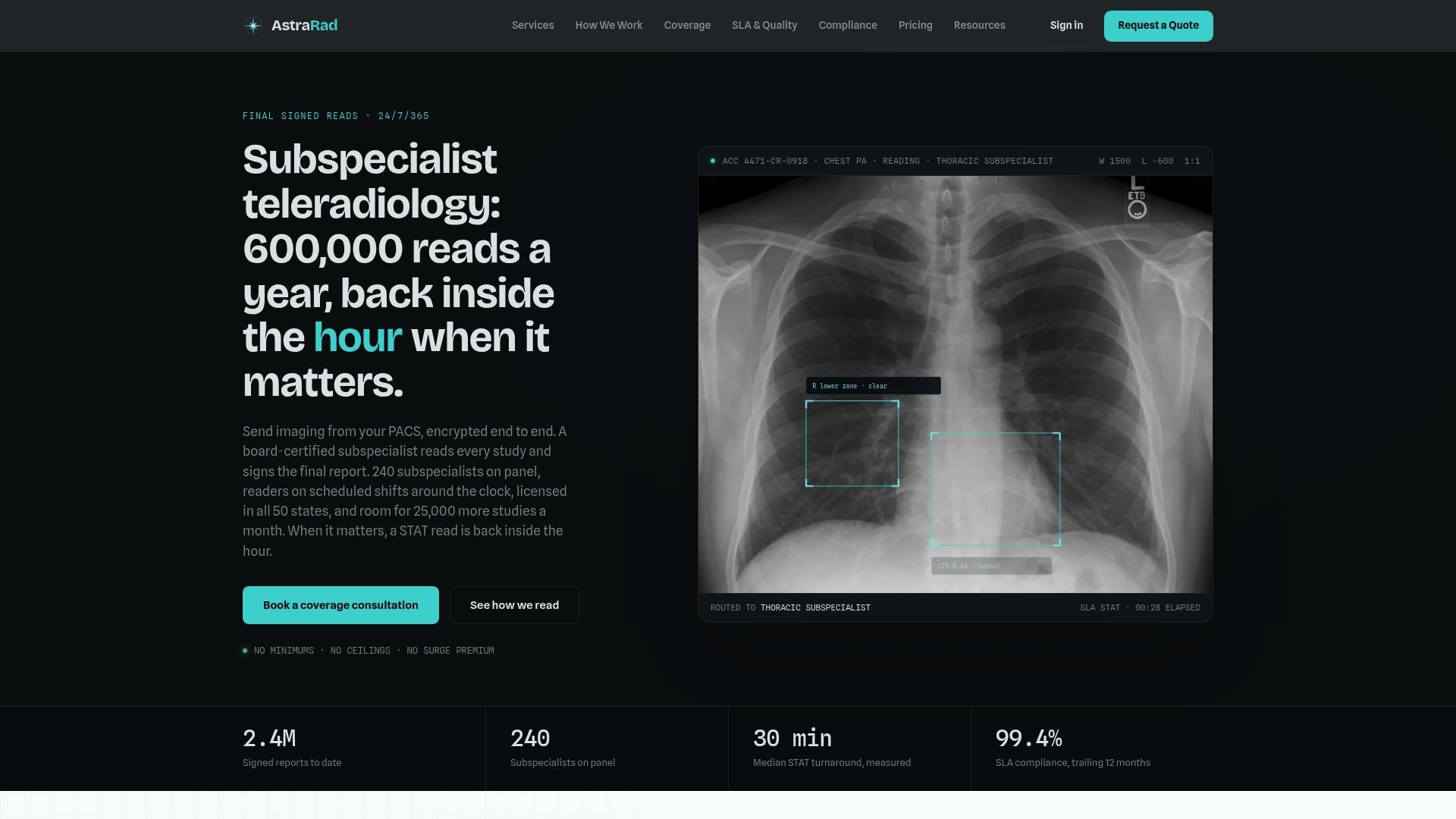
If you're evaluating vendors against the checklist in this article, ask for the same evidence from AstraRad that you'd ask from anyone else: percentile turnaround datasets, QA discrepancy reports, and a sample SLA showing how breach thresholds and escalation are written into the contract. AstraRad maintains state-by-state licensing coverage to support hospitals and imaging centers across different jurisdictions, and per-report pricing is detailed on the pricing page. Request a sample SLA and QA report before your next contract renewal, and compare it line by line against the checklist above.
Sources
Reference these directly in your contract appendix rather than paraphrasing them secondhand:
- AHRQ workflow evidence (PACS study)
- 6 keys to selecting a world-class teleradiology provider , Applied Radiology
FAQ
What is a good SLA compliance rate for teleradiology?
Most defensible contracts target 90th-percentile compliance in the high 90s for percentage terms, paired with an absolute cap on severe outliers rather than a percentage alone. AstraRad reports 99.4% SLA compliance over the past year as one reference point, but always request the underlying percentile data rather than accepting a single headline number.
What is a KPI in a radiology department?
A KPI in radiology is a measurable indicator tied to turnaround, quality, or safety, such as median and 90th-percentile TAT, QA discrepancy rate per 1,000 reads, and critical-result notification timing. These indicators only work as management tools when reported with consistent denominators and a fixed cadence, not as one-off snapshots.
What is the average turnaround time for radiology reports?
Average turnaround varies sharply by urgency and modality: STAT studies commonly target a median of 15 to 60 minutes, while routine inpatient CT often runs a median of 2 to 6 hours. Always ask for the 90th percentile alongside any median, since the average alone hides how often a study runs far longer than expected.
What is the highest paid type of radiologist?
Compensation varies by subspecialty and practice setting, and this article doesn't cover radiologist compensation data. Administrators evaluating a teleradiology vendor are generally better served asking about subspecialty coverage ratios and credentialing than compensation benchmarks, since coverage depth affects turnaround and accuracy directly.
How do I measure teleradiology SLA metrics correctly?
Break turnaround into sub-intervals (routing, interpretation, dictation, signature, delivery) rather than tracking one blended number, and report median alongside the 90th percentile for every modality and urgency tier. Pair that with critical-result notification timing and monthly QA discrepancy rate per 1,000 reads, reported with full denominators rather than summary percentages alone.
Recommended
Related on AstraRad
- Resources
Teleradiology for urgent care: the setup guide
How to set up teleradiology for urgent care: X-ray-heavy workflow, same-day final reads, overread discrepancy data, real costs, and a launch checklist.
- Resources
First hour PACS downtime checklist for radiology teams
Actionable playbook for radiology teams: 15 minute alert, 1 hour escalation, paper workflows, image reconciliation, and when to engage teleradiology.
- Resources
Radiology overflow reading services: how they work
How radiology overflow reading services work: the triggers that route spillover studies, the routing rules that keep control, and the per-read economics.
Put a radiologist's name on your next read.
Tell us your modalities and monthly volume. A complete per-report rate card, with turnaround tiers and SLA terms in writing, lands in your inbox within one business day.