Ultrasound teleradiology 5 step checklist for admins
Guide for administrators to start a teleultrasound pilot: evidence, a 5 step technical and QA checklist, licensure rules, and rural deployment options.
Ultrasound teleradiology is clinically viable for many indications when the connecting infrastructure, sonographer training, and quality assurance program are all in place. Systematic-review evidence backs remote reading for antenatal scans and basic point-of-care exams, though specialized anatomy like cardiac and neurologic structures still shows lower visualization rates. The model depends on bandwidth, sonographer competence, licensure compliance, and a defined SLA before it can carry clinical weight.
TL;DR:
- Teleultrasound accuracy is high for antenatal and basic point-of-care exams but is limited in specialized areas like cardiac and neurologic imaging.
- Successful implementation requires confirming minimum bandwidth, DICOM compatibility, and secure transmission, especially in rural or resource-limited settings.
- Ongoing quality assurance relies on peer review, adherence to standards, and strict SLAs for turnaround times, with continuous training vital for remote staff.
- Deployment models vary from low-cost store-and-forward for existing staff to more expensive synchronous and robotic systems for real-time guidance in low-skill environments.
- Vendor selection should prioritize integration with existing workflows, guaranteed turnaround times, and subspecialty coverage, with AstraRad offering tailored solutions.
Table of Contents
- What ultrasound teleradiology is and how it gets delivered
- What do systematic reviews say about teleultrasound accuracy?
- Technical and integration checklist for administrators
- How do licensure, QA, and SLAs govern the model?
- Rural and low-resource deployment models
- What clinical leaders should do next
- Why AstraRad fits ultrasound teleradiology programs
- Sources
- FAQ
What ultrasound teleradiology is and how it gets delivered
Ultrasound teleradiology, sometimes called teleultrasound, moves the interpretation step away from the point of acquisition. It comes in two operational shapes. Synchronous models involve live guidance, often through telesonography or telerobotic systems, where a remote physician directs probe movement or reviews images in real time. Asynchronous models use store-and-forward transmission: a local sonographer completes the scan, sends the study, and a remote reader interprets it later.
Common venues include antenatal clinics, emergency departments running point-of-care ultrasound (POCUS), vascular labs, urgent care centers, and outpatient practices that lack on-site subspecialists. The operational flow looks consistent across settings:
- A sonographer or technologist acquires the images at the point of care.
- The study transmits through DICOM to a reading platform or PACS.
- A radiologist or qualified physician interprets the images remotely.
- A signed report returns to the ordering clinician's system, usually through the same PACS or EHR connection.
That last step matters more than most administrators expect. A workflow that requires a separate login portal tends to lose adoption fast, while one that lands the report directly in the existing PACS keeps volume flowing without extra clicks. Some teleradiology providers structure ultrasound and X-ray overflow reads around direct integration that matches studies to a physician credentialed for the specific modality and returns reports without a separate portal. For administrators comparing vendors, that integration detail often decides whether a pilot actually sticks. You can see how the overflow reporting model works end to end.
What do systematic reviews say about teleultrasound accuracy?
The strongest available evidence sits in obstetrics. A 2026 systematic review and meta-analysis of 71 studies found antenatal teleultrasound reached a pooled diagnostic accuracy AUC of 0.93, with a false-positive rate of 0.03, when identifying fetal structures remotely. Sensitivity pooled lower, at 0.70, which means some true abnormalities were missed across the studies reviewed. That gap between high specificity and moderate sensitivity is the number administrators should sit with before assuming teleultrasound performs identically to bedside reads.
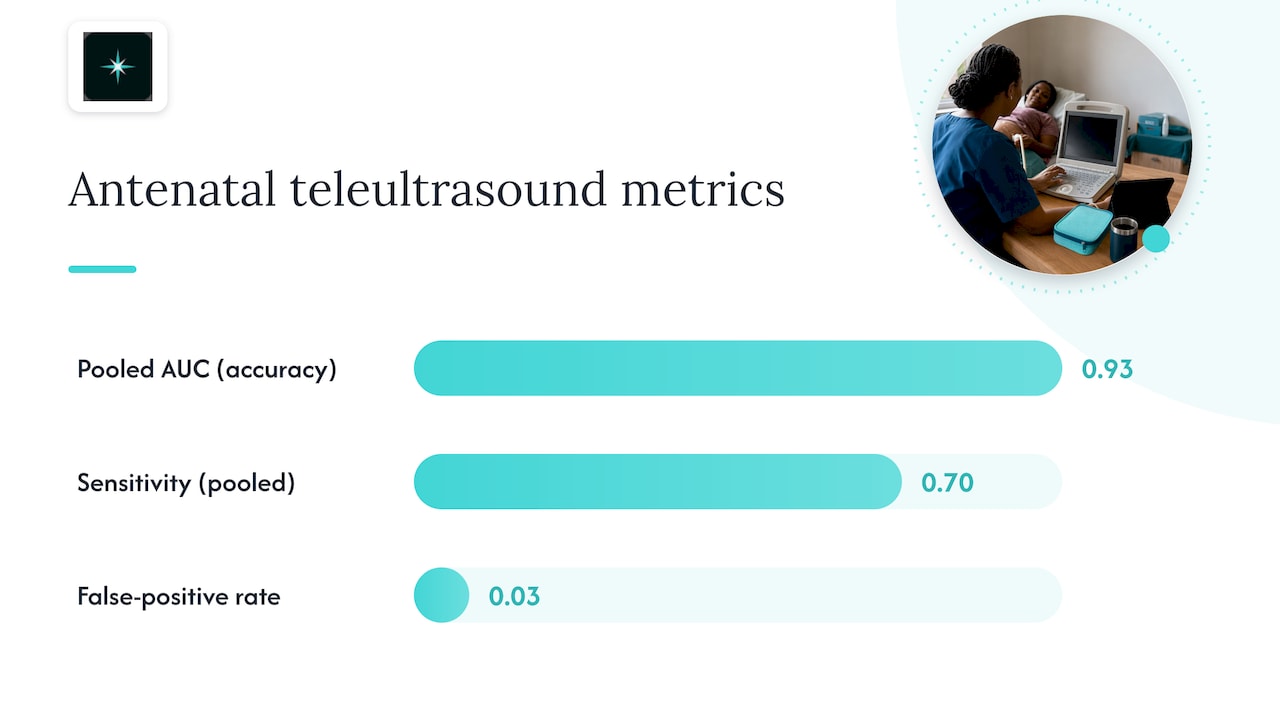
A pooled AUC of 0.93 with a 0.03 false-positive rate suggests antenatal teleultrasound rarely flags a normal structure as abnormal, but the accompanying sensitivity figure means a portion of true findings can still be missed, according to the same meta-analysis.
Performance varies sharply by anatomy:
- Gross fetal and placental structures showed consistently strong visualization across the reviewed studies.
- Cardiac and neurologic anatomy showed lower visualization rates, tied closely to bandwidth and frame rate limits.
- Telesonography feasibility in emergency and remote settings held up across 28 papers, but accuracy dropped when transmission components or bandwidth fell short.
- Neither 3D, 4D, nor robotic teleultrasound has shown a consistent edge over standard 2D scanning for routine antenatal work.
None of this evidence was generated under every possible network condition or exam type, so a program built on it still needs a local pilot with its own accuracy tracking before scaling.
Technical and integration checklist for administrators
Image fidelity depends on bandwidth and frame rate more than any other single variable, and specialized anatomy needs a wider margin than routine screening. Device choice shapes both cost and quality: handheld probes offer flexibility for rural or urgent care settings, cart-based systems give better resolution for complex studies, and telerobotic setups add remote-guidance capability at a materially higher price point.
- Confirm minimum bandwidth and frame rate specs with the vendor before committing to an exam type.
- Map DICOM and PACS compatibility against your current system rather than assuming universal support.
- Check for HL7 or FHIR support if results need to flow into other clinical systems.
- Decide whether reports return through your existing PACS or require a separate portal.
- Ask how the vendor secures transmitted images in transit and at rest.
AI tools are starting to help with image quality triage and automated measurements, but they remain assistive rather than diagnostic, and no current tool replaces the reading physician's judgment.
Pro Tip: Run a side-by-side bandwidth test at the actual acquisition site, not just the IT closet: rural clinics often have weaker signal at the exam room than at the router.
Device procurement decisions carry their own trade-offs worth comparing across manufacturers before locking in a platform, as outlined in this comparison of DEXA machine manufacturers covering similar considerations for imaging equipment selection.
How do licensure, QA, and SLAs govern the model?
A teleultrasound program only holds up under scrutiny when its governance layer is as solid as its technology. CMS guidance requires teleradiologists to enroll in the state where they perform services and to list their actual practice location, which means administrators need to verify licensure before assigning any remote reader to a case.
Quality assurance runs on a few connected pieces:
- RADPEER-style peer review programs catch discrepancies between initial and secondary reads.
- ACR clinical image testing guidance sets image quality, labeling, and documentation standards tied to accreditation.
- SLA terms should separate STAT turnaround from routine turnaround, since a mixed queue without tiered commitments tends to bury urgent studies.
- Liability and responsibility handoffs need to be spelled out in the contract, not assumed from the workflow diagram.
Training is not a one-time onboarding step. A 2024 scoping review on teleultrasound implementation found that successful programs built continuous feedback loops between remote readers and on-site sonographers, treating education as an ongoing function rather than a launch checklist item.
Rural and low-resource deployment models
Store-and-forward pilots cost less to launch and fit rural clinics that already have a sonographer on staff but no local radiologist. Synchronous or telerobotic models cost more up front and demand stronger connectivity, but they close the skill gap in sites where no trained sonographer is available at all.
- Store-and-forward: lower cost, works with existing staff, limited to indications with established remote accuracy.
- Synchronous telesonography: higher connectivity and staffing coordination needs, but supports real-time guidance where local skill is thin.
- Telerobotic: highest equipment cost, useful mainly where neither a sonographer nor a live-guiding physician can be on-site regularly.
Budget planning should account for connectivity upgrades first, since a network resurvey often reveals gaps that device specs alone will not show. Device procurement, sonographer training, and recurring per-study interpretation fees follow. A hub-and-spoke staffing pattern, pairing a local sonographer with a remote subspecialist covering multiple spoke sites, tends to spread fixed costs across more studies than a one-to-one contract. AstraRad's rural and critical access hospital coverage describes how that hub-and-spoke pattern runs in practice, and staffing models that lean on remote administrative and clinical support, as covered in this overview of virtual medical assistants, can extend the same coordination benefit to scheduling and intake.
What clinical leaders should do next
Start narrow. Pick one indication with strong evidence behind it, antenatal anatomic screening is the clearest example, and define measurable endpoints before expanding to anything else. Confirm your bandwidth, device, and QA plan against the checklist above before go-live, not after the first flagged discrepancy. When you talk to vendors, structure the conversation around integration depth, SLA guarantees split by acuity, and how much clinician training support comes bundled rather than billed separately.
Rafael Vieira
Why AstraRad fits ultrasound teleradiology programs
Certain teleradiology services deliver final signed ultrasound reports through board-certified subspecialists matched to modality and body part, with guaranteed turnaround commitments and direct PACS integration that avoids separate login portals.
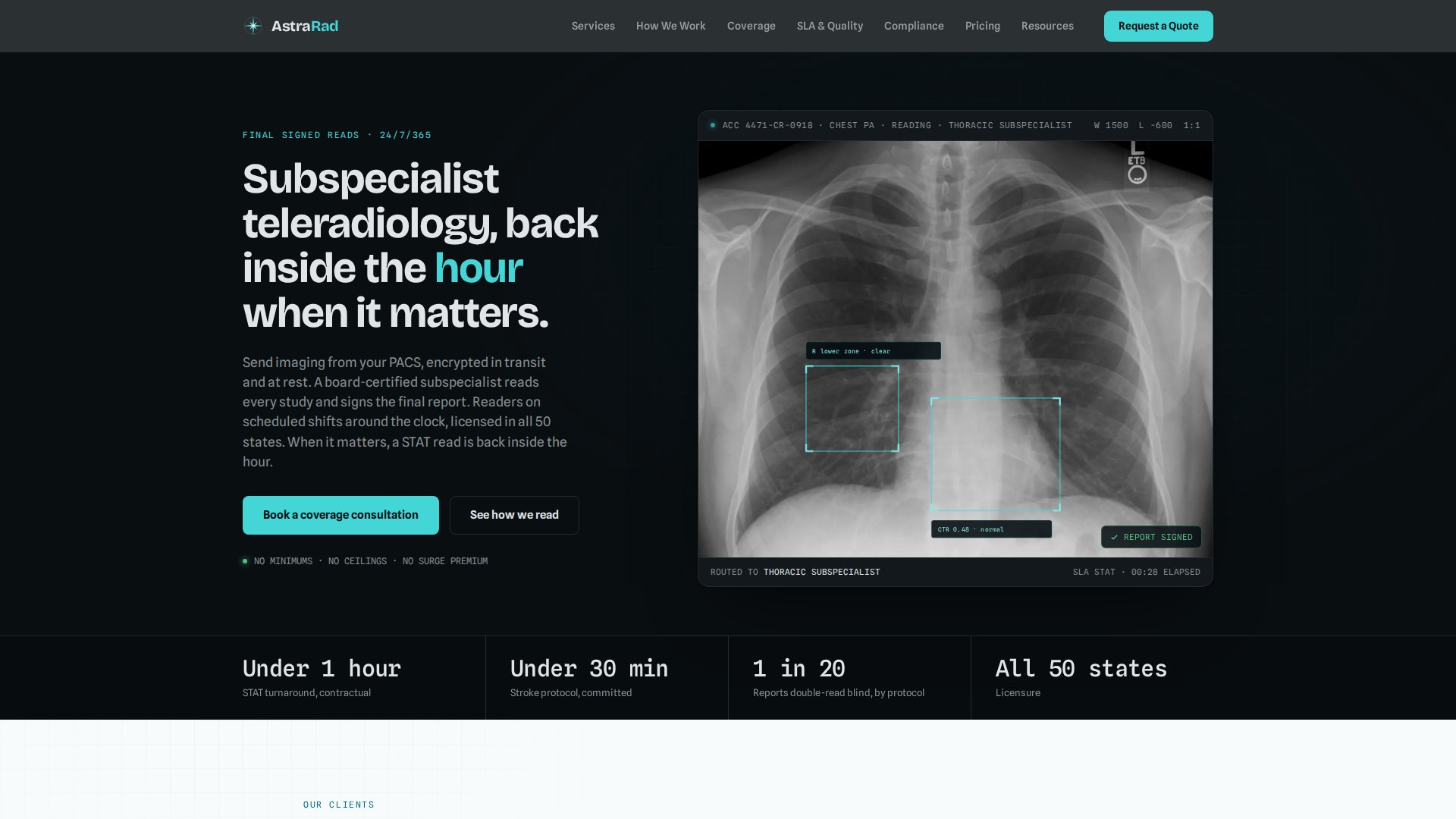
Those features map directly onto the selection criteria this guide has walked through: turnaround speed for STAT versus routine cases, subspecialty coverage for the anatomy your program actually scans, and integration that preserves your existing workflow instead of replacing it. If you are evaluating vendors for an ultrasound overflow or rural coverage program, AstraRad's ultrasound and X-ray overflow reporting page lays out coverage details and next steps for a pilot conversation.
Sources
For deeper validation, review the obstetric teleultrasound meta-analysis, CMS telehealth enrollment guidance, and ACR clinical image testing standards. Quality-assessment frameworks like QUADAS help administrators judge study reliability.
This article is general information, not a substitute for advice from a qualified doctor. Consult a qualified healthcare professional about your own circumstances before acting on anything here.
- Teleultrasound in obstetrics: A systematic review and meta-analysis
- Telesonography in emergency medicine: A systematic review
- Understanding telehealth enrollment (CMS)
- Clinical image testing: ultrasound (ACR accreditation support)
FAQ
What is the highest paid type of radiologist?
Compensation varies widely by subspecialty, practice setting, and region, and no single source in this review breaks down radiologist pay by subspecialty. Administrators researching compensation benchmarks should consult a current physician compensation survey rather than general industry commentary.
What is the difference between radiology and teleradiology?
Radiology is the medical specialty of interpreting imaging studies, while teleradiology is a delivery model where that interpretation happens remotely, with images transmitted through DICOM to a reading physician instead of a radiologist on site. The clinical standard for the read stays the same; only the location and transmission step change.
What is an ultrasound radiologist called?
There is no single formal title, ultrasound studies may be interpreted by a general radiologist, a subspecialist such as an OB/GYN sonologist, or another qualified physician depending on the exam type. The sonographer who performs the scan is a distinct role from the physician who interprets and signs the report.
How much do teleradiology services cost?
Teleradiology pricing typically runs on a per-report fee-for-service basis rather than a flat subscription, with rates varying by modality and turnaround tier. AstraRad publishes its per-report pricing by study type for administrators comparing costs across vendors.
Recommended
Related on AstraRad
- Resources
Pilot plan to validate after hours radiology coverage
Safety first guide for hospital admins: demand subspecialist final reads, SLAs, PACS integration, and a 3,6 week pilot to prove after-hours coverage.
- Resources
Best teleradiology companies 2026: an honest comparison
Only AstraRad and vRad publish turnaround numbers among the best teleradiology companies of 2026. Compared on pricing, subspecialties, QA and ownership.
- Resources
Radiology reading services: comparing the 3 models in 2026
Radiology reading services come in three forms: hospital-based, independent group, and teleradiology. How they differ on cost, speed, and quality.
Put a radiologist's name on your next read.
Tell us your modalities and monthly volume. A complete per-report rate card, with turnaround tiers and SLA terms in writing, lands in your inbox within one business day.