Pilot plan to validate after hours radiology coverage
Safety first guide for hospital admins: demand subspecialist final reads, SLAs, PACS integration, and a 3,6 week pilot to prove after-hours coverage.
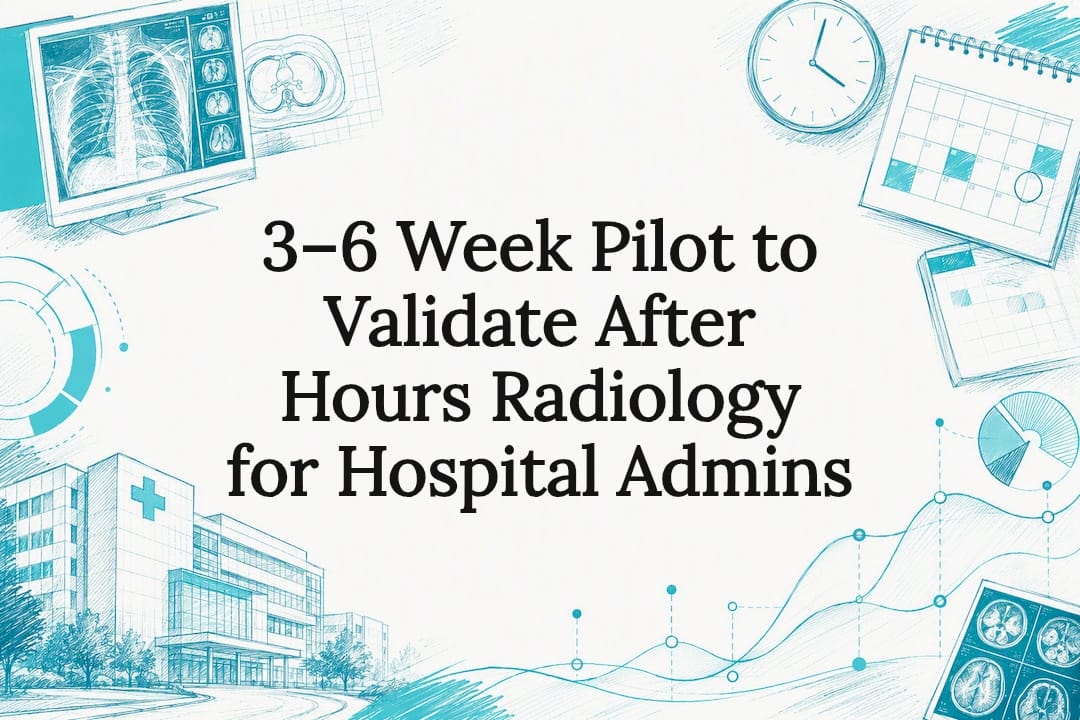
Reliable after-hours radiology coverage requires four things without exception: subspecialist-capable final reads for cases that need them, measurable turnaround-time targets tracked against a service-level agreement, direct integration with existing PACS and EMR systems, and a documented critical-results escalation path. Fatigue-aware scheduling isn't optional either. A program missing any of these isn't a coverage gap. It's a patient-safety gap wearing a staffing schedule's clothes.
TL;DR:
- Hospitals should ensure final subspecialist reads for critical cases, not just preliminary reports, to reduce clinical risk during overnight shifts.
- Staffing must keep shifts under 12 hours, start around 9 or 10 p.m., and rotate clockwise to minimize fatigue and maintain accuracy.
- Seamless IT integration with PACS, HL7/FHIR feeds, and single sign-on is essential to avoid workflow disruptions and prompt critical-results notification.
- Clear, measurable SLAs with defined turnaround times and peer review systems are vital for maintaining quality and accountability.
- Choosing an after-hours partner involves verifying subspecialty coverage, SLA transparency, security compliance, and conducting a pilot before long-term commitments.
Table of Contents
- What after-hours radiology coverage includes: models, modalities, and read types
- Why does subspecialty access matter after hours?
- Staffing and scheduling practices that actually reduce fatigue risk
- Workflow and IT integration: PACS, reporting, and security
- Quality, peer review, and the SLAs worth putting in a contract
- How should hospitals choose and contract an after-hours partner?
- Implementing after-hours coverage: a pilot plan you can run in weeks
- Publisher perspective: why this matters and where AstraRad fits
- Getting after-hours coverage right without the long-term risk
- Sources
- FAQ
What after-hours radiology coverage includes: models, modalities, and read types
Hospitals typically choose among four coverage models, each with real trade-offs. In-house night staffing gives you the most control but costs the most and strains recruiting. Dedicated night-shift radiologists solve the fatigue problem for one team but don't scale for smaller facilities. Teleradiology, sometimes called "nighthawk" service, brings subspecialty depth to hospitals that can't staff it themselves. Hybrid models blend an on-call in-house radiologist with a teleradiology partner for overflow and subspecialty gaps, a structure many mid-size hospitals settle on after outgrowing pure in-house coverage.
Overnight volume skews toward a predictable set of studies:
- ED and trauma CT, the highest-volume overnight category in most hospitals
- Portable and ED X-ray
- Point-of-care and ED ultrasound
- MRI and PET-CT when a subspecialist read is clinically warranted
The distinction between a final signed report and a preliminary read matters more than most schedules acknowledge. Preliminary reads let high-volume ED programs move fast, but a final read from a subspecialist is what actually closes clinical risk. Comprehensive modality coverage across CT, MRI, X-ray, and ultrasound is now standard among established providers, but coverage without final subspecialist sign-off is only half the job.
Why does subspecialty access matter after hours?
Generalist overnight reads carry real clinical risk in specific categories: acute stroke and neuroradiology, complex abdominal CT in unstable patients, subtle musculoskeletal fractures, post-op complications, and PET-CT oncology follow-up. These aren't edge cases. They're the exact studies most likely to arrive at 2 a.m.
The fatigue signal is measurable. A pilot study of radiology residents found statistically significant declines in 2 of 6 cognitive tests after night-float shifts, alongside night shifts averaging nearly 12 hours and 78.1 studies per shift, compared with lower volume and more sleep on day shifts.
That combination, more volume, less sleep, measurably reduced complex reasoning, is precisely the environment in which a missed subspecialty finding turns into a callback, a delayed admission, or a discharge that shouldn't have happened. Teleradiology partners built around subspecialty routing exist specifically to extend that expertise overnight rather than leaving a generalist to carry the whole overnight caseload alone. The operational fallout of getting this wrong shows up downstream: slower ED throughput, second-guessed admission decisions, and clinicians who stop trusting the overnight read altogether.
Staffing and scheduling practices that actually reduce fatigue risk
Schedule design is not a soft HR concern here. It's a diagnostic-accuracy lever, and the evidence on it is specific enough to build a policy around.
- Keep shifts under 12 hours. Anything longer measurably erodes attention and speed.
- Start night shifts around 9 to 10 p.m. rather than midnight. Earlier starts reduce accumulated sleepiness before the shift's hardest hours.
- Cap consecutive night shifts at a moderate number to prevent compounded sleep debt.
- Use double staffing or scheduled breaks on historically high-volume nights rather than assuming a single radiologist can absorb all surges.
- Rotate shifts clockwise (day to evening to night) in multi-week schedules to better align with circadian rhythms.
Real-time volume dashboards matter as much as the schedule itself. Programs that monitor per-shift study counts as they happen can reroute overflow to a secondary reader before quality erodes, instead of discovering the problem in next week's discrepancy report.
Pro Tip: Build your night schedule around your hospital's own volume curve, not a generic template. A facility with a 1 a.m. trauma surge needs different staffing than one whose volume peaks at 9 p.m., and the AJR shift-length and start-time guidance works best layered on top of your actual admission patterns, not applied blind.
Workflow and IT integration: PACS, reporting, and security
A coverage model that requires your ED staff to log into a separate portal at 3 a.m. is a coverage model that will get skipped under pressure. Integration has to be invisible to the ordering clinician.
- Direct PACS access so studies route and reports return without a separate login
- HL7 or FHIR metadata feeds so orders, patient data, and reports sync automatically
- Single sign-on for any radiologist or reviewing physician touching the system overnight
- EMR report routing that lands the signed report where clinicians already look
Critical-results workflows need the same rigor as the read itself: a defined notification chain (who gets called, in what order, within what window), timestamped documentation of every step, and an audit trail that survives a quality review. The Joint Commission's guidance on critical-results communication is the baseline most hospitals get measured against, and it assumes documentation exists for every handoff, not just the ones that go smoothly. Security requirements should not be an afterthought bolted onto a signed contract; HIPAA compliance, HITRUST attestation, role-based access, and encryption in transit and at rest belong in the vendor's documentation before you sign anything, not after an audit flags a gap.
Quality, peer review, and the SLAs worth putting in a contract
Vague promises of "fast turnaround" are not a metric. Ask for numbers, and ask how they're tracked.
- A STAT median turnaround target, commonly under 60 minutes for the most urgent cases
- A published SLA compliance percentage, reported on a fixed cadence rather than only when asked
- Clear written definitions distinguishing STAT, urgent, and routine studies, since a vendor's "urgent" and your ED's "urgent" may not match
- A RADPEER-style peer review process with routine discrepancy scoring, not just a policy document that mentions one
- A remedial process for radiologists who trend as outliers on discrepancy rates
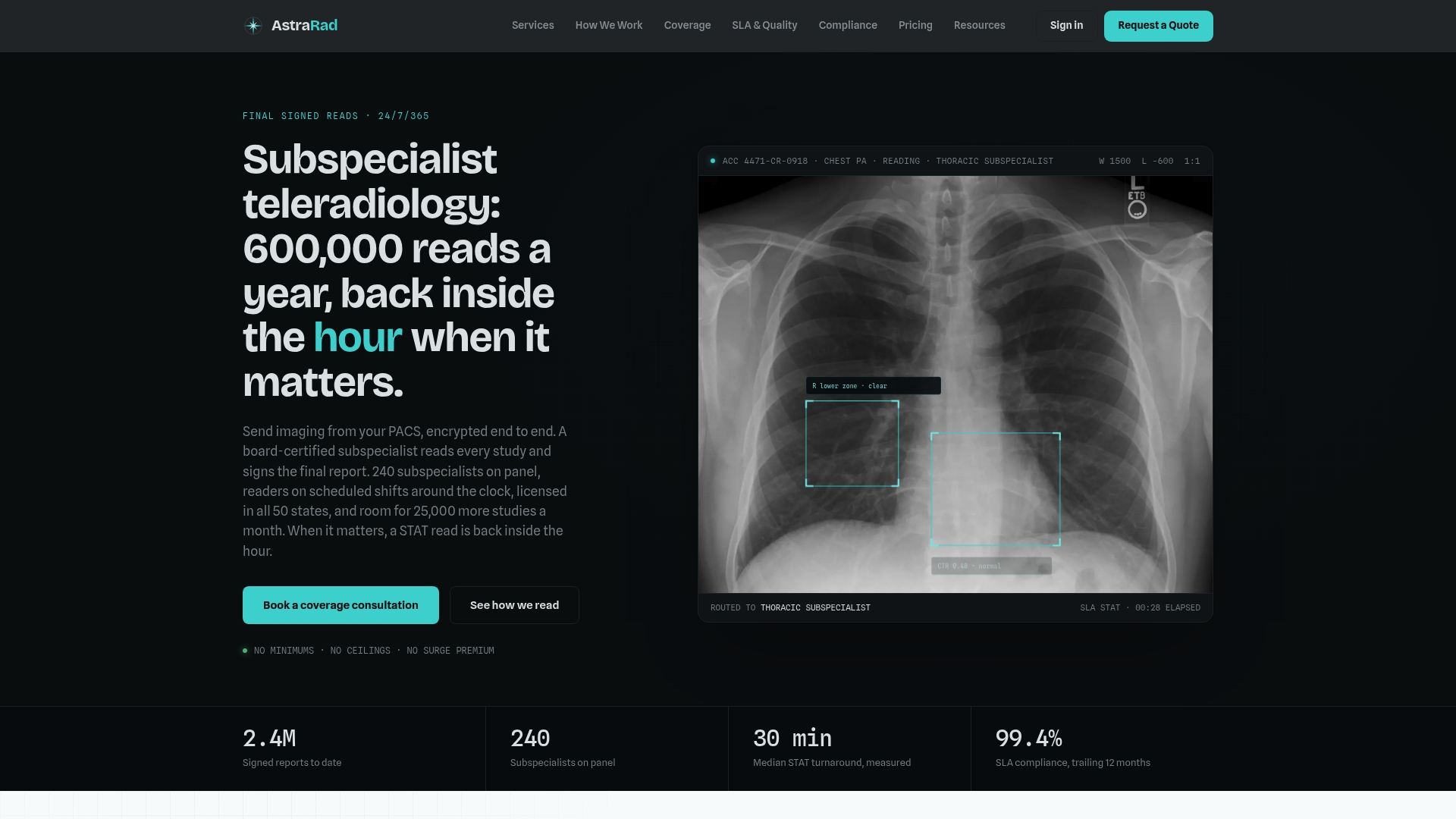
One useful benchmark: AstraRad reports a 30-minute median STAT turnaround alongside 99.4% SLA compliance over the past year, the kind of specific, trackable figure that belongs in any vendor conversation instead of a general assurance of speed.
How should hospitals choose and contract an after-hours partner?
Selection should run through a checklist, not a gut feeling built from a single sales call.
- Confirm subspecialty coverage matches your actual case mix, not a generic "we cover everything" claim.
- Get SLA numbers in writing, with a defined reporting cadence attached.
- Ask how integration works: does it require a new portal, or does it sit inside your existing PACS?
- Request security attestations (HIPAA, HITRUST) and read them, don't just file them.
- Ask what the peer-review program actually measures and how often results get reviewed with your team.
- Ask about typical study volume per radiologist per shift and what happens when volume spikes past that.
- Ask how backup coverage works if a radiologist is unavailable mid-shift.
- Negotiate a pilot period with explicit acceptance criteria before committing to a multi-year term.
A short reference call with an existing client, focused specifically on how missed SLAs get handled, tells you more than any pitch deck. The ACR's teleradiology resources outline the legal and practice standards worth checking your shortlist against before you get to the negotiating table.
Implementing after-hours coverage: a pilot plan you can run in weeks
- Run a needs assessment: pull your actual overnight volume, modality mix, and current SLA misses from the last quarter.
- Define target SLAs and KPIs in writing before talking to any vendor, so you're evaluating against your own bar, not theirs.
- Select a model, whether in-house, hybrid, or a teleradiology partner, based on that assessment.
- Complete technical integration: PACS connection, HL7/FHIR feeds, and critical-results routing tested before go-live.
- Run a 3 to 6 week pilot with a defined case volume and explicit success thresholds.
- Evaluate SLA adherence, clinician satisfaction, and confirm zero missed critical-result notifications during the window.
- Scale to full coverage only after the pilot clears every threshold, not just most of them.
Pro Tip: Assign one named escalation contact for the entire pilot window. Ambiguity about who owns a missed SLA during a trial is the single fastest way to lose stakeholder confidence before the data even comes in.
Publisher perspective: why this matters and where AstraRad fits
Some providers offer final signed reports from board-certified subspecialists across imaging modalities, backed by guaranteed turnaround times and direct PACS integration with no separate portal to manage. That combination, subspecialty depth, a measurable SLA, and integration that doesn't add friction to an ED workflow, maps directly onto the checklist items covered above. None of this claims to solve every staffing challenge a hospital faces. It addresses the specific gap this article has focused on: getting a qualified, timely, auditable read when your in-house team can't cover the hours.
Rafael Vieira
Getting after-hours coverage right without the long-term risk
Some teleradiology models are built for hospitals that need subspecialist final reads without carrying the staffing burden of covering nights and weekends in-house. Studies may be read by board-certified subspecialists matched to each modality, with guaranteed turnaround times, and integration may run directly through existing PACS setups, eliminating the need for new logins for ED staff at night.
If your hospital is evaluating vendors, a structured pilot with defined acceptance criteria is the fastest way to confirm fit before committing long term. Hospitals in Colorado can review licensed CO coverage details directly, and any administrator building a budget should start with per-report pricing by study type to see how the numbers compare against current staffing costs.
This article is general information, not a substitute for advice from a qualified doctor. Consult a qualified healthcare professional about your own circumstances before acting on anything here.
Sources
- After-hours radiology: challenges and strategies for the radiologist (AJR)
- Effects of night-float shifts on cognitive function among radiology residents
- ACR teleradiology resources
- Joint Commission guidance and resources
FAQ
What is the 28-day rule in radiography?
The "28-day rule" isn't a standard radiology turnaround benchmark. It typically refers to specific regulatory or billing timeframes that vary by jurisdiction and payer, so check the exact rule with your compliance team rather than assuming it applies to after-hours reporting.
Will urgent care give you a CT scan?
Most urgent care centers don't have CT equipment on-site, but many operate X-ray and refer CT cases to affiliated imaging centers or EDs, often supported by teleradiology partners for urgent care X-ray and CT reads.
Do radiologists read MRIs on weekends?
Yes. Hospitals with weekend MRI volume typically cover it through in-house on-call radiologists, teleradiology partners, or a hybrid arrangement, since weekend and holiday coverage requires the same subspecialty and SLA standards as weeknight coverage.
Will the ER do imaging overnight?
Yes, EDs run CT, X-ray, and ultrasound around the clock, and overnight volume is typically the highest single driver of after-hours radiology demand in most hospitals.
How fast should a STAT read come back overnight?
A reasonable target is a median turnaround under 60 minutes for STAT cases, tracked against a published SLA compliance rate rather than an informal promise.
Recommended
Related on AstraRad
- Resources
4 acuity tiers and ready critical findings list
Ready-to-implement critical findings checklists, four acuity tiers, and escalation templates aligned with ACR guidance, plus a teleradiology SLA model
- Resources
Teleradiology no monthly minimum: terms, trade-offs, gotchas
Why teleradiology contracts carry monthly minimums, which vendors drop them, what no-minimum terms trade away, and the disguised minimums to catch.
- Resources
Teleradiology to reclaim time for radiology peer learning
Operations first guide for radiology leaders: use ACR and AJR evidence to set up peer learning, measure impact, and reclaim conference time with...
Put a radiologist's name on your next read.
Tell us your modalities and monthly volume. A complete per-report rate card, with turnaround tiers and SLA terms in writing, lands in your inbox within one business day.