4 acuity tiers and ready critical findings list
Ready-to-implement critical findings checklists, four acuity tiers, and escalation templates aligned with ACR guidance, plus a teleradiology SLA model
A critical finding is any imaging result that could cause serious harm or change immediate management if it goes uncommunicated, from a tension pneumothorax to a ruptured aneurysm. It demands rapid, verbal, documented communication to a responsible clinician, not a routine report signature. Most departments target rapid contact, but the exact timeframe matters less than having a written policy, an escalation tree, and a documented timestamp for every case.
TL;DR:
- Critical findings that could cause harm or death require immediate verbal notification within one hour, while urgent findings need communication within six hours.
- The escalation process must include direct calls to responsible clinicians, documented attempts, and fallback procedures if the primary contact is unreachable.
- Documentation should specify who was contacted, how, and when, with standardized phrasing in reports to ensure clarity and accountability.
- Departmental policies must adapt the critical results checklist, prioritizing findings like tension pneumothorax, intracranial hemorrhage, ruptured aneurysm, and malpositioned life-support lines.
- Regular audits and leadership sign-off are essential to maintain compliance, and teleradiology services can support consistent turnaround times for STAT and urgent reads.
Table of Contents
- What are the acuity tiers and communication timelines?
- Critical findings checklist by body system
- How should you document and escalate a critical finding?
- How do you write an impression that gets acted on?
- Closing the loop on incidental findings
- What does it take to implement and audit this?
- How a teleradiology partner supports this workflow
- Balancing sensitivity and specificity in your critical findings list
- Where AstraRad fits if you're building this out
- Sources
- FAQ
What are the acuity tiers and communication timelines?
Radiology departments generally sort findings into four tiers, each with its own clock and its own bar for what counts as "done." Yale's critical result guidelines frame the tiers around communication urgency rather than diagnostic severity alone, which is the distinction most new policies get wrong.
- Critical: Requires immediate verbal notification, generally within one hour, for findings that could cause death or serious harm if missed (tension pneumothorax, aortic dissection, large intracranial bleed).
- Urgent: Warrants communication within about six hours, for findings that need prompt but not instantaneous action (moderate pulmonary embolism, new fracture with neurovascular concern).
- Important/nonroutine: Should reach the treating clinician within a day or two, often through the standard report and EHR flag, not a phone call.
- Routine: Follows normal reporting turnaround with no special notification required.
"Already communicated" status only counts when the radiologist logs who was reached, how (phone, secure text, in-person), and when. A voicemail or an unanswered page does not satisfy the requirement.
Critical findings checklist by body system
No list captures every scenario, and local context, patient history, and clinical correlation always outrank a generic table. Still, having a standing reference cuts hesitation at 2 a.m., and it's the backbone of most institutional policies, including the taxonomy described in a peer-reviewed framework for extracting critical findings from radiology reports.
Neuro
- Large intracranial hemorrhage or new midline shift
- Acute ischemic stroke with large vessel occlusion
- Brain herniation
- Unstable spine fracture with cord compromise
Chest
- Tension pneumothorax
- Aortic dissection or rupture
- Massive pulmonary embolism
- Free air suggesting perforation
- Malpositioned endotracheal tube
Abdomen and pelvis
- Ruptured or rapidly expanding abdominal aortic aneurysm
- Bowel ischemia or perforation with free air
- Ectopic pregnancy
- Testicular or ovarian torsion
Vascular
- Acute arterial occlusion threatening a limb
- Active hemorrhage or pseudoaneurysm
- Significant vessel dissection outside the chest
Musculoskeletal
- Fracture with vascular compromise
- Septic joint findings
- Compartment syndrome signs on imaging
OB and pediatrics
- Placental abruption
- Intussusception
- Nonaccidental trauma patterns
Nuclear medicine
- V/Q findings indicating high probability pulmonary embolism
- Unexpected metastatic disease on a staging study
Devices and lines
- Malpositioned central line, chest tube, or feeding tube threatening life support
- Pneumothorax following line placement
The highest-priority items on this entire list, the ones that justify interrupting a busy clinician immediately, are tension pneumothorax, large intracranial hemorrhage, ruptured AAA, aortic dissection, torsion, and any malpositioned line supporting ventilation or feeding. Every department should adapt this checklist, get it signed off by radiology and clinical leadership together, and revisit it during audits rather than treating it as fixed once approved.
How should you document and escalate a critical finding?
The ACR practice parameter for communication of diagnostic imaging findings sets the baseline standard, but the operational sequence needs local specificity. A workable escalation tree looks like this:
- Call the ordering or covering clinician directly. This is the primary contact, not a delegate, whenever reasonably reachable.
- If unreachable, wait a fixed interval, commonly 15 minutes, then escalate to the next clinician in the chain: covering physician, ED attending, or a designated charge nurse.
- Document every attempt, including time, method, and who you reached, directly in the report or a critical results log.
- If the finding changes after further review, issue an addendum immediately rather than relying on a verbal correction alone.
Contact sequence and acceptable delegates should be spelled out in policy, following the model in UAB's policy for communication of critical findings, which names specific fallback roles rather than leaving escalation to individual judgment.
Pro Tip: Build a standard phrase into your dictation template, something like "Findings discussed with Dr. [name] at [time] via [method]," so documentation happens automatically instead of as an afterthought after a busy shift.
How do you write an impression that gets acted on?
Put the urgent finding first, always. A clinician skimming a report under pressure often reads only the first line of the impression, so burying a torsion or a large bleed under three benign observations defeats the point of flagging it at all.
- Lead the impression with the most urgent finding, stated plainly.
- Avoid repeating the full descriptive findings verbatim in the impression; summarize instead.
- Note pertinent negatives sparingly, only when they change management.
- Record who you told, how, and when, directly in the report.
- If the interpretation changes later, correct it with a dated addendum, not a phone call alone.
This mirrors guidance from an AJR primer on radiology report language, which found concise, prioritized impressions are more likely to be read in full.
Pro Tip: If a finding persists across two or three prior exams without any documented action, treat that as its own red flag. Silence from the clinical team usually means they never saw it, not that it stopped mattering.
Closing the loop on incidental findings
Not every actionable finding is a critical one. A 4 mm pulmonary nodule or an adrenal incidentaloma rarely needs a phone call, but it still needs to reach someone who will schedule follow-up. That's the gap where patients fall through.
- Distinguish incidental actionable findings from true critical results in the report language itself.
- Use EHR-triggered alerts or worklists to flag studies needing follow-up rather than relying on memory.
- Assign a case manager or navigator role to track open loops past the initial report.
- Track acknowledgement rate and follow-up completion rate as standing quality metrics.
Vanderbilt's electronic trigger and alert process is the clearest evidence this works at scale: in the first 13 months, 888 of 932 targeted ED episodes, 95 percent, had documented communication and a follow-up plan. That's not a marginal improvement over manual tracking. It's the difference between hoping someone remembers and knowing the system caught it.
What does it take to implement and audit this?
A critical-results list only works if leadership signs off on it and someone actually checks compliance. Start with a policy draft reviewed by radiology, emergency medicine, and hospital risk management together, not radiology alone.
- Secure formal sign-off from department chairs and patient safety committees before rollout.
- Audit monthly using a sample of flagged cases, similar to RADPEER-style peer review, checking documentation completeness against your SLA targets.
- Build technical hooks into the workflow: chart pop-ups, standardized report headers, or a radiology coordination center handling notification calls centrally.
- Report compliance rates to leadership on a recurring cadence, quarterly at minimum, so drift gets caught early.
How a teleradiology partner supports this workflow
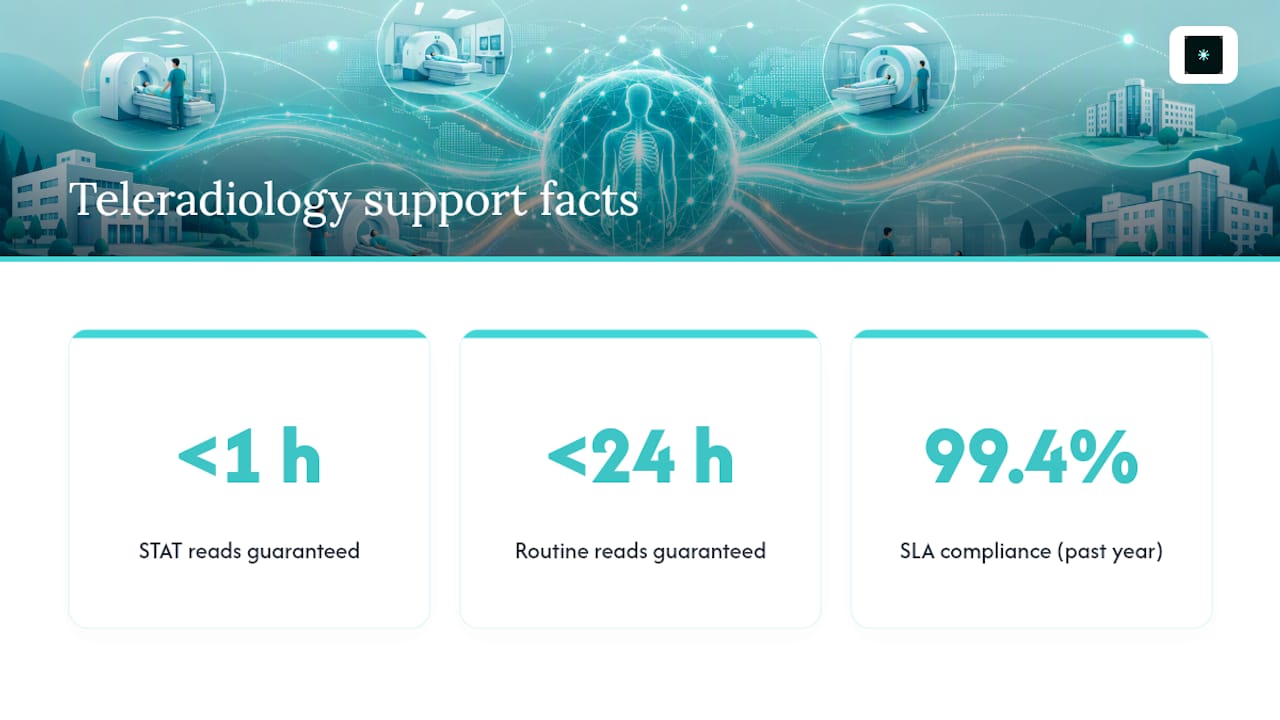
AstraRad exists precisely because consistent critical-results communication depends on consistent staffing and consistent turnaround, not heroics from an overnight solo reader. Every study AstraRad interprets goes to a board-certified subspecialist in that modality, with STAT reads guaranteed under one hour and routine studies under 24 hours, backed by a 99.4% SLA compliance rate over the past year. Because some teleradiology services integrate directly with existing PACS systems, critical findings can flow into the same escalation workflow your department already uses, without a separate portal to check. Departments still need to confirm state licensing and local workflow fit before onboarding, but the operational pattern of subspecialist reads plus guaranteed timelines maps directly onto the acuity tiers and documentation standards described above.
Balancing sensitivity and specificity in your critical findings list
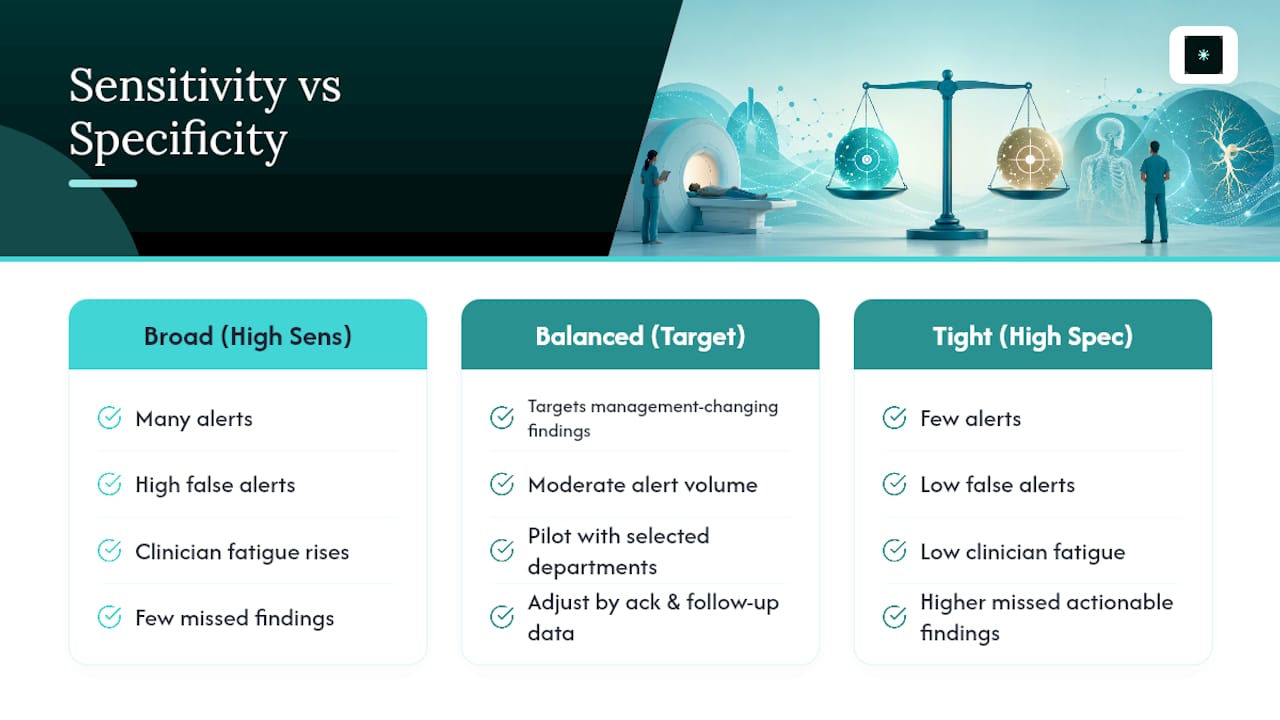
The temptation is to make the list exhaustive, flagging everything remotely concerning. That backfires. Broad lists generate alert fatigue, and clinicians start tuning out calls, which defeats the entire purpose of a critical-results program.
The better approach narrows the list to findings that genuinely change immediate management, pilots it with a subset of ordering departments, and adjusts based on acknowledgement and follow-up data rather than committee intuition. A list built once and never revisited is already outdated by the time your case mix shifts.
Rafael Vieira
Where AstraRad fits if you're building this out
If your department is drafting or revising a critical-results policy, the bottleneck is often coverage: who reads the STAT chest CT at 3 a.m., and how fast can they call it in? A teleradiology partner can provide subspecialist reads with guaranteed turnaround, including under one hour for STAT cases, so the escalation tree you build on paper actually has someone reliable at the other end of it around the clock.
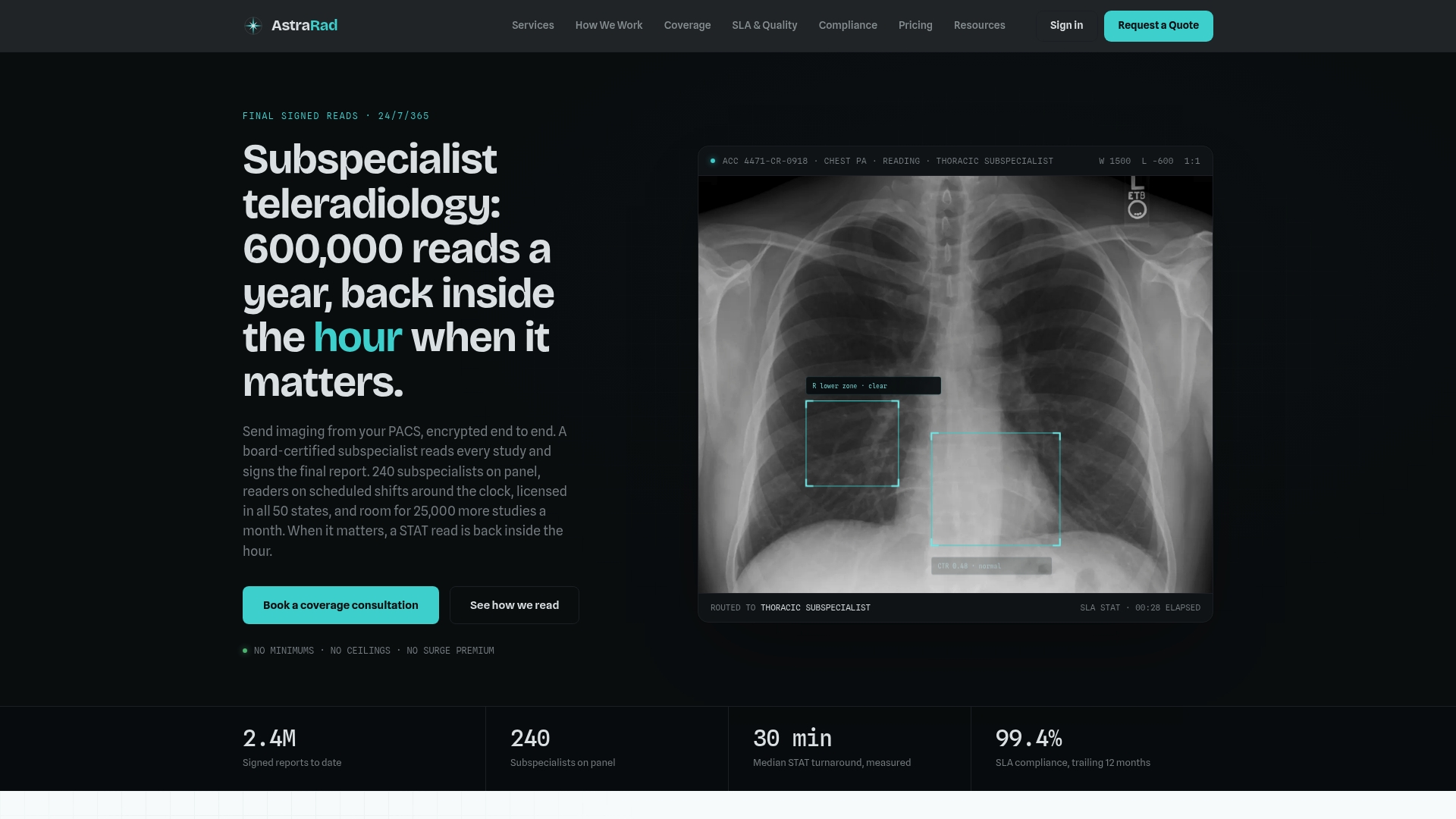
That reliability shows up in the numbers: a 30-minute median STAT turnaround with 99.4% SLA compliance means your escalation policy isn't waiting on staffing gaps to fail. Because reports arrive through your existing PACS, there's no new portal for on-call clinicians to learn during a crisis. If overnight or weekend coverage is the weak link in your critical-results workflow, see how AstraRad's STAT reads work and check turnaround guarantees for your specific case volume.
Sources
Use the ACR practice parameter and SUNY Downstate's policy as templates; use Vanderbilt's outcome data as evidence for EHR-trigger investment.
This article is general information, not a substitute for advice from a qualified doctor. Consult a qualified healthcare professional about your own circumstances before acting on anything here.
- ACR practice parameter for communication of diagnostic imaging findings
- Critical Result Guidelines | Radiology & Biomedical Imaging (Yale)
- Radiology critical values policy (SUNY Downstate)
- Critical radiology alert process (AHRQ / Vanderbilt)
- Framework for extracting critical findings in radiology reports (PMC)
FAQ
What are considered critical results in radiology?
Critical results are imaging findings that could cause death or serious harm without immediate action, such as tension pneumothorax, large intracranial hemorrhage, ruptured aneurysm, or organ torsion, and they require rapid verbal communication and documentation.
What are some examples of abnormal findings on imaging?
Abnormal findings range from incidental, non-urgent items like small benign cysts or nodules to critical findings requiring immediate action, such as bowel perforation, massive pulmonary embolism, or a malpositioned life-support line.
Can a radiologist tell if a mass is cancerous?
Imaging can strongly suggest malignancy based on size, shape, and growth pattern, but a definitive cancer diagnosis typically requires tissue sampling; radiologists flag suspicious masses for biopsy or further workup rather than issuing a final diagnosis from images alone.
Recommended
Related on AstraRad
- Resources
Teleradiology no monthly minimum: terms, trade-offs, gotchas
Why teleradiology contracts carry monthly minimums, which vendors drop them, what no-minimum terms trade away, and the disguised minimums to catch.
- Resources
Teleradiology to reclaim time for radiology peer learning
Operations first guide for radiology leaders: use ACR and AJR evidence to set up peer learning, measure impact, and reclaim conference time with...
- Resources
Structured radiology reporting for leaders
For radiology leaders: an evidence based, clinician first playbook showing when templates suffice, when to adopt DICOM SR/FHIR, and how to run governance
Put a radiologist's name on your next read.
Tell us your modalities and monthly volume. A complete per-report rate card, with turnaround tiers and SLA terms in writing, lands in your inbox within one business day.