ED imaging turnaround: what to put in your contract
ED imaging turnaround is measured from exam completion to final signature; here is how to define, benchmark and contract it with a teleradiology partner.

ED imaging turnaround is the time between the last image of an emergency department exam arriving and the radiologist signing the final report. To control it, measure that interval by exam type, define STAT narrowly, and write the target and the measurement method into your teleradiology contract. A number without a defined start and stop point cannot be enforced.
- Definition: The American College of Radiology (ACR) registry tracks turnaround from exam completion to final radiologist signature, and reports the 25th, 50th, 75th and 90th percentiles.
- Benchmarking: ACR's GRID tools flag outlier exams so you can see the slow tail, not just the average.
- Evidence: One academic center's after-hours neuroimaging turnaround fell from 530 minutes to 38 minutes after it moved to a 24/7 coverage model, according to an RSNA quality improvement report.
- Contract terms: AstraRad commits to STAT under 4 hours, routine in 24 to 48 hours and stroke protocol under 30 minutes, measured from last-image arrival to signature.
TL;DR
- Define turnaround as last-image arrival to final signed report, and use percentiles, not averages.
- Keep the STAT label for true emergencies. Over-labeling slows everyone.
- Look beyond reading speed: image transfer, report routing and preliminary-to-final handoffs often cause the wait.
- Ask for tiered turnaround commitments, final signed reports overnight, and SLA terms in writing before you sign.
Table of Contents
- Who is writing this, and why it matters to you
- What is ED imaging turnaround, and how is it measured?
- Which timestamps should your SLA use?
- Why is the average turnaround number misleading?
- What turnaround should an ED expect for STAT, routine and stroke studies?
- What actually causes ED imaging delays?
- Does 24/7 subspecialist coverage change turnaround?
- How does STAT over-labeling hurt turnaround?
- How does PACS integration affect turnaround?
- Why does communication between radiologists and ED staff matter?
- What should turnaround penalties look like in a teleradiology contract?
- What does AstraRad offer for ED imaging turnaround?
- How do you choose a teleradiology partner for ED volume?
- How do you start improving ED imaging turnaround this quarter?
- FAQ
- Sources
Who is writing this, and why it matters to you
AstraRad is a US teleradiology service that delivers final signed reports read by board-certified subspecialists. We sell per-report teleradiology to hospitals, imaging centers and radiology groups, so we have a commercial interest in this topic. We have tried to write the page we would want a procurement team to read before any vendor call, ours included. Where we describe our own terms, we state them as contract commitments. Where we describe the wider field, we link the source.
Our teleradiology services cover CT, MRI, X-ray, ultrasound and PET-CT. Every read is performed inside the United States, on scheduled US shifts 24/7/365.
What is ED imaging turnaround, and how is it measured?
ED imaging turnaround is the elapsed time from a defined start event to a defined end event for an emergency department imaging study. The start and end points vary by facility, which is why comparisons fail. The ACR registry uses exam completion to final signature as its basis for benchmarking across ED, inpatient and ambulatory settings.
A few related terms are worth fixing in your own policy:
- Turnaround time (TAT) is the interval between two timestamps in the imaging workflow. It is a measurement, not a promise.
- A final signed report is the radiologist's completed interpretation, authenticated with a signature, that becomes part of the legal medical record.
- A preliminary report is an initial read that may be revised before the final report is signed. It is a different deliverable with a different risk.
- A STAT study is an exam the ordering clinician flags as needing immediate interpretation because a delay could change patient care.
An RSNA-hosted quality project on STAT body imaging shows how many different intervals can hide inside one number. Order-to-exam, exam-to-read and read-to-final each carry their own delay. When you write a contract, name the two timestamps exactly.
Which timestamps should your SLA use?
An SLA, or service level agreement, is a written contract term that sets a measurable performance target and the remedy when it is missed. For teleradiology, the cleanest SLA clock starts when the last image of the study arrives at the reading service and stops at the radiologist's signature on the final report.
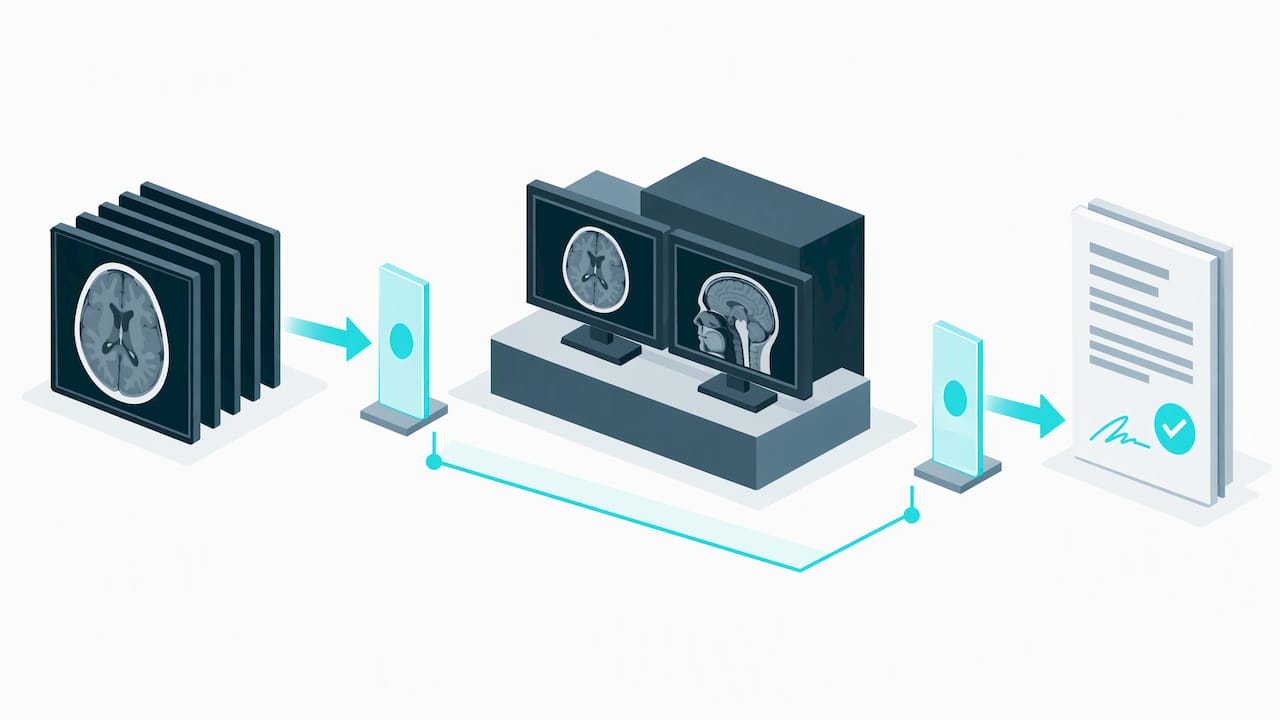
That definition protects both sides. The vendor is not penalized for a modality that was slow to push images, and you are not billed for a read that sits unsigned.
Here is how the common clock choices compare:
| Clock definition | Starts at | Stops at | Who controls the delay | Risk for the buyer |
|---|---|---|---|---|
| Order to report | Order entered | Report available | ED, technologists, transport, radiologist | Hard to assign cause, hard to enforce |
| Exam complete to final signature | Technologist completes exam | Final signature | Imaging center plus reader | Includes your own image-transfer delays |
| Last-image arrival to final signature | Last image received by reader | Final signature | Reading service | Clear accountability for the read |
| Last-image arrival to preliminary | Last image received | Preliminary posted | Reading service | Final may arrive much later |
If you use exam-complete-to-final internally and last-image-arrival externally, track the gap between them. That gap is your own transfer time, and it is often larger than expected. ACR documentation on exam search and turnaround describes using exam-level data to find outliers and check data accuracy.
Why is the average turnaround number misleading?
An average hides the slow exams, and the slow exams are the ones an ED clinician remembers. Percentiles are a better basis for contracts because they show how the tail behaves. The ACR GRID registry calculates the 25th, 50th, 75th and 90th percentiles so facilities can monitor performance and identify outliers.
Consider two hypothetical services, each averaging the same time. One signs nearly everything close to that average. The other signs most studies quickly and leaves a handful for hours. The averages match, but the second service erodes clinician trust. These are illustrative, not measured figures.
Quality improvement literature supports the concern. The RSNA-hosted material notes that when turnaround is highly variable, ED clinicians lose trust in the system and tend to over-use STAT orders, which degrades efficiency further. A related RadioGraphics study from 2013 used quality improvement techniques specifically to decrease the variability in ED radiograph turnaround.
When you review a vendor, ask for:
- The percentile you will be measured on (for example, the share of STAT reads inside the committed window).
- How outliers are reported to you, and how often.
- Whether the measurement is exam-level, so you can audit it against your own PACS timestamps.
What turnaround should an ED expect for STAT, routine and stroke studies?
There is no single national standard that every ED must meet. Targets vary by study type, acuity and staffing model, and each facility sets its own policy. What you can do is tier the targets so each study type has a defined clock.
A workable tier structure has three levels:
| Tier | Typical ED use | What to define in the contract |
|---|---|---|
| STAT | Trauma, suspected bleed, acute abdomen, suspected PE | Clock start and stop, final vs. preliminary, escalation path |
| Routine | Stable patients, follow-up, non-emergent imaging | Window in hours, weekend and holiday treatment |
| Stroke protocol | Suspected acute stroke, time-critical neuroimaging | Tightest clock, direct communication of critical findings |
AstraRad is a US teleradiology service that delivers final signed reports read by board-certified subspecialists. Our committed turnaround, measured from last-image arrival to radiologist signature, is:
- STAT: under 4 hours, with under 2 hours or under 1 hour available on request
- Routine: 24 to 48 hours
- Stroke protocol: under 30 minutes
These are contract commitments, written into the coverage plan that follows a discovery call. They are final signed reports at every tier, including overnight, not preliminary reads awaiting a later final. You can read more on how this works in practice on our STAT radiology reads page.
What actually causes ED imaging delays?
Reading speed is only one part. Process mapping often shows delays in image transmission, in the interval from order entry to image completion, or in the handoff from preliminary to final report. The ACR's exam search and turnaround documentation supports reviewing exam-level data to find those outliers rather than guessing.
A practical way to find the cause is to split the pathway into segments and time each one:
- Order to exam start: scheduling, transport, patient preparation.
- Exam start to exam complete: technologist time, repeat images.
- Exam complete to images available to the reader: modality push, PACS latency, routing rules.
- Images available to final signature: reader availability, subspecialty match, worklist priority.
- Final signature to clinician awareness: report delivery, critical result communication.
Focusing on only the fourth segment tends to miss most of the wait an ED clinician experiences. If your teleradiology vendor is fast but your modality sends images late, the SLA will look fine and the ED will still be waiting.
Does 24/7 subspecialist coverage change turnaround?
It can. Overnight and weekend gaps are a common source of long waits, and coverage design is one lever. An academic center's quality improvement report on after-hours neuroimaging described exam-complete-to-final-report time dropping from 530 minutes to 38 minutes, a reduction of up to 93%, after a new 24/7 coverage model. That is one center's result and not a promise for any other site.
The lesson for buyers is about structure. When final reads are staffed on scheduled shifts, an overnight study does not wait for a morning worklist. A few questions to ask any coverage partner:
- Are overnight reads final signed reports, or preliminary reads with a later final?
- Is the reader matched to the modality and body part, such as a neuroradiologist for a head CT?
- Are the shifts scheduled, or is coverage best-effort?
- Where are the reads performed?
Our answer to each: reads are final signed reports at every tier, each study is routed to a subspecialist matched to modality and body part, shifts are scheduled 24/7/365, and every read is performed inside the United States. See our pages on nighthawk radiology coverage and weekend and holiday coverage for how overnight and weekend cover is structured.
How does STAT over-labeling hurt turnaround?
When too many orders are marked STAT, the label stops meaning anything. One project documented in the RSNA quality material found nearly 50% of imaging orders marked STAT, which diluted genuine emergencies. The fix described there was re-educating clinicians on STAT criteria, not pressuring radiologists to read faster.
A more recent RSNA quality improvement report took on the same issue by reclassifying the priority of a specific exam, CT head without contrast.
For your contract, this has two consequences:
- Agree on a written STAT definition with your ED leadership before you send volume to a vendor.
- Ask how the vendor handles a worklist when STAT volume spikes, and whether the committed windows hold.
A tight STAT definition protects every other tier. It also keeps the stroke protocol and true trauma reads from queuing behind studies that could have been routine.
How does PACS integration affect turnaround?
PACS integration is the technical connection that lets a reading service pull images from, and return reports to, your picture archiving and communication system (PACS). It affects turnaround because manual steps add human latency at both ends.
AHRQ-hosted research on order entry gives a sense of scale. A study of computerized provider order entry, published in AHRQ's Advances in Patient Safety series (2005), found turnaround falling 61.6%, from 31 hours to 11.9 hours, across 490 pre-implementation and 680 post-implementation orders on medical-surgical units. It is not a teleradiology study, but it shows how system integration changes speed.
On the reporting side, extra portals and fax-based delivery introduce delays, communication failures and data entry errors that can cancel out a fast read. For that reason we deliver reports straight into your existing PACS, DICOM conformant, with no extra portal. For integration requirements, check:
- DICOM conformance for image exchange
- Whether the report returns to the same PACS your ED clinicians already use
- Any HL7 or FHIR interfaces your RIS or EHR needs
- Whether the vendor charges platform fees (we do not)
Why does communication between radiologists and ED staff matter?
Turnaround is partly a team outcome. RSNA-linked quality material describes successful programs as ones where radiologists and ED staff work as a multidisciplinary team instead of in siloed, adversarial exchanges.
That applies to remote readers too. A shared understanding of what each STAT order means, who to call and how a critical finding is escalated closes loops faster than a faster dictation speed. Reading about workflow design and communication between radiologists and ED staff in outpatient settings can also give your team ideas for coordination.
Patient safety experts also treat reliable turnaround as safety infrastructure. The AHRQ's PSNet describes failsafe mechanisms such as alerts for unacknowledged critical findings, so actionable results reach the clinician even during busy shifts. In a contract, that translates to a defined critical-result communication path.
What should turnaround penalties look like in a teleradiology contract?
A turnaround penalty is a contract remedy, usually a service credit or fee reduction, applied when a vendor misses a committed window. There is no universal formula, so the useful work is defining the terms precisely so both parties know when a remedy applies.
When you negotiate, put these items in writing:
| Term | Why it matters |
|---|---|
| Clock start and stop | Prevents disputes about which timestamps count |
| Tier definitions | Separates STAT, routine and stroke protocol |
| Measurement method | Names the data source and who can audit it |
| Reporting cadence | Weekly or monthly reports tied to the SLA |
| Remedy | Service credit, escalation or termination rights |
| Exclusions | Downtime, incomplete studies, missing clinical history |
| Final vs. preliminary | Ensures the clock stops at the final signed report |
The ACR's Facility Summary Report is one example of how a facility can monitor whether it is meeting report turnaround targets and how many exams are outliers across modalities. Use a comparable report for your vendor so you can verify what you are told.
At AstraRad, turnaround is committed by contract, and a coverage plan with SLA terms in writing follows the discovery call. Ask us for the exact language you want to see, and ask every other vendor the same.
What does AstraRad offer for ED imaging turnaround?
AstraRad is a US teleradiology service that delivers final signed reports read by board-certified subspecialists. For ED imaging, that means a defined path from last-image arrival to signature, with committed windows for each tier.
What a hospital or imaging center gets under contract:
- Subspecialist matching: each study goes to a subspecialist matched to modality and body part, across ten subspecialties and twelve study types.
- Coverage: scheduled US shifts 24/7/365, with all reads performed inside the United States.
- Licensing and quality: radiologists licensed in all 50 states, and 1 in 20 reports independently double-read, blind, for peer review.
- Integration: reports delivered into your existing PACS, with no extra portal.
- Compliance: HIPAA aligned, working as a business associate under a signed BAA.
- Pricing: per report with no minimums. Request the complete per-report rate card at /pricing, delivered within one business day.
- Start-up: the first signed report arrives within 10 business days of countersignature.
Smaller sites can see our approach to overnight gaps on the rural and critical access hospital page, and larger systems can review teleradiology for hospitals. To discuss your ED volume and write the SLA, book a discovery call.
How do you choose a teleradiology partner for ED volume?
Choose on contract terms and workflow fit, not on a single headline speed claim. A business associate agreement (BAA) is a contract in which a vendor agrees to safeguard protected health information on your behalf as HIPAA requires, and it should be signed before any study moves.
Use this checklist when comparing alternatives by type, such as in-house overnight residents, a locum arrangement, a per-report teleradiology service or a large multi-site radiology group:
| Criterion | What to ask |
|---|---|
| Report type | Final signed at every tier, or preliminary with later final? |
| Credentialing | State licensure for your site, hospital privileging support |
| Subspecialty match | Is the reader matched to modality and body part? |
| Turnaround | Tiered, contractual, with defined clocks |
| Quality | Peer review rate and method |
| Integration | Reports into your PACS, no extra portal |
| Compliance | Signed BAA, HIPAA alignment documented |
| Commercials | Per-report vs. fixed fee, minimums, platform fees |
Credentialing deserves early attention, because state licensure and your medical staff privileging process set the real start date. Our radiologists are licensed in all 50 states, which removes the licensure question for your location.
How do you start improving ED imaging turnaround this quarter?
Start by measuring. Pull exam-level timestamps for ED studies for a recent period and calculate percentiles by modality. Then fix what the data points to, whether that is STAT definitions, image transfer or overnight coverage.
A short sequence that works:
- Baseline: calculate the 50th and 90th percentile of exam-complete-to-final time for ED CT, X-ray and ultrasound.
- Segment: time image availability to the reader separately from the read itself.
- Reclassify: review STAT use with ED leadership and agree on criteria.
- Close coverage gaps: identify the hours with the longest tails, typically nights and weekends.
- Write the SLA: use the clock definition, tiers and remedies in the table above.
- Review monthly: compare vendor reports against your own PACS data.
If your longest delays cluster in overnight or weekend hours, an outside coverage partner with final reads may close them faster than recruiting. Our teleradiology coverage options describe nights, weekends and overflow arrangements.
FAQ
What is a good ED imaging turnaround time?
There is no single national standard, so set targets by study type and acuity. Many facilities use tighter targets for STAT and stroke studies than for routine exams. Benchmark your own data by percentile, for example with the ACR GRID registry, and write the targets into your SLA.
What is the difference between a preliminary and a final report in the ED?
A preliminary report is an initial read that may change. A final signed report is the radiologist's authenticated interpretation. For contract purposes, define whether your turnaround clock stops at the preliminary or the final, because the gap between them can be large.
Can a teleradiology service provide STAT reads overnight?
Yes, if its radiologists work scheduled overnight shifts and are licensed for your state. AstraRad commits to STAT under 4 hours by contract, measured from last-image arrival to signature, with under 2 hours or under 1 hour on request. Overnight reads are final signed reports.
What are turnaround time penalties in a radiology contract?
They are remedies, often service credits, when a vendor misses a committed window. Terms vary by contract. Define the clock, the tier, the data source and the remedy in writing, and list exclusions such as incomplete studies.
Does teleradiology require a new portal for ED clinicians?
Not necessarily. AstraRad delivers reports straight into your existing PACS, DICOM conformant, with no extra portal. Ask any vendor how reports return to your systems, since portals and faxes add manual steps and delay.
How is turnaround priced in teleradiology?
Pricing is commonly per report. AstraRad prices per report with no minimums, and you can request the full rate card at /pricing, delivered within one business day.
Sources
- ACR NRDR: GRID Measures
- ACR NRDR: GRID Exam Search and Turnaround Time
- ACR Support: GRID Facility Summary Report
- RSNA: Optimizing Emergency Radiology Service Excellence, Neuroimaging Final Report Turnaround
- RSNA: Reduction in Turnaround Times for STAT Exams in Body Imaging
- RSNA: Prioritize, Optimize and Achieve, STAT Imaging Order Efficiency
- RadioGraphics: Decreasing Variability in Turnaround Time for ED Radiographs (2013)
- AHRQ: Efficiency Gains with Computerized Provider Order Entry
- AHRQ PSNet
Related on AstraRad
- Resources
Teleradiology contract terms: a buyer's checklist
Teleradiology contract terms every US hospital, imaging center and radiology group should define: SLA, BAA, credentialing, PACS downtime and pricing.
- Resources
2027 Medicare fee schedule: the radiology numbers explained
The CY2027 Medicare fee schedule cuts both conversion factors while ACR estimates radiology gains 2 percent. Both are true. Model your dollars per RVU.
- Resources
Radiology addendum policy: how to write one that works
A radiology addendum policy defines when to amend a signed report, who notifies the ordering provider, and how you audit it; here is how to write one.
Put a radiologist's name on your next read.
Tell us your modalities and monthly volume. A complete per-report rate card, with turnaround tiers and SLA terms in writing, lands in your inbox within one business day.