Teleradiology contract terms: a buyer's checklist
Teleradiology contract terms every US hospital, imaging center and radiology group should define: SLA, BAA, credentialing, PACS downtime and pricing.

Teleradiology contract terms are the written commitments that govern how a vendor reads your studies: turnaround measured from a defined start and stop, who signs the report, how the vendor is credentialed, how PHI is protected under a BAA, how reports reach your PACS, and how you pay. Define each one in measurable language before you sign, because vague terms are the ones that cause disputes later.
This guide walks US hospital administrators, imaging center directors and radiology group leaders through each clause, with RFP questions to ask and red flags to strike.
- A Business Associate Agreement is required under HIPAA when a vendor creates, receives, maintains or transmits ePHI for you, per HHS guidance.
- CMS finalized a rule in 2011 that lets hospitals credential distant-site telemedicine practitioners through an agreement with the telemedicine entity, per CMS.
- A turnaround commitment should state its clock: last-image arrival to radiologist signature.
- Three tiers cover most coverage plans: STAT, routine and stroke protocol.
- Per-report pricing with no minimums keeps cost tied to the volume you actually send.
- The final signed report, not a preliminary read, should be the deliverable at every tier.
TL;DR
- Write turnaround as a number with a start event, a stop event and a list of exclusions.
- Require a signed BAA, license verification in every state where studies originate, and a credentialing path your medical staff office can accept.
- Specify subspecialty assignment by modality and body part, not a general promise of subspecialty readers.
- Define PACS, VPN and downtime responsibilities, and the escalation path, in the contract itself.
- Ask for a per-report rate card, termination rights, and quality assurance terms such as blind peer review.
Table of Contents
- What are teleradiology contract terms?
- Who wrote this guide, and what is our interest?
- What turnaround terms belong in a teleradiology SLA?
- What should a teleradiology BAA cover?
- How do credentialing and licensure work in a teleradiology contract?
- How do you write subspecialty coverage into the agreement?
- What should the contract say about PACS integration and downtime?
- How do per-report pricing and other models compare?
- Which quality and termination clauses protect you?
- What teleradiology RFP questions should you ask?
- How to get a coverage plan and rate card from AstraRad
- Contract red flags to strike before you sign
- FAQ
- Sources
What are teleradiology contract terms?
Teleradiology contract terms are the clauses in a services agreement that define the scope, performance, compliance and payment obligations between a facility and a remote radiology provider. A teleradiology services agreement is a contract in which a vendor interprets diagnostic images off site and returns signed reports to the facility.
Most agreements fall into a few groups:
- Scope: modalities, subspecialties, hours of coverage, and what happens to overflow or backlog.
- Performance: turnaround tiers, how they are measured, exclusions and remedies.
- Compliance: BAA, licensure, credentialing, peer review and reporting.
- Technology: PACS integration, DICOM conformance, VPN access and downtime procedures.
- Commercial: per-report fees, minimums, term, renewal and termination.
A sample agreement found online is a starting point at best. The terms that protect you are specific to your modalities, your volume pattern and your PACS.
Who wrote this guide, and what is our interest?
AstraRad is a US teleradiology service that delivers final signed reports read by board-certified subspecialists. We sell teleradiology to hospitals, imaging centers and radiology groups, so we have a commercial interest in this topic, and you should read the guide with that in mind.
We wrote it from the buyer's side of the table: the clauses below are the ones we think any vendor should be willing to put in writing. You can see how our service works on the services page, and how a study moves from your PACS to a signed report on how we work. Nothing here requires you to choose us.
What turnaround terms belong in a teleradiology SLA?
A teleradiology SLA is a service level agreement that commits the vendor to return a signed report within a stated time for each priority tier. The clause should name the clock start, the clock stop, the tier, and the studies excluded. Without all four, the number on the page is a marketing figure rather than a contract term.
Define the clock
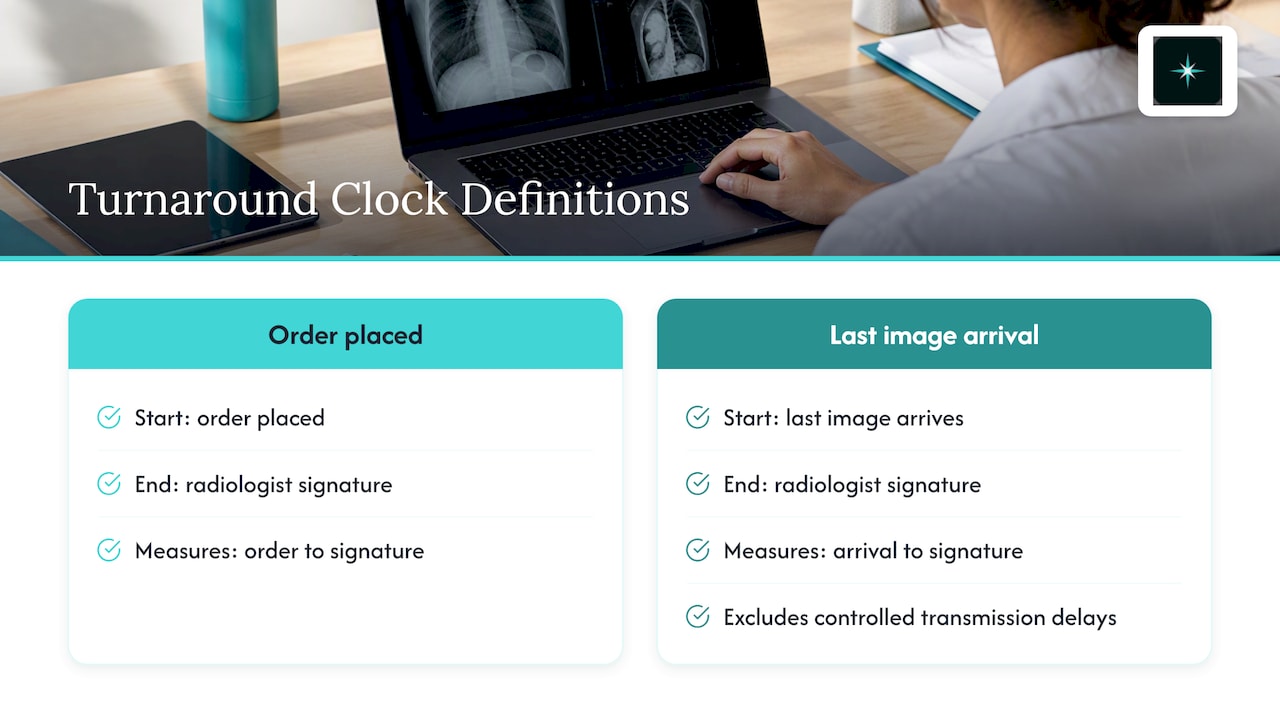
Two clock definitions are common. One starts when the order is placed, the other when the last image arrives at the vendor. The second is cleaner because it excludes delays you control, such as late image transmission. Our own contract commitments are measured from last-image arrival to radiologist signature. Whichever definition you use, write it out and make sure both parties' reporting tools measure the same interval.
Tier structure
The table shows a typical tier layout, using the commitments we make as one example of how to word them.
| Tier | What it covers | Example contract commitment |
|---|---|---|
| Stroke protocol | Acute stroke imaging, such as non-contrast head CT and CT angiography | Under 30 minutes |
| STAT | Emergency and time-sensitive studies | Under 4 hours; under 2 hours or under 1 hour on request |
| Routine | Non-urgent outpatient and inpatient studies | 24 to 48 hours |
The ACR Bulletin guidance on radiology contracts notes that performance language works only when it is measurable, and that metrics defined vaguely can later be used as grounds for termination for cause. That advice is written for radiologists reading employment agreements, but the principle holds on the facility side: a metric you cannot measure is a metric you cannot enforce.
Exclusions and remedies
List the exclusions explicitly. Common ones are downtime events, incomplete studies, missing clinical history, and studies sent under the wrong priority. The same ACR guidance advises naming which studies or events are excluded from turnaround metrics rather than leaving them to interpretation. Then write the remedy: a monthly report, a corrective action plan after repeated misses, and a termination right if misses continue. A commitment with no remedy is a preference.
Our STAT radiology reads page describes how we handle time-critical studies, and the SLA terms we put in writing follow the discovery call.
What should a teleradiology BAA cover?
A Business Associate Agreement is a written contract between a HIPAA covered entity and a vendor that handles PHI on its behalf. A teleradiology vendor receives images and reports containing PHI, so a signed BAA is required before any study is transmitted.
HHS guidance on business associates explains that the agreement must describe the permitted uses of PHI, require the vendor to apply the appropriate safeguards, and require it to report security incidents and breaches. Use that as the minimum, then add operational detail:
- Breach notification window: a specific number of days your compliance officer can live with.
- Subcontractors: whether any reading, transcription or hosting is delegated, and whether those parties sign their own BAAs.
- Location of reads and storage: whether every read is performed inside the United States.
- Return or destruction of data at termination.
- Audit cooperation if you receive a regulator inquiry.
Word this carefully in procurement documents. A vendor should describe itself accurately, for example as HIPAA aligned and operating as a business associate under a signed BAA, and your compliance team should verify the safeguards behind that statement. Our own position is exactly that: AstraRad is HIPAA aligned and works as a business associate under a signed BAA.
How do credentialing and licensure work in a teleradiology contract?
Credentialing is the process by which a facility verifies a physician's identity, licensure, training and competence before granting privileges. For teleradiology, the contract should state who credentials, which licenses are verified and how often, and what documentation the vendor supplies to your medical staff office.
The 2011 CMS final rule on telemedicine changed the process hospitals and critical access hospitals can use to credential and privilege practitioners who deliver care through telemedicine. Under it, a hospital can rely on the credentialing decisions of the distant-site entity when a written agreement is in place, instead of repeating the full process for every reader. Your agreement must be written to support that arrangement, so ask your medical staff office and counsel what the agreement must contain for your governing body to accept it.
Build these items into the clause:
- State licensure. Studies are interpreted under the license of the state where the patient is. Ask for licenses held in every state you send from, and a process to add a state. AstraRad radiologists are licensed in all 50 states; see teleradiology state licensing for how coverage works, including Colorado and Texas.
- Board certification. Require board certification in radiology, and subspecialty training where you are buying subspecialty reads.
- Primary source verification and a schedule for re-verification.
- Identity verification. The Joint Commission permits off-site identity verification when formal documentation is kept in the practitioner's credentials file.
- Delivery of credentialing packets on a stated timeline.
- Notice of changes, such as a license action, within a fixed number of days.
If you are a critical access hospital, our page on rural and critical access hospital teleradiology covers overnight coverage questions specific to that setting.
How do you write subspecialty coverage into the agreement?
Subspecialty coverage means studies are routed to a radiologist trained in the relevant body part, such as neuroradiology for brain MRI or musculoskeletal radiology for joint studies. A clause that only promises subspecialty readers "where available" gives you no enforceable assignment.
The ACR Bulletin guidance observes that subspecialty welcome language in contracts is often too vague, and that you need to clarify case assignment rules and the specific modalities in scope. Translate that into your RFP:
- Which subspecialties are covered, and during which hours?
- Is every study matched to a subspecialist by modality and body part, or only some?
- What happens overnight: a general radiologist, or the same subspecialty match?
- What is the fallback when a subspecialist is unavailable, and is the facility notified?
AstraRad routes every study to a subspecialist matched to the modality and body part, across ten subspecialties and twelve study types, on scheduled US shifts 24/7/365. We put final signed reports at every tier, including overnight. For modality detail, see MRI teleradiology reporting, PET-CT and nuclear medicine reads and X-ray and ultrasound overflow reads.
What should the contract say about PACS integration and downtime?
PACS integration terms define how images reach the vendor and how signed reports return to your system. The contract should require DICOM conformance, name the integration method, and state who owns each part of the connection, including VPN and firewall configuration.
Specify these items:
- Report delivery: reports return directly to your existing PACS, with no separate portal your staff must monitor.
- Standards: DICOM for images, and the HL7 or FHIR interfaces your RIS and EHR use for orders and results.
- Security: encryption in transit, the VPN or secure transport in use, and firewall rules your IT team must approve.
- Implementation timeline: milestones from countersignature to first signed report. Ours is the first signed report within 10 business days of countersignature.
- Testing: a test period with sample studies before go-live.
The ACR guidance advises standardizing a downtime policy inside the contract and defining responsibility for PACS and VPN outages. Remote reading depends on network stability, so write the escalation path: who calls whom, how quickly, what the fallback transmission method is, and how downtime is treated in turnaround measurement. Without that, a network failure on your side can show up as a missed SLA, or a failure on theirs can go unremedied.
How do per-report pricing and other models compare?
Per-report pricing means you pay a fixed fee for each completed, signed study, with the fee varying by modality or study type. It is one of several models, and each shifts risk differently.
| Model | How you pay | Where the risk sits | Watch for |
|---|---|---|---|
| Per report, no minimums | A fee per signed study | Vendor carries idle capacity | Fee schedule by study type, add-on charges |
| Per report with volume minimums | Per study, with a monthly floor | You pay for unused volume | Shortfall billing, tiered rates |
| Flat monthly retainer | Fixed fee for coverage | You pay whether or not studies arrive | Volume caps and overage fees |
| Platform or subscription fee plus reads | Software fee plus per-read charge | Extra fixed cost | Per-user or per-site fees |
Our model is per report with no minimums and no additional platform fees, so cost follows the volume you send. That suits facilities with variable overnight volume, seasonal peaks or backlog projects. Request the complete per-report rate card, which we deliver within one business day, and compare it with other proposals line by line. Ask every bidder to price the same sample month so the comparison is fair.
Check how the fee schedule handles:
- Priority surcharges for STAT or stroke studies.
- Multi-part or comparison studies and addenda.
- Cancelled or incomplete studies.
- Annual rate adjustments and notice periods.
Which quality and termination clauses protect you?
Quality assurance clauses define how the vendor monitors accuracy and how you see the results. Peer review is a process in which a second radiologist independently reviews a sample of reads to measure agreement and catch errors.
Ask for these terms in writing:
- Peer review rate and method. We independently double-read 1 in 20 reports, blind, for peer review.
- Discrepancy handling: how you are notified, how addenda are issued, and how fast.
- Reporting to you: regular compliance and performance reporting you can use for your own quality committee.
- Critical result communication: a defined process and time for phoning urgent findings to the ordering clinician.
- Termination: termination for convenience with a reasonable notice period, termination for cause with a cure period, and transition assistance so studies keep flowing during a changeover.
- Exclusivity: whether you may use more than one vendor for overflow.
Be careful with practice parameters. The ACR explains that its practice parameters and technical standards are educational tools, not legal standards of care. Referencing them as a contractual obligation without review can create obligations nobody intended. If you want to incorporate a standard, have counsel decide which version and which sections apply.
What teleradiology RFP questions should you ask?
A teleradiology RFP is a request for proposals in which a facility asks vendors to describe their service, credentials, technology and pricing in a comparable format. Good RFP questions force specifics that you can later turn into contract language.
| Topic | Question to ask | What a strong answer includes |
|---|---|---|
| Reading location | Are all reads performed inside the United States? | A yes or no, plus subcontractor disclosure |
| Signature | Is every report final and signed, including overnight? | Final signed reports at every tier |
| Turnaround | How is each tier measured, and what is excluded? | Clock start, clock stop, exclusions, remedy |
| Subspecialty | How are studies assigned? | Rules by modality and body part |
| Licensure | Which states are covered, and how are new states added? | Licensing process and timeline |
| Credentialing | What packet do you supply for our medical staff office? | Contents and delivery time |
| Compliance | Will you sign our BAA? Describe your safeguards. | BAA, incident reporting, subcontractors |
| Integration | How do reports return to our PACS? | DICOM details, interfaces, test plan |
| Quality | What share of reports is peer reviewed? | Rate, blind method, reporting |
| Pricing | What does each study type cost, and are there minimums? | Full rate card, no hidden platform fees |
| Onboarding | How long from signature to first report? | Dated milestones |
Issue the same sample volume and study mix to every bidder. When you score responses, weight written commitments above verbal promises.
How to get a coverage plan and rate card from AstraRad
AstraRad is a US teleradiology service that delivers final signed reports read by board-certified subspecialists. If you are building an RFP or reviewing a draft agreement, you can request a per-report rate card and receive it within one business day, or book a discovery call at /book-a-call. A coverage plan with SLA terms in writing follows the call, so you can review the actual clauses before you sign. Pricing is per report with no minimums. Learn more about AstraRad and the studies we read on our services page.
Contract red flags to strike before you sign
A red flag is a clause that shifts risk to you without a matching commitment from the vendor. These are the ones to look for:
- Turnaround stated without a clock start or stop.
- Preliminary reads that are "finalized" later by a different party.
- Subspecialty claims with no assignment rules.
- Automatic renewal with a long notice window.
- Volume minimums or platform fees not shown on the rate card.
- Silence on downtime, VPN and PACS responsibilities.
- A BAA that is missing, or that omits subcontractors.
- Unlimited exclusions from the SLA.
If you find several in one draft, ask for a revised version before involving your legal team in a full review.
FAQ
What is the most important term in a teleradiology contract?
The turnaround clause is usually the most contested, because it needs a defined clock start, clock stop, tier and list of exclusions. Pair it with a written remedy and a termination right for repeated misses. The BAA is a close second because HIPAA requires it before PHI is shared.
Do you need a BAA for teleradiology?
Yes. A teleradiology vendor receives images and reports containing PHI, so HIPAA requires a Business Associate Agreement before transmission. HHS guidance says it must describe permitted uses and require safeguards and incident reporting. Your compliance officer should review the final text.
How is teleradiology turnaround time measured in a contract?
The contract should say where the clock starts and stops. AstraRad measures its committed turnaround from last-image arrival to radiologist signature. Ask any vendor for its definition, the tiers it covers, such as STAT, routine and stroke protocol, and the studies excluded from measurement.
Can a hospital rely on a teleradiology vendor's credentialing?
In some cases, yes. A 2011 CMS rule lets hospitals use a streamlined process for distant-site practitioners when a written agreement with the telemedicine entity exists. Your medical staff office and counsel should confirm what your agreement and bylaws must contain.
Are there minimum volumes in teleradiology contracts?
Some vendors require monthly minimums, retainers or platform fees, and others do not. Ask for the full fee schedule and every condition attached to it. AstraRad prices per report with no minimums, and you can request the rate card to compare it against other proposals.
Sources
Related on AstraRad
- Resources
ED imaging turnaround: what to put in your contract
ED imaging turnaround is measured from exam completion to final signature; here is how to define, benchmark and contract it with a teleradiology partner.
- Resources
2027 Medicare fee schedule: the radiology numbers explained
The CY2027 Medicare fee schedule cuts both conversion factors while ACR estimates radiology gains 2 percent. Both are true. Model your dollars per RVU.
- Resources
Radiology addendum policy: how to write one that works
A radiology addendum policy defines when to amend a signed report, who notifies the ordering provider, and how you audit it; here is how to write one.
Put a radiologist's name on your next read.
Tell us your modalities and monthly volume. A complete per-report rate card, with turnaround tiers and SLA terms in writing, lands in your inbox within one business day.