FHIR imaging: run a 30 to 90 day vendor pilot
Hospital procurement advice: evaluate PACS integrated FHIR imaging, compare teleradiology vendors, and run a 30 to 90 day pilot with written SLAs to prove

For hospital administrators and imaging directors, FHIR imaging in this context means outsourced, PACS-integrated final signed reports read by board-certified subspecialists on a guaranteed turnaround. It works well for night coverage, overflow volume, and subspecialty gaps, and it can produce real ROI. The right next step is a 30 to 90 day pilot with written SLAs and a tested integration path before you sign a long-term contract.
TL;DR:
- Conduct a 30 to 90-day pilot with clear SLAs and tested PACS integration before committing to a long-term outsourcing partner.
- Ensure the vendor provides final signed reports on the first read with guaranteed turnaround times, supported by a measured SLA compliance rate.
- Confirm PACS integration involves a shared or global worklist that automates study routing, priors transfer, and report delivery without manual data entry.
- Negotiate specific contract terms including precise turnaround guarantees, licensure verification, malpractice coverage, and a robust critical-results escalation protocol.
- Compare vendors on subspecialty depth, SLA metrics, proof of performance, and the ability to integrate seamlessly with your existing PACS workflow.
Table of Contents
- Why Outsourced Final Reads Matter for Coverage and Cost
- What Does PACS Integration Have to Look Like to Actually Work?
- What Your Contract Needs on Turnaround, Licensing, and Critical Results
- A Checklist for Comparing Teleradiology Vendors Side by Side
- Building a Simple ROI Model for Outsourced Reads
- How to Onboard a Final-Reads Partner Without Disrupting Operations
- Preparing Your Team for the Workflow Change
- Contract Terms Worth Negotiating Before You Sign
- How AstraRad Builds Final-Read Teleradiology
- How AstraRad Fits Into Your Coverage Plan
- Sources
Why Outsourced Final Reads Matter for Coverage and Cost
The old nighthawk model gave you a preliminary read and made you wait for a final the next morning. That two-step process is largely gone. Modern teleradiology vendors deliver final signed reports the first time, which eliminates the addendum cycle that used to eat into radiologist and referring-physician time.
Three coverage shapes exist, and most groups end up in the third:
- In-house only: full subspecialty depth during the day, but fixed FTE salaries whether volume is high or low, and gaps at night or when a subspecialist is on vacation.
- Fully outsourced: variable per-study cost and instant access to subspecialists you could never recruit locally, but you give up some direct control over reporting style.
- Hybrid: core daytime coverage stays in-house; outsourcing fills nights, weekends, overflow, and subspecialty reads your group doesn't carry. Most facilities land here because it shifts a slice of fixed cost into a variable one without disrupting daytime operations.
The financial case is not theoretical. One outsourcing analysis found roughly a 63% internal rate of return when outsourcing covered about 30% of an additional FTE's workload, using an average outsourced cost near $50 per case. That number becomes your baseline in the ROI section below. Beyond the math, groups that outsource nights and overflow typically see fewer addenda, less locum dependence, and faster turnaround because subspecialists are reading studies in their own wheelhouse instead of a generalist stretching across modalities.
What Does PACS Integration Have to Look Like to Actually Work?
A vendor relationship that requires your technologists to log into a second portal, re-key patient IDs, or manually pull prior studies isn't integration. It's a workaround, and workarounds break under volume.
The architecture that actually holds up merges your PACS workflow with remote reading through a shared or global worklist, sometimes called a SuperPACS approach. Studies route via DICOM directly into the radiologist's queue, priors and structured metadata travel with the study, and the signed report returns to your RIS automatically. Nobody on your staff should be doing manual data entry to make this work, and a merged PACS and teleradiology workflow is what makes multi-site reading efficient rather than chaotic.
Watch for these failure modes when you evaluate a vendor:
- Priors don't transfer automatically, forcing the radiologist to read without comparison history.
- Reports land in a separate vendor portal instead of routing back into your RIS.
- Technologists must manually push studies rather than relying on automated DICOM routing.
- HL7 order and result matching breaks, causing mismatched patient records.
Before signing anything, run a small batch of real (de-identified, if needed) studies end to end and confirm the report lands in your RIS without a human touching it. That single test tells you more than any sales deck.
What Your Contract Needs on Turnaround, Licensing, and Critical Results
A vendor that promises speed without contractual teeth is making a marketing claim, not a commitment. Build these into the written agreement, not a verbal assurance.
- Turnaround guarantees by acuity. STAT reads under one hour, routine studies under 24 hours, with the vendor reporting compliance on a regular cadence, not just when asked.
- Concordance and audit rights. Require a sample audit process with a stated concordance rate target, so you have a way to catch drift before it becomes a pattern.
- State licensure documentation. The radiologist must hold an active license in the state where the study originates, and the vendor should manage license verification and renewal cadence as part of ongoing credentialing, not a one-time check.
- Malpractice and privileging documentation. Get primary-carrier malpractice documentation and privileging terms spelled out, not summarized.
- Closed-loop critical-results protocol. A signed report sitting in a queue is not the same as a radiologist calling a clinician about a pneumothorax. Testing the callback and escalation matrix before go-live is the single cheapest risk-reduction step available to you.
Pro Tip: Run a mock critical finding through the escalation chain before your first live case. If nobody picks up the phone within your defined window during the drill, you've found the gap while it's still free to fix.
A Checklist for Comparing Teleradiology Vendors Side by Side
Procurement teams tend to compare price per study and stop there. That's the fastest way to end up locked into a vendor whose subspecialty bench is thin or whose SLA has no teeth.
Split your evaluation into three buckets.
Operational fit:
- Subspecialty bench depth by modality (neuro, MSK, body, cardiac, PET-CT), not just "general radiology."
- Dedicated reading team assigned to your account rather than a rotating anonymous pool.
- Peer review and quality assurance process documented, not just claimed.
- Report templates that match or adapt to your referring physicians' expectations.
Commercial terms:
- Per-report pricing broken out by modality, since a chest X-ray and a contrast CT are not the same cost.
- Volume minimums or onboarding fees that lock you in before you've validated fit.
- SLA remedies: what actually happens contractually if turnaround targets are missed repeatedly.
- How addenda and amended reports are billed, if at all.
Proof you can request before signing:
- Sample SLA compliance reports from an existing client relationship.
- A credentials roster showing board certification and state licensure.
- A redacted performance dashboard showing real turnaround data, not marketing averages.
Ask any vendor you're evaluating for its measured SLA compliance rate, the window it covers, and how it is calculated, since "we guarantee fast turnaround" without a measured compliance rate is just a slogan.
Building a Simple ROI Model for Outsourced Reads
You don't need a finance team to model this. Start with the same assumption the outsourcing research uses: roughly $50 per outsourced case as a modal average, then compare that against the fully loaded marginal cost of adding another FTE radiologist, salary, benefits, malpractice, and recruiting included.
The 63% internal rate of return cited earlier assumed outsourcing displaced about 30% of an additional FTE's workload. Scale that logic to your own numbers:
- Calculate your current night, weekend, and overflow volume as a percentage of total FTE capacity you'd otherwise need to hire for.
- Multiply avoided locum shifts and avoided new hires by their fully loaded cost, then subtract your projected per-case outsourcing spend.
- Factor in the addenda reduction from subspecialist-first reads, since fewer amended reports means less physician time spent chasing corrections.
Stress-test the model on three variables before you commit: study volume swings seasonally, modality mix shifts the average per-case price, and addenda rates change if a vendor's initial read quality is inconsistent. Run the numbers at your actual volume, not an industry average, and the picture usually gets clearer, not murkier.
How to Onboard a Final-Reads Partner Without Disrupting Operations
Credentialing is usually the longest pole in the tent, especially for multi-state coverage where each state license and privileging cycle runs on its own timeline. Ask upfront what documentation the vendor needs from you and what their typical lead time looks like for your specific states.
- Credentialing and privileging. Confirm state licensure per originating site and get a written renewal cadence, not a one-time snapshot.
- IT integration testing. Validate DICOM routing, confirm priors transfer with the study, and test that the signed report routes back into your RIS with zero manual steps. Confirm your BAA and security review are complete before any real patient data flows.
- Pilot design. Run 30 to 90 days with a defined sample size and acceptance thresholds, for example STAT turnaround met in 98% of cases, concordance above 98% on sampled audit reads, and clinician satisfaction above 4 out of 5.
- Go/no-go review. Compare pilot metrics against your acceptance thresholds and have a rollback plan ready if the numbers fall short.
Pro Tip: Set your pilot's rollback trigger in writing before you start, not after a bad week. Deciding thresholds under pressure almost always favors the vendor, not your department.
Preparing Your Team for the Workflow Change
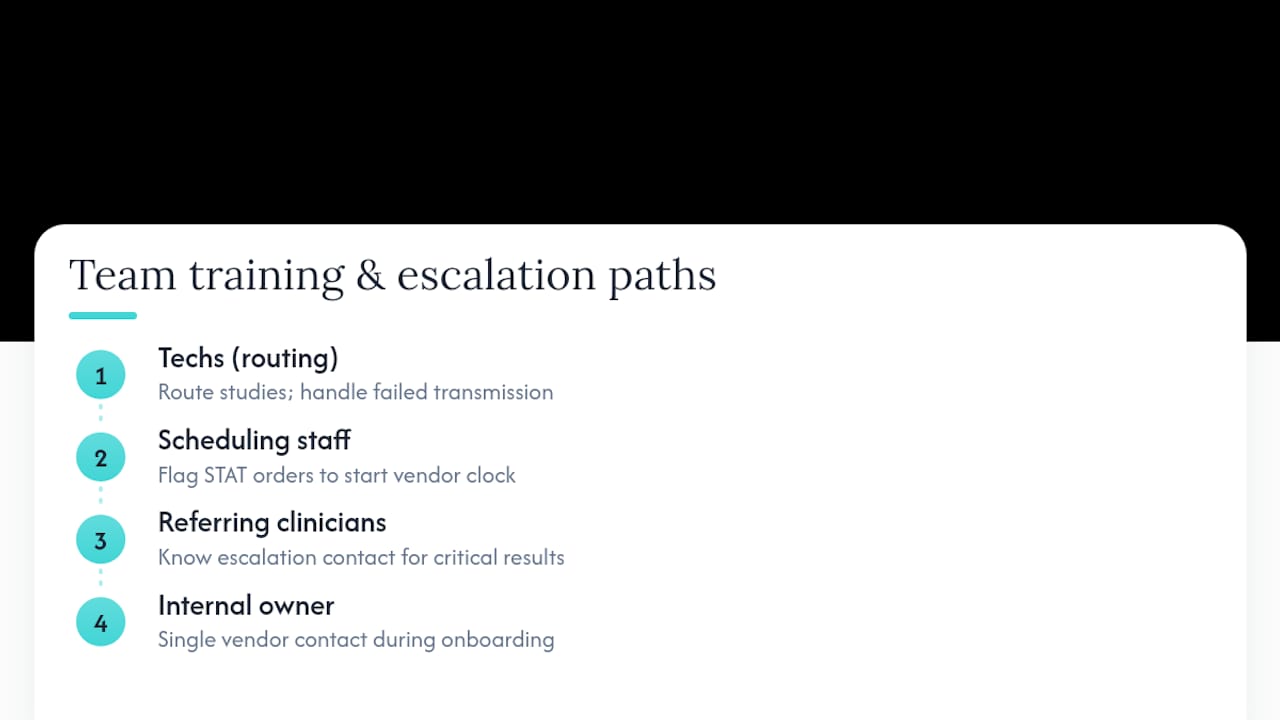
The technology integration is usually easier than the change management. Technologists who've spent years calling the on-call radiologist directly now route studies through an automated worklist, and that shift needs explicit training, not an assumption that "it's intuitive."
Build a short training cycle around three groups. Technologists need to understand exactly how a study routes to the vendor and what to do if a study fails to transmit. Front-desk and scheduling staff need clarity on how STAT orders get flagged so the vendor's turnaround clock actually starts on time. Referring clinicians need to know who to call for a critical result, since a new vendor relationship without clear escalation contacts creates confusion at exactly the wrong moment.
Expect some friction in the first two to three weeks as staff adjust to a new report format or a different radiologist voice in dictations. That's normal, and it's exactly why a pilot period with defined acceptance metrics matters more than a hard cutover. Document any recurring confusion during the pilot and fix the process, not just the individual complaint.
One underrated element: assign a single internal point person who owns the vendor relationship during onboarding. Without that person, integration issues get reported inconsistently, and the vendor spends weeks reconstructing a problem that a dedicated contact could have flagged on day one.
Contract Terms Worth Negotiating Before You Sign
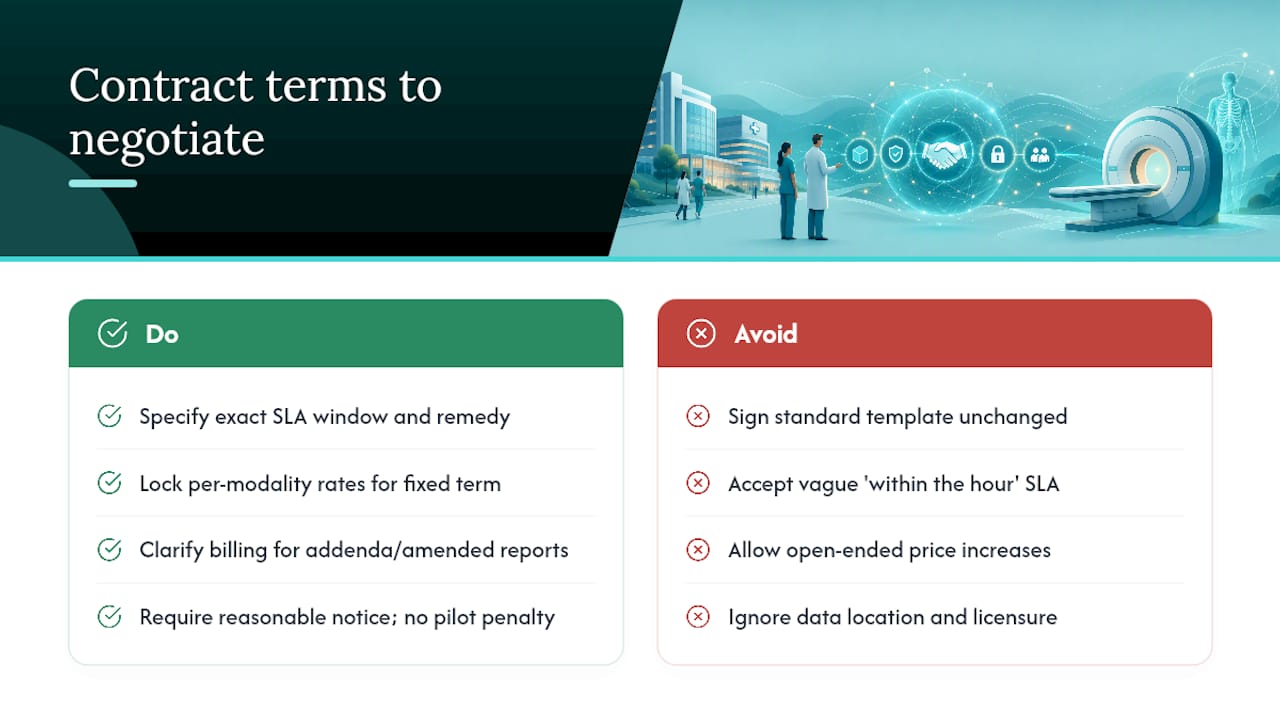
Most teleradiology contracts arrive as a standard template, and most administrators sign them close to as-is. That's a mistake, because several terms are genuinely negotiable if you know to ask.
Turnaround SLAs should specify the exact measurement window, not a vague "within the hour" promise, and should include a defined remedy, such as a credit, if the vendor misses the target repeatedly over a stated period. Pricing terms should lock in per-modality rates for a defined term rather than allowing open-ended increases, and you should clarify upfront how addenda or amended reports get billed. Termination clauses deserve particular attention: look for a reasonable notice period and confirm there's no penalty for a pilot that doesn't convert to a full contract.
Data handling terms matter as much as clinical terms. Confirm the Business Associate Agreement covers exactly how imaging data is stored, transmitted, and purged, and ask where the vendor's servers and radiologists are physically located, since that affects both HIPAA exposure and state licensure requirements. Finally, negotiate a defined onboarding fee cap or waiver tied to pilot volume, since some vendors will reduce or eliminate setup costs in exchange for a committed pilot period.
None of these terms are unusual to ask for. Vendors confident in their SLA performance generally have no problem putting remedies and specifics in writing.
How AstraRad Builds Final-Read Teleradiology
The pattern that shows up across every outsourcing study cited above is the same: outsourcing works when it behaves like an extension of your department, not a black box vendor relationship. That means board-certified subspecialists reading in their actual area of expertise, turnaround commitments that hold up under audit, and integration that doesn't force your staff into a second workflow.
AstraRad was built around that logic directly. Every study gets read by a board-certified subspecialist, with STAT under 4 hours as the standard, 2-hour and 1-hour STAT available on request at a higher multiplier, and routine studies in 24 to 48 hours. Reports return through your existing PACS, and coverage runs through state-licensed radiologists, including Florida-licensed coverage for sites that need it.
How AstraRad Fits Into Your Coverage Plan
If you're weighing a pilot against sticking with locums or stretching your current staff thinner, the math above points in one direction: predictable per-report costs beat unpredictable staffing gaps. AstraRad delivers final signed reports from board-certified subspecialists, with STAT under 4 hours as the standard, faster STAT on request, and routine studies in 24 to 48 hours.
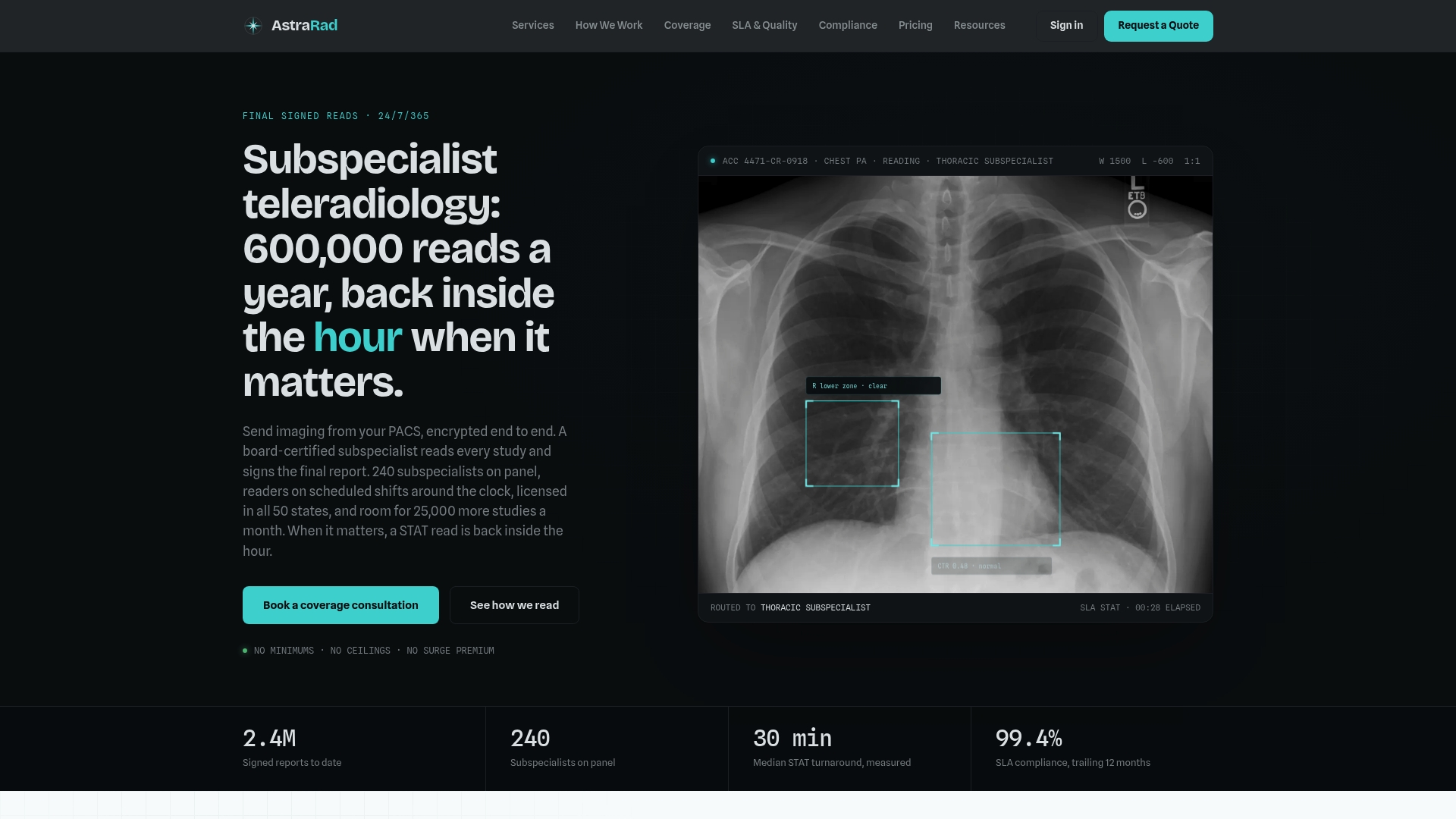
Integration runs through your existing PACS, so there's no second portal for your technologists to learn and no manual re-entry breaking your workflow. You can check per-report pricing by study type, review how the integration actually works end to end, or confirm state licensing coverage for your specific sites. If overflow, night coverage, or a subspecialty gap is the problem you're solving for, the next reasonable step is a scoped pilot with defined acceptance metrics, not a multi-year commitment. Reach out to set up that pilot and see the turnaround numbers against your own volume before you decide anything.
Sources
- USCDI diagnostic imaging data standard
- Analysis teases out true value of outsourcing anytime reads
- Merging PACS and teleradiology: SuperPACS whitepaper (Carestream)
- Teleradiology operating models: in-house, outsourced, hybrid (OmniPACS)
Recommended
Related on AstraRad
- Resources
2027 Medicare fee schedule: the radiology numbers explained
The CY2027 Medicare fee schedule cuts both conversion factors while ACR estimates radiology gains 2 percent. Both are true. Model your dollars per RVU.
- Resources
Clinician-radiologist communication: closing the loop
Clinician-radiologist communication fails when critical results reach a system but never reach the physician, and closed-loop standards close that gap.
- Resources
The hidden cost of the prelim-plus-overread model
The prelim-plus-overread model pays two radiologists and bills one report per overnight study. Cost the overread time, callbacks, and amendments first.
Put a radiologist's name on your next read.
Tell us your modalities and monthly volume. A complete per-report rate card, with turnaround tiers and SLA terms in writing, lands in your inbox within one business day.