Musculoskeletal teleradiology with 99.4% SLA and PACS
Imaging centers get fellowship trained musculoskeletal teleradiology reads with PACS integration, SLA backed turnarounds, and STAT results under one hour.

Musculoskeletal teleradiology sends MRI, CT, X-ray, and ultrasound studies to board-certified subspecialists working remotely, who return a signed report on the same PACS timeline as an on-site radiologist. It solves two problems at once: coverage gaps during nights and weekends, and access to fellowship-trained MSK expertise that many imaging centers cannot staff full-time. Use it for STAT trauma reads, overflow volume, and second-opinion consults on complex joint, spine, or tumor cases.
TL;DR:
- Credentialed subspecialty radiologists with MSK fellowship training are essential for accurate detection of subtle findings like early necrosis or stress reactions.
- PACS integration with direct DICOM connection and encrypted transmission ensures smooth, secure workflow without staff re-entry or added steps.
- Per-report pricing varies by modality complexity, with additional charges for STAT, after-hours, or weekend reads; volume commitments can reduce costs.
- Most services guarantee STAT turnaround under one hour and routine reports within 24 hours, with AstraRad achieving 99.4% SLA compliance.
- Verify licensure coverage maps, structured reports, peer review metrics, and clear incident protocols when choosing a remote MSK teleradiology partner.
Table of Contents
- What musculoskeletal teleradiology covers and who benefits
- When should you send MRI versus CT, X-ray, or ultrasound?
- Quality, credentials, and trust signals to require
- PACS integration, secure transmission, and AI-assisted triage
- Pricing and service models for MSK teleradiology
- How do you choose a musculoskeletal teleradiology partner?
- AstraRad's approach to musculoskeletal teleradiology
- Ready to fill your MSK coverage gaps?
- Sources
- FAQ
What musculoskeletal teleradiology covers and who benefits
Musculoskeletal imaging spans more modalities than most people expect. MRI handles soft tissue and occult injury, CT resolves complex fracture patterns, plain X-ray remains the workhorse first-line study, and ultrasound supports dynamic assessment and needle guidance. A capable remote radiology service reads across all four, plus PET-CT when oncology or infection cases call for it.
Certain provider settings lean on this model more than others:
- Imaging centers filling coverage gaps during off-peak hours or radiologist vacations
- Orthopedic practices needing fast subspecialist reads on pre-surgical MRI
- Sports medicine clinics managing acute injury volume without an in-house MSK radiologist
- Emergency departments and urgent care centers requiring STAT fracture and joint reads
- Radiology groups clearing routine backlog without hiring additional staff
The common thread is timing pressure combined with a need for accuracy that a generalist read might miss, particularly in occult fractures, subtle labral tears, or early infection markers.
When should you send MRI versus CT, X-ray, or ultrasound?
Modality choice in musculoskeletal imaging follows the clinical question, not habit. Guidance from musculoskeletal imaging practice treats plain radiographs as the essential first study for most complaints, with MRI as the preferred advanced modality once soft tissue or occult pathology is suspected.
- X-ray first. Suspected fracture, joint effusion, or degenerative change starts here, and most cases resolve without further imaging.
- MRI for soft tissue and occult injury. Ligament tears, labral pathology, occult fractures not visible on X-ray, and pre-operative surgical planning all favor MRI.
- CT for cortical bone detail. Complex intra-articular fractures, pre-op planning for hardware placement, and cases where MRI is contraindicated point to CT.
- Ultrasound for dynamic and guided procedures. Tendon assessment during motion and image-guided injections or aspirations benefit from real-time ultrasound.
A patient with knee pain after a fall might move from X-ray (ruling out fracture) to MRI (confirming a meniscal tear) within the same visit. Remote subspecialists reading both stages consistently catch findings a rotating generalist could miss.
Quality, credentials, and trust signals to require
Board certification alone does not guarantee MSK expertise. Fellowship training in musculoskeletal radiology matters because it shapes how a radiologist reads subtle findings like early avascular necrosis or stress reaction patterns that a general radiologist might normalize.
Before signing with any remote radiology partner, confirm these baseline requirements:
- Board certification plus MSK fellowship training for every radiologist reading MSK studies
- Active state licensure covering every state where your patients are imaged, with a documented coverage map
- Structured peer review and RADPEER-style QA metrics tracked over time
- Published SLA and turnaround-time reporting, not just a verbal promise
- A written incident-response plan for discrepant reads or missed criticals
Pro Tip: Ask for three de-identified sample MRI reports before signing anything. Look specifically at how the radiologist handles metallic artifact and postsurgical changes; these are the cases where sloppy reporting shows up first.
High SLA compliance across reporting volume is a figure worth benchmarking against whatever your current provider is willing to disclose in writing.
PACS integration, secure transmission, and AI-assisted triage

Workflow friction kills teleradiology adoption faster than read quality ever will. The strongest setups connect directly to your existing PACS through DICOM, so studies route automatically without staff re-entering patient data into a separate portal. Zero-footprint viewers matter here too: one evaluation found this approach cut image access times to roughly 50 seconds, against nearly five minutes for traditional VPN-based access.
Key infrastructure elements to confirm with any partner:
- PACS/DICOM-first connection with no separate login portal for your technologists
- Encrypted transmission with HIPAA-aligned safeguards documented in writing
- AI-assisted triage flagging likely critical findings to shorten time-to-notice on urgent cases
- A defined critical-communication protocol specifying who calls the ordering physician and when
The handoff itself should feel invisible to your staff: a technologist completes the study, it routes automatically, a subspecialist reads and signs, and the report returns to the same PACS worklist. Teleradiology's operational benefits depend heavily on this kind of tight PACS integration rather than a bolt-on viewer that adds a step.
Pricing and service models for MSK teleradiology
Most musculoskeletal teleradiology runs on per-report pricing, where you pay for each signed study rather than a flat monthly retainer. Volume commitments can lower per-report rates, but they also lock you into a minimum you need to actually hit.
Expect these variables to move your invoice:
- Modality complexity: MRI and CT reads typically cost more than X-ray or ultrasound
- STAT premiums for reads returned under tight turnaround windows
- After-hours or weekend surcharges, common across the industry
- Contracted volume discounts versus per-report spot pricing
Confirm who holds the final signature on each report for licensing and liability purposes, how often invoices are issued, and what documentation you need to retain for compliance audits. Keep signed reports and QA logs on file; a payer or accreditation review will ask for them eventually.
How do you choose a musculoskeletal teleradiology partner?
Selecting a partner comes down to five checkable items, not a sales pitch.
- Confirm subspecialty coverage. Ask directly whether MSK studies are read exclusively by fellowship-trained subspecialists or mixed into a general radiologist pool.
- Verify licensure and coverage maps. Request a state-by-state list; gaps here create billing and compliance headaches later.
- Get SLA numbers in writing. Ask for average and guaranteed turnaround times for STAT, urgent, and routine studies, not just "fast."
- Request sample reports and QA metrics. Structured reporting with clear impressions and measurements signals a mature workflow.
- Walk through PACS integration. Ask exactly how a study moves from your system to a signed report, and how long setup takes.
Pro Tip: During vendor calls, ask what happens when a radiologist flags a critical finding at 2 a.m. If the answer is vague about who gets called and how fast, that is your red flag.
Watch for providers who dodge specifics on licensure, cannot produce peer review data, or quote turnaround ranges so wide they mean nothing. Many imaging centers start by outsourcing only STAT and after-hours coverage, then expand into routine and overflow reads once the partnership proves reliable.
AstraRad's approach to musculoskeletal teleradiology
AstraRad provides final signed musculoskeletal reports through board-certified subspecialists, with guaranteed turnaround under one hour for STAT studies and under 24 hours for routine cases. The service integrates directly into an imaging center's existing PACS, so technologists never log into a separate portal to send or retrieve studies.
Every report passes through structured peer review before it reaches your worklist, and AstraRad tracks SLA compliance at 99.4% across its reporting volume over the past year. For an imaging center director weighing coverage gaps against staffing costs, that combination of subspecialist reads and measured turnaround is the operational proof that matters more than a sales claim.
Rafael Vieira
Ready to fill your MSK coverage gaps?
If you are comparing in-house hiring against a remote radiology group, the math usually comes down to fixed staffing costs versus paying only for the reports you actually need. AstraRad works on a per-report model, so an imaging center can add subspecialist MSK coverage for nights, weekends, or overflow volume without committing to a full-time hire.
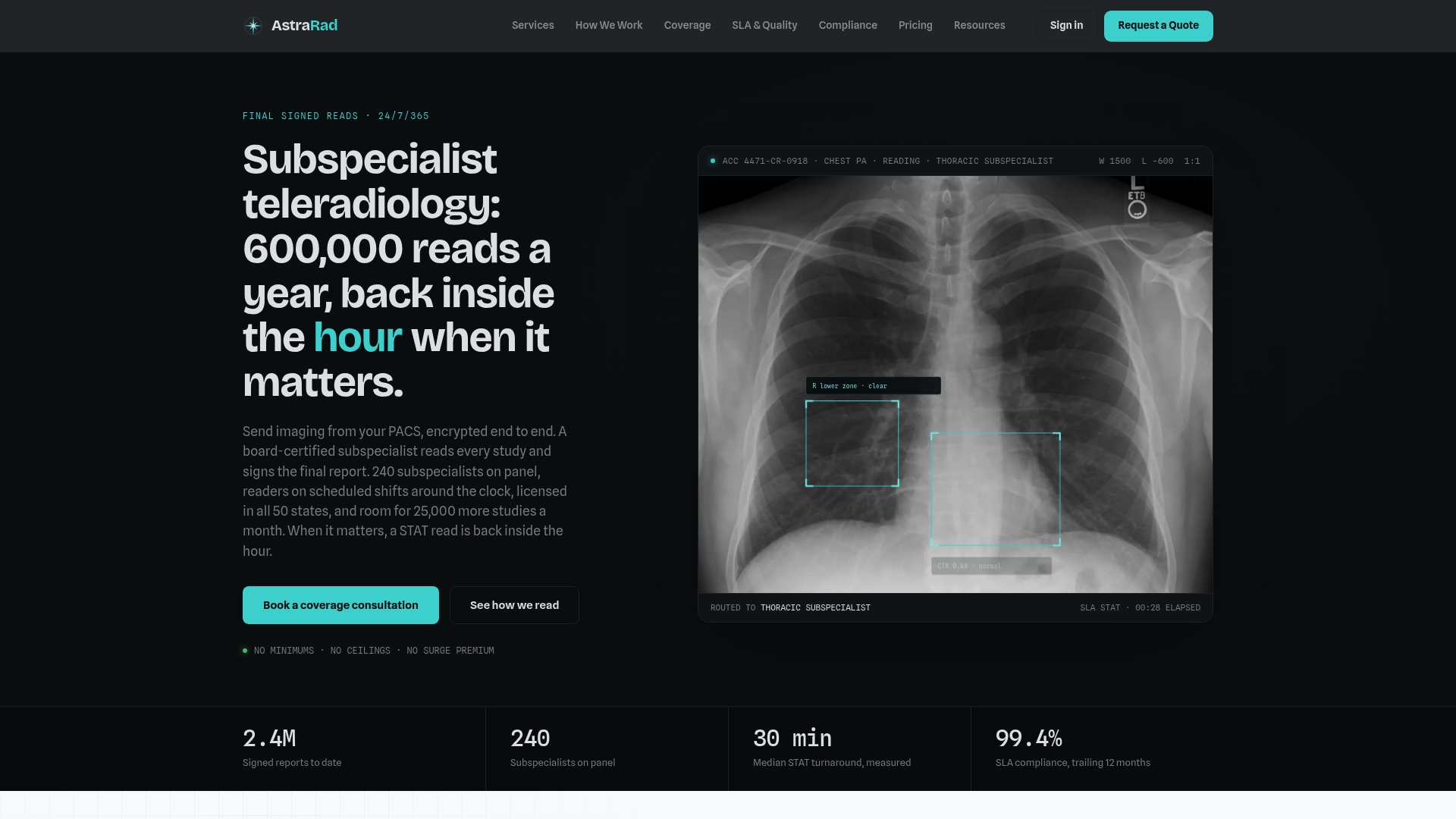
Every study routes through your existing PACS with no new portal to train staff on, and reports come back signed by one of AstraRad's 240 US subspecialty teleradiologists. Check current per-report pricing by study type or review how the integration process works before your next credentialing cycle. If your team operates specifically in Colorado, AstraRad also maintains licensed CO coverage ready for onboarding.
Sources
The American College of Radiology publishes the accreditation and modality standards worth requesting from any teleradiology vendor. The systematic review on teleradiology's empirical foundations documents diagnostic concordance with on-site reads and reduced patient transfers.
This article is general information, not a substitute for advice from a qualified doctor. Consult a qualified healthcare professional about your own circumstances before acting on anything here.
- Evaluation of a novel teleradiology technology for image-based distant consultations: applications in neurosurgery
- Teleradiology benefits, technology, and applications , Philips
- The role of MRI in musculoskeletal practice: a clinical perspective
FAQ
What is the average salary for a musculoskeletal radiologist in the US?
Compensation varies widely by region, practice setting, and whether the role includes teleradiology volume, and no single verified national figure applies uniformly across the specialty.
What is the highest-paid radiology subspecialty?
Pay rankings shift year to year and by practice type, so no fixed subspecialty holds a permanent top spot; interventional and neuroradiology are commonly cited as competitive alongside musculoskeletal.
What do musculoskeletal radiologists do?
They interpret imaging of bones, joints, muscles, and soft tissue, including MRI, CT, X-ray, and ultrasound, for trauma, sports injury, tumor, infection, and pre-surgical planning cases.
How long does it take to become a musculoskeletal radiologist?
The path typically requires four years of medical school, a radiology residency, and an additional one-year musculoskeletal fellowship for subspecialty certification.
How fast is a typical musculoskeletal teleradiology turnaround?
Well-run services guarantee STAT reads in under an hour and routine studies within 24 hours; AstraRad holds to these windows with 99.4% SLA compliance over the past year.
Recommended
Related on AstraRad
- Resources
Cut teleradiology credentialing to under 21 days
Checklist for hospital admins: verify licenses, privileging, payer enrollment, MOUs and PACS provisioning to cut teleradiology go live from 60,120 days
- Resources
Teleradiology without volume commitment: who needs it, how
Teleradiology without volume commitment fits seasonal clinics, startups, and mobile imaging. How commitment-free contracting works and what to verify.
- Resources
Pilot plan to validate after hours radiology coverage
Safety first guide for hospital admins: demand subspecialist final reads, SLAs, PACS integration, and a 3,6 week pilot to prove after-hours coverage.
Put a radiologist's name on your next read.
Tell us your modalities and monthly volume. A complete per-report rate card, with turnaround tiers and SLA terms in writing, lands in your inbox within one business day.