Pediatric teleradiology for hospital admins
Operational procurement guide for hospital administrators procuring pediatric teleradiology, with peer reviewed turnaround benchmarks (including 1.6%
Pediatric teleradiology sends children's imaging studies to subspecialty-trained radiologists working remotely, closing the gap when no pediatric radiologist is on-site. The result is faster, more accurate reads for X-ray, CT, MRI, and ultrasound studies at any hour. This is delivered through pediatric subspecialists producing final signed reports with SLA-backed turnaround times and direct PACS integration. The sections below cover the clinical benchmarks, credentialing standards, and procurement checklist administrators need before signing a contract.
TL;DR:
- Pediatric-trained radiologists significantly reduce the risk of misinterpreting growth variants and congenital anomalies compared to general radiologists.
- Credentialing requires fellowship training, board certification, and ongoing quality monitoring to ensure discrepancy rates stay around 1.6 percent, regardless of experience.
- Turnaround times for STAT cases can be under one hour, with routine studies guaranteed within 24 hours, depending on the vendor’s SLA commitments.
- Key technical requirements include direct PACS integration, encrypted data transfer, state licensure, and structured pediatric-specific reporting templates.
- Effective communication protocols and parental involvement are essential, especially for critical findings like abuse or trauma, ensuring timely, context-rich delivery of results.
Table of Contents
- What is pediatric teleradiology and why does subspecialty interpretation matter?
- Subspecialist expertise, quality assurance, and discrepancy rates
- What imaging modalities does pediatric teleradiology cover?
- How fast should pediatric teleradiology turnaround actually be?
- Technical, licensure, and privacy checklist
- Where does pediatric teleradiology fit: after-hours, rural, and overflow coverage
- How do you choose a pediatric teleradiology partner?
- AstraRad's pediatric teleradiology coverage at a glance
- Communication protocols that keep referring pediatricians and families informed
- Technology and pediatric-specific imaging protocols
- Training and continuing education for pediatric teleradiologists
- Ethical considerations in remote pediatric imaging
- Author perspective: practical next steps for implementation
- Get pediatric subspecialist reads with guaranteed turnaround
- Sources
- FAQ
What is pediatric teleradiology and why does subspecialty interpretation matter?
Pediatric teleradiology is the remote interpretation of children's imaging studies by radiologists with dedicated pediatric training, transmitted through secure networks to hospitals and clinics that lack that expertise on staff. Children are not small adults on a scanner table. Their skeletons still have open growth plates, their organs sit differently, and their radiation sensitivity is higher, which changes both the imaging protocol and how a finding should be read.
A general radiologist reading a pediatric wrist film or an abdominal CT without pediatric training is more likely to misread a normal variant as pathology, or miss a subtle congenital anomaly. That drives repeat imaging, extra radiation exposure, and unnecessary sedation for younger patients who cannot stay still for a scan.
- Pediatric-trained readers recognize growth plate variants and congenital anomalies that general radiologists often flag incorrectly.
- Subspecialty reads reduce repeat studies and unnecessary sedation events.
- Fewer callbacks and clarification requests mean faster discharge decisions and better throughput in the emergency department.
Subspecialist expertise, quality assurance, and discrepancy rates
Credentials alone don't guarantee accuracy. Ask any prospective partner for proof of fellowship training in pediatric radiology, board certification, and, where applicable, a Certificate of Added Qualification. Then ask how they monitor performance after those credentials are earned.
Statistic: A peer-reviewed analysis of after-hours pediatric teleradiology reports found an actionable discrepancy rate of about 1.6 percent between preliminary and final reads, a rate comparable to inter-observer variability in adult emergent imaging.
That same study found something administrators tend to overlook: years of experience did not consistently correlate with lower discrepancy rates. Formal QA processes moved the needle more than tenure did. When evaluating a vendor, prioritize:
- A documented peer-review program with regular sampling, not just an internal policy statement.
- Site-specific discrepancy dashboards you can review, not a single aggregate number quoted in a sales deck.
- Prospective peer sampling that catches drift before it becomes a pattern.
What imaging modalities does pediatric teleradiology cover?
Pediatric subspecialty coverage spans the full modality list, but each one carries its own pediatric-specific wrinkle that a generalist reader can miss.
- X-ray: the highest volume modality, with growth plate and skeletal survey nuances that matter for suspected abuse cases.
- CT: dose optimization protocols matter more here than in adult imaging, since cumulative radiation exposure in childhood carries lifetime risk.
- MRI: motion artifact and sedation coordination drive both image quality and scheduling; see how MRI teleradiology reporting handles subspecialist review for these cases.
- Ultrasound: heavily operator-dependent, which makes real-time technologist communication part of the read quality.
- Nuclear medicine and PET: lower volume but high stakes, mostly oncology staging and surveillance.
Neurotrauma, congenital anomalies, and oncology imaging are the cases where a pediatric subspecialist read matters most. Vendors typically offer both preliminary reads for immediate clinical action and final signed reports, with STAT cases routed on a separate, faster track than routine studies. AstraRad's modality coverage spans CT, MRI, X-ray, ultrasound, and PET-CT under that same routing structure.
How fast should pediatric teleradiology turnaround actually be?
Turnaround time claims vary wildly across vendors, so it helps to know what the published benchmarks actually look like. A multistate emergency neuroimaging study found a mean turnaround of 37.5 minutes for CT and 61.2 minutes for MR studies, with trauma accounting for 66% of positive findings and an overall positive-finding rate of 13.4%.
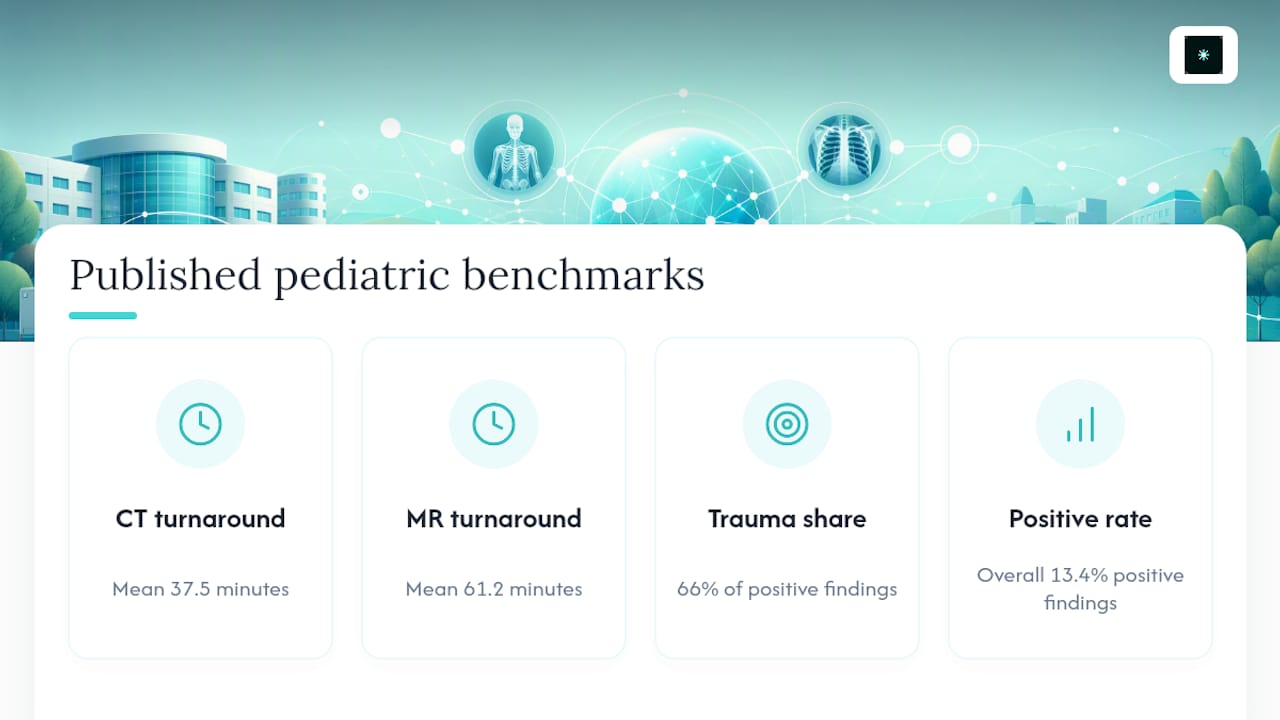
Mean and median tell different stories. A mean can be pulled upward by a handful of complex cases that legitimately took longer, while the median shows what a typical case actually experiences. When a vendor quotes a single number, ask which one it is, and ask for the distribution behind it.
STAT and routine cases should never share the same clock. A STAT designation should trigger immediate escalation protocols, direct phone contact with the ordering physician for critical findings, and a defined time ceiling, not just a "best effort" promise. When you evaluate a vendor's KPI dashboard, look for turnaround broken out by modality, the actionable discrepancy rate discussed earlier, and SLA compliance percentage over a rolling period, not just a single quarter's snapshot.
Technical, licensure, and privacy checklist
Before signing anything, verify the infrastructure and compliance details that determine whether the partnership actually works day to day.
- Confirm direct PACS and DICOM integration so studies route without a separate login portal for your technologists.
- Verify EMR access and prior-study availability, ideally with HL7 or FHIR compatibility for structured reporting.
- Check that the vendor's radiologists hold active licensure in your state, and confirm supervision rules if fluoroscopic or image-guided procedures are involved.
- Require a signed HIPAA business associate agreement, encrypted transfer protocols, and audit logging on every study.
Pro Tip: Ask for a live PACS test transfer before signing anything. A vendor that hesitates to run a sample integration is telling you how the real rollout will go.
Radiologists working remotely should also have access to prior imaging and the patient's broader record, a standard reflected in guidance on multistate teleradiology performance that ties remote reads into local safety and quality operations rather than treating them as an isolated transaction.
Where does pediatric teleradiology fit: after-hours, rural, and overflow coverage
Different institutions reach for pediatric teleradiology for different reasons, and knowing which scenario you're solving for shapes what you should ask a vendor.
- After-hours emergency coverage: closes the gap when no pediatric radiologist is physically in-house overnight, particularly for neuroimaging where minutes matter.
- Rural and critical-access hospitals: get subspecialist reads without carrying the cost of a full-time pediatric radiologist on staff, a model detailed on AstraRad's rural and critical-access hospital coverage page.
- Urgent care and overflow support: fast X-ray and CT turnaround keeps patient flow moving during volume spikes or when in-house reading capacity is stretched thin.
Surveys of after-hours radiology coverage models show wide variation, from trainee-only overnight coverage to full teleradiology partnerships, and teleradiology now factors into after-hours strategy at a meaningful share of surveyed institutions. There's no universal right answer here. The model that fits a 40-bed rural hospital looks different from what a 300-bed children's hospital needs for overnight neurotrauma coverage.
How do you choose a pediatric teleradiology partner?
Run every prospective vendor through the same three-part check before signing.
- Operational fit: confirm guaranteed SLAs in writing, named escalation contacts for critical findings, genuine 24/7 coverage, and demonstrated capacity to absorb volume spikes without turnaround slipping.
- Clinical fit: confirm pediatric subspecialists read every modality you send, ask for the peer-review program's structure, and request the actual actionable discrepancy rate rather than a marketing figure.
- Technical and legal fit: confirm PACS integration, state licensure coverage matching your patient population's geography, a signed HIPAA BAA, and a pricing model you can forecast against volume.
Red flags worth walking away from: SLAs stated as ranges instead of guarantees, credentialing details the vendor won't put in writing, and pricing that changes after volume commitments are signed.
AstraRad's pediatric teleradiology coverage at a glance
Pediatric studies are read by board-certified subspecialists who deliver final signed reports, not preliminary interpretations. Turnaround times can be SLA-backed: STAT cases may route on a sub-hour track, and routine studies are guaranteed under 24 hours. Integration often runs directly through existing PACS, so technologists typically do not need a separate portal.
- High SLA compliance can be sustained over time.
- STAT cases may be guaranteed under one hour; routine studies guaranteed under 24 hours.
- Volume capacity is built to support hospitals, imaging centers, and radiology groups handling high case loads without backlog buildup.
Administrators evaluating fit for after-hours, rural, or overflow coverage can review AstraRad's use-case breakdown or request a quote to see how these numbers apply to actual study volume.
Communication protocols that keep referring pediatricians and families informed
A signed report that arrives fast but lands in the wrong inbox, or lands without context, doesn't help anyone. Pediatric teleradiology only works operationally when the communication loop around the report is as tight as the read itself.
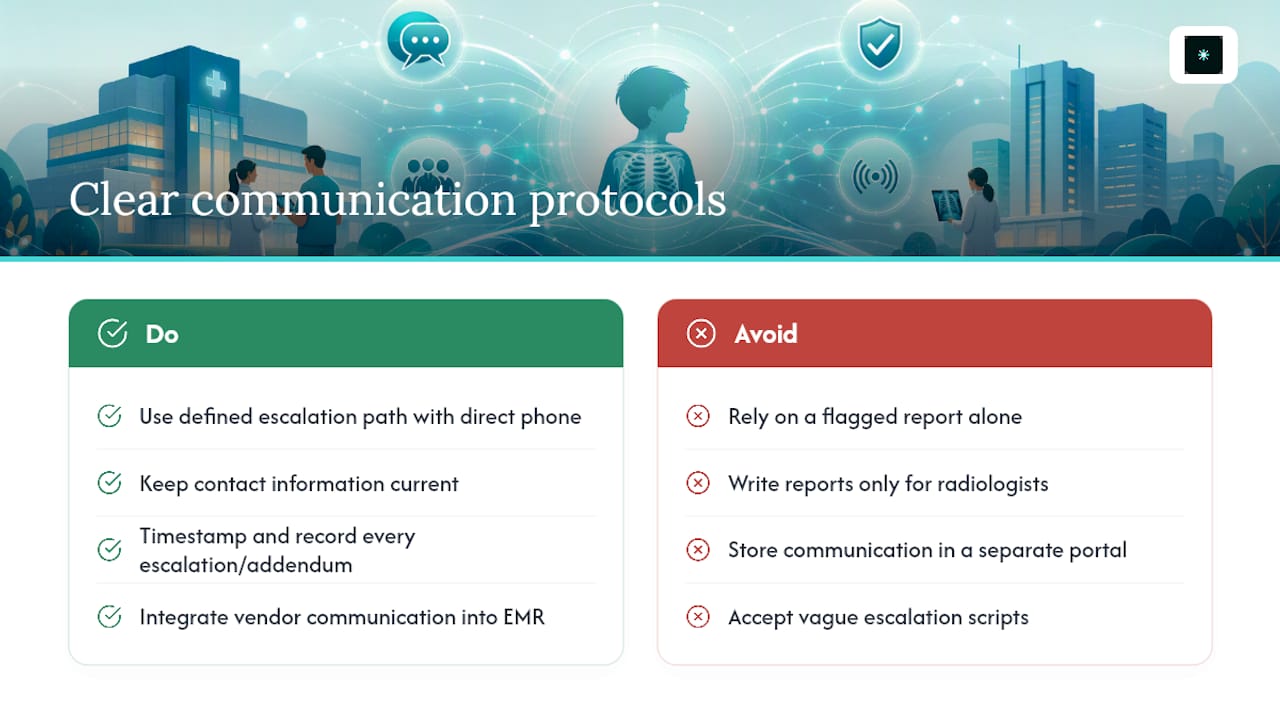
Critical and STAT findings need a defined escalation path: direct phone contact with the ordering physician, not just a flagged report sitting in a queue. This matters more in pediatrics than in adult imaging, because a delayed communication about a suspected non-accidental trauma finding or an acute intracranial process carries consequences measured in minutes, not hours. The radiologist reading remotely should know exactly who to call, and that contact information needs to stay current as staffing changes.
Routine findings still need clear, jargon-appropriate language in the final report, since the referring pediatrician may not be a radiology specialist and the family will eventually see or hear a summary of that report. A report written for another radiologist to parse isn't the same as one written to be handed to a worried parent explaining "what the scan showed."
Documentation matters too. Every escalation call, every addendum, and every correction to a preliminary read needs a timestamp and a record of who was notified and when. This protects the patient's continuity of care and gives the receiving institution an audit trail if a discrepancy surfaces later during peer review. Vendors integrated into your existing EMR, rather than operating through a standalone portal, make this documentation loop far easier to maintain, since the communication history lives with the rest of the patient's record instead of in a separate system nobody checks.
Ask any prospective partner to walk you through their actual escalation script for a critical pediatric finding at 2 a.m. If they can't describe it specifically, that's a gap worth flagging before you sign.
Technology and pediatric-specific imaging protocols
The infrastructure behind pediatric teleradiology has to do more than move images from point A to point B. It has to preserve image quality, protect dose data, and support protocols built specifically around smaller, more radiation-sensitive patients.
Weight-based and age-based dose protocols are non-negotiable on the technical side. A CT protocol tuned for an adult chest delivers far more radiation than a pediatric patient needs, and a teleradiology partner's technology stack should flag protocol mismatches before the study even reaches the reading radiologist. Some pediatric-focused programs build automated checks into their PACS workflow that catch an adult protocol accidentally applied to a small child, a safeguard that matters more in a distributed reading model where the radiologist isn't standing next to the scanner.
Bandwidth and compression settings matter more in pediatric imaging than administrators often assume. Subtle findings, a hairline fracture through a growth plate, a small congenital vascular anomaly, can disappear into compression artifacts if the transmission pipeline isn't built to preserve diagnostic-quality resolution. Confirm that any teleradiology partner transmits full-resolution DICOM data, not a compressed preview.
Structured reporting templates built for pediatric findings, rather than adult templates with a note added, help standardize how findings get communicated across a network of referring providers. And integration with your PACS directly, instead of a bolt-on viewer, keeps prior studies accessible to the reading radiologist, which matters enormously for tracking how a congenital finding or an oncology case evolves over multiple studies.
Training and continuing education for pediatric teleradiologists
Fellowship training in pediatric radiology is the entry credential, typically an additional year beyond diagnostic radiology residency, but it isn't the finish line. Pediatric imaging technology, dose-reduction protocols, and diagnostic criteria shift often enough that a radiologist who stopped learning the year they finished fellowship starts falling behind within a few years.
Board certification through the American Board of Radiology, often paired with a Certificate of Added Qualification in pediatric radiology, sets the baseline. What separates a strong pediatric teleradiology group from an adequate one is what happens after that certification: structured continuing medical education specifically in pediatric imaging, regular case conferences that include the remote radiologists rather than treating them as outside contractors, and exposure to enough case volume across enough institutions to keep pattern recognition sharp.
This is where the earlier point about discrepancy rates connects directly to training structure. A study on preliminary and final report discrepancies found that experience alone didn't predict accuracy. What predicted it was active participation in quality processes, meaning radiologists who stayed engaged with peer review and case feedback performed more consistently than those coasting on tenure. That's a strong argument for asking any vendor not just "how many years of experience does your team have" but "what does ongoing education look like for your pediatric readers, and how is it verified."
Ask specifically whether teleradiologists join your institution's morbidity and mortality conferences or tumor boards, even remotely. Radiologists who are cut off from that feedback loop lose one of the fastest ways to catch and correct patterns before they become discrepancies.
Ethical considerations in remote pediatric imaging
Reading a child's imaging study from hundreds of miles away raises ethical questions that don't come up the same way in adult teleradiology. Consent and parental involvement sit at the center of most of them.
Parents and guardians are the decision makers for a minor's care, and when a diagnosis or a critical finding gets delivered through a remote radiologist who has never met the family, the referring physician carries more of the responsibility for making sure that information lands with appropriate context and compassion. That puts pressure on the communication protocols discussed earlier: an ethical remote-reading relationship depends on the local clinical team being fully looped in, not sidelined by the speed of the remote read.
Suspected abuse and non-accidental trauma cases carry particular weight. A radiologist reading remotely needs the same access to clinical history and prior imaging as an on-site radiologist would have, because a skeletal survey read without context can miss patterns that only make sense alongside a social work note or a prior emergency visit. Isolating the remote radiologist from that context isn't just a workflow gap, it's a patient-safety issue specific to pediatric cases in a way it rarely is for adult studies.
Equity of access matters too. Rural and critical-access hospitals often turn to teleradiology precisely because they can't recruit a pediatric radiologist locally, which means the quality of that remote relationship directly determines whether children in underserved areas get subspecialty-level care or get left with a generalist read by default. That's a real ethical stake behind an operational decision, and it's worth naming directly rather than treating pediatric teleradiology as purely a staffing and logistics question.
Author perspective: practical next steps for implementation
Most administrators treat the vendor contract as the finish line. It's the starting line. Once a pediatric teleradiology partnership is live, the real work is keeping it sharp. Bring the remote radiologists into your peer review and morbidity meetings instead of treating them as an outside service. Run quarterly connectivity and failover tests with your IT team, because the worst time to discover a PACS handoff fails is during a trauma case at 3 a.m. And publish your KPI dashboard, turnaround by modality, discrepancy rate, SLA compliance, where clinical leadership actually sees it, not buried in a vendor's quarterly email.
Rafael Vieira
Get pediatric subspecialist reads with guaranteed turnaround
A team of board-certified pediatric subspecialists reads studies remotely, producing final signed reports instead of preliminary reads. STAT cases may route on a sub-hour SLA track, routine studies are typically guaranteed under 24 hours, and integration can run through existing PACS with no separate portal to manage.
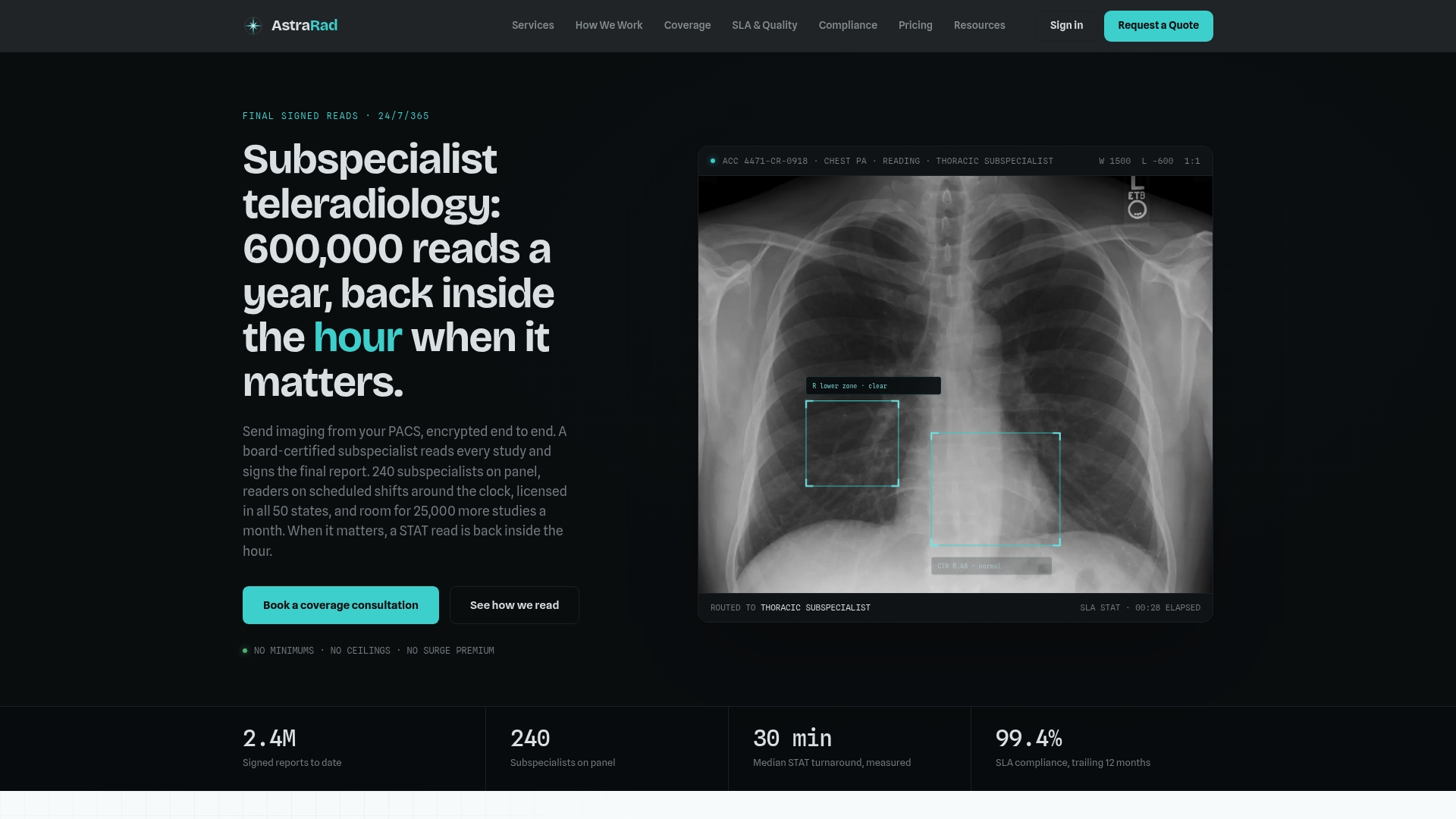
If turnaround speed is the deciding factor for your emergency department or overnight coverage, review the STAT radiology reads page for the SLA details and sub-hour performance data. For a full breakdown of per-report costs by study type, the pricing page lays out the fee structure so your team can forecast against expected volume. Request a quote today to see how AstraRad's turnaround and coverage model fits your institution's pediatric imaging needs.
This article is general information, not a substitute for advice from a qualified doctor. Consult a qualified healthcare professional about your own circumstances before acting on anything here.
Sources
- Performance of a multistate teleradiology service in emergency pediatric and adolescent neuroimaging: a two-year retrospective study
- Discrepancy rates of preliminary and final reports for after-hours pediatric teleradiology interpretations
FAQ
How many years does it take to become a pediatric radiologist?
Becoming a pediatric radiologist typically takes four years of medical school, a four-year diagnostic radiology residency, and one additional year of pediatric radiology fellowship, roughly nine years of post-college training total.
What is the highest-paid specialty in radiology?
Interventional radiology and neuroradiology tend to rank among the highest-paid radiology subspecialties, though compensation varies by region, practice setting, and call burden rather than following a fixed national scale.
What is the difference between radiology and teleradiology?
Radiology refers to the medical specialty of interpreting imaging studies, while teleradiology describes the practice of sending those studies electronically to a radiologist working remotely rather than on-site.
Is there such a thing as a pediatric radiologist?
Yes. Pediatric radiologists complete an additional fellowship year beyond diagnostic radiology residency, focused specifically on interpreting imaging studies in children, whose anatomy, physiology, and disease patterns differ from adults.
Does the provider offer pediatric teleradiology coverage?
Board-certified subspecialists provide final signed reports across pediatric imaging modalities, which can be backed by SLA turnaround guarantees and direct PACS integration for hospitals and imaging centers.
Recommended
Related on AstraRad
- Resources
5 priority rules for imaging IT
This playbook for Imaging IT covers five DICOM image routing rules, plus monitoring and spool policies that stop misroutes and reduce STAT delays.
- Resources
Subspecialty coverage matrix for hospital contracts
Download a procurement ready subspecialty coverage matrix template to copy directly into hospital contracts, including SLA figures and RFP test cases.
- Resources
Weekend radiology coverage: the staffing math
What weekend radiology coverage costs in 2026: the staffing math of internal call, weekend hires, locums, and per-report teleradiology, with sources.
Put a radiologist's name on your next read.
Tell us your modalities and monthly volume. A complete per-report rate card, with turnaround tiers and SLA terms in writing, lands in your inbox within one business day.