Subspecialty coverage matrix for hospital contracts
Download a procurement ready subspecialty coverage matrix template to copy directly into hospital contracts, including SLA figures and RFP test cases.

A subspecialty coverage matrix is a tabular mapping of subspecialty radiologists to the imaging modalities, body parts, and defined availability windows your facility requires. Before signing with any teleradiology partner, confirm three things on that matrix: named subspecialists (not a generic pool), a clear modality-to-anatomy mapping, and documented availability windows with SLA backing. Some teleradiology providers build and share this exact matrix during onboarding.
TL;DR:
- Confirm that the subspecialty, modality, and body part mappings are explicitly documented for each radiologist to prevent misrouting at odd hours.
- Ensure the coverage windows specify actual reading hours, with automatic routing rules in place and clear escalation paths if primary subspecialists are unavailable.
- Verify the vendor provides evidence of quality assurance, including SLA compliance, board certification, licensing, and ongoing disagreement tracking, preferably with prospective peer reviews.
- Require a live routing demonstration during RFPs to identify gaps and ensure contract terms tie guaranteed coverage and escalation procedures directly to the documented matrix.
- Prioritize vendors that supply a detailed, populated operational matrix with named subspecialists, SLA data, and testing cases before signing to reduce onboarding surprises.
Table of Contents
- What Belongs in a Subspecialty Coverage Matrix Template?
- Which Subspecialists and Modalities Actually Matter?
- How Do Coverage Windows and Staffing Models Work?
- What QA and Compliance Signals Should Each Row Carry?
- How Do You Put the Matrix Into Contracts and Onboarding?
- How AstraRad Structures Its Own Coverage Matrix
- Common Pitfalls and Three High-Impact Checks
- Get an operational matrix for your next RFP as an alternative to piecing together coverage promises from a sales deck: instead of taking a vendor's word for subspecialty availability, you can obtain the actual matrix, complete with named readers, modality mapping, and SLA history, before signing anything. That means fewer surprises during onboarding and a contract you can hold a vendor to line by line.
- Sources
- FAQ
What Belongs in a Subspecialty Coverage Matrix Template?
A usable matrix has six columns, and skipping any one of them creates a blind spot you will not discover until a case gets misrouted at 2 a.m. Subspecialty names the reading specialist category (neuroradiology, MSK, and so on). Modality lists the imaging type: CT, MRI, ultrasound, PET-CT, X-ray. Body part or study type narrows the modality to a specific clinical use, since a chest CT and a CT angiogram often route to different readers. Coverage window states the hours that subspecialist is actually reading, not just "on staff." Turnaround commitment separates STAT from routine, because a single blended promise hides where you're actually exposed. Escalation path names who reads the case if the primary subspecialist is unavailable.
Here's a compact version you can drop into a spreadsheet or contract appendix:
| Subspecialty | Modality | Body Part / Study | Coverage Window | TAT Commitment | Escalation |
|---|---|---|---|---|---|
| Neuroradiology | CT, MRI | Brain, spine, stroke protocol | 24/7 | STAT under 1 hour | Second neuroradiologist on call |
| Pediatric radiology | X-ray, CT, MRI | Non-trauma pediatric studies | Daytime panel, 7 a.m. to 7 p.m. | Routine under 24 hours | General radiologist with pediatric peer review |
| Nuclear medicine | PET-CT | Oncology staging/restaging | Business hours, next-day for off-hours | Routine under 24 hours | Queued to next available NM reader |
Pediatric and nuclear medicine rows are the two most commonly shortchanged in vendor proposals, since fewer readers hold both credentials. If your facility runs any pediatric trauma volume or PET-CT oncology work, ask specifically whether those hours are staffed live or batched for next-day reads.
Which Subspecialists and Modalities Actually Matter?
Six subspecialty categories cover the overwhelming majority of hospital and imaging center volume, and each one maps to a fairly predictable modality set:
- Neuroradiology: CT and MRI of the brain, spine, and stroke protocols.
- Musculoskeletal (MSK): MRI and X-ray of joints, sports injuries, and post-surgical imaging.
- Body imaging: CT and MRI of the abdomen, pelvis, and chest.
- Pediatric radiology: X-ray, CT, and MRI across all pediatric-specific protocols.
- Breast imaging: mammography, breast MRI, and breast ultrasound.
- Nuclear medicine: PET-CT and other nuclear studies, often oncology-driven.
A buyer's guide from 5C Network frames this directly: teleradiology partners should offer named subspecialists with 24/7 access across neuroradiology, MSK, body, pediatric, breast, and nuclear medicine, because complex cases in these categories carry real management consequences. A subspecialist reading a 3T brain MRI for suspected stroke, a breast MRI for a BI-RADS upgrade, or a pediatric abdominal CT catches findings a general radiologist can miss, which changes the treatment plan, not just the report language.
Statistic Callout: Structured onboarding with prospective secondary reads, followed by continuous sampling, measurably lowers disagreement rates in sub-specialized teleradiology networks, reinforcing why the "named subspecialist" column matters more than a general credentialing line.
How Do Coverage Windows and Staffing Models Work?
"Availability" means little until you attach hours to it. In-house supplement means the teleradiology partner fills specific gaps around your existing on-site staff. After-hours nighthawk covers nights and weekends only, with daytime reads handled locally. 24/7 subspecialist availability means a named subspecialist panel is reachable every hour of every day for that specific modality. Part-time daytime panels cover business hours only, common for lower-volume subspecialties like nuclear medicine.
The matrix should show which model applies per subspecialty row, since a vendor can be legitimately 24/7 for neuroradiology and daytime-only for nuclear medicine at the same time. Automated routing rules belong in the matrix too: a study should route by modality and body part to the correct subspecialist automatically, not through manual triage that adds delay. Rural and critical-access hospitals depend heavily on this after-hours structure to close nighttime staffing gaps.
Before signing, verify these five items:
- Which coverage window applies to each subspecialty, in writing.
- Whether routing is automatic or requires a manual step.
- What happens when the primary subspecialist is unavailable mid-shift.
- Whether weekend and holiday coverage differs from weekday coverage.
- How the vendor handles volume spikes during flu season or mass-casualty events.
Pro Tip: Ask for a live demonstration of routing during your RFP, not just a written policy. Watching a test case move from PACS submission to subspecialist assignment in real time exposes gaps a policy document never will.
What QA and Compliance Signals Should Each Row Carry?
Every row in your matrix needs evidence attached, not just a name and a schedule. Capture these fields per subspecialty:
- Board certification status for each named subspecialist.
- State medical license coverage matching your facility's location.
- Peer-review model, ideally a RADPEER-style structured second read.
- SLA and turnaround time commitments, split by STAT and routine.
- Recent SLA compliance percentage, requested for the trailing 12 months.
Two QA models exist: retrospective sampling, where a small percentage of reads gets reviewed after the fact, and concurrent (prospective) QA, where secondary reads happen in real time before or shortly after the report signs. A peer-reviewed evaluation of a sub-specialized teleradiology network found that prospective secondary reads for new subspecialists, followed by continuous sampling, reduced disagreement rates more reliably than periodic retrospective checks alone. Push for concurrent QA in the contract, not a vague annual audit clause.
When requesting SLA data, ask a specific question: "What percentage of STAT reads met the committed turnaround time over the last 12 months, broken out by modality?" A vendor that can answer that instantly, with state-by-state licensing detail attached, is operating the matrix as a live document rather than a sales artifact.
How Do You Put the Matrix Into Contracts and Onboarding?
The matrix only earns its value once it becomes enforceable language, not a reference sheet nobody reopens after signing.
- Map integration first. Confirm DICOM routing paths and HL7 or FHIR messaging for order and result delivery, and test a sample study through each modality before go-live.
- Write coverage into the contract. Tie guaranteed coverage hours, escalation SLAs, and replacement-staffing commitments directly to specific matrix rows, not to the agreement as a whole.
- Set a reporting cadence. Require monthly or quarterly SLA compliance reports broken out by subspecialty and modality.
- Run acceptance tests. Submit real-format test cases across your highest-volume modalities and confirm turnaround, routing, and report format before full launch.
- Set a go-live timeline. A phased rollout, typically two to four weeks, covering PACS integration, routing tests, and one subspecialty at a time, catches problems before full volume hits.
The ACR's teleradiology practice standards outline baseline expectations for image transmission quality and turnaround, useful as a technical benchmark when writing acceptance criteria into your own contract language.
How AstraRad Structures Its Own Coverage Matrix
A teleradiology provider staffs its panel with a large team of board-certified subspecialists who collectively complete hundreds of thousands of reads each year, matched to modality and body part rather than assigned generically. That scale runs on a documented matrix internally: MRI studies route to neuroradiology or MSK readers by protocol, PET-CT and nuclear medicine cases route to nuclear medicine specialists, and every row carries a guaranteed turnaround, under one hour for STAT and under 24 hours for routine, backed by 99.4% SLA compliance over the past year.
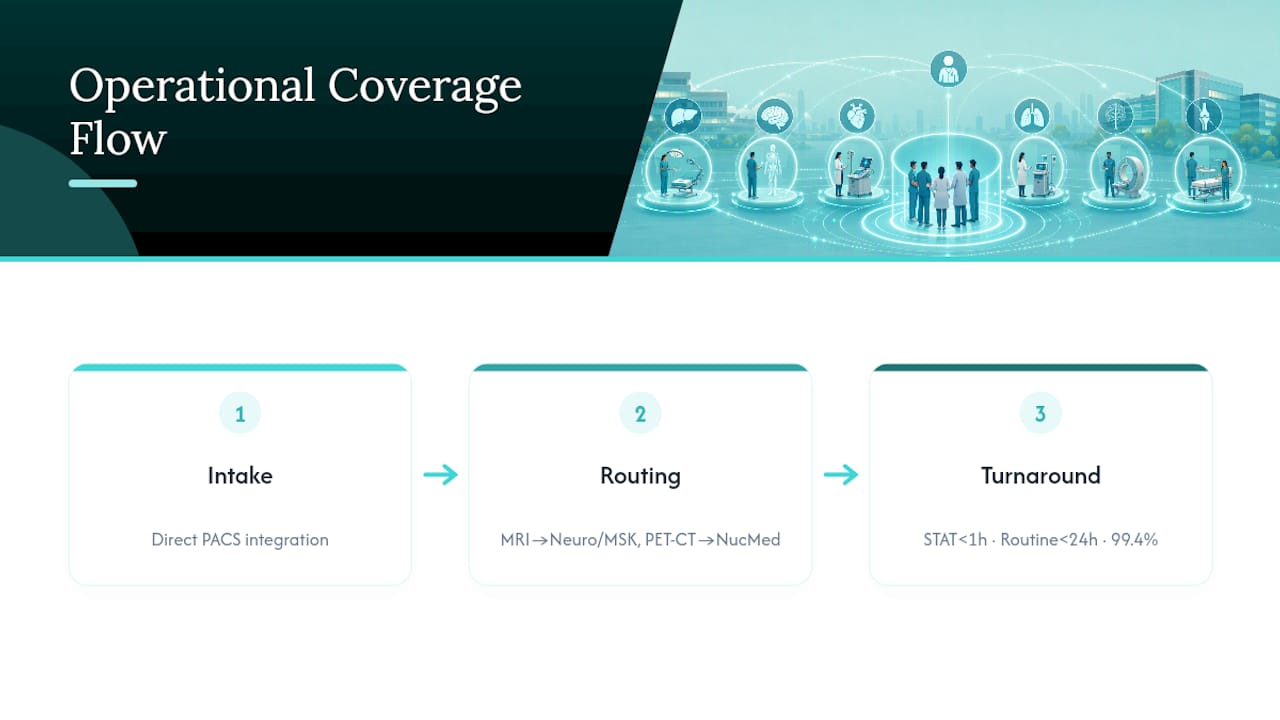
Every study reaches AstraRad's readers through direct PACS integration, with no added portal login. During an RFP or pilot, ask the teleradiology provider for its populated operational matrix and sample acceptance test cases; comparing that document against a competing vendor's proposal usually reveals which one is actually staffed to the claims on paper.
Common Pitfalls and Three High-Impact Checks
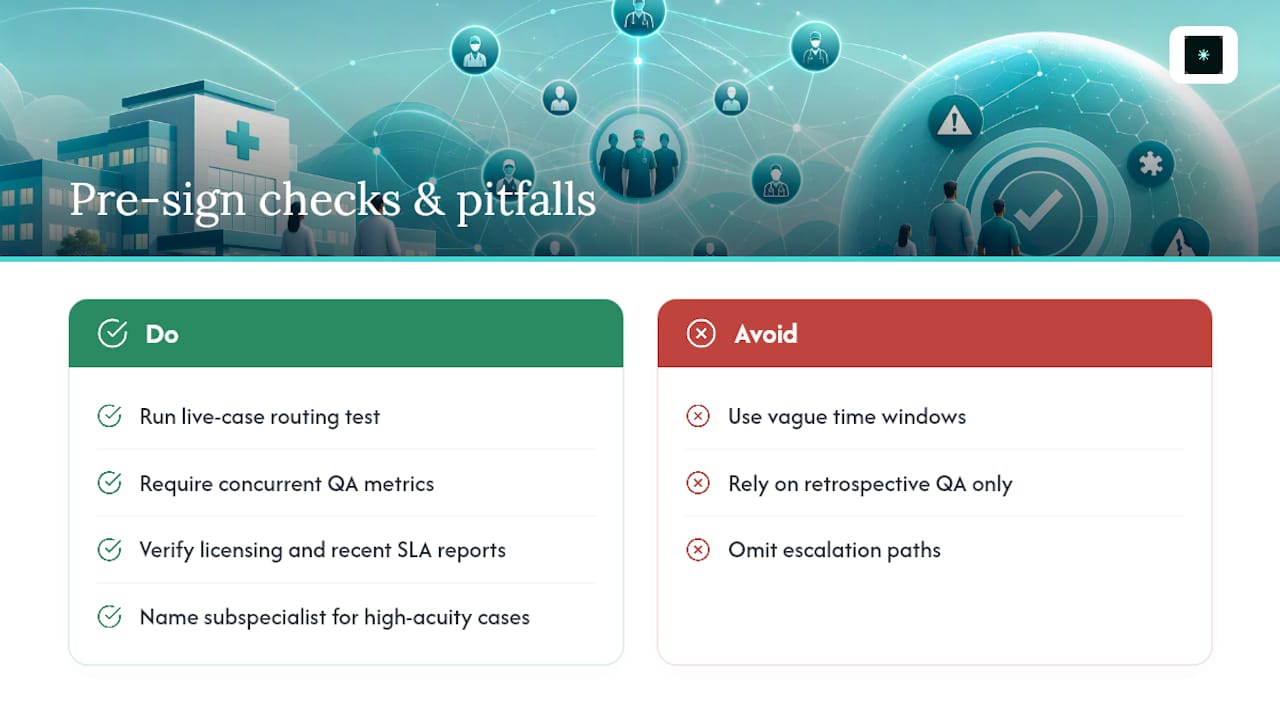
Three mistakes sink most coverage matrix rollouts. Vague windows ("business hours") without exact time zones or holiday schedules create disputes later. Weak QA, retrospective-only sampling with no disagreement tracking, hides quality problems until an outcome forces the issue. Missing escalation paths leave a facility stranded when a primary subspecialist is out.
Run three checks before signing anything: request a live-case routing test, require concurrent QA metrics rather than an annual summary, and verify state licensing alongside recent SLA reporting. Generalist reads are acceptable for routine, low-acuity studies; anything touching stroke protocols, oncology staging, pediatric trauma, or breast imaging findings warrants a named subspecialist every time.
Rafael Vieira
Get an operational matrix for your next RFP as an alternative to piecing together coverage promises from a sales deck: instead of taking a vendor's word for subspecialty availability, you can obtain the actual matrix, complete with named readers, modality mapping, and SLA history, before signing anything. That means fewer surprises during onboarding and a contract you can hold a vendor to line by line.
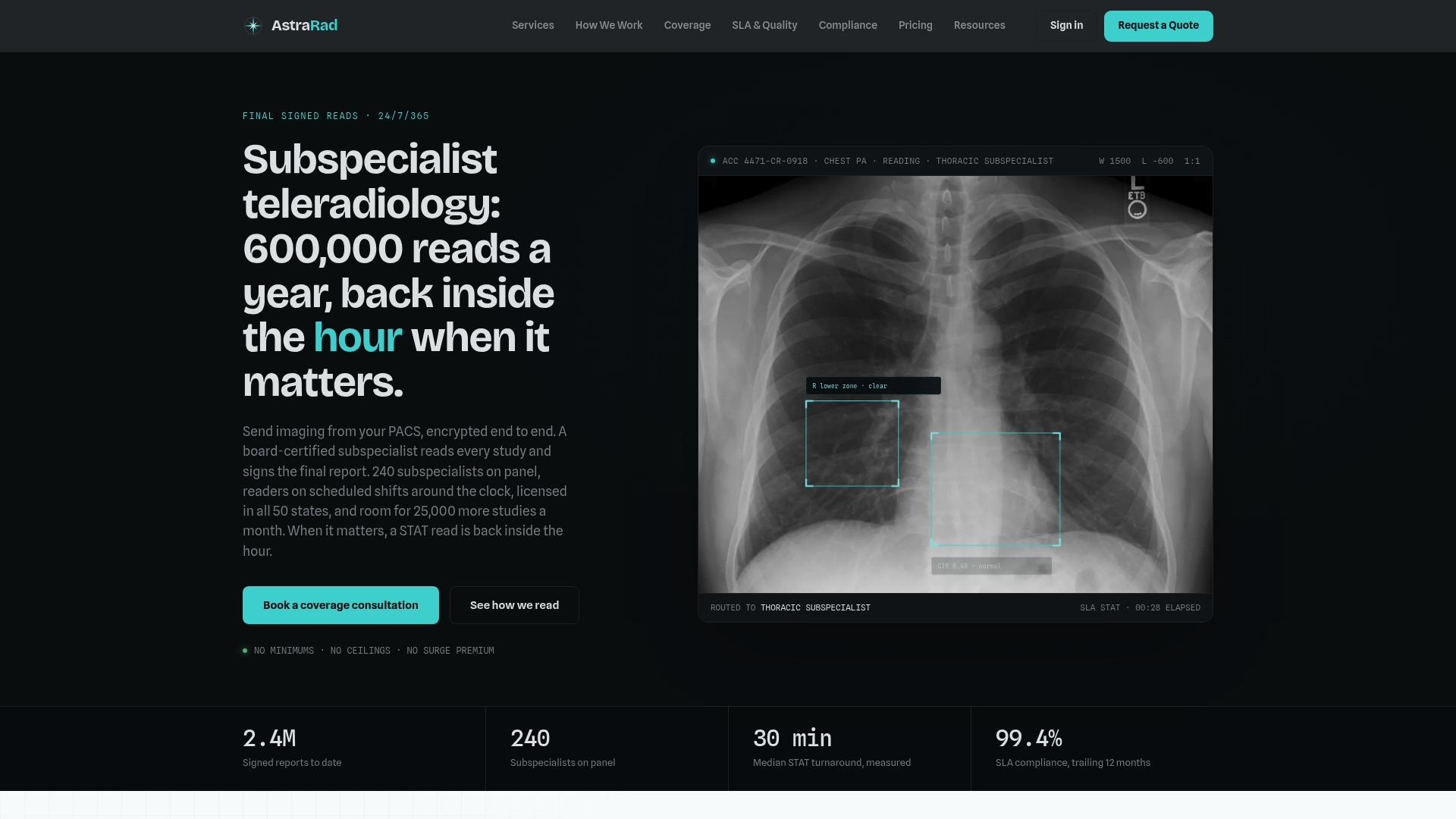
If you're building an RFP or planning a pilot, request AstraRad's operational coverage matrix and sample test cases directly, and use it as the baseline against any other proposal you're comparing.
Sources
- ACR emergency department coverage parameter
- Quality Assurance of a Cross-Border and Sub-Specialized Teleradiology Service
This article is general information, not a substitute for advice from a qualified doctor. Consult a qualified healthcare professional about your own circumstances before acting on anything here.
FAQ
What Is a Subspecialty Coverage Matrix?
It's a table mapping named subspecialist radiologists to the imaging modalities, body parts, and availability windows a facility needs covered. It lets procurement teams confirm exactly who reads what and when, rather than relying on general claims about "subspecialty coverage."
Which Subspecialties Should Every Matrix Include?
At minimum: neuroradiology, MSK, body imaging, pediatric radiology, breast imaging, and nuclear medicine, based on standard buyer's guide criteria. Facilities with heavy oncology or trauma volume should weight nuclear medicine and pediatric rows more carefully.
How Do I Verify a Vendor's SLA Claims?
Request the vendor's actual SLA compliance percentage over the trailing 12 months, broken out by modality and STAT versus routine.
Is Concurrent QA Better Than Retrospective Sampling?
Yes, for catching disagreements early. Peer-reviewed research found that prospective secondary reads combined with continuous sampling reduced disagreement rates more effectively than periodic retrospective review alone.
Does a teleradiology provider give a populated coverage matrix?
Some providers share their populated matrix and sample acceptance test cases during RFPs and pilots, showing which of their board-certified subspecialists cover each modality, body part, and time window.
Recommended
Related on AstraRad
- Resources
5 priority rules for imaging IT
This playbook for Imaging IT covers five DICOM image routing rules, plus monitoring and spool policies that stop misroutes and reduce STAT delays.
- Resources
Weekend radiology coverage: the staffing math
What weekend radiology coverage costs in 2026: the staffing math of internal call, weekend hires, locums, and per-report teleradiology, with sources.
- Resources
Pediatric teleradiology for hospital admins
Operational procurement guide for hospital administrators procuring pediatric teleradiology, with peer reviewed turnaround benchmarks (including 1.6%
Put a radiologist's name on your next read.
Tell us your modalities and monthly volume. A complete per-report rate card, with turnaround tiers and SLA terms in writing, lands in your inbox within one business day.