Per report teleradiology to avoid stark law radiology risk
U.S. compliance playbook for Stark Law radiology referrals: fix documentation gaps, verify CMS exceptions, and use per report teleradiology to lower
Stark Law covers radiology directly. Radiology sits on the designated health services (DHS) list, so any physician with a financial relationship to an imaging provider cannot refer Medicare patients there unless a specific exception applies. Violations carry strict liability, meaning intent doesn't matter. A referral either fits an exception, on paper, before the study happens, or it exposes the practice to civil penalties and possible exclusion from federal programs.
TL;DR:
- Most in-office ancillary services exceptions require imaging to be conducted in the same building or location that meets supervision rules, billed under the group’s own tax ID, to avoid Stark violations.
- CMS’s DHS code list must be checked annually, as services previously excluded from DHS might be added later, affecting compliance.
- A radiologist’s follow-up imaging requests related to an original referral are generally not considered referrals if properly documented, reported, and linked to the initial order.
- Using per-report fee structures for teleradiology, supported by fair market value documentation and active licensing, helps practices avoid Stark risk in outsourced imaging.
- The most common compliance failures involve missing signed contracts before arrangements start and inadequate documentation of carve-outs, making proactive contractual and operational controls essential.
Table of Contents
- What does Stark Law actually prohibit for radiology referrals?
- When is a radiologist's request not a "referral" under Stark?
- Which Stark exceptions protect most imaging arrangements?
- How should radiology practices structure a Stark compliance program?
- Structuring a teleradiology vendor relationship to avoid Stark pitfalls
- Enforcement trends and near-term priorities
- Where AstraRad fits if you're outsourcing radiology reads
- Where to verify the details yourself
- Sources
- FAQ
What does Stark Law actually prohibit for radiology referrals?
The statute is 42 U.S.C. §1395nn, commonly called the Stark Law after the congressman who wrote it. It bars a physician from referring Medicare patients for designated health services to an entity where the physician, or an immediate family member, holds a financial relationship, unless the arrangement fits a defined exception. CMS lists radiology and certain other imaging services explicitly under DHS, alongside clinical lab services, physical therapy, and durable medical equipment.
Two things make this law unusual compared to most healthcare fraud statutes. First, it's civil, not criminal, which means no intent requirement. Second, it applies even when the imaging order is medically appropriate and clinically justified. A radiologist reading a genuinely necessary CT scan can still trigger a violation if the referring physician has an undisclosed ownership stake and no exception covers the arrangement.
Enforcement carries real teeth. According to CMS, civil money penalties can reach substantial amounts per improper claim, and repeat or willful violations can lead to exclusion from Medicare and Medicaid altogether. The 2020 CMS final rule added flexibility for value-based arrangements but tightened the requirement that compensation reflect fair market value rather than referral volume.
Before assuming a service falls outside DHS, check the actual code list:
- CMS publishes the definitive CPT/HCPCS codes for DHS categories, updated periodically.
- Radiology and certain imaging-related services appear explicitly; some diagnostic services tied to a procedure may not.
- Don't rely on a competitor's internal compliance memo or a vendor's marketing claim. Pull the current CMS list directly.
Pro Tip: Bookmark the CMS physician self-referral page and check it annually. DHS code lists get revised, and a service that was excluded last year can be added the next.
When is a radiologist's request not a "referral" under Stark?
Radiology carries a built in carve-out that catches a lot of compliance officers off guard. When a radiologist requests additional imaging, tests, or consultations related to a patient already referred for a specific radiology service, and the results come back to the requesting physician as a written report, that request generally is not treated as a "referral" under the statute.

The StatPearls overview explains this exception in plain terms: it exists because radiologists routinely need follow-up views, contrast studies, or additional sequences to complete a diagnostic picture, and Congress didn't want that clinical judgment treated the same as a self-interested referral.
The carve-out only holds up if specific conditions are documented, every time:
- The radiologist's request must be triggered by, and directly related to, the original referral.
- A written report of the results has to go back to the referring physician.
- The request should be recorded in the same chart or system that tracks the original order, not in a separate log that's hard to reconcile later.
This is where documentation gaps get practices in trouble. Some imaging modalities blur the line. Intra-procedure imaging, like fluoroscopic guidance during a biopsy, generally sits outside DHS because it's part of the procedure itself, not a separate diagnostic referral. Certain limited ultrasound or X-ray checks performed at point of care may also fall outside the DHS definition. But "generally" isn't good enough for an audit. Check every borderline code against the current CMS list before assuming it's exempt, and keep that check on file.
Which Stark exceptions protect most imaging arrangements?
Three exceptions cover the bulk of radiology-related Stark risk. Compliance officers who understand these well can catch most problems before a contract gets signed.
- In-office ancillary services (IOAS) exception. This is the one multi-specialty groups lean on most. It requires the imaging to happen in the same building where the group provides other services, or in a centralized location that meets specific supervision rules, and it requires the group to bill under its own name and tax ID rather than passing the claim through. Miss the location or supervision requirement, and the exception collapses even if everything else checks out.
- Value-based arrangements. The 2020 final rule created new flexibility here, but it comes with strings: the arrangement needs defined value-based goals, monitoring metrics, and documentation showing the arrangement wasn't structured to reward referral volume.
- Fair market value (FMV) and commercial reasonableness. Any compensation arrangement, whether a lease, a medical directorship, or an equipment rental, has to reflect what an arm's length transaction would pay, independent of how many studies get referred.
The most common misapplication is a compensation formula that scales with referral volume, even indirectly. A per-square-foot equipment lease that quietly adjusts based on scan counts is a red flag regulators look for specifically.
Pro Tip: If a compensation formula needs a spreadsheet to explain why it isn't tied to referral volume, that's usually a sign it is.
How should radiology practices structure a Stark compliance program?
A working compliance program rests on three pillars: contracts, documentation, and monitoring. None of them work in isolation.
Contract essentials:
- Every financial arrangement needs a contemporaneous written agreement, signed before the arrangement starts, not backfilled after the fact.
- The agreement should include FMV evidence, ideally from an independent valuation, plus language establishing commercial reasonableness.
- Build in termination and audit rights so the practice can exit or inspect the arrangement if terms drift from what was documented.
CMS and OIG guidance repeatedly flags the absence of a written contract at the arrangement's start as the single most common compliance failure. It's the first thing an auditor asks for, and it's the easiest gap to fix before anyone signs anything.
Operational controls and monitoring matter just as much as the paperwork:
- Log every radiologist-initiated request and its return report in the same system, so the carve-out documentation exists in one place.
- Run billing checks that flag DHS codes against active financial relationships before claims go out.
- Schedule periodic referral-pattern audits, ideally quarterly, comparing referral volume against compensation terms to catch drift early.
- Require sign-off from both compliance and legal on any new imaging-related financial arrangement.
- Train radiologists, referring physicians, and billing staff annually on what counts as a referral and what documentation the carve-out requires.
When an arrangement's structure is genuinely ambiguous, CMS advisory opinions under Section 1877 offer a formal way to get clarity before committing to a structure that could unravel later.
Structuring a teleradiology vendor relationship to avoid Stark pitfalls
One practical way radiology groups reduce Stark exposure is by separating clinical payment entirely from referral relationships. Some teleradiology vendors operate on a per-report fee-for-service model where healthcare providers pay for each completed study signed by a subspecialist, avoiding ownership stakes or referral-based compensation formulas. That structure sidesteps the volume-and-value problem regulators scrutinize most closely.
When vetting any teleradiology vendor for Stark risk, ask for:
- Written FMV support for the per-report pricing structure.
- Proof of active state licensing in every jurisdiction served.
- Audit logs showing the signed-report workflow from PACS submission to final report.
- Evidence of peer review and ongoing QA, not a one-time certification.
Pro Tip: Ask any vendor for their SLA compliance rate over the last twelve months, not just their advertised turnaround time. Some vendors publish their SLA compliance rates, which is the kind of performance a compliance file should include.
Enforcement trends and near-term priorities
Recent enforcement patterns keep landing on the same two failures: missing written agreements and misapplied carve-outs where documentation didn't match what actually happened. Compliance officers should prioritize three things this quarter: confirm every imaging-related contract is signed and current, run a referral-pattern audit against existing compensation terms, and verify that carve-out documentation, request and report, lives in the chart, not a separate file. When a structure feels defensible but unclear, that's the signal to loop in counsel or request a CMS advisory opinion before, not after, a claim gets filed.
Rafael Vieira
Where AstraRad fits if you're outsourcing radiology reads
If your practice is weighing outsourced imaging interpretation as part of tightening Stark compliance, the structure of the vendor relationship matters as much as the read quality. AstraRad's per-report pricing keeps compensation tied to completed work, not referral volume, which is the exact distinction CMS scrutinizes under the 2020 final rule.
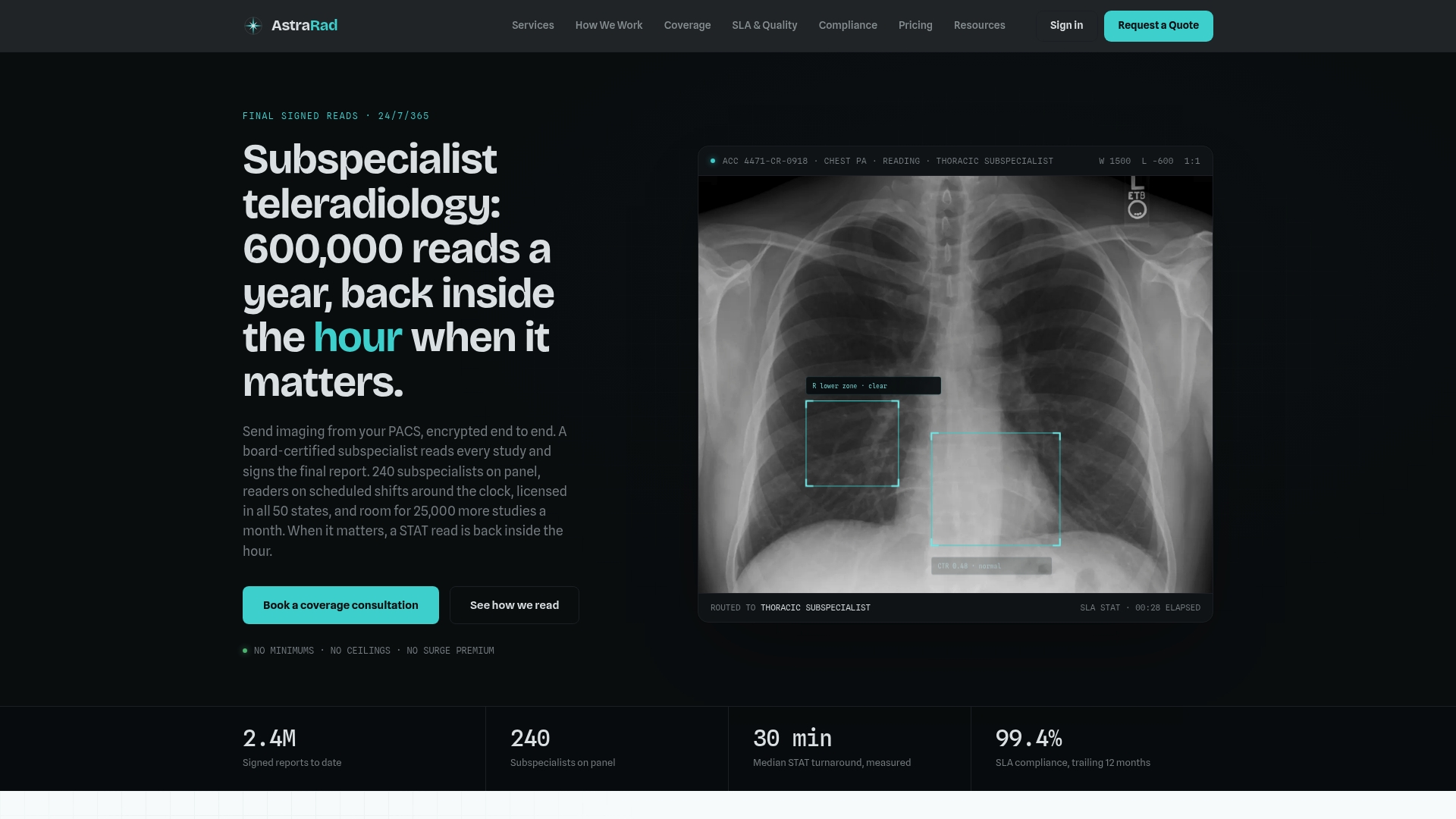
Certain teleradiology providers deliver final signed reports from board-certified subspecialists, with turnaround under one hour for STAT cases and under 24 hours for routine studies, and integrate directly into existing PACS without a separate portal. Before signing with any teleradiology provider, ask for their FMV documentation, current state licensing, audit trail, and peer review process. AstraRad maintains state-by-state licensing coverage, including in Colorado, so compliance teams can verify jurisdictional readiness before a single study gets sent. Review the per-report pricing structure and licensing coverage for your state to see whether the model fits your practice's compliance posture.
Where to verify the details yourself
Don't take any secondhand summary, including this one, as the final word on your specific arrangement. Start with CMS's physician self-referral page for the current DHS code list and penalty figures, then read the 2020 final rule fact sheet for exception details. HHS guidance on Section 1877 covers advisory opinions, and the StatPearls overview is a solid plain-language legal summary for onboarding new compliance staff.
This article is general information, not a substitute for advice from a qualified lawyer. Consult a qualified legal professional about your own circumstances before acting on anything here.
Sources
- Physician Self-Referral
- Stark Law - StatPearls - NCBI Bookshelf
- Guidance for Section 1877 of the Social Security Act (physician self-referral)
FAQ
Who does the Stark Law prohibit from making referrals?
The law prohibits a physician from referring Medicare patients for designated health services, including radiology, to an entity where the physician or an immediate family member has a financial relationship, unless an exception applies.
What are some exceptions to the Stark Law?
The most commonly used exceptions for imaging include in-office ancillary services, fair market value compensation arrangements, and, since the 2020 final rule, certain value-based arrangements with defined monitoring requirements.
What are CMS guidelines for referrals?
CMS requires that any financial relationship tied to a referral be documented in a contemporaneous written agreement, reflect fair market value, and never be structured around referral volume or value, as detailed on CMS's physician self-referral page.
What is not allowed under the Stark Law?
A physician cannot refer a Medicare patient for a designated health service like radiology to a provider they have a financial stake in without a valid exception. Violations are strict liability, meaning even a clinically appropriate referral can trigger civil penalties if no exception fits.
Recommended
Related on AstraRad
- Resources
90 day QA checklist to lower discrepancy rates
Compare real-time (3,5%) and audit (20,30%) discrepancy rates. Use evidence-backed benchmarks, KPIs, and a 90 day QA pilot to reduce misses and guide
- Resources
STAT radiology reads: routing, escalation, and QA
How to run STAT radiology reads as a program: order discipline, routing rules, turnaround benchmarks, escalation paths, and quality control that holds.
- Resources
Musculoskeletal teleradiology with 99.4% SLA and PACS
Imaging centers get fellowship trained musculoskeletal teleradiology reads with PACS integration, SLA backed turnarounds, and STAT results under one hour.
Put a radiologist's name on your next read.
Tell us your modalities and monthly volume. A complete per-report rate card, with turnaround tiers and SLA terms in writing, lands in your inbox within one business day.