Stroke imaging teleradiology: how it works for hospitals
Stroke imaging teleradiology explains protocols, CT and CTA reads, contract terms, and PACS delivery so hospital buyers can evaluate vendors wisely.

Stroke imaging teleradiology is the remote interpretation of brain and vascular imaging for suspected stroke patients by a radiologist who is not on site. A hospital sends non-contrast CT and CT angiography to a remote subspecialist, who returns a final signed report fast enough to support thrombolysis and thrombectomy decisions. The value depends on three things you can write into a contract: who reads, how fast, and how the report reaches your PACS.
- Imaging sequence: Non-contrast CT (NCCT) is enough for an intravenous thrombolysis decision within 4.5 hours, while CT angiography is the standard way to find large vessel occlusion for thrombectomy, per a 2023 STAIR XII roundtable in Stroke.
- Process effect: A 2024 analysis of 1,160 emergency department telestroke consults found that a standardized stroke alert process cut door-to-needle time by 29.26 minutes.
- Our commitment: AstraRad commits by contract to a stroke protocol turnaround of under 30 minutes, measured from last-image arrival to radiologist signature.
- Coverage: Reads are performed inside the United States on scheduled shifts 24/7/365, by radiologists licensed in all 50 states.
- Quality control: 1 in 20 AstraRad reports is independently double-read, blind, for peer review.
TL;DR
- Stroke imaging teleradiology gives a hospital without a neuroradiologist on site a final signed read of NCCT and CTA, any hour of the day.
- Imaging order matters: NCCT first to exclude hemorrhage, CTA next to identify thrombectomy candidates, advanced perfusion only when it will change the decision.
- Contract terms to demand: a defined clock (last-image arrival to signature), a stroke protocol tier, written SLA terms, a signed BAA and delivery into your existing PACS.
- Most avoidable delay sits in image transfer, post-processing and communication, not in the read itself.
- AstraRad offers per-report pricing with no minimums and a stroke protocol tier committed at under 30 minutes.
Table of Contents
- What does stroke imaging teleradiology include?
- Who is AstraRad, and why are we writing this?
- How does an acute stroke read move from scanner to signed report?
- What should the imaging protocol contain?
- Where do the minutes actually go in telestroke imaging?
- What should a stroke protocol clause in a teleradiology contract say?
- Why does subspecialty matching matter for stroke reads?
- How does AI triage fit with a teleradiology read?
- Which PACS and IT questions should you settle before go-live?
- Who needs stroke imaging teleradiology the most?
- What does stroke imaging teleradiology cost?
- How can AstraRad cover your stroke protocol?
- How do you compare vendors on the same criteria?
- What mistakes slow down telestroke imaging?
- FAQ
- Sources
What does stroke imaging teleradiology include?
Stroke imaging teleradiology is a service in which a remote radiologist interprets acute stroke imaging and reports the findings to the treating team. It typically covers NCCT of the head, CTA of the head and neck, and sometimes CT perfusion or MRI, depending on what your emergency department acquires.
The ACR practice parameter for endovascular thrombectomy in acute stroke states the goals of imaging: exclude hemorrhage and stroke mimics such as tumor, estimate the size of the ischemic core, and identify the vessel occlusion. A teleradiology read has to answer those same questions, in that order of urgency.
Two terms are often confused in procurement conversations:
- Teleradiology is a service model in which a radiologist interprets images from a different location than where they were acquired.
- Telestroke is a service model in which a stroke neurologist evaluates a patient remotely by video and reviews the imaging. It is a clinical consult, not a radiology report.
A telestroke neurologist makes the treatment decision. A teleradiologist produces the final signed report that goes into the medical record and supports that decision. Many hospitals need both, and they work best when the imaging read does not wait on the neurology consult or the other way around.
Who is AstraRad, and why are we writing this?
AstraRad is a US teleradiology service that delivers final signed reports read by board-certified subspecialists. We sell this service to hospitals, imaging centers and radiology groups, so we have a commercial interest in the topic, and we say so openly. We wrote this guide so you can judge any provider, including us, against the same checklist.
Our stroke protocol is one of three turnaround tiers, alongside STAT and routine. Each is committed by contract and measured from last-image arrival to radiologist signature. The full range of modalities and study types is on our teleradiology services page, and our STAT CT reads page covers the emergency CT side in more detail.
How does an acute stroke read move from scanner to signed report?
An acute stroke read moves in five steps: patient scanned, images sent, case prioritized, report signed, report delivered to the PACS. The clock that matters to you starts when the last image arrives at the reading service and stops at the radiologist's signature, so each handoff before and after should be known.
- Scan. Your technologist acquires NCCT, usually followed immediately by CTA of the head and neck when a large vessel occlusion is suspected.
- Transfer. Images leave your scanner or PACS over a DICOM connection to the reading service. This is where configuration, firewall rules and encryption decisions are made once, during onboarding.
- Prioritization. The case enters the reading queue flagged as stroke protocol, ahead of routine work.
- Read. A subspecialist matched to the modality and body part interprets the study and signs a final report.
- Delivery. The signed report posts to your existing PACS, so the emergency physician and the neurologist see it where they already work.
The last step is easy to overlook. A report that lives in a separate portal is a report someone has to remember to open. AstraRad delivers into the client's existing PACS with no extra portal, and our integration is DICOM conformant.
What should the imaging protocol contain?
The core protocol is NCCT first, CTA second, and perfusion only when it will change management. The 2023 STAIR XII workshop report notes that NCCT suffices for a thrombolysis decision, CTA or MRA is the standard route to identify large vessel occlusion for thrombectomy candidacy, and over-reliance on advanced imaging can itself delay treatment.
That has practical consequences for how you scope a teleradiology contract.
| Study | Question it answers | Typical use in the stroke pathway |
|---|---|---|
| NCCT head | Is there hemorrhage or a mimic? | First study, drives thrombolysis eligibility within the treatment window |
| CTA head and neck | Is there a large vessel occlusion? Where? | Thrombectomy triage, early and late windows |
| CT perfusion | How much salvageable tissue remains? | Selected patients, often later windows; useful when the answer changes the plan |
| MRI brain | Is infarction confirmed, and how large is the core? | When CT is inconclusive or the onset time is unknown |
The ACR practice parameter for CT perfusion in neuroradiologic imaging is a useful reference for acquisition and interpretation standards when you add perfusion. ACR is clear that such documents are educational tools, and the treating physician's judgment about the patient's condition, resources and urgency takes precedence. Your protocol should say the same: the teleradiology report informs the decision, it does not replace the clinical team.
Should CTA wait for a creatinine result?
In most emergency stroke cases it should not. A review of guidelines for acute ischemic stroke treatment indicates that in emergency settings, CTA can proceed without waiting for serum creatinine when large vessel occlusion is suspected and there is no known history of renal impairment. Confirm the policy with your own radiology and neurology leadership, write it into the protocol, and tell your reading service so technologists are not second-guessed at 3 a.m.
What about MRI?
MRI is a legitimate part of the pathway when CT is inconclusive, but it is slower to acquire in most emergency departments. If your hospital uses MRI for stroke, make sure your teleradiology contract covers it with the same subspecialty matching. Our MRI teleradiology page describes how those studies are read.
Where do the minutes actually go in telestroke imaging?
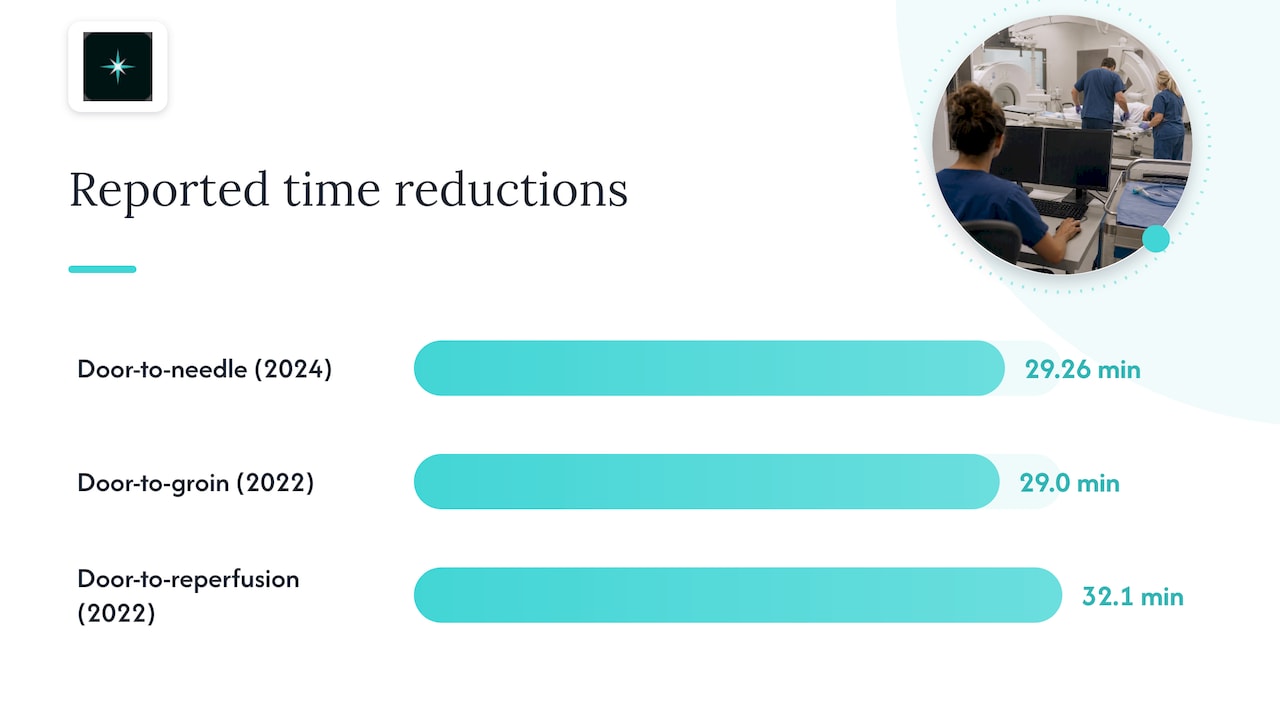
Most avoidable delay in telestroke imaging comes from process around the read: late alerts, slow image transfer, repeated scans and unclear communication. The radiologist's interpretation is rarely the largest block of time, which is why a faster read alone will not rescue a slow pathway.
The published numbers are worth knowing, and each comes with its own limits:
| Finding | Result | Source and year |
|---|---|---|
| Standardized ED stroke alert process with early telestroke notification at a primary stroke center | Door-to-needle time reduced by 29.26 minutes (95% CI 17.45 to 41.08) | Stroke abstract, 2024 |
| Direct-to-angiography-suite triage for suspected large vessel occlusion, compared with imaging first and then transfer | Median door-to-groin time reduced by 29.0 minutes, door-to-reperfusion by 32.1 minutes | Systematic review and meta-analysis, 2022 |
Neither result describes a teleradiology vendor. The first shows what a better alert and imaging workflow does at a hospital using telestroke. The second applies to centers with a thrombectomy-capable angiography suite and a particular triage model, so it does not map onto every spoke hospital. Use them to set your own targets, not to predict a vendor's performance.
The practical lessons for a buyer:
- Notify early. The 2024 process change emphasized early notification of the telestroke service, before the scan finished.
- Avoid repeat imaging. When a hospital transfers a patient, the receiving center needs the original images. The hub-and-spoke thrombectomy paper from UK practice describes 24/7 CT and CTA at every site and image transfer through a secure exchange portal, so the receiving team can see the scan without redoing it. The setting is the NHS, but the workflow principle carries over.
- Measure the transfer leg. Studies of door-in to door-out time at spoke sites in two telestroke networks show why hospitals track time spent at the spoke site, not only the read.
- Define your clocks. Decision time, turnaround time and door-to-needle time are different measurements. Write which one your contract uses.
What should a stroke protocol clause in a teleradiology contract say?
A stroke protocol clause should name the tier, the clock, the commitment and the remedy in writing. If any of the four is missing, the term cannot be audited, and your administrators will have nothing to hold the vendor to when a case runs long.
Use this checklist when you review a proposed SLA:
| Contract element | What to require |
|---|---|
| Tier definition | A distinct stroke protocol tier, separate from STAT and routine |
| Clock | Start and stop events stated precisely, for example last-image arrival to radiologist signature |
| Commitment | A turnaround figure committed by contract, with the report type stated as a final signed report, not a preliminary read |
| Overnight and holiday coverage | Same report type and same tier at every hour, with no downgrade to preliminary reads after midnight |
| Reader qualifications | Board-certified subspecialists, matched to the modality and body part |
| Licensing and credentialing | Licensure in your state, and a documented credentialing process for your medical staff office |
| Quality assurance | A stated peer review method and how results are reported to you |
| Compliance | Business associate relationship under a signed BAA |
| Integration | Delivery to your existing PACS, DICOM conformant |
| Pricing | Per-report fees and any minimums or platform fees stated in the rate card |
For AstraRad, the stroke protocol tier is committed at under 30 minutes, measured from last-image arrival to radiologist signature. STAT is under 4 hours, with under 2 hours or under 1 hour available on request, and routine is 24 to 48 hours. We provide SLA terms in writing in the coverage plan that follows a discovery call.
Why does subspecialty matching matter for stroke reads?
Subspecialty matching means each study goes to a radiologist trained for that modality and body part, rather than to whoever is next in a general queue. For stroke, that means brain and neurovascular imaging reviewed by a reader comfortable with subtle early ischemic change, vessel occlusion and the mimics that can look like stroke.
The field is also changing. Commentary on the Acute Stroke Imaging Research Roadmap IV discusses imaging selection in an era when recent trial results have led clinicians to treat patients with larger infarct cores, which may soften traditional imaging exclusion criteria. A reading service has to adapt to those protocol changes. Ask any vendor how it updates reader guidance when your stroke center revises its criteria, and who on your side approves the change.
AstraRad routes every study to a subspecialist matched to the modality and body part, across ten subspecialties and twelve study types. One in 20 reports is independently double-read, blind, for peer review, and the results feed quality assurance reporting.
How does AI triage fit with a teleradiology read?
AI triage software flags studies that may contain a large vessel occlusion so they rise in the reading queue. It is a prioritization aid, not a diagnosis, and the radiologist still reads the study and signs the report.
The STAIR XII workshop in Stroke is the best reference here for neuroimaging priorities. It describes the main purpose of perfusion imaging as increasingly about detecting medium-sized vessel occlusions eligible for thrombectomy, and it warns about delay from over-reliance on advanced imaging. For a buyer, the questions are simple. Does the tool run inside your PACS workflow or require a separate step? Who validates it? What happens to a case the software does not flag? A study with no flag must still be read within its contracted tier.
Which PACS and IT questions should you settle before go-live?
Settle the DICOM routing, firewall rules, encryption method and report return path before the first live case. Stroke cases are the wrong place to discover that a port is closed or that reports are posting to the wrong worklist.
A practical onboarding list for your PACS administrator:
- DICOM connectivity: Application entity titles, ports and routing rules for stroke protocol studies, tested with sample studies.
- Network security: Firewall configuration and encryption in transit, reviewed by your information security team.
- Study identification: Consistent study descriptions or routing rules so a stroke CT is labeled as stroke protocol at the scanner, not by a phone call.
- Report return: Final signed reports delivered into the existing PACS, with HL7 or other interface details agreed if your RIS or EHR needs them.
- Downtime plan: A documented fallback if the connection fails, including who calls whom.
- Access to prior imaging: Confirmation that the reader can see relevant comparison studies.
On compliance, AstraRad is HIPAA aligned and works as a business associate under a signed BAA. Your compliance office will want that agreement in place before any protected health information leaves your network.
Who needs stroke imaging teleradiology the most?
Hospitals without in-house neuroradiology around the clock need it most: critical access hospitals, community hospitals, freestanding emergency departments and groups that cover many sites with a small reading team. It also helps larger systems that need overflow at night or during a surge.
The common thread is a gap between when a scanner runs and when a qualified reader is available. A rural emergency department may scan a suspected stroke at 2 a.m. with no radiologist in the building. A radiology group may be stretched thin across weekends. Each needs a final signed report, not a placeholder.
Our pages on teleradiology for rural and critical access hospitals and on urgent care X-ray and CT reads describe how coverage is set up for those settings. Urgent care centers that stabilize and transfer patients should also decide, in advance, how a suspected stroke is handled, since many will not have CT on site.
What does stroke imaging teleradiology cost?
Cost depends on the pricing model, and the model matters more than any single number. Common models are per-report fees, monthly minimums, platform or portal fees and annual volume commitments. Each shifts risk differently, and each should be compared on the same basis: the total cost per final signed report at your expected volume.
| Pricing model | How it works | Risk to your budget |
|---|---|---|
| Per report, no minimums | You pay for each completed report | Cost tracks volume; low volume does not create a penalty |
| Monthly or annual minimum | You pay a floor regardless of volume | Low-volume months cost more per report |
| Platform or portal fee added | Per-report fee plus a software charge | Total cost is harder to compare |
| Volume commitment with tiered rates | Lower rates at higher committed volume | Forecast errors become your problem |
Stroke volume is unpredictable, which makes minimums a poor fit for many emergency departments. AstraRad prices per report with no minimums and no additional platform fees. We do not publish rates in articles. You can request a complete per-report rate card, delivered within one business day, and a discovery call leads to a coverage plan with SLA terms in writing. The first signed report arrives within 10 business days of countersignature.
How can AstraRad cover your stroke protocol?
If you want a vendor to cover stroke protocol reads, AstraRad is built for that request. AstraRad is a US teleradiology service that delivers final signed reports read by board-certified subspecialists. Every read happens inside the United States, on scheduled shifts 24/7/365, and the final signed report is the product at every tier, including overnight.
The stroke protocol tier is committed at under 30 minutes by contract. Reports go straight into your PACS. Pricing is per report, with no minimums. To see the range of studies we cover, start at our teleradiology services overview, or visit AstraRad to request a rate card or book a discovery call.
How do you compare vendors on the same criteria?
Compare vendors by asking every one the same ten questions, in writing, and scoring the answers against your contract checklist. Marketing pages tell you what a company wants to say. A written response to a structured request tells you what it will sign.
- Is the stroke protocol a separate tier, and what is its committed turnaround?
- When does the clock start, and when does it stop?
- Is every report a final signed report, including overnight?
- Are all reads performed in the United States?
- Who reads brain and neurovascular studies, and how are they credentialed for our medical staff?
- Which states are covered by licensure?
- How is quality measured, and how often are reports peer reviewed?
- How do reports reach our PACS, and does anyone have to log in to a second system?
- Is there a signed BAA, and how is protected health information handled?
- What are the minimums, platform fees and exit terms?
Keep the answers in one scoring sheet and have your radiology chair, emergency medicine lead, neurology lead, PACS administrator and compliance officer review it together. A procurement decision that involves all five rarely has surprises at go-live.
What mistakes slow down telestroke imaging?
The most common mistakes are procedural: delaying CTA for lab results, repeating scans after transfer, sending stroke cases through the routine queue and failing to test the integration. Each is fixable before the next patient arrives.
- Waiting on labs that guidelines do not require. See the creatinine discussion above and confirm your own policy.
- Repeat imaging after transfer. Make sure images travel with the patient or ahead of them, in a format the receiving center can open.
- Unclear ownership of the call. Decide who phones the emergency physician with critical findings, and write down the number.
- No test cases. Run sample stroke studies through the entire path, including the report return, before go-live.
- Treating a preliminary read as final. If a vendor issues preliminary reports after hours, your hospital inherits a reconciliation task the next morning.
FAQ
What is stroke imaging teleradiology?
Stroke imaging teleradiology is the remote interpretation of CT, CT angiography and sometimes MRI for suspected stroke by an off-site radiologist. The radiologist reviews the images, signs a final report and returns it to the hospital's PACS so the treating team can act on it.
What imaging is needed for a suspected stroke?
Non-contrast CT of the head is the first study, used to exclude hemorrhage and guide thrombolysis decisions within the treatment window. CT angiography is then used to find large vessel occlusion for thrombectomy, according to the 2023 STAIR XII report. Perfusion or MRI is added for selected patients.
What is the difference between telestroke and teleradiology?
Telestroke is a remote neurology consult in which a stroke specialist evaluates the patient and advises on treatment. Teleradiology is the remote interpretation of the images. A hospital often uses both: the neurologist makes the clinical decision while the teleradiologist provides the final signed imaging report.
How fast should a stroke imaging read be?
There is no single universal number in a contract; it should be committed in writing, with the start and stop points defined. AstraRad's stroke protocol tier is committed at under 30 minutes, measured from last-image arrival to radiologist signature, and the commitment sits in the SLA terms of your coverage plan.
Do teleradiology reports go into our existing PACS?
They should, and you should ask. AstraRad delivers final signed reports straight into the client's existing PACS with no extra portal, and the integration is DICOM conformant. Your PACS administrator should test connectivity and report return with sample studies before go-live.
Sources
- Abstract 34: Achieving a 30 Minute Door to Needle Time in a Primary Stroke Center via Telestroke, Stroke, 2024
- Direct to angiography suite approaches for the triage of suspected acute stroke patients: systematic review and meta-analysis, 2022
- Priorities for Advancements in Neuroimaging in the Diagnostic Workup of Acute Stroke, Stroke, 2023
- Guidelines for Acute Ischemic Stroke Treatment
- Hub-and-spoke model for thrombectomy service in UK NHS practice, 2021
- Door in door out and transportation times in 2 telestroke networks, 2019
- ACR,ASNR,SIR,SNIS Practice Parameter for Endovascular Thrombectomy and Revascularization in Acute Stroke
- ACR,ASNR,SPR Practice Parameter for CT Perfusion in Neuroradiologic Imaging
- Acute Stroke Imaging Research Roadmap IV, Stroke
Recommended
Related on AstraRad
- Resources
2027 Medicare fee schedule: the radiology numbers explained
The CY2027 Medicare fee schedule cuts both conversion factors while ACR estimates radiology gains 2 percent. Both are true. Model your dollars per RVU.
- Resources
Radiology addendum policy: how to write one that works
A radiology addendum policy defines when to amend a signed report, who notifies the ordering provider, and how you audit it; here is how to write one.
- Resources
Clinician-radiologist communication: closing the loop
Clinician-radiologist communication fails when critical results reach a system but never reach the physician, and closed-loop standards close that gap.
Put a radiologist's name on your next read.
Tell us your modalities and monthly volume. A complete per-report rate card, with turnaround tiers and SLA terms in writing, lands in your inbox within one business day.