Teleradiologist contracts: what to require before signing
A procurement-focused explainer for hospital administrators: what to require from a teleradiologist contract, how to verify PACS integration

A teleradiologist is a licensed, board-certified radiologist who interprets medical images from a remote location and issues a signed diagnostic report, the same legal document a hospital's on-site radiologist would produce. The role exists to close two gaps at once: access to subspecialty expertise and faster turnaround, without adding headcount on site. Every report still requires active state licensure and institutional credentialing before it can be signed.
TL;DR:
- Teleradiologists must maintain active state licenses in every jurisdiction they interpret studies for, increasing administrative workload with each new state.
- Auditing SLA compliance and reviewing sample signed reports are crucial steps before contracting a teleradiology provider.
- AstraRad commits by contract to STAT reads under 4 hours (under 2 hours or 1 hour on request), routine reads in 24 to 48 hours, and stroke protocol reads under 30 minutes.
- Licensing, credentialing, and infrastructure integration are key hurdles, so ask providers for end-to-end DICOM transfer demos before signing.
- Using teleradiology shifts on-call culture and staffing practices and should be piloted on a small scale with tracked SLA and QA data.
Table of Contents
- What does a teleradiologist do day to day?
- How does teleradiology work from image capture to signed report?
- What qualifications and licensure does a teleradiologist need?
- Intra-mural or extra-mural: which teleradiology model fits?
- What are the benefits and limitations of teleradiology?
- How do you evaluate and contract a teleradiology service?
- How AstraRad operationalizes subspecialty reads and SLAs
- What does distributed reading mean for your radiology staffing?
- AstraRad: how we can help and where to learn more
- FAQ
- Sources
What does a teleradiologist do day to day?
A teleradiologist spends most of a shift reading studies: CT, MRI, X-ray, ultrasound, and PET-CT, depending on the contract and the subspecialty match. Each study ends in a final signed report that becomes part of the patient's permanent record, not a preliminary note pending a second look.
Two reading arrangements are common. A primary read means the teleradiologist's report is the only interpretation the patient receives. A consultative or secondary read supplements an on-site radiologist's work, often for a complex or ambiguous case. Either way, the teleradiologist communicates directly with the referring clinician when findings are urgent, usually by phone or secure message, before the written report reaches the chart.
- The signed report includes the clinical history, technique, findings, impression, and the radiologist's credentials.
- Reports route back through the transmitting site's PACS or EMR, so they appear where clinicians already look for them.
- Critical findings trigger a direct call to the ordering provider, separate from the written report.
How does teleradiology work from image capture to signed report?
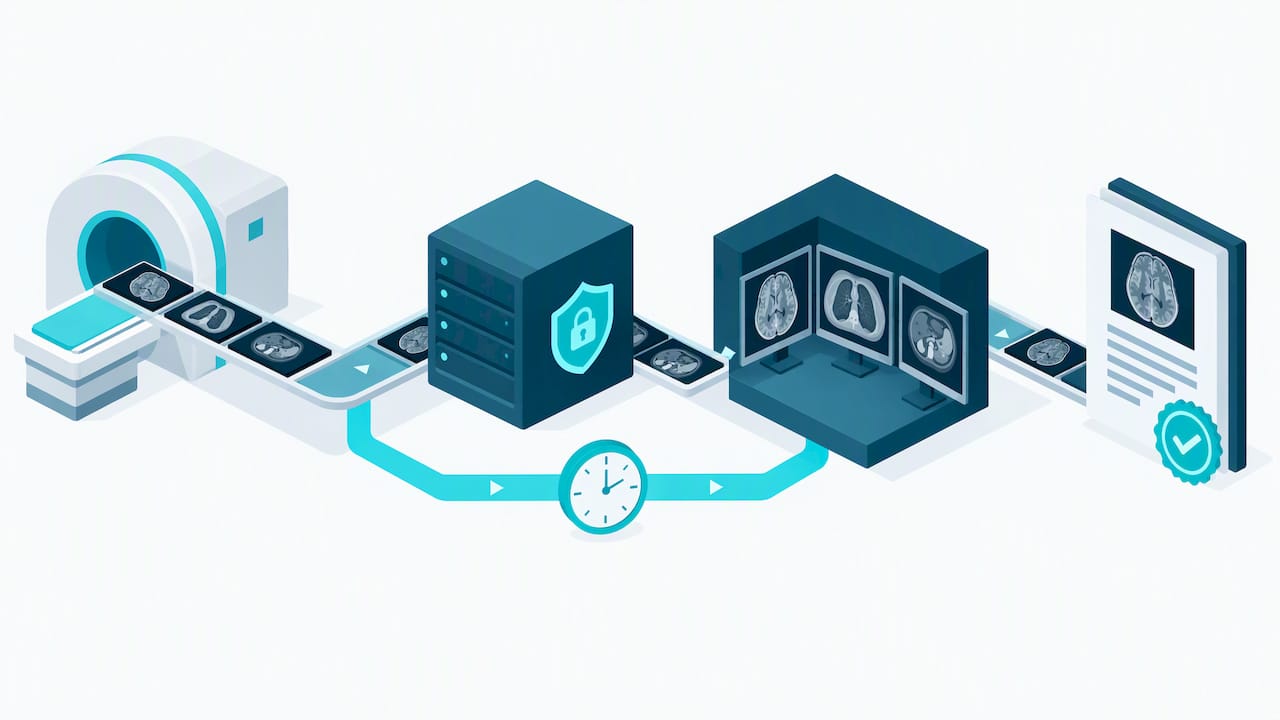
The path from a patient's scan to a signed report follows a consistent sequence, regardless of which vendor handles the read.
- The imaging site acquires the study and exports it in DICOM format, the universal standard for medical image files.
- The study moves across an encrypted connection, often a secure VPN or an encrypted transfer protocol covered by a business associate agreement, to the reading radiologist's workstation.
- The radiologist reviews the images on a diagnostic-grade monitor through a PACS or a zero-footprint viewer that requires no local software install.
- The radiologist dictates and signs the report, which flows back to the originating site's PACS or EMR through HL7 messaging.
- The report lands in the patient's chart, and urgent findings generate an immediate call alongside the written note.
Secure, standards-based transmission is not optional. Compliant teleradiology depends on adherence to HIPAA and DICOM standards to keep patient-identifiable data protected as it moves between sites. Turnaround tiers typically split into STAT, urgent, and routine categories, each with its own service-level target, and a well-run program reports compliance against those targets on a recurring schedule rather than only when something goes wrong.
Pro Tip: Ask any prospective teleradiology partner to walk through a sample DICOM transfer end to end before you sign anything, not just describe it.
What qualifications and licensure does a teleradiologist need?
Procurement teams and medical staff offices should verify credentials before a single study crosses the wire, not after. The baseline is the same whether the radiologist sits down the hall or three time zones away.
- Completion of an ACGME-accredited radiology residency, or an equivalent recognized training pathway.
- Board certification in diagnostic radiology, with subspecialty fellowship training where the contract calls for it.
- An active, unrestricted medical license in every state where the radiologist will interpret studies, since licensure is state-specific and does not automatically transfer.
- Institutional credentialing and privileging at the receiving facility, plus malpractice coverage that names the teleradiology arrangement explicitly.
- Participation in a peer review program that samples reads for accuracy and consistency over time.
Multi-state licensing is where many administrators underestimate the workload. A perspective in the radiology literature notes that teleradiologists often maintain active licenses in every state where they read, which creates real administrative overhead for both the radiologist and the contracting hospital. Our licensing coverage page breaks down how that works in practice.
Intra-mural or extra-mural: which teleradiology model fits?
Teleradiology splits into two governance models, and the difference matters more than most contracts acknowledge up front. The ESR white paper on teleradiology defines intra-mural (in-sourced) arrangements as reads performed by radiologists within the same health system or a tightly affiliated group, versus extra-mural (outsourced) arrangements where an external provider handles the work.
- Intra-mural setups usually preserve full EPR access and tighter governance, since the reading radiologist already sits inside the organization's credentialing and IT structure.
- Extra-mural arrangements trade some of that direct access for speed and subspecialty breadth, which is why they fit after-hours coverage, overflow and backlog support, and rural hospitals without resident subspecialists.
- Either model requires the same transparency commitment: the ESR recommends that patients be informed when their images may be read through teleradiology, and that the reporting radiologist's qualifications stay available on request.
What are the benefits and limitations of teleradiology?
Teleradiology extends coverage into hours and locations that would otherwise go unstaffed, and it opens access to subspecialty reads that a smaller hospital could never justify hiring full time. Turnaround often improves because the reading pool is not limited to whoever is physically on call that night.
The tradeoffs are real, though. Licensing complexity grows with every new state served. EPR access varies by model, which can leave a remote radiologist reading without the prior reports or lab values an on-site colleague would have open. Clinical context sometimes arrives incomplete, and that gap falls on both sides to manage.
- Benefit: extended after-hours and weekend coverage without adding on-site staff.
- Benefit: access to fellowship-trained subspecialists for complex modalities like MRI and PET-CT.
- Limitation: licensing and credentialing overhead scales with every jurisdiction served.
- Safety baseline: dose and equipment performance should track ACR technical standards for remote imaging, including monitoring and shared liability guidance.
Radiology sits among the top five highest-paid US medical specialties, a trend tied in part to demand for diagnostic imaging and remote reading capacity. That demand is a large part of why teleradiology coverage has become a staffing lever rather than a stopgap.
How do you evaluate and contract a teleradiology service?
A procurement checklist keeps the conversation grounded in what actually determines whether a contract works six months in.
- Ask for SLA targets by tier (STAT, urgent, routine) and request median turnaround data, not just the contractual ceiling.
- Confirm how often SLA compliance gets reported and whether that reporting is automated or manually compiled.
- Walk through PACS and EMR integration specifics: does the radiologist read inside your existing viewer, or do you need a separate portal?
- Verify DICOM and HL7 support, plus single sign-on if your IT policy requires it.
- Request the roster's board certification details and ask how the peer review and QA program samples reads.
- Ask for a sample signed report so your medical staff can judge format and clinical detail before go-live.
- Clarify the pricing model (per-report is standard), liability and indemnity terms, data ownership, and the realistic onboarding timeline.
Pro Tip: Treat the integration proof-of-concept as a real test, not a formality: stream a full CT or MRI series through the proposed viewer and time it yourself before you commit. Our how-we-work page outlines what that technical path looks like for a new client. For a second opinion on vetting any remote health platform, the telehealth platform HIPAA guidance from Klyr Media covers similar ground from a broader telehealth angle.
How AstraRad operationalizes subspecialty reads and SLAs
AstraRad is a teleradiology provider built around a narrow claim: every study is read and signed by a US board-certified subspecialist matched to that modality and body part with contractual turnaround commitments rather than best-effort targets. AstraRad commits to STAT reads under 4 hours, under 2 hours or 1 hour on request, routine reads in 24 to 48 hours, and stroke protocol reads under 30 minutes, and integrates directly into a client's existing PACS rather than adding another portal to log into. Those are contract commitments, and they illustrate what procurement should ask any teleradiology vendor to put in writing rather than take on faith.
Before signing with any provider, including AstraRad, request:
- The SLA reporting format, broken out by turnaround tier, and how often it is sent.
- A live integration proof-of-concept against your actual PACS environment.
- The licensure roster for the states where your facility operates.
- A peer review summary showing how QA sampling works in practice.
Our services page lists modality coverage in detail for administrators comparing options.
What does distributed reading mean for your radiology staffing?
Shifting reads off site changes more than coverage hours. It reshapes on-call culture, retention conversations, and how junior radiologists build case variety. A short pilot, measured against real SLA and QA data, tells you more about fit than any sales conversation will. Start small: one modality, one shift gap, one quarter of data before you expand.
AstraRad: how we can help and where to learn more
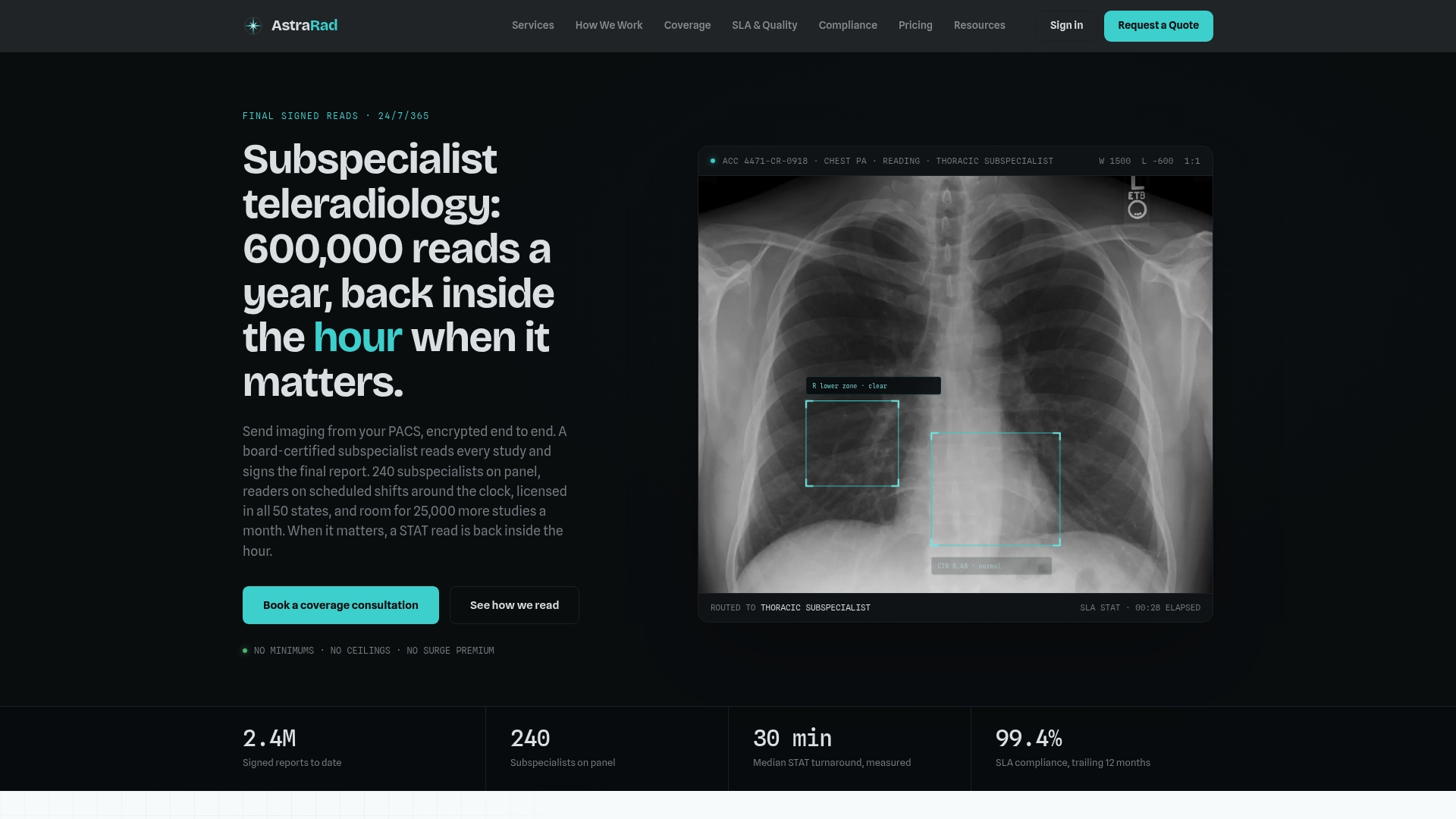
If your gap is subspecialty coverage or a turnaround target you cannot staff for internally, AstraRad reads are signed by US board-certified subspecialists under SLA-backed commitments for both STAT and routine studies, and the workflow runs through your existing PACS instead of a new system to train staff on.
- Request a sample signed report and the SLA reporting format before you evaluate anything else.
- Ask for an integration proof-of-concept scoped to your current PACS.
- Review per-report pricing to budget a pilot without guessing at cost.
This article is general information, not a substitute for advice from a qualified doctor. Consult a qualified healthcare professional about your own circumstances before acting on anything here.
FAQ
How long does it take to become a teleradiologist?
Becoming a teleradiologist follows the same path as becoming any radiologist: four years of medical school, a radiology residency (typically four to five years through an ACGME-accredited program), and often a one- to two-year fellowship for subspecialty work. Board certification and active state licensure come after training is complete, before any teleradiology contract can begin.
What is the highest pay for a radiologist?
Specific top-end compensation figures vary widely by subspecialty, geography, and practice setting and are not consistently published. What is documented is that radiology ranks among the top five highest-paid US medical specialties, a trend linked to demand for diagnostic imaging and remote reading capacity.
How do you become a teleradiologist?
A teleradiologist first completes standard radiology training: medical school, an ACGME-accredited residency, board certification, and any relevant fellowship. From there, the radiologist obtains active, unrestricted licenses in the states where they intend to read and secures credentialing with the facilities or teleradiology group they will work for.
What is the average salary for a teleradiologist in the USA?
No single, verified average salary figure for teleradiologists specifically is publicly documented, since compensation varies by subspecialty, contract volume, and region. What is established is that radiology overall sits among the top five highest-paid medical specialties in the country.
Sources
- Secure image exchange and standards for teleradiology (peer‑reviewed article)
- ACR practice parameter for remote imaging and teleradiology technical standards
- Radiology among top specialties for pay, compensation growth
Recommended
Related on AstraRad
- Resources
What a teleradiologist does: training and credentials
A teleradiologist is a board-certified radiologist reading remotely. Training path, licensing, shift structure, and how to verify who reads your studies.
- Resources
Inside a teleradiology company: how the machine works
How a teleradiology company actually operates behind the reading room: worklist engines, night staffing, licensing operations, credentialing, and QA.
- Resources
Radiology compliance reporting for compliance officers
Checklist for compliance officers to make radiology reports audit ready: required fields, PACS risk analysis, ACR RADS, MIPS dose capture, audit cadence
Put a radiologist's name on your next read.
Tell us your modalities and monthly volume. A complete per-report rate card, with turnaround tiers and SLA terms in writing, lands in your inbox within one business day.