3 teleradiology billing fixes to stop Medicare denials
Medicare teleradiology billing checklist for billing teams: fix PC/TC allocation, confirm PECOS and MAC jurisdiction, and enter the correct CMS-1500 box

Teleradiology billing follows the same PC/TC framework as any radiology claim: the originating facility bills the technical component with modifier TC, and the interpreting radiologist bills the professional component with modifier 26. Confirm the radiologist's PECOS or CMS-855I enrollment matches the correct MAC jurisdiction, and enter the interpreter's actual practice location, not the facility's address, in CMS-1500 box 32. Get those three things right and most denial risk disappears before a claim ever leaves the building.
TL;DR:
- Ensuring the radiologist's PECOS enrollment and practice location match the MAC jurisdiction is crucial, as mismatches frequently cause claim denials.
- For billing, the facility must use modifier TC for the technical component and the radiologist's group bills with modifier 26 for the professional component, avoiding inappropriate telehealth modifiers.
- Place of service codes should reflect where the technical work occurred, and box 32 must list the radiologist's actual PECOS-enrolled location to prevent location mismatch edits.
- State licensure must be current everywhere imaging studies originate, with regular updates and documentation to avoid audit findings and credentialing issues.
- Verifying payer-specific rates through direct contract review and repeating this process annually helps prevent financial discrepancies and ensures correct reimbursement.
Table of Contents
- Medicare rules, enrollment, and reassignment for teleradiology
- Professional component (PC) vs technical component (TC): who bills and how
- Claim mechanics: place of service, CMS-1500 box 32, and payer routing
- State licensure, credentialing, and MAC jurisdiction pitfalls
- Anti-markup rule and billing for reassigned claims
- Common teleradiology billing scenarios and practical examples
- Compliance checklist: documentation, audit readiness, and best practices
- How AstraRad supports compliant billing operations
- Billing differences and requirements for commercial/private insurers vs Medicare
- Guidance on reimbursement rates and how to verify payer-specific rules
- Handling denials and appeals specific to teleradiology claims
- Patient consent requirements and their impact on billing
- Integration of teleradiology billing with electronic health record (EHR) systems
- Author perspective: practical governance steps billing teams should prioritize
- Sources
- FAQ
Medicare rules, enrollment, and reassignment for teleradiology
Medicare doesn't have a separate rulebook for teleradiology. It applies the same Medicare Program Integrity Manual Chapter 10 enrollment and reassignment framework used for any physician who bills through a group. The practical difference is geography: your radiologist might sit in a home office in Arizona while reading studies for a hospital in Ohio, and both PECOS and the Medicare Administrative Contractor need to reflect that reality accurately.
CMS retired the standalone 855R reassignment form. Reassignment now runs through PECOS directly or the consolidated CMS-855I, which simplifies adding or removing a radiologist from a group's roster. The catch is enrollment location. A group must be enrolled with the MAC jurisdiction covering wherever the radiologist regularly interprets studies, not just where the group's home office sits.
Before onboarding any new teleradiology vendor or independent contractor radiologist, verify:
- Active PECOS enrollment matching the radiologist's actual reading location
- Reassignment on file connecting the radiologist to the billing group's NPI
- MAC jurisdiction alignment between the radiologist's location and the group's enrollment
- State medical license current in every state where studies originate
Professional component (PC) vs technical component (TC): who bills and how?
The professional component covers the physician's interpretation and report. The technical component covers the equipment, technologist, and facility costs of producing the image. CMS payment condition guidance treats these as two distinct billable services even when they happen at different locations for the same study.
For teleradiology, the split maps cleanly:
- The imaging facility bills the technical component using modifier TC, since it owns the equipment and performed the acquisition.
- The interpreting radiologist's group bills the professional component using modifier 26, regardless of physical distance from the scanner.
- Neither party bills the global (unmodified) code, since no single entity performed both halves of the service.
One frequent error: applying telehealth modifiers 95, GT, or GQ to a radiology read. Telehealth billing rules generally exclude image interpretation from that category, so those modifiers don't belong on a PC claim line.
Claim mechanics: place of service, CMS-1500 box 32, and payer routing
Place of service should reflect where the technical component happened, not where the radiologist sat when reading it. POS 02 (telehealth provided other than in patient's home) and POS 10 rarely apply to a radiology professional component claim, because CMS doesn't classify the interpretation itself as a telehealth encounter.
Box 32 on the CMS-1500 form asks for the service facility location. For the professional component, that means the radiologist's actual practice location as enrolled in PECOS, not a generic corporate address. Getting this wrong triggers a location mismatch edit at the MAC level.
Before submitting a batch of teleradiology claims, check:
- POS code matches the technical component's actual service site
- Box 32 lists the radiologist's PECOS-enrolled address and NPI, not the vendor's headquarters
- The claim routes to the MAC covering that specific location
- Any edit rejection referencing "provider location" gets traced back to a PECOS or box 32 mismatch first
State licensure, credentialing, and MAC jurisdiction pitfalls
CMS enrollment doesn't grant a license to practice medicine. That's a state-by-state requirement, and it's where a surprising number of teleradiology arrangements fall apart. CMS itself is relatively permissive about where a radiologist physically sits, but the American College of Radiology's position is stricter, and many groups adopt that more conservative standard to avoid state medical board exposure.
Practical verification steps for any remote reading arrangement:
- Confirm active licensure in the state where the patient received the imaging study, not just where the radiologist lives
- Cross-check licensure renewal dates against your credentialing calendar quarterly
- Log every radiologist's practice location changes and update PECOS within CMS-required windows
- Reconcile the PECOS practice location type field, since CMS allows a "home office for administrative/telehealth use only" designation that keeps home addresses off public directories while preserving accurate MAC routing
Pro Tip: Build a single spreadsheet or credentialing system that tracks license expiration, PECOS enrollment date, and MAC jurisdiction side by side for every radiologist. Most audit findings trace back to one of these three going stale without anyone noticing.
Anti-markup rule and billing for reassigned claims
The anti-markup rule limits what a billing entity can charge Medicare when it purchases a diagnostic test's technical or professional component from an outside supplier and bills for it as its own. CMS payment condition guidance caps the billed amount at the lower of the supplier's net charge or the fee schedule rate for the performing entity.
This differs from a properly reassigned claim, where the radiologist has formally reassigned billing rights to the group under PECOS, and the group bills directly under its own arrangement rather than "purchasing" an interpretation from an outside vendor.
Documentation that protects against anti-markup findings:
- Signed reassignment forms on file for every radiologist billing under the group
- Contract language specifying whether services are reassigned or purchased under an anti-markup arrangement
- Claim-level notes tying each interpretation to a specific reassignment or purchase agreement, useful if a vendor's per-report pricing structure is ever questioned during review
Common teleradiology billing scenarios and practical examples
Setting works differently depending on where the patient sits when the study happens.
- Hospital inpatient: The technical component is typically bundled into the hospital's Part A payment, so a supplier billing a separate TC claim for an inpatient study usually gets it adjusted or denied. Only the professional component bills separately to Part B.
- Outpatient or freestanding imaging center: Both PC and TC bill separately, routed to the MAC covering each billing entity's respective location.
- Skilled nursing facility (SNF): Consolidated billing rules often mean the technical component falls under the SNF's responsibility, similar to inpatient logic, per CMS billing guidance.
- Critical access hospital (CAH): CAHs frequently bill on a cost basis rather than fee schedule, which changes how the technical component reconciles against Medicare payment.
Most denials in these scenarios trace back to billing the TC separately when it should have been bundled, or vice versa.
Compliance checklist: documentation, audit readiness, and best practices
Audit exposure in teleradiology usually comes from paperwork gaps, not intentional fraud. OIG enforcement activity has repeatedly flagged provider enrollment and location errors as a recurring vulnerability.
Keep these current at all times:
- Enrollment records, reassignment forms, and state licenses stored together and reviewed monthly
- Radiologist practice location logs updated the same week any change happens
- Signed vendor contracts with explicit billing-responsibility and anti-markup language
- A remediation log documenting every MAC edit response and denial appeal outcome
Pro Tip: Run a small pre-audit sample of 15 to 20 claims each month, checking PECOS status, box 32 accuracy, and PC/TC modifier pairing. Catching a pattern early is far cheaper than a full post-payment review.
How AstraRad supports compliant billing operations
AstraRad is a US teleradiology provider delivering final signed reports through board-certified subspecialists across every major imaging modality. Its radiologists carry state licensure aligned to each client's coverage area, and onboarding is built around PECOS-aware enrollment so billing teams aren't left reconciling mismatched jurisdictions after the fact. Paired with direct PACS integration and guaranteed turnaround times, a compliance-focused partner like this reduces the enrollment and documentation gaps that typically drive denials.
Billing differences and requirements for commercial/private insurers vs Medicare
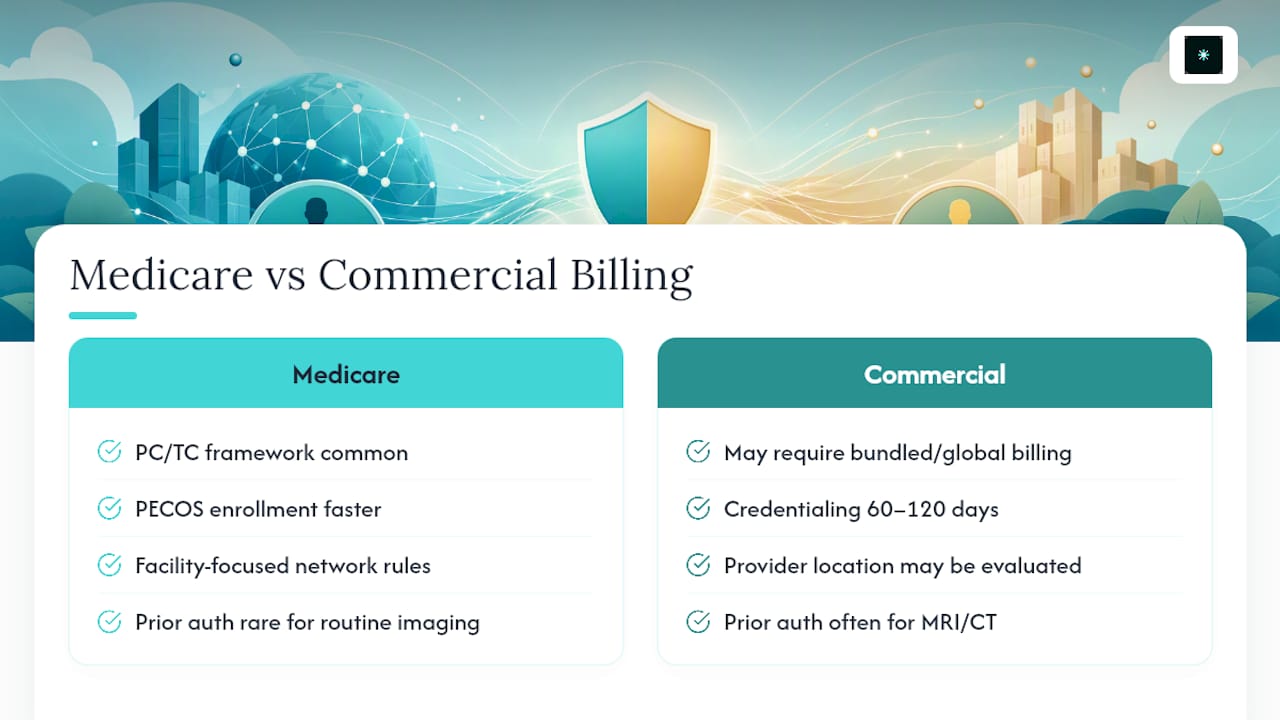
Commercial payers don't follow Medicare's PC/TC framework uniformly. Some private insurers accept the same modifier 26 and TC structure, while others require bundled global billing from a single entity regardless of where the interpretation happened. That inconsistency means a claim format that clears Medicare cleanly can bounce back from a commercial payer for an entirely different reason.
Credentialing timelines diverge too. Medicare enrollment through PECOS typically moves faster than commercial payer credentialing, which can take 60 to 120 days depending on the insurer and specialty. A radiologist who's fully PECOS-enrolled and reading Medicare claims without issue might still be unable to bill a specific commercial plan until credentialing clears, which creates a real gap if a teleradiology arrangement launches before that paperwork finishes.
Network status matters more with commercial insurers than with Medicare. A radiologist reading remotely for an in-network facility doesn't automatically inherit in-network status with every payer that facility contracts with. Some commercial plans specifically evaluate the location of the reading radiologist, not just the facility, when determining network participation and applicable reimbursement.
Prior authorization requirements also differ sharply. Medicare rarely requires prior authorization for standard diagnostic imaging interpretation, but many commercial plans require it for advanced imaging like MRI or CT, and a missing authorization can result in denial of the professional component even when the technical component is paid. Billing teams working across both Medicare and commercial payers need separate checklists, not a single unified process, because the two systems diverge on credentialing speed, network rules, and authorization requirements in ways that a one-size-fits-all workflow won't catch.
Guidance on reimbursement rates and how to verify payer-specific rules
Medicare publishes its Physician Fee Schedule rates publicly, giving billing teams a fixed, predictable baseline for professional component reimbursement by CPT code and geographic locality. Commercial payer rates aren't public in the same way. Each contract negotiates its own rate, and that rate can vary by facility, radiologist network status, and even the specific imaging modality being read.
The most reliable way to verify payer-specific rates is direct confirmation, not assumption. Pull the actual fee schedule attachment from each commercial contract rather than relying on a facility's general sense of "what usually gets paid." Contracts get amended, and a rate that was accurate eighteen months ago may no longer reflect the current agreement.
For groups using outside teleradiology vendors, understanding per-report pricing structures matters just as much as understanding payer reimbursement, since the margin between what a vendor charges per interpretation and what a payer reimburses determines whether a given study type is financially sustainable to outsource. Running that comparison by modality, rather than as a blanket average, usually reveals that some study types are far more profitable to send out than others.
Rate verification should happen on a recurring schedule, not just at contract signing. Payer fee schedules update annually at minimum, and Medicare's own rates shift each calendar year based on the finalized Physician Fee Schedule. A verification calendar tied to contract renewal dates and the calendar year keeps billing assumptions from drifting out of date.
Handling denials and appeals specific to teleradiology claims
Most teleradiology denials trace back to one of three causes: a location mismatch between box 32 and the enrolled PECOS address, an inappropriate telehealth modifier applied to a radiology read, or a MAC jurisdiction conflict where the radiologist's enrollment doesn't match the reading location tied to the claim.
Start any denial review by checking the remittance advice reason code before assuming the clinical documentation is at fault. A surprising number of teleradiology denials are administrative, not clinical, meaning the interpretation itself was fine but the claim's location or modifier data didn't match what the MAC expected. Fixing a resubmission without correcting the underlying PECOS or box 32 issue just produces the same denial again.
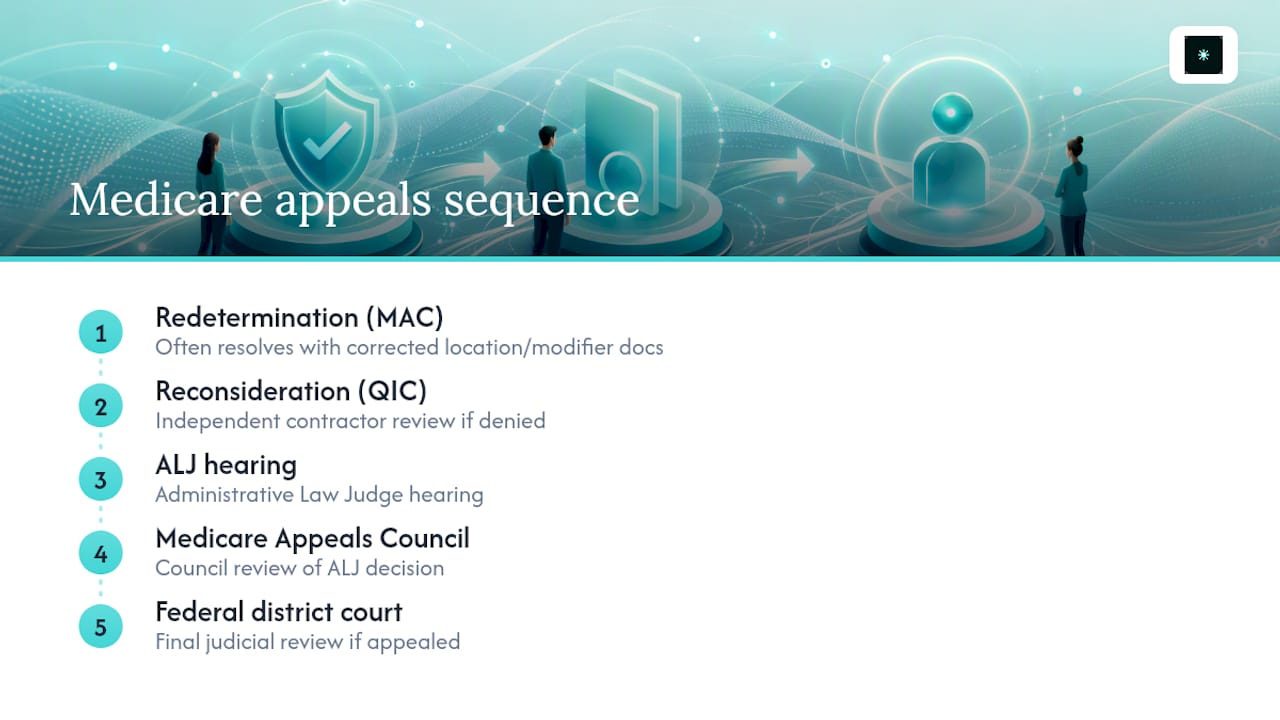
Appeals for teleradiology claims follow the standard Medicare five-level appeals process: redetermination by the MAC, reconsideration by a Qualified Independent Contractor, an Administrative Law Judge hearing, Medicare Appeals Council review, and finally federal district court. Most location or modifier errors resolve at the redetermination level once corrected documentation is submitted, so escalating further is rarely necessary if the underlying paperwork gets fixed promptly.
Commercial payer appeals typically move faster than Medicare's formal process, but timelines are payer-specific and often shorter, sometimes as little as 30 to 60 days from denial notice. Missing that window can forfeit appeal rights entirely, so tracking denial dates against each payer's specific appeal deadline matters more than treating every denial with the same response timeline.
A pattern worth watching: if the same denial reason recurs across multiple claims for one radiologist, the fix belongs at the enrollment or credentialing level, not the claim level. Resubmitting individual claims without correcting the root PECOS or licensure issue wastes staff time on a problem that will keep recurring.
Patient consent requirements and their impact on billing
Teleradiology generally does not require the same explicit telehealth consent that applies to interactive clinical telehealth visits, because CMS does not classify remote image interpretation as a telehealth encounter under §410.78. The patient consents to the imaging study itself at the point of care, and that consent typically covers interpretation regardless of where the interpreting radiologist is physically located.
That said, some states and some facility policies require separate disclosure that a study may be interpreted by a remote radiologist rather than an on-site physician. This isn't a Medicare billing requirement, but a facility operating without that disclosure where state law requires it can face compliance exposure that eventually surfaces during a broader audit, even if the billing itself is technically correct.
From a billing standpoint, missing or improperly documented consent rarely triggers a direct claim denial the way a PECOS mismatch does. The bigger risk is downstream: a compliance review or malpractice inquiry that examines consent documentation alongside billing records, and finds gaps that call the entire arrangement into question. Facilities contracting with any teleradiology vendor should confirm state-specific disclosure requirements as part of vendor onboarding, not as an afterthought once claims are already flowing.
Document consent practices the same way you document licensure and enrollment: with a dated record, not a verbal assurance. If a state requires specific disclosure language about remote interpretation, that language should appear in the same intake paperwork used for the imaging study itself.
Integration of teleradiology billing with electronic health record (EHR) systems
Claims data doesn't originate in a vacuum. It flows from an order placed in the EHR, through the PACS where the image lives, to the radiologist's workstation, and back into the EHR as a signed report before it ever reaches the billing system. A break anywhere in that chain, especially a mismatch between the ordering location recorded in the EHR and the interpreting location on the claim, creates exactly the kind of box 32 or POS error that triggers a MAC edit.
The practical goal is making sure the EHR's encounter data and the billing system's claim data agree on where the technical component happened and who performed the professional component. When a teleradiology vendor integrates directly with a facility's existing PACS rather than requiring a separate portal, that reduces one common point of data mismatch: staff no longer manually re-enter location or provider information into a second system, which is where transcription errors creep in.
Reconciliation should happen at the report level, not just at the claim level. When a signed report lands back in the EHR, the radiologist's NPI, practice location, and the study's service date should all match what eventually appears on the claim. Building an automated check between these two systems, rather than relying on manual review, catches mismatches before a claim ever reaches the MAC, saving the rework cycle of a denial and resubmission.
Facilities evaluating a new teleradiology arrangement should ask upfront how the vendor's reporting workflow integrates with the existing EHR and PACS, since a workflow that requires duplicate manual entry is inherently more error prone than one built for direct integration.
Author perspective: practical governance steps billing teams should prioritize
The billing teams that stay out of trouble aren't the ones with the most sophisticated software. They're the ones who treat PECOS reconciliation and license tracking as a monthly habit rather than a once-a-year scramble. Pair that with routine pre-audit sampling and a requirement that vendors formally attest to reassignment status in writing, not just verbally at contract signing. And put billing responsibility and anti-markup language directly into the contract itself, because a verbal understanding means nothing when a MAC auditor asks for documentation six months from now.
Rafael Vieira
Sources
- New and improved processes when billing Medicare for reassigned teleradiology services | Reed Smith
- Telehealth Billing Rules in 2026: What Changed and What to Watch | Healix RCM
- CMS Claims Processing Manual (CLM) , Radiology and payment conditions
- eCFR §410.78 Telehealth services
This article is general information, not a substitute for advice from a qualified financial advisor. Consult a qualified financial professional about your own circumstances before acting on anything here.
FAQ
What Are CMS's Billing Guidelines for Radiology Services?
CMS bills radiology under the PC/TC split: the interpreting physician bills the professional component with modifier 26, and the facility performing the technical work bills modifier TC. Payment conditions, including inpatient bundling and anti-markup limits, are detailed in the CMS Claims Processing Manual.
Is Teleradiology Considered Telehealth?
No. CMS generally does not classify remote image interpretation as telehealth under §410.78, so telehealth modifiers like 95 or GT and POS codes 02/10 typically don't apply to a radiology professional component claim.
What Are the CMS Billing Guidelines for EKG Interpretation?
EKG interpretation follows a similar professional/technical split as radiology, billed separately when performed by different entities, though specific coverage and payment rules for EKGs sit in CMS's broader diagnostic test payment guidance rather than radiology-specific manual sections. Verify current CPT coverage against the CMS telehealth code list if remote interpretation is involved.
What Are the Radiology Coding Rules I Should Watch for Changes?
Radiology coding rules continue to center on accurate PC/TC modifier use, correct POS reporting, and PECOS-aligned box 32 entries. Billing teams should check the CMS telehealth code list and Physician Fee Schedule updates each year, since CPT and coverage determinations can shift with each annual rule update.
How Do I Fix a MAC Jurisdiction Mismatch on a Teleradiology Claim?
Confirm the radiologist's PECOS-enrolled practice location matches the MAC jurisdiction where the claim was submitted. If they don't align, update the PECOS practice location entry and resubmit once the correction is reflected in the enrollment system.
Recommended
Related on AstraRad
- Resources
STAT teleradiology turnaround: benchmarks and SLA terms
What STAT teleradiology turnaround is achievable in 2026: cited benchmarks, the clock definitions that change the number, and SLA language to demand.
- Resources
90 day QA checklist to lower discrepancy rates
Compare real-time (3,5%) and audit (20,30%) discrepancy rates. Use evidence-backed benchmarks, KPIs, and a 90 day QA pilot to reduce misses and guide
- Resources
Per report teleradiology to avoid stark law radiology risk
U.S. compliance playbook for Stark Law radiology referrals: fix documentation gaps, verify CMS exceptions, and use per report teleradiology to lower
Put a radiologist's name on your next read.
Tell us your modalities and monthly volume. A complete per-report rate card, with turnaround tiers and SLA terms in writing, lands in your inbox within one business day.