Cut teleradiology credentialing to under 21 days
Checklist for hospital admins: verify licenses, privileging, payer enrollment, MOUs and PACS provisioning to cut teleradiology go live from 60,120 days
Teleradiology credentialing rests on three gating requirements that all have to clear before a distant-site radiologist can sign a single report: a medical license in the state where the patient is physically located, hospital privileging at the requesting facility, and payer enrollment that lets the read get billed. CMS's rules on credentialing by proxy and Joint Commission telehealth standards decide how much of that work a hospital can lean on a vetted partner for. The fastest path through it is assembling a complete, pre-verified provider file and running licensing, privileging, and payer work in parallel instead of in sequence.
TL;DR:
- State licensing delays often occur due to non-participating states, telemedicine registration requirements, and renewal lags, which can extend the process beyond 60 days.
- Hospital privileging by proxy is permitted when the distant site has accredited credentialing processes and formal agreements detailing performance and audit rights.
- Payer enrollment, especially with Medicare, Medicaid, and commercial plans, can add several weeks to months, as each entity operates on its own processing timeline.
- Using pre-verified provider files and initiating PACS IT setup early can reduce credentialing times from 60-120 days to under 21 days.
- A centralized credentialing operation and proactive licensing portfolio management significantly improve the speed and efficiency of multi-state teleradiology deployment.
Table of Contents
- What is the teleradiology credentialing process?
- State medical licensing: what actually slows go-live
- Hospital privileging and credentialing by proxy: how it actually works
- Payer enrollment, CAQH, and billing readiness
- How long does credentialing take, and where does it stall?
- Operational best practices for managing credentialing at scale
- Compliance standards and the documents you need on file
- What operational readiness actually looks like
- Ready to shorten your own credentialing timeline?
- Primary sources worth reading directly
- Sources
- FAQ
What is the teleradiology credentialing process?
Teleradiology credentialing runs on three stacked approval tracks, and none of them can be skipped or fully substituted for another.
- State medical licensing. The radiologist needs an active license in the state where the patient sits during the exam, not where the radiologist reads from.
- Hospital privileging. The requesting facility's medical staff office has to grant defined privileges, typically scoped by modality (CT, MRI, X-ray, PET-CT).
- Payer enrollment. Medicare, Medicaid, and commercial plans need the provider enrolled and CAQH profiles current before a claim gets paid.
Primary-source verification (PSV) and a National Practitioner Data Bank (NPDB) check run underneath all three tracks, confirming board certification, work history, and any disciplinary flags. Most hospitals should plan for 60 to 120 days end to end. Groups that run these tracks in parallel, rather than waiting for one to finish before starting the next, cut that timeline dramatically.
State medical licensing: what actually slows go-live
Licensing is where most credentialing timelines break down, mainly because hospital administrators assume "licensed" means one thing when it means one thing per state. A radiologist reading a study for a patient in Ohio needs an Ohio license, full stop, regardless of where AstraRad's subspecialist physically sits.
The Interstate Medical Licensure Compact speeds issuance for the states that participate, but it does not cover every state, and it does not eliminate ongoing renewal obligations or state-specific telemedicine registration requirements that sit on top of the base license. Some states require a separate telemedicine registration even after the standard license is issued, and a handful run notably longer review timelines than the compact average.
Three steps compress this clock without cutting corners:
- Pre-file fingerprinting and background checks before a specific assignment is even confirmed.
- Verify CME hours and disciplinary history early, since a single missing record can stall an entire application.
- Track renewal calendars centrally so no license lapses mid-contract and interrupts coverage.
Pro Tip: Treat state licensing as a standing portfolio, not a per-contract task. Pre-licensing a bench of radiologists into your top target states before you need them shaves weeks off every future go-live.
Hospital privileging and credentialing by proxy: how it actually works
A privileging committee reviews the core evidence for a distant-site radiologist as it would for an on-staff physician: PSV documentation, NPDB results, malpractice history, and peer review performance data. What differs with teleradiology is whether the hospital does that verification itself or accepts it secondhand.
- CMS and Joint Commission both permit credentialing by proxy, letting a hospital rely on the distant site's own credentialing decision, provided the distant-site organization's program meets equivalent standards and a formal agreement is in place.
- The Joint Commission's telehealth accreditation program gives hospitals a concrete signal to check for: an accredited distant-site partner has already had its credentialing process externally validated.
- The written agreement itself needs specific teeth. At minimum it should spell out roster delivery timing, ongoing performance and feedback reporting, and a right-to-audit clause so the hospital can verify the proxy relationship whenever it wants.
The VA's National Teleradiology Program is a useful federal reference point here: distant-site teleradiologists are privileged by the host VA facility, with a formal MOU and a VetPro provider profile maintained under host-site oversight. It is proxy credentialing done at scale, with the paperwork built in from the start.
Payer enrollment, CAQH, and billing readiness
A radiologist can be fully licensed and fully privileged and still generate a claim that gets rejected, because payer enrollment runs on its own separate clock. Medicare and Medicaid enrollment has its own processing windows, and commercial payers each set their own credentialing criteria on top of that, so a provider approved by one plan is not automatically approved by another.
Excellus BCBS's teleradiology credentialing policy is a good real-world example of what a commercial payer actually demands: licensure in both the transmitting and receiving state, board certification, adequate malpractice coverage, and a credentialing approval that commonly lasts several years before recredentialing kicks in.
Before signing a teleradiology agreement, confirm:
- CAQH profiles are current and fully attested, not just submitted.
- Malpractice coverage extends across every jurisdiction where reads will happen.
- The contract states plainly which party, originating facility or distant site, owns the billing relationship for each claim.
How long does credentialing take, and where does it stall?
Sixty to 120 days is the honest industry benchmark for full teleradiology credentialing, covering licensure, privileging, and payer enrollment together. Groups that show up with a pre-built, pre-verified provider file and a working proxy agreement have compressed that same process to under 21 days.
The gap between those two numbers comes down to four recurring bottlenecks:
| Stage | Typical delay driver |
|---|---|
| State licensing | Non-compact states, telemedicine registration lag |
| Primary-source verification | Slow third-party responses, incomplete files |
| Committee review | Monthly or quarterly privileging committee cadence |
| IT/PACS provisioning | VPN and PACS credentials issued last, after privileging closes |
That last row surprises a lot of administrators, especially considering the importance of security and HIPAA compliance in IT/PACS provisioning and data-sharing controls. Privileging can be fully signed off, and the radiologist still can't read a single study until network access and PACS credentials are provisioned, which is why IT setup deserves to start the same week privileging does, not after it.
Pro Tip: Ask your IT team to build the PACS/VPN provisioning ticket the moment a candidate clears PSV, not after the privileging committee votes. Running that ticket in parallel with committee review, instead of after it, is often the single biggest timeline win available.
Operational best practices for managing credentialing at scale
Credentialing stops being a recurring fire drill once a hospital or radiology group treats it as a staffed operational function rather than a one-off project tied to each new hire. A common staffing benchmark is one full-time credentialing specialist for every 10 to 15 radiologists, though the right ratio shifts with facility count and how many states a group covers.
Centralizing the function, rather than splitting it across individual departments, pays off in three concrete ways:
- Renewal deadlines get tracked in one calendar instead of a dozen spreadsheets.
- NPDB monitoring runs continuously instead of only at the three-year recredentialing mark.
- Privileging packet templates get reused instead of rebuilt from scratch for every new facility relationship.
Treat state licensing coverage as a standing portfolio rather than a reactive task list, and the same discipline that speeds one go-live starts speeding every subsequent one too.
Compliance standards and the documents you need on file
Joint Commission telehealth accreditation standards, ACR practice guidance, and CMS conditions of participation are three reference points a compliance officer should be able to point to during any survey or audit.
Keep these documents retained and audit-ready at all times:
- Copies of every PSV verification, not just a summary attestation.
- NPDB query results for each credentialed radiologist.
- Signed MOUs and rosters covering every proxy credentialing relationship.
- Privileging letters specifying exact modality scope.
Recredentialing runs on a typical three-year cycle, matching the approval duration commercial payers commonly use, with annual attestations expected in between to confirm nothing material has changed.
What operational readiness actually looks like
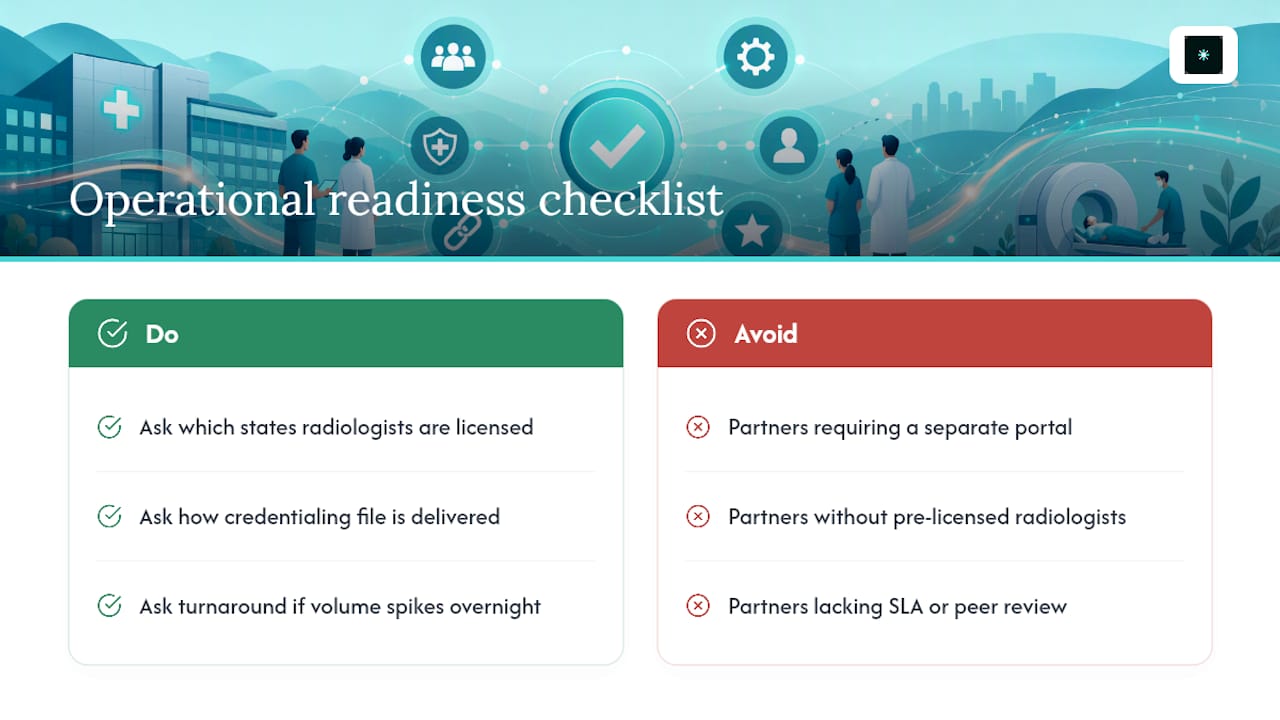
A teleradiology partner's real value shows up in how much of this checklist is already solved before a hospital signs a contract. AstraRad maintains active state licensing coverage across its subspecialist bench, integrates directly with a hospital's existing PACS rather than requiring a separate portal, and backs every read with a documented peer review process and a 99.4% SLA compliance record over the past year.
Those capabilities map directly onto the bottlenecks above: pre-licensed radiologists shrink the state licensing clock, and PACS integration removes the IT provisioning delay entirely. Before signing with any distant-site partner, ask three questions: Which states are your radiologists currently licensed in? How does your credentialing file get delivered for our proxy review? And what happens to turnaround time if our volume spikes overnight?
Rafael Vieira
Ready to shorten your own credentialing timeline?
Most of the delay hospitals run into isn't the paperwork itself, it's waiting on licensing and PACS provisioning that could have run in parallel from day one. AstraRad's subspecialists already carry active licenses across a wide state footprint, which means your privileging committee isn't stuck waiting on a state license application before it can even open a file.
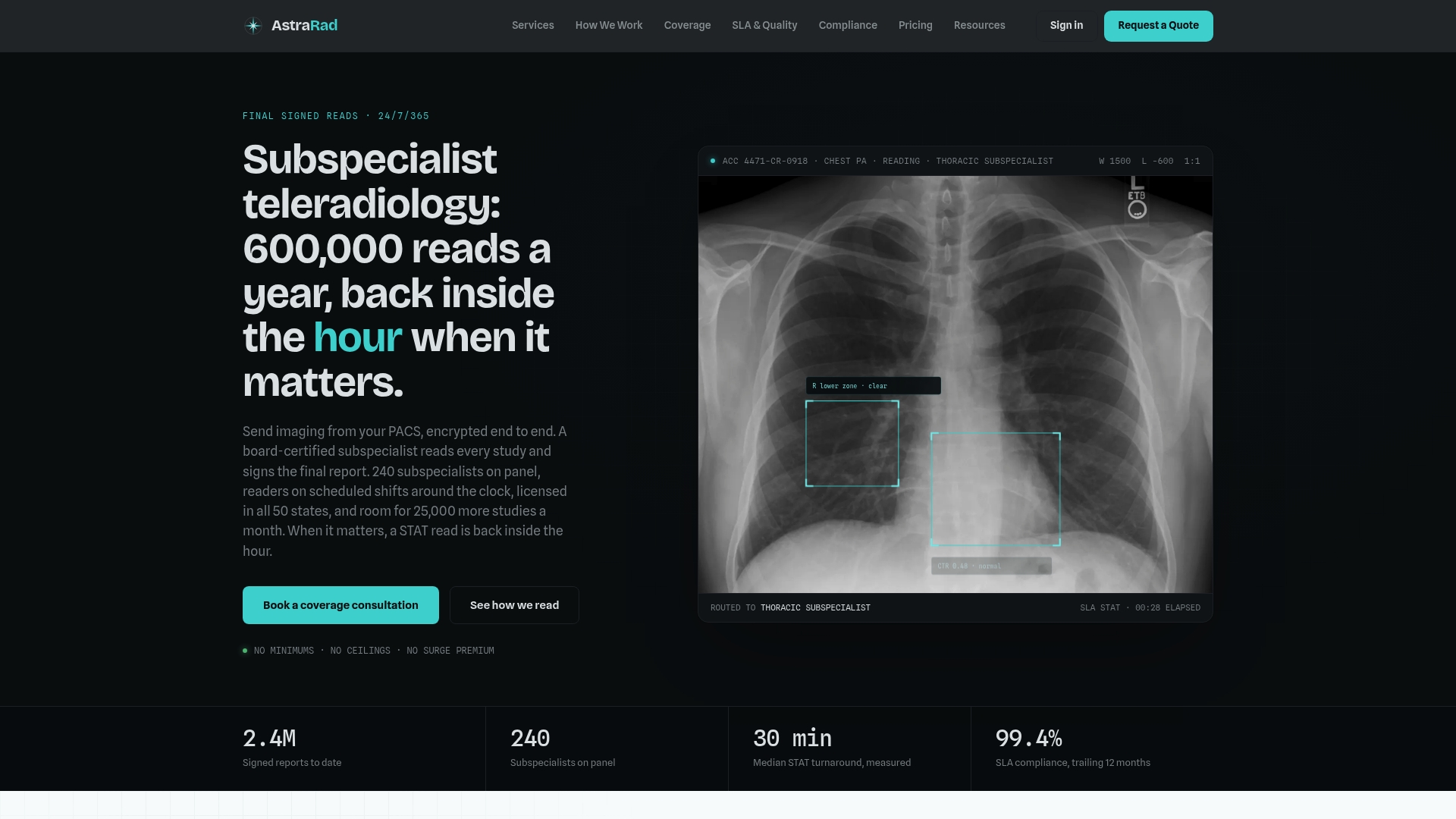
That readiness translates directly into faster go-live: no new portal to stand up, since AstraRad connects straight into your existing PACS, and every read carries the same peer-reviewed compliance backing that supports that 99.4% SLA figure. If you're evaluating coverage for a specific market, check teleradiology coverage in Colorado as one example of how state-level licensing readiness works in practice, or review per-report pricing to see how the cost structure lines up against your current backlog. Request a credentialing readiness review and get a straight answer on how quickly your facility could be live.
Primary sources worth reading directly
- VHA Directive on NTP credentialing: the clearest federal example of host-site privileging and MOU structure in practice.
- Joint Commission telehealth accreditation: the accreditation standard hospitals should ask distant-site partners about directly.
- ACR teleradiology practice resources: links to underlying CMS and Joint Commission proxy guidance.
- Excellus BCBS credentialing policy: a real commercial payer's licensure and coverage requirements.
This article is general information, not a substitute for advice from a qualified doctor. Consult a qualified healthcare professional about your own circumstances before acting on anything here.
Sources
- VHA Directive: Credentialing and privileging for National Teleradiology Program (NTP)
- Teleradiology credentialing timeline: How long and how to speed it up
- Excellus BCBS: credentialing policy for teleradiology
- Multi‑state licensing for teleradiology: the compliance reality
- ACR: Teleradiology practice and legal/business considerations (links to Joint Commission/CMS guidance)
FAQ
How long does it take to credential a teleradiologist?
Full credentialing, covering state licensing, hospital privileging, and payer enrollment, typically runs 60 to 120 days. Groups using pre-verified files and proxy agreements have compressed that to under 21 days.
What are the two types of credentialing?
Hospitals generally choose between primary credentialing, where the requesting facility independently verifies every document itself, and credentialing by proxy, where it relies on a distant-site organization's own credentialing decision under a formal agreement.
How many years does it take to become a teleradiologist?
A radiologist needs four years of medical school plus a residency, typically five years, before subspecialty fellowship training, putting the standard path at roughly nine to ten years before independent practice. Teleradiology credentialing itself adds weeks to months on top of that, not additional years.
Does the Interstate Medical Licensure Compact cover every state?
No. The Interstate Medical Licensure Compact speeds licensing in participating states but doesn't include every state, and it doesn't remove separate telemedicine registration or renewal requirements in states that impose them.
Who is responsible for teleradiology billing, the originating site or the distant site?
It depends on the contract. The agreement should state explicitly which party, the originating facility or the distant-site provider, owns the billing relationship for each claim, since that decision affects which party's payer enrollment and CAQH status governs reimbursement.
Recommended
Related on AstraRad
- Resources
Teleradiology without volume commitment: who needs it, how
Teleradiology without volume commitment fits seasonal clinics, startups, and mobile imaging. How commitment-free contracting works and what to verify.
- Resources
Pilot plan to validate after hours radiology coverage
Safety first guide for hospital admins: demand subspecialist final reads, SLAs, PACS integration, and a 3,6 week pilot to prove after-hours coverage.
- Resources
4 acuity tiers and ready critical findings list
Ready-to-implement critical findings checklists, four acuity tiers, and escalation templates aligned with ACR guidance, plus a teleradiology SLA model
Put a radiologist's name on your next read.
Tell us your modalities and monthly volume. A complete per-report rate card, with turnaround tiers and SLA terms in writing, lands in your inbox within one business day.