Teleradiology PACS workflow for hospital imaging
Practical PACS to teleradiology workflow mapping for hospital imaging teams. Follow a six step workflow, compliance checklist, and AstraRad's 99.4% SLA
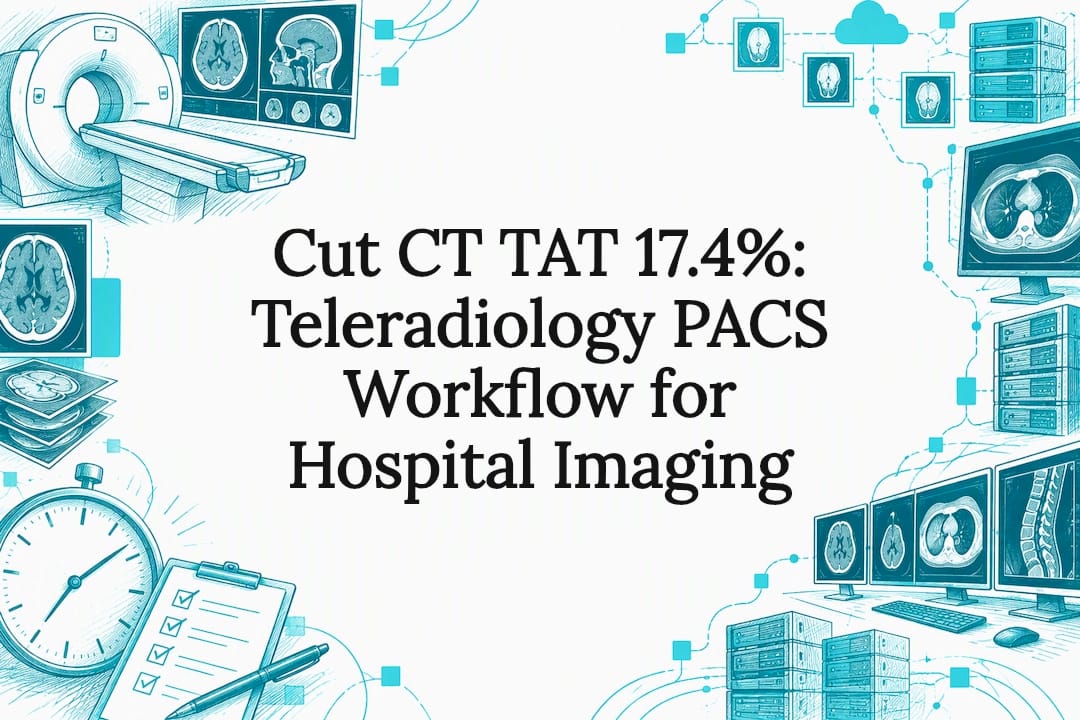
A tightly integrated PACS and teleradiology workflow delivers faster, auditable final reads by combining automated routing, secure image transport, and defined SLA-driven governance. The best implementations pair a well-configured PACS with a teleradiology partner that reads directly off the existing system rather than layering on another portal. Get the routing rules, worklist logic, and escalation paths right, and turnaround time drops while the compliance trail stays intact.
TL;DR:
- A well-configured PACS with automated routing and governance significantly reduces turnaround times and maintains compliance in teleradiology workflows.
- Modern PACS handle storage, DICOM services, metadata management, and workflow tools, enabling seamless remote reading environments.
- Critical integration components include a universal viewer embedded in or launched from the EHR and secure image transport via internet gateways or VPNs.
- Routine workflows should incorporate automated triggers, SLAs, escalation procedures, and continuous QA to ensure reliable and timely report delivery.
- Remote reading environments must meet technical standards for bandwidth, displays, security, and calibration to preserve diagnostic accuracy comparable to onsite reads.
Table of Contents
- Why PACS Is Central to Teleradiology Workflows
- What Does an End-to-End Teleradiology PACS Workflow Look Like?
- Integration Architecture and Key Components
- Operational Controls: Worklist Management, SLAs, Escalation, and QA
- Technical Specs and Environment for Remote Readers
- Compliance, Standards, and Risk Controls
- Implementation Checklist and Phased Rollout Plan
- Common Pitfalls and How to Mitigate Them
- AstraRad Perspective: Real-World Integration and SLA Outcomes
- Get PACS Integration That Doesn't Add a New Portal
- Sources
- FAQ
Why PACS Is Central to Teleradiology Workflows
PACS is the backbone that makes remote reading possible at all. It stores and retrieves DICOM images, manages study metadata, and pushes the right exam to the right worklist without anyone manually hunting for files. Without a functioning PACS layer, teleradiology collapses into email attachments and phone calls, which is exactly the failure mode that early teleradiology programs struggled with before enterprise imaging matured.
A modern PACS does four things well:
- Storage and retrieval: archives studies and serves them back on demand, indexed by patient, accession number, and modality.
- DICOM services: handles the C-STORE, C-FIND, and C-MOVE transactions that move images between the acquisition device, archive, and viewer.
- Metadata management: keeps patient demographics, exam codes, and priority flags synchronized so downstream systems route studies correctly.
- Display and workflow tools: hanging protocols, window/level presets, and measurement tools that a remote reader needs to interpret consistently.
PACS also talks constantly to the RIS and EHR, pulling the order context (why the study was ordered, what the clinician needs to know) and pushing results back once a report is signed. A published architecture review frames this shift plainly: merging PACS and teleradiology turns isolated data stores into shared workflows, letting a remote subspecialist participate in a site's reading queue the same way an on-site radiologist would.
The distinction between local PACS, cloud PACS, and a vendor-neutral archive matters for scale. Local PACS works fine for a single site with predictable volume. Cloud-based PACS solutions and VNAs matter once you're consolidating multiple facilities or contracting with an outside teleradiology group, because they eliminate the need to replicate infrastructure at every location.
What Does an End-to-End Teleradiology PACS Workflow Look Like?
A functioning teleradiology PACS workflow runs through six discrete steps, and where any one of them breaks down, turnaround time suffers immediately.
- Acquisition and DICOM routing. The modality generates the study and sends it via DICOM to the local PACS, tagging it with accession number, modality, and priority.
- Metadata normalization. Study details get cleaned and standardized so automated rules downstream can act on them reliably, rather than choking on inconsistent naming conventions across scanners.
- Prefetching and automated routing. Rules engines push studies into a unified worklist based on modality, priority, and subspecialty match, pulling relevant prior studies ahead of time so the reader isn't waiting on retrieval.
- Secure transmission and remote access. The study reaches the remote radiologist through the existing PACS viewer over an encrypted connection, with no separate login or portal required.
- Interpretation and sign-off. The radiologist reads, dictates through voice recognition, routes flagged cases through peer review, and signs the final report.
- Distribution and audit logging. The signed report flows back to the RIS and EHR, and every touchpoint gets logged for compliance and quality tracking.
The step most organizations skip is formalizing the trigger that starts step three. A quality improvement initiative reported in the emergency radiology literature replaced manual phone-based teleradiology requests with EMR-integrated request buttons and automated worklist referrals.
Statistic callout: Automating the request trigger alone, without touching interpretation speed, cut CT order-to-result TAT by 17.4% in one emergency department program.
That single change, automating the handoff instead of relying on someone to notice a study needs a remote read, produced more measurable improvement than most technology purchases would. It's a useful reminder that workflow design often beats hardware spend.
Integration Architecture and Key Components
Four architectural pieces determine whether a teleradiology PACS workflow scales past one facility or breaks the moment you add a second site.
A vendor-neutral archive (VNA) consolidates images from multiple PACS instances into a single retrievable store, which matters enormously once a health system or imaging group operates more than one facility on more than one PACS vendor. VNAs reduce duplication and lower future migration costs by giving every site the same patient-centric retrieval layer instead of siloed archives.

The internet gateway versus VPN decision affects both security posture and reader experience. A dedicated internet gateway, the model HIMSS's Digital Imaging Adoption Model recommends as the "share" step in enterprise imaging maturity, generally offers more predictable performance for high-volume image transfer than a traditional site-to-site VPN, though VPNs remain common where IT teams already have that infrastructure in place.
Key integration components to plan for:
- VNA layer for cross-site archive consolidation and lifecycle management.
- Internet gateway or secure VPN tunnel for encrypted image transport to remote readers.
- Universal viewer embedded in or launched from the EHR, so radiologists and referring clinicians see the same image without switching applications.
- HL7/FHIR interfaces synchronizing orders, results, and metadata between RIS, PACS, and EHR in near real time.
The universal viewer piece deserves particular attention. Every extra login a remote radiologist has to manage is friction that slows reads and increases error risk. Improving PACS connectivity through a shared viewer, rather than a bolt-on portal, is one of the most underrated levers for teleradiology efficiency.
Operational Controls: Worklist Management, SLAs, Escalation, and QA
Technology alone doesn't guarantee timely reads. Governance does. Worklist routing logic needs to sort by three variables simultaneously: clinical priority, modality, and subspecialty match, so a STAT head CT lands in front of a neuroradiologist within minutes, not somewhere in a generic queue behind routine chest X-rays.
SLA tiers should be explicit and monitored, not assumed:
- STAT: typically under one hour from study completion to signed report.
- Urgent: same-day turnaround with defined maximum windows.
- Routine: generally under 24 hours, tracked against a rolling compliance percentage.
Escalation hierarchies matter as much as the technology stack itself. ACR practice parameters call for documented escalation procedures and robust communication protocols between on-site and remote staff, plus downtime procedures for when connectivity or systems fail. Skipping this step, treating escalation as an informal "call the radiologist's cell phone" arrangement, is a common gap auditors flag during compliance reviews.
Peer review and QA can't be an afterthought bolted on at contract renewal. A structured program (RADPEER-style scoring, routine case sampling, discordance tracking) needs to run continuously, feeding back into routing decisions and individual reader performance reviews.
Pro Tip: Build your SLA dashboard around the same three tiers your radiologists already use clinically, STAT, urgent, routine, instead of inventing a separate reporting taxonomy. It cuts confusion during audits and keeps IT and clinical staff speaking the same language.
Technical Specs and Environment for Remote Readers
Remote reading environments have to match the diagnostic performance of an on-site reading room, and the specifications aren't vague. A systematic review of home-based teleradiology setups recommends sustained bandwidth of 50 to 100 Mbps and ambient lighting between 25 and 75 lux, both directly tied to preserving diagnostic image quality and reader comfort over long shifts.
That same review found that 65% of institutions established home reading workstations during the pandemic, and 96% of those institutions reported turnaround times that stayed the same or improved once the setups were properly configured. The takeaway isn't that remote reading is automatically inferior. It's that configuration discipline is what separates a strong remote program from a weak one.
Beyond bandwidth and lighting, remote reading stations need:
- Medical-grade displays, properly calibrated and periodically re-validated against DICOM grayscale standards.
- Prefetch and caching so prior studies load before the radiologist opens the current exam, not during it.
- Multi-factor authentication and endpoint hardening on every remote workstation, with full activity logging.
- Encrypted transport end to end, from acquisition device through to the remote viewer session.
None of this is optional if the goal is diagnostic parity with an on-site read.
Compliance, Standards, and Risk Controls
ACR technical standards set the floor for remote imaging practice, and they're specific about what they expect. ACR's practice parameter for remote CT and MR supervision requires PACS/RIS integration adequate for timely review, documented communication protocols between remote and on-site staff, and validation testing whenever a non-OEM remote control tool sits between the radiologist and the imaging system.
HIPAA's Security Rule adds another layer. Off-site reading means protected health information crosses networks the covered entity doesn't fully control, which raises the bar on encryption, access logging, and business associate agreements with any teleradiology partner.
Practical risk controls worth building into contracts and IT policy:
- Require documented validation testing for any third-party remote access software before production use.
- Loop in risk management and legal counsel early when contracting with a new teleradiology group, not after the agreement is signed.
- Maintain retrievable verification records: license checks, credentialing files, and peer review logs, available for audit at any time.
- Treat remote monitoring cyber risk as an ongoing IT security review item, not a one-time vendor questionnaire.
Implementation Checklist and Phased Rollout Plan
Rolling out or upgrading a teleradiology PACS workflow works best in three deliberate phases rather than a single cutover.
- Inventory and alignment. Catalog every PACS, RIS, and EHR system in play, confirm vendor integration capabilities, and get clinical department heads to sign off on the routing logic before any technical work starts.
- Pilot. Scope a limited pilot, one modality or one shift, with clear success metrics (TAT, discordance rate, connectivity uptime) and a written runbook for failover if the remote connection drops mid-shift.
- Scale. Once the pilot metrics hold, consolidate worklists across additional sites, formalize SLA monitoring dashboards, and align staffing models to the new routing volume.
- Operate. Move into steady-state operations: scheduled audits, continuous quality improvement cycles, and quarterly review of SLA compliance against contract terms.
Pro Tip: Run your failover runbook as a live drill, not a tabletop exercise, before go-live. A downtime plan that only exists on paper tends to fail exactly when you need it most.
Northern Light's teleradiology deployment is a useful real-world reference point here: consolidating multiple site worklists into one centralized reading queue with load balancing let the health system flex staffing without losing subspecialty matching, a pattern worth studying before your own scale phase.
Common Pitfalls and How to Mitigate Them
Most teleradiology PACS workflow failures trace back to four recurring problems.
- Interoperability gaps between systems. Interface mapping between PACS, RIS, and EHR often breaks during vendor upgrades. Maintain a test suite and version control for every interface change before it goes live.
- Worklist fragmentation. Multiple disconnected worklists across sites create blind spots where studies sit unread. Consolidate into a single normalized worklist with prefetch rules applied consistently.
- Image quality and latency problems. Slow transfers or degraded images at the remote end usually trace back to insufficient bandwidth or missing caching. Enforce quality-of-service policies on the network and set minimum bandwidth thresholds before onboarding remote readers.
- Staffing and licensure gaps. Coverage holes appear when contractual SLAs don't match actual staffing capacity across time zones. Document escalation paths and confirm licensure coverage matches the states you actually serve.
AstraRad Perspective: Real-World Integration and SLA Outcomes
AstraRad's model illustrates what a properly integrated workflow looks like in practice. Studies route directly through the client's existing PACS, board-certified subspecialists matched to the modality and body part read and sign the report, and the finished report flows back without anyone touching a separate portal. That integration point, reading off the system a client already runs rather than requiring a new login, is the same principle the architecture section above describes as reducing context switching and error risk.
AstraRad reports 99.4% SLA compliance over the past year, with contractual turnaround commitments of under one hour for STAT cases and under 24 hours for routine studies. Those figures are AstraRad's own reported performance, offered here as an illustrative example of what disciplined worklist routing and defined escalation hierarchies, the same controls covered earlier, can produce at scale. Peer review runs on every study as a standard quality check, mapping directly to the QA loop that any resilient teleradiology architecture depends on.
Rafael Vieira
Get PACS Integration That Doesn't Add a New Portal
If your team has already invested in worklist logic, escalation rules, and a compliant reading environment, the next decision is who reads the overflow, nights, and STAT volume without forcing your radiologists to learn another system. AstraRad connects directly to the PACS you already run: no separate portal, no new login, no workflow retraining. That's the practical difference between a teleradiology vendor and one that actually integrates.
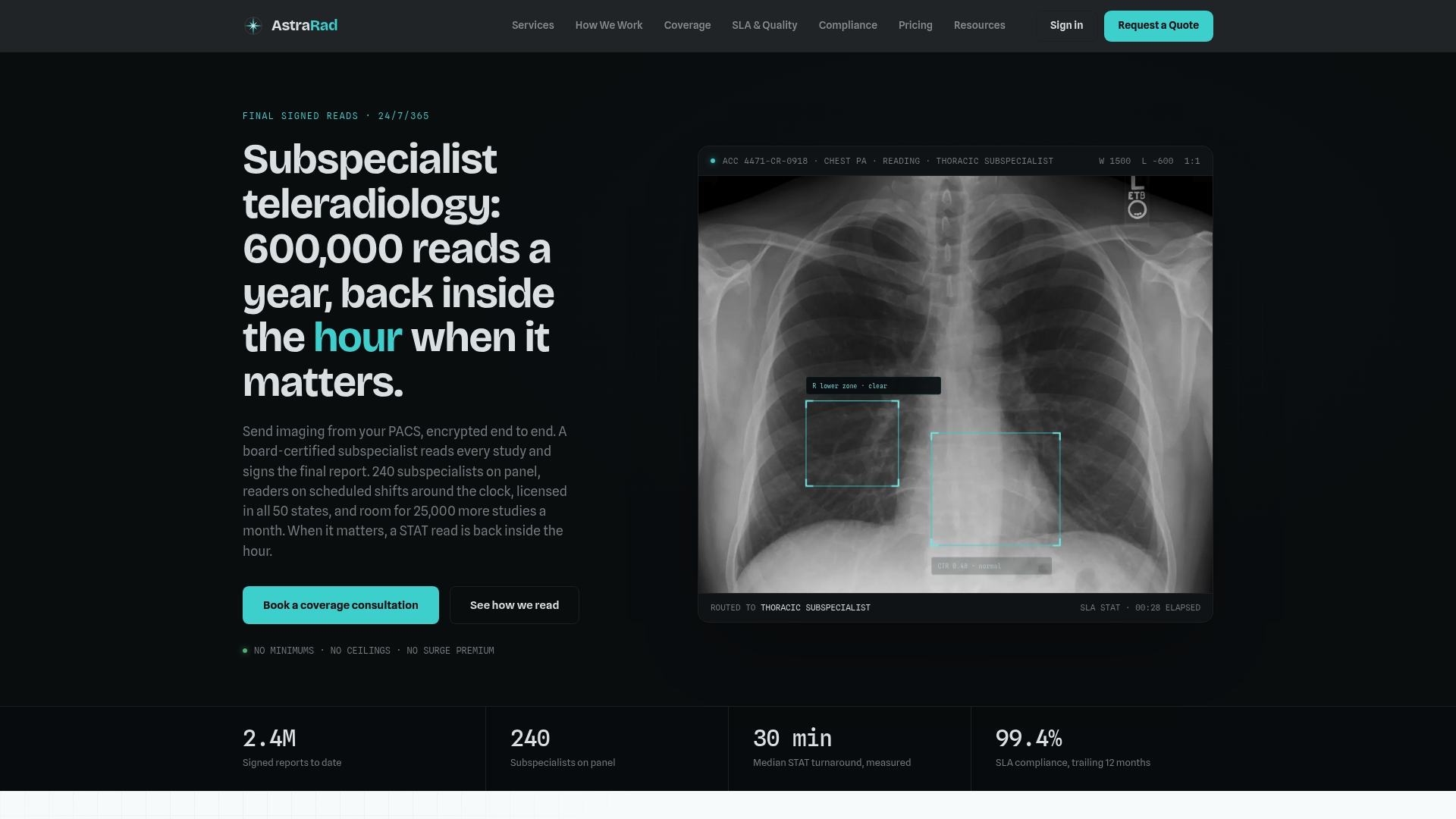
Every study is read and signed by a US board-certified subspecialist matched to the modality, backed by contractual turnaround commitments of under one hour for STAT cases and under 24 hours for routine studies, with no volume minimums. For groups covering nights, weekends, or overflow capacity, AstraRad's 24/7 coverage model slots into the escalation hierarchy your team already designed. Check per-report pricing for your modality mix and see how the numbers compare against adding internal night shift capacity.
This article is general information, not a substitute for advice from a qualified doctor. Consult a qualified healthcare professional about your own circumstances before acting on anything here.
Sources
The recommendations above draw on ACR's technical standard for remote CT and MR supervision, which governs communication and escalation requirements, and HIMSS's Digital Imaging Adoption Model, which frames the centralize-share-access-store-connect strategy for enterprise imaging maturity.
On the quality improvement side, the emergency department TAT reduction study demonstrates measurable gains from automated request triggers, while the home-based teleradiology requirements review supplies the technical baselines for remote reading environments cited throughout this piece.
- Breaking the bottleneck: a quality improvement initiative to reduce overnight CT turnaround times in the emergency department
- Review of technical, ergonomic, and operational requirements for effective home-based teleradiology implementation
- ACR practice parameter for the supervision and performance of CT and MR imaging at remote locations
- Digital Imaging Adoption Model (DIAM) | HIMSS
FAQ
What Is the Role of PACS in Teleradiology?
PACS stores, retrieves, and displays diagnostic images while managing the DICOM transactions and metadata that let a remote radiologist see the same study an on-site reader would see. It's the shared data layer that makes distributed reading possible without shipping physical film or files.
What Are the Steps Involved in a Teleradiology PACS Workflow?
The core sequence runs acquisition and DICOM routing, metadata normalization, automated worklist routing, secure remote transmission, interpretation and sign-off, then distribution back to the EHR with audit logging. Automating the trigger between preliminary read and teleradiology request alone cut CT turnaround time by 17.4% in one quality improvement program.
Which PACS System Is Best for Teleradiology Workflows?
There's no single best PACS vendor. What matters is whether the PACS supports reliable DICOM routing, HL7/FHIR interfaces to your RIS and EHR, and either direct integration or VNA consolidation for multi-site scale. A teleradiology partner like AstraRad works within your existing PACS rather than requiring a specific vendor or a separate viewer.
What Is the Highest Paid Type of Radiologist?
Compensation varies by subspecialty and geography, and interventional radiology tends to rank among the higher-paying subspecialties due to its procedural demands. Diagnostic subspecialties reading high volumes of complex studies, such as neuroradiology, also command strong compensation, though exact figures depend on market and employment structure rather than a single industry-wide number.
How Does AstraRad Integrate With an Existing PACS?
AstraRad connects directly into the client's current PACS so studies route to subspecialists without a new portal or login. Reports come back signed and integrated into the existing system, following the same distribution and audit-logging steps outlined in the workflow above.
Recommended
Related on AstraRad
- Resources
Teleradiology SLA metrics for procurement
This procurement checklist sets SLA clock-start rules, median+90th targets, audit logs, surge tests, and uptime/security terms to protect patients.
- Resources
Teleradiology for urgent care: the setup guide
How to set up teleradiology for urgent care: X-ray-heavy workflow, same-day final reads, overread discrepancy data, real costs, and a launch checklist.
- Resources
First hour PACS downtime checklist for radiology teams
Actionable playbook for radiology teams: 15 minute alert, 1 hour escalation, paper workflows, image reconciliation, and when to engage teleradiology.
Put a radiologist's name on your next read.
Tell us your modalities and monthly volume. A complete per-report rate card, with turnaround tiers and SLA terms in writing, lands in your inbox within one business day.