Workload balancing in radiology: models that work
Workload balancing in radiology explained: how to measure it, route studies by subspecialty, protect accuracy, and add teleradiology overflow coverage.
Workload balancing in radiology is the practice of distributing imaging studies across available radiologists so that no reader is overloaded, no queue stalls, and every study reaches a reader qualified to interpret it. The most durable programs combine measurement, subspecialty routing, protected breaks and an overflow option for peaks. This guide shows hospital administrators, imaging center directors and radiology group leaders how to build that.
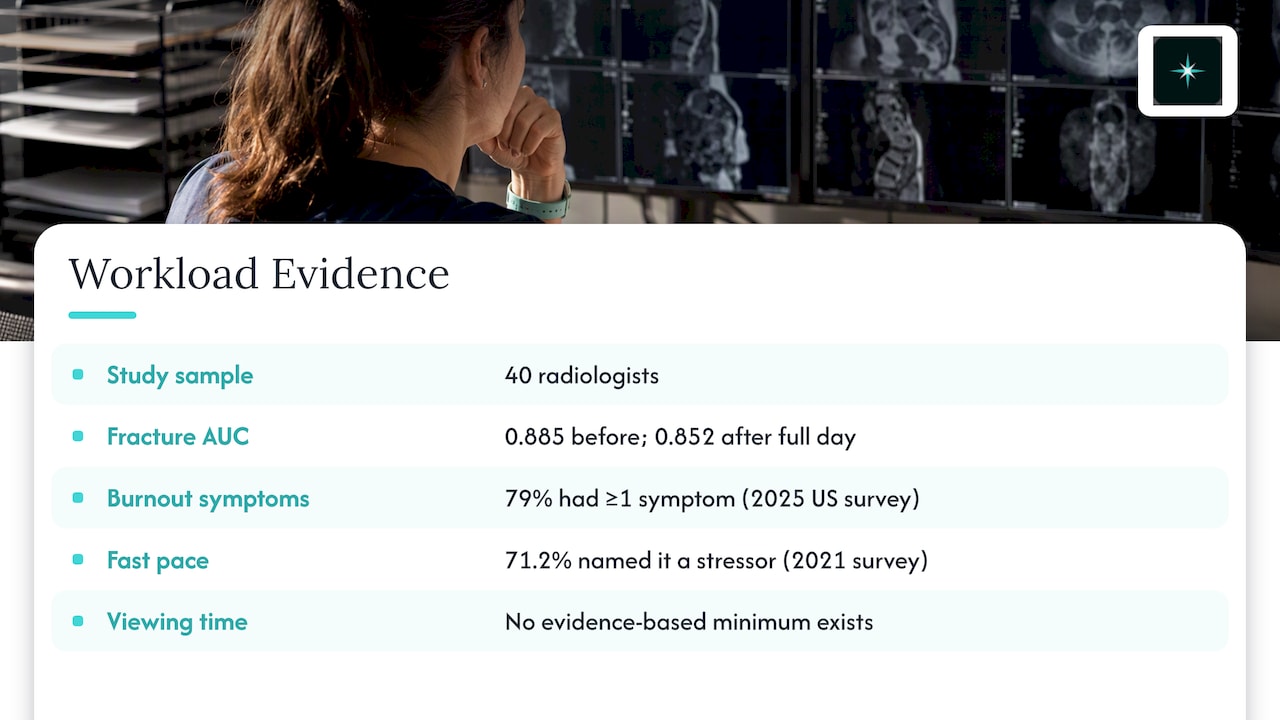
- Fatigue has a measured cost: in a study of 40 radiologists, fracture detection accuracy fell from 0.885 to 0.852 AUC after a full day of clinical reading.
- Burnout is widespread: a 2025 survey found that 79% of neuroradiologists reported at least one burnout symptom.
- Redesign beats hiring alone: the ACR reported in April 2026 that some large groups raised effective capacity by 10% without adding headcount.
- AstraRad turnaround is committed by contract: STAT under 4 hours, routine 24 to 48 hours, and stroke protocol under 30 minutes.
- AstraRad pricing is per report with no minimums, and radiologists are licensed in all 50 states.
TL;DR
- Balance workload by measuring it first: study counts alone hide the difference between a screening mammogram and a complex neuro MRI.
- Route by subspecialty and acuity, not only by who is next in line.
- Build breaks and night coverage into the schedule itself, because rest that depends on willpower rarely happens.
- When internal capacity runs out, contract overflow with written SLA terms, credentialing, a signed BAA and direct PACS integration.
- Review the balance monthly. A fair distribution drifts as volume and staffing change.
Table of Contents
- What Is Workload Balancing in Radiology?
- Why Does Radiology Workload Balancing Matter?
- Where Does AstraRad Fit in a Workload Balancing Plan?
- How Is Radiology Workload Measured?
- Which Radiology Workload Balancing Models Work Best?
- How Do You Prevent Cherry-Picking and Hidden Backlogs?
- How Do Breaks, Nights and Weekends Fit Into Balancing?
- What Does Balancing Look Like in an Outpatient Setting?
- When Should You Add Teleradiology to Balance Workload?
- What Do AstraRad's Commitments Look Like in a Contract?
- How Do You Roll Out a Balancing Program in 90 Days?
- How Do You Choose Where Overflow Should Go?
- Add Subspecialty Overflow Without Minimums
- FAQ
- Sources
What Is Workload Balancing in Radiology?
Workload balancing in radiology is a distribution method that assigns studies to radiologists based on volume, case complexity, subspecialty, availability and priority. The goal is equitable, timely reads. It operates on a worklist inside the PACS, the RIS or an orchestration layer that sits on top of them, and it can be as simple as a shift rotation or as automated as rules-based routing.
Two terms are worth fixing in place. A worklist is the ordered list of unread studies a radiologist sees. A relative value unit (RVU) is a standardized measure of the work a service requires, used to compare the effort of different exam types.
Balancing answers two separate questions. The first is availability: which radiologists are on and able to read right now. The second is allocation: which of those readers should get this particular study. A network needs both. Availability without allocation produces a free-for-all in which the easiest cases disappear first. Allocation without availability sends studies to people who are off shift or already saturated.
Balancing also works across sites. A multicenter department in Italy, for example, described a RIS function that balances emergency night-shift activity across hospitals. The principle carries over to any US health system with more than one campus: a queue at one facility should not sit while a reader at another has capacity.
Why Does Radiology Workload Balancing Matter?
Workload balancing matters because overload degrades both accuracy and retention. Measured fatigue lowers detection performance, and burnout is common among practicing radiologists. For administrators, an unbalanced queue also means missed turnaround commitments to referring clinicians, emergency departments and patients.
The evidence is specific. In the study of 40 radiologists, diagnostic accuracy for fracture detection dropped after a full day of clinical work, from 0.885 to 0.852 AUC, a statistically significant change. That study measured one task in a controlled setting, so treat it as a signal, not a universal rate.
Burnout data point the same direction. A 2025 survey of US neuroradiologists reported that 79% had at least one burnout symptom, and the authors link rising workloads with burnout and interpretive errors. A 2021 survey of breast radiologists found that 71.2% named working too fast as a stressor.
A caution belongs here. RSNA experts note that no evidence-based minimum viewing time exists to justify a universal workload cap, and that administrative mandates may backfire. That is an argument for local, data-driven balancing rather than a fixed number of studies per shift. Your own turnaround and discrepancy data should set the limits.
Where Does AstraRad Fit in a Workload Balancing Plan?
AstraRad is a US teleradiology service that delivers final signed reports read by board-certified subspecialists. We publish this guide, and we have a commercial interest: we sell overflow, night, weekend and subspecialty coverage that can take volume off a stretched internal worklist. We think that is a legitimate balancing tool, and it works best alongside the internal practices described here, not in place of them.
The model is simple. Every study is routed to a subspecialist matched to the modality and body part, across ten subspecialties and twelve study types, on scheduled US shifts 24/7/365. Every read is performed inside the United States, and reports go straight into your existing PACS with no extra portal. You can review the full scope on our teleradiology services page.
How Is Radiology Workload Measured?
Radiology workload is measured by combining study volume with a complexity weighting, most often RVUs, plus the time a reader spends on each case. Raw study counts mislead because a routine chest radiograph and a multiphase abdominal CT do not demand the same effort. A usable metric reflects both.
Most groups track a blend of the following:
- Study count by modality. Easy to pull from the PACS, but blind to complexity.
- RVUs per reader per shift. Adds a complexity weighting, though RVU values can understate the effort of difficult cases.
- Time from last-image arrival to signature. This is the turnaround measure, and it shows where queues build.
- Queue depth by priority. The count of unread STAT, routine and stroke studies at any moment.
- Share of after-hours work. Nights and weekends exhaust specific people, and a flat average hides that.
The last item matters more than it seems. The ACR notes that workforce stress is rarely uniform: high-acuity shifts and specialized cases wear down particular radiologists. Measure by reader and by shift type, not only by department total.
Which Radiology Workload Balancing Models Work Best?
The best balancing model is the simplest one that matches your volume, site count and subspecialty mix. Small single-site practices often do well with scheduled rotations. Multi-site groups usually need rules-based routing or a centralized subspecialty pool. Every model benefits from an overflow option.
| Model | How it works | Strength | Weakness |
|---|---|---|---|
| Static assignment | Studies go to a reader by site, day or modality | Easy to run, predictable | Ignores real-time queue depth |
| Round-robin worklist | Next study goes to the next available reader | Fairness by count | Blind to complexity and subspecialty |
| Rules-based routing | Subspecialty, priority and availability decide assignment | Matches case to reader | Rules need regular tuning |
| Centralized subspecialty pool | Shared queue across sites, with variable FTE tracks | Flexible, uses scarce expertise | Needs cultural buy-in and governance |
| Contracted overflow | Defined study types or hours go to an outside reader | Absorbs peaks and gaps | Needs SLA, credentialing and integration work |
The ACR describes the shift in direction. Practices are moving from hiring more to redesigning work, using variable FTE tracks and centralized subspecialty pools to match each radiologist's effort to system needs. Some large groups reported about 10% more effective capacity without added headcount.
Can software alone balance a radiology worklist?
No. Software distributes studies, but it cannot fix how a group values subspecialty work or non-clinical duties. When those incentives are off, readers tend to cherry-pick, which means they leave difficult studies for others and the backlog grows. A balancing rule should be paired with agreed expectations and visible reporting on who reads what.
How Do You Prevent Cherry-Picking and Hidden Backlogs?
You prevent cherry-picking by removing the choice: assign studies by rule instead of letting readers select from an open list, and report distribution transparently. Cherry-picking is the habit of choosing easy, fast studies and leaving complex ones, which inflates one reader's volume while stretching the turnaround of everyone else's cases.
A practical set of controls:
- Restrict open-list access for the hardest studies so they are assigned, not claimed.
- Weight complexity in the metric you report, so taking a difficult MRI is not penalized.
- Publish the oldest unread study on a shared screen, so aging cases are visible.
- Review distribution monthly by reader, shift and study type, and discuss outliers as a group.
- Set an escalation threshold, such as a queue age at which studies move to overflow automatically.
The fifth control is where an outside reading partner earns its place. A written trigger removes the argument about when to send work out, and it protects the readers who would otherwise absorb the backlog.
How Do Breaks, Nights and Weekends Fit Into Balancing?
Breaks, nights and weekends belong in the balancing design, not beside it. Radiologists often skip breaks because they fear extending the shift to clear a growing queue. When coverage for lunch and walk breaks is built into the schedule, rest stops being a personal choice and becomes a structural feature.
The ACR Bulletin makes the point directly. A co-chair of the ACR Well-Being Committee argues that leaders must build break coverage into the workload and stop stigmatizing rest, because the pressure to keep reading is an unspoken expectation, not a written policy.
Night and weekend work needs the same structural thinking. Rotating it evenly across a small group often means everyone carries a burden that nobody chose. Variable tracks let some readers take more after-hours work in exchange for other terms, and contracted coverage can cover the remainder. See how that works in practice in our write-up on weekend and holiday radiology coverage.
What Does Balancing Look Like in an Outpatient Setting?
In outpatient settings, balancing means matching scheduled study volume to reader capacity before the day starts, because appointments are predictable in a way emergency imaging is not. Outpatient work is the natural place to rebalance first. It tolerates routine turnaround, so it is the easiest volume to move.
A software intervention at one academic center distributed routine outpatient radiographs to existing modality or section readers, and it improved workload balance among radiologists. That is an example of moving the most portable work first. For a broader view of practice-level approaches to study volumes, staffing capacity and clinician well-being, this collection of outpatient radiology lab coordination examples shows how coordination choices play out in day-to-day operations.
When outpatient radiographs and ultrasound dominate the queue, a contracted reader can take the whole category. Our page on X-ray and ultrasound overflow final reads covers that arrangement.
When Should You Add Teleradiology to Balance Workload?
Add teleradiology when internal balancing has reached its limit: queues age past your turnaround targets, subspecialty gaps leave studies waiting for a specific reader, or night and weekend coverage depends on a few exhausted people. Teleradiology is the interpretation of imaging studies by a radiologist at a different location than the patient and the scanner.
Common triggers include:
- Predictable peaks, such as seasonal volume or a new modality line.
- Unfilled positions, where hiring will take months.
- Subspecialty gaps, such as no neuroradiology or musculoskeletal reader on a given shift.
- After-hours demand, where overnight reads require a final signed report, not a preliminary one.
- Backlog events, such as a system outage or a staffing loss that leaves a queue to clear.
The economics of outsourcing volume are covered in our piece on overflow radiology reads and the ROI of outsourcing. The short version is that per-report fees convert a fixed staffing cost into a variable one, which suits volume that rises and falls.
What should an overflow contract specify?
An overflow contract should specify turnaround by priority, how it is measured, credentialing and licensure, HIPAA terms, integration and quality review. Verbal assurances are not enough: ask for the coverage plan and SLA terms in writing. The table below lists the items buyers should check.
| Contract item | What to ask for |
|---|---|
| Turnaround | Committed times by tier, with the measurement start and stop points defined |
| Report type | Final signed reports at every tier, including overnight |
| Credentialing | Board certification, subspecialty match and state licensure |
| BAA | A signed business associate agreement before any protected data moves |
| PACS integration | DICOM conformant delivery into your existing PACS, with no separate portal |
| Peer review | A defined, blind double-read process and how results are shared |
| Pricing | Per-report rates in writing, and any minimums or platform fees stated |
| Onboarding | A timeline from signature to the first signed report |
What Do AstraRad's Commitments Look Like in a Contract?
AstraRad is a US teleradiology service that delivers final signed reports read by board-certified subspecialists. Our turnaround is committed by contract and measured from last-image arrival to radiologist signature. STAT is under 4 hours, with under 2 hours or under 1 hour available on request. Routine is 24 to 48 hours. Stroke protocol is under 30 minutes.
Other terms buyers ask about:
- Quality: 1 in 20 reports is independently double-read, blind, for peer review.
- Licensure: radiologists are licensed in all 50 states.
- Compliance: we are HIPAA aligned and work as a business associate under a signed BAA.
- Integration: reports go into your existing PACS, DICOM conformant, with no extra portal.
- Onboarding: the first signed report arrives within 10 business days of countersignature.
- Commercial terms: pricing is per report with no minimums.
For time-critical work, read how we handle STAT radiology reads. For a broader view of nights, weekends and overflow, see our teleradiology coverage options.
How Do You Roll Out a Balancing Program in 90 Days?
A 90-day rollout works in three stages: measure the current state, change the routing rules, then add overflow and review. Keep the first month purely diagnostic. Changing routing before you know where queues build usually moves the problem instead of solving it.
- Days 1 to 30: baseline. Pull study counts, RVUs, turnaround and queue age by reader, shift and modality. Identify which study types age fastest.
- Days 31 to 45: set rules. Decide which studies are assigned by rule, which stay on the open list, and what queue age triggers escalation.
- Days 46 to 60: build rest into the schedule. Add break coverage and rebalance after-hours work, using variable tracks if your group is willing.
- Days 61 to 75: connect overflow. Sign the contract, complete the BAA, and test PACS delivery of final signed reports on a small batch.
- Days 76 to 90: review. Compare turnaround and queue age against the baseline, and discuss distribution openly with the group.
Treat the numbers as a conversation starter, not a verdict. The ACR makes the case that balancing is a design problem and not only a staffing one, which is why the group's agreement matters as much as the algorithm.
How Do You Choose Where Overflow Should Go?
Send overflow where the mismatch is largest: the study types with the longest queue age, the shifts with the thinnest coverage, and the subspecialties you cannot staff internally. Start with a narrow slice, prove the integration and turnaround, then widen the scope.
| Situation | Good first slice to send out |
|---|---|
| Routine outpatient volume outpacing readers | Radiographs and ultrasound |
| No overnight subspecialist | Overnight CT and MRI with final signed reports |
| MRI backlog | MRI by modality-matched subspecialists |
| Oncology imaging volume | PET-CT and nuclear medicine reads |
| Weekend queues | Defined weekend and holiday blocks |
When MRI is the constraint, our MRI teleradiology reporting page lists the subspecialty approach. For oncology volume, see PET-CT and nuclear medicine reads.
Add Subspecialty Overflow Without Minimums
If your worklist is aging faster than your group can hire, we can scope a coverage plan with you. AstraRad is a US teleradiology service that delivers final signed reports read by board-certified subspecialists, with pricing per report, no minimums, and SLA terms in writing after a discovery call. Start with the AstraRad teleradiology overview to see the services, then request a rate card or book a call.
FAQ
What does workload balancing mean in radiology?
It means distributing imaging studies across radiologists by volume, complexity, subspecialty and availability, so no reader is overloaded and no queue stalls. It operates through worklist rules in the PACS, RIS or an orchestration tool. The aim is timely, accurate reads and a sustainable workload for the people doing them.
How is workload calculated in radiology?
Most practices combine study counts with relative value units, then add turnaround time and queue age. Counts alone ignore complexity, while RVUs can understate difficult cases. A reliable view tracks all of these by reader, shift and modality, so leaders can see where work is piling up and who is carrying it.
Can teleradiology help balance radiology workload?
Yes. Teleradiology adds reading capacity for peaks, nights, weekends and subspecialty gaps without a permanent hire. It works best with written SLA terms, credentialing, a signed BAA and direct PACS delivery of final signed reports. AstraRad is a US teleradiology service that delivers final signed reports read by board-certified subspecialists.
Is there a safe limit on how many studies a radiologist can read per day?
No universal limit has been established. RSNA experts note that no evidence-based minimum viewing time exists to set one, and that administrative mandates may be counterproductive. Set limits locally, using your own turnaround, discrepancy and fatigue indicators, and review them regularly with your radiologists.
What should a hospital ask before outsourcing radiology reads?
Ask for committed turnaround by tier and how it is measured, board certification and state licensure, a signed BAA, DICOM conformant PACS integration, a peer review process, and per-report pricing with any minimums stated. Request the coverage plan and SLA terms in writing before the first study is sent.
Sources
- Long radiology workdays reduce detection and accommodation accuracy (PubMed)
- Third Comprehensive Survey of the Neuroradiology Work Environment in the United States (PubMed, 2025)
- What Causes the Most Stress in Breast Radiology Practice? (PubMed, 2021)
- Workforce Economics: How Imaging Practices Are Adapting (ACR Bulletin, April 2026)
- Give Me a Break, Please (ACR Bulletin, 2023)
- Mandating limits on workload, duty and speed in radiology (RSNA Radiology)
- Workload Balancing in Emergency Night Shifts for a Multicenter Diagnostic Imaging Department (PMC)
Recommended
Related on AstraRad
- Resources
Audit teleradiology report quality: a 12-point scorecard
Audit teleradiology report quality before you sign: score 20 blinded reports against 12 criteria, with pass thresholds and a quarterly cadence.
- Resources
ED imaging turnaround: what to put in your contract
ED imaging turnaround is measured from exam completion to final signature; here is how to define, benchmark and contract it with a teleradiology partner.
- Resources
Teleradiology contract terms: a buyer's checklist
Teleradiology contract terms every US hospital, imaging center and radiology group should define: SLA, BAA, credentialing, PACS downtime and pricing.
Put a radiologist's name on your next read.
Tell us your modalities and monthly volume. A complete per-report rate card, with turnaround tiers and SLA terms in writing, lands in your inbox within one business day.