Imaging center overflow reporting: how it works
Imaging center overflow reporting explained: when to use it, what to put in the contract, and how final signed radiology reports reach your PACS.
Imaging center overflow reporting is an arrangement in which an outside radiology provider reads the studies your own radiologists cannot get to in time and returns final signed reports into your PACS. It works best when the contract defines turnaround, coverage hours, escalation and credentialing before the first study is routed. Done well, it protects turnaround during volume spikes, vacations and staffing gaps.
- Coverage terms: The American College of Radiology (ACR) advises that remote coverage contracts specify shift start and end times, weekend and holiday frequency, time zone, downtime rules and queue or maximum-turnaround requirements (ACR Bulletin, 2026).
- Quality assurance: The ACR Teleradiology Practice White Paper (2013) says teleradiology providers should take part in an established quality-assurance program that includes formal peer review.
- Federal reference point: The VA amended VHA Directive 1916 on November 26, 2025, to reference guidance on state licensure, credentialing and privileging by proxy, and ongoing professional practice evaluation for contract teleradiologists.
- AstraRad scope: AstraRad covers ten subspecialties and twelve study types, with radiologists licensed in all 50 states and every read performed inside the United States.
- AstraRad turnaround: AstraRad's committed turnaround is under 4 hours for STAT, 24 to 48 hours for routine, and under 30 minutes for stroke protocol.
TL;DR
- Overflow reporting sends only the excess or uncovered studies to an outside radiology provider, and you keep your own readers for everything else.
- Define turnaround, coverage hours, escalation paths and downtime rules in the contract before go-live.
- Verify subspecialty matching, state licensure, credentialing, peer review and the BAA before you route a single study.
- Per-report pricing with no minimums lets cost follow the volume you actually send.
Table of Contents
- What is imaging center overflow reporting?
- When do imaging centers and radiology groups need overflow reads?
- Who wrote this guide, and what does AstraRad sell?
- How does an overflow radiology reading workflow route cases and deliver reports?
- What turnaround times and escalation terms should the contract define?
- What should you verify before routing studies to an outside reader?
- How do you plan vacation and holiday radiology coverage?
- How is radiology overflow reporting priced?
- How can AstraRad support your overflow reads?
- FAQ
- Sources
What is imaging center overflow reporting?
Imaging center overflow reporting is a contracted service in which an outside radiology provider interprets studies that exceed your in-house reading capacity and delivers final signed reports to you. The studies stay in your workflow. Your PACS, your ordering clinicians and your report distribution do not change. Only the reader changes.
Three related terms come up in this search area:
- Overflow reads are individual studies sent out because the local queue is too long or the right reader is unavailable.
- Radiology overflow reading services are the contracted providers that accept those studies under agreed turnaround terms. AstraRad's overview of how radiology overflow reading services work walks through the model in more detail.
- Vacation coverage is a planned form of overflow, where a defined block of reads is routed outside while in-house radiologists are away.
A final signed report is a report that the interpreting radiologist has reviewed and signed, so your referring clinicians can act on it without a second read. A preliminary read is an interim impression that still needs a final over-read. Overflow arrangements for imaging centers and hospitals usually require final reports, because preliminary reads create a second step for your own staff.
When do imaging centers and radiology groups need overflow reads?
You need overflow reads when the number of studies waiting for interpretation grows faster than your readers can clear them, or when a coverage gap opens that you cannot fill internally. The triggers fall into a few repeatable patterns, and most are predictable enough to plan for in advance.
| Situation | What happens in-house | What overflow covers |
|---|---|---|
| Planned vacations and conferences | Fewer readers on the schedule | A defined block of daily reads or a full shift |
| Nights, weekends and holidays | Thin or no coverage | Scheduled shifts, including STAT |
| Seasonal or referral-driven volume spikes | Queue grows past the routine window | The excess studies above a set threshold |
| Unfilled radiologist position | Standing gap in capacity | A recurring slice of the worklist |
| Subspecialty gap (prostate MRI, spine MRI, PET-CT, mammography) | Generalist reads or delayed referral | Reads matched to the modality and body part |
| Backlog after downtime or a new modality | Studies waiting past the contract window | One-time backlog clearance |
The common thread is that the trigger can be named in advance. If you can describe it, you can write it into the agreement. AstraRad's guide to hospital radiology surge capacity covers how to recognize queue growth early enough to act before referring clinicians feel it.
Who wrote this guide, and what does AstraRad sell?
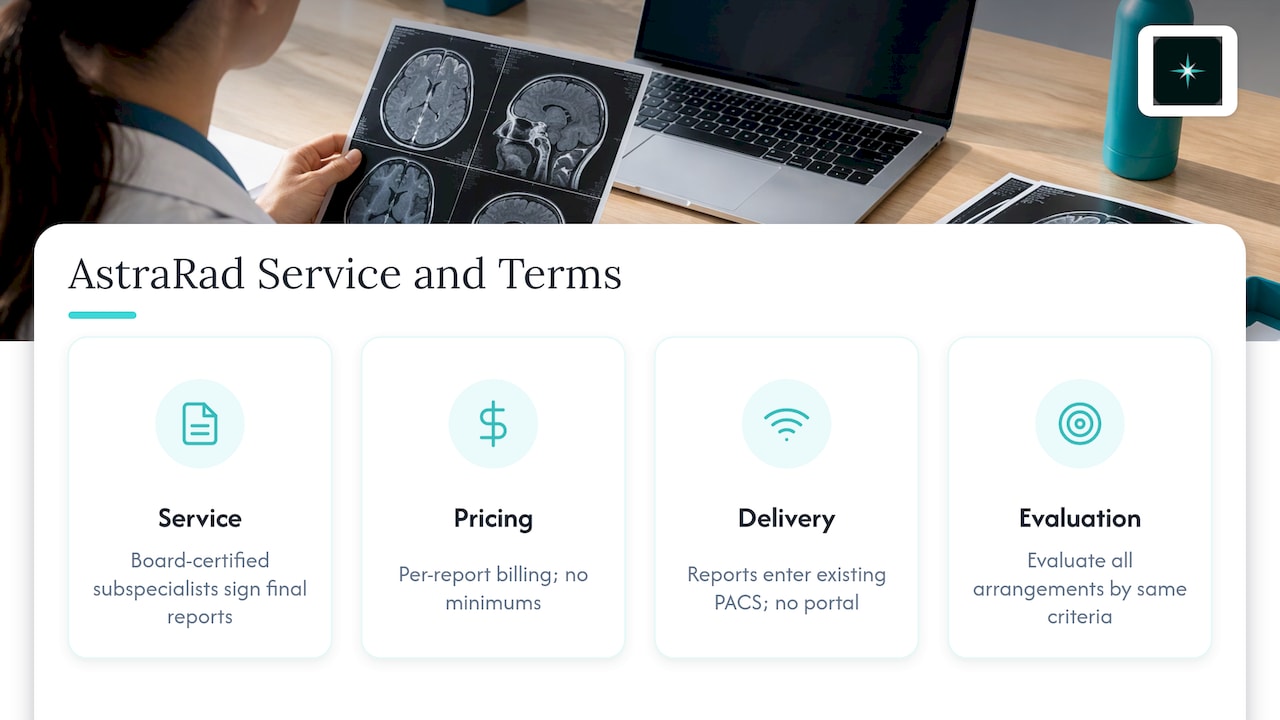
AstraRad is a US teleradiology service that delivers final signed reports read by board-certified subspecialists. We published this guide, and we have a commercial interest in it: imaging centers, hospitals and radiology groups pay us per report for the overflow, after-hours and subspecialty reads described here. Pricing is per report with no minimums, and reports go into your existing PACS with no extra portal. We wrote the rest of this page so you can evaluate any overflow arrangement against the same criteria, including ours.
How does an overflow radiology reading workflow route cases and deliver reports?
An overflow workflow routes a study from your PACS to an outside reader, who interprets it and returns a signed report to the same PACS. The steps are the same whether the study is a routine outpatient MRI or a STAT head CT. What differs is the priority tier and the turnaround clock attached to it.
- Study acquisition. The technologist completes the exam and the images arrive in your PACS as usual.
- Routing rule. A rule you define sends the study to the outside provider. Common rules are by queue length, by time of day, by modality or by priority flag.
- Subspecialty matching. The provider assigns the study to a reader matched to the modality and body part, so a prostate MRI goes to a reader who reports prostate MRI.
- Interpretation. The radiologist reads the study against the history and any priors you supply.
- Critical findings communication. The ACR white paper says teleradiologists should be engaged in communication of results, particularly critical findings, and should remain available for consultation with referring physicians or onsite radiologists after interpretation (ACR White Paper on Teleradiology, 2013).
- Final signed report. The signed report is delivered into your PACS, where your clinicians already look for results.
At AstraRad, turnaround is committed by contract and measured from last-image arrival to radiologist signature. That definition matters. A clock that starts when the order is placed or stops when the report is faxed measures something different, and it is worth confirming which one any provider uses.
What turnaround times and escalation terms should the contract define?
A radiology overflow contract should define the priority tiers, the turnaround clock for each, the coverage schedule, the escalation path and the downtime rules. The ACR's 2026 contract guidance says to state shift start and stop times, weekend and holiday coverage, time zone, and queue or maximum-turnaround expectations, plus exceptions such as strokes and add-ons (ACR Bulletin, 2026).
A service level agreement (SLA) is the part of a contract that sets measurable service commitments, such as turnaround by priority tier, and says what happens when they are missed. Use this table as a drafting checklist.
| Term | What to specify | Why it matters |
|---|---|---|
| Priority tiers | Names and definitions of each tier | Prevents disputes over what counts as STAT |
| Turnaround clock | Start event and stop event | Keeps measurement consistent |
| Coverage hours | Shifts, time zone, weekends, holidays | Removes ambiguity on nights and holidays |
| Exceptions | Stroke protocol, add-ons, repeat studies | Clarifies which studies run on a separate clock |
| Escalation | Phone contact, who calls whom, critical findings | Defines what happens when a finding cannot wait |
| Downtime | Rules for PACS or connectivity outages | Keeps studies moving when a system fails |
| Volume spikes | How surges above the expected volume are handled | Avoids a queue at the provider's end |
| Reporting | Turnaround and quality reporting cadence | Gives you evidence for compliance reviews |
AstraRad's committed turnaround tiers are STAT under 4 hours (under 2 hours or under 1 hour on request), routine 24 to 48 hours, and stroke protocol under 30 minutes. AstraRad's guide to turnaround time SLA language shows how to word these commitments in a contract. After a discovery call, a coverage plan with SLA terms in writing follows.
What should you verify before routing studies to an outside reader?
Before you route any studies, verify five things: subspecialty expertise, state licensure, PACS integration, quality review and privacy safeguards. Each one maps to a contract clause, and each one can be checked with a document request rather than a promise.
Subspecialty expertise
A subspecialty read is an interpretation by a radiologist trained in a specific area, such as neuroradiology, musculoskeletal, breast or body imaging. Ask how studies are matched to readers, and whether the match is by modality and body part. AstraRad routes every study to a board-certified subspecialist matched this way, across ten subspecialties and twelve study types.
State licensure and credentialing
State licensure is the license a physician must hold in the state where the patient is located. Credentialing is the process by which your facility verifies a reader's qualifications and grants privileges. Your medical staff office will want documentation for both. The VA's directive on contract teleradiology programs, VHA Directive 1916, amended November 26, 2025, references licensure, credentialing and privileging by proxy, and ongoing professional practice evaluation, which are the same topics a private facility's medical staff office reviews. AstraRad's radiologists are licensed in all 50 states, and AstraRad's licensing page explains how state coverage works.
PACS integration
A PACS (picture archiving and communication system) is the system that stores and displays your images. Confirm that the provider delivers reports into your existing PACS and works with DICOM, the standard format for medical images. AstraRad reports go straight into the client's existing PACS with no extra portal, and the integration is DICOM conformant.
Quality review
Peer review is the process in which a second radiologist independently checks a sample of reads for accuracy. The ACR white paper says teleradiology providers should regularly participate in an established quality-assurance program, including formal peer review (ACR White Paper on Teleradiology, 2013). At AstraRad, 1 in 20 reports is independently double-read, blind, for peer review.
Privacy safeguards and the BAA
A business associate agreement (BAA) is the signed contract that HIPAA requires when a vendor handles protected health information for a covered entity. The ACR white paper says teleradiology providers must ensure privacy and security compliance for equipment and transmission interfaces regardless of where the reader sits. For a broader look at screening remote platforms, see this piece on vetting remote platforms for HIPAA. AstraRad is HIPAA aligned and works as a business associate under a signed BAA.
How do you plan vacation and holiday radiology coverage?
Plan vacation and holiday coverage by deciding which reads leave your worklist, for how long, and under which priority tiers, then writing that into the contract before the dates arrive. A fixed block of days with a defined volume is easier to staff than a request made the week before.
A workable approach has four parts:
- Map the gap. List the dates, the modalities and the daily volume your absent readers would normally handle.
- Set the routing rule. Decide whether you send everything from certain modalities, or only the studies above a queue threshold.
- Agree the tiers. Confirm which studies run as STAT, routine or stroke protocol during the gap, and what turnaround applies to each.
- Confirm escalation. Name who your technologists and clinicians call, and who at the provider answers.
Because AstraRad reads on scheduled US shifts 24/7/365, final signed reports are available at every tier, including overnight. AstraRad's guide to weekend and holiday radiology coverage covers how to schedule this without stretching your own readers.
How is radiology overflow reporting priced?
Radiology overflow reporting is usually priced in one of three ways: per report, per shift or block, or as a fixed monthly commitment. Each model puts the cost in a different place, so the right choice depends on how predictable your volume is.
| Model | What you pay for | Best matched to |
|---|---|---|
| Per report | Each completed, signed study | Variable, seasonal or unpredictable volume |
| Per shift or block | Reserved reader time for set hours | Predictable, recurring coverage gaps |
| Fixed monthly commitment | A minimum volume or retainer | Steady, high-volume arrangements |
AstraRad prices per report with no minimums, so your cost follows the number of signed reports you receive. You can request the per-report rate card and receive it within one business day. The first signed report arrives within 10 business days of countersignature. For a full list of clauses to negotiate beyond price, see AstraRad's guide to teleradiology contract terms.
How can AstraRad support your overflow reads?
AstraRad is a US teleradiology service that delivers final signed reports read by board-certified subspecialists. For imaging centers, hospitals and radiology groups, that means overflow, overnight and subspecialty studies handled by readers matched to the modality and body part, with turnaround committed by contract and reports delivered into your existing PACS.
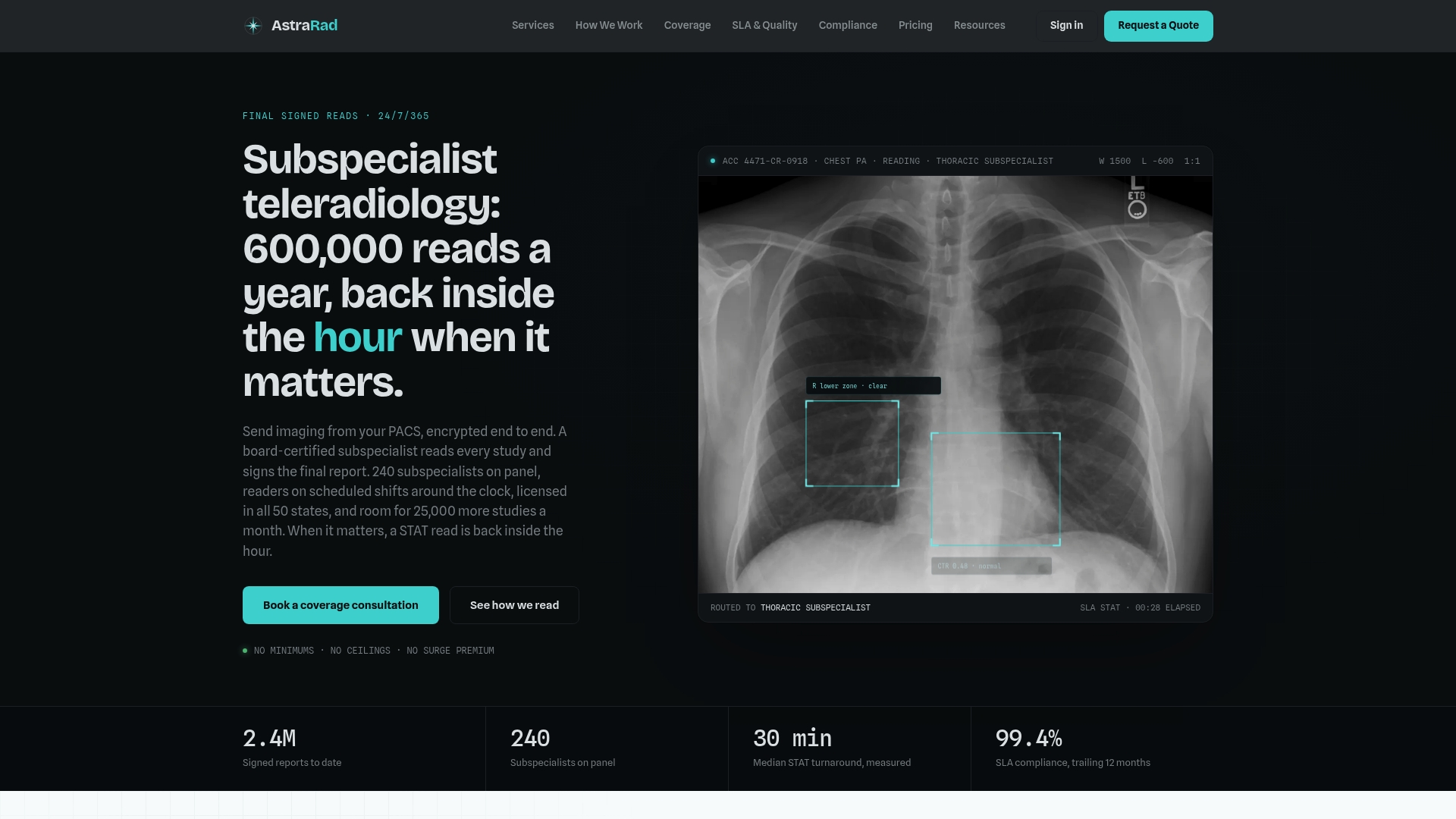
Our teleradiology services cover CT, MRI, X-ray, ultrasound, mammography and PET-CT. AstraRad has no volume minimums and no additional platform fees, and it works as a business associate under a signed BAA.
Sources
- ACR Bulletin: Your First Radiology Contract: What You Need to Know (2026)
- ACR White Paper on Teleradiology (2013)
- VHA Directive 1916, VHA Teleradiology Programs (amended November 26, 2025)
Ready to scope your overflow coverage? Book a discovery call or request the per-report rate card.
Frequently asked questions
What is the difference between overflow reads and full outsourcing?
Overflow reads send only the studies above your in-house capacity to an outside provider, while full outsourcing moves an entire modality or site. Overflow keeps your radiologists in the workflow and uses the outside provider for peaks, gaps and subspecialty studies. The contract defines which studies route out and which stay.
Can overflow reporting cover nights, weekends and holidays?
Yes. Overflow arrangements can cover scheduled shifts at any hour, provided the contract defines coverage hours, time zone and holiday terms. AstraRad reads on scheduled US shifts 24/7/365 and delivers final signed reports at every tier, including overnight, with every read performed inside the United States.
How should an overflow contract measure turnaround?
Measure turnaround from a defined start event to a defined stop event, by priority tier. AstraRad measures from last-image arrival to radiologist signature. The ACR's 2026 contract guidance also advises specifying queue or maximum-turnaround requirements and exceptions such as strokes and add-ons.
Do overflow radiologists need to be licensed in my state?
The reading radiologist must hold a license in the state where the patient is located, and your facility must credential the reader. Ask for licensure documentation for the states you serve. AstraRad's radiologists are licensed in all 50 states, which covers state coverage for studies from any of them.
How quickly can an overflow arrangement start?
Start time depends on contracting, credentialing and PACS connectivity. At AstraRad, the first signed report arrives within 10 business days of countersignature. A discovery call comes first, followed by a coverage plan with SLA terms in writing.
Related on AstraRad
- Resources
SLA clauses for healthcare vendors: a buyer's guide
SLA clauses for healthcare vendors: the metrics, remedies, BAA terms and exit rights US hospital and imaging center buyers should put in writing.
- Resources
What to ask a teleradiology vendor's references
Ask a teleradiology vendor's references for their worst month and what the vendor did. Includes a 12 question script and four deal stopping answers.
- Resources
Onboarding credentialing packet: what to include
An onboarding credentialing packet lists the documents, verifications and timelines hospitals and imaging centers need before a provider starts reading.
Put a radiologist's name on your next read.
Tell us your modalities and monthly volume. A complete per-report rate card, with turnaround tiers and SLA terms in writing, lands in your inbox within one business day.